The Human Eye and the Colourful World
Why This Matters
In the last chapter you learned how a convex lens bends light to form an image. Now meet the most extraordinary lens you’ll ever use — the one inside your own eye. It focuses on a book in your hands and then, in a fraction of a second, on a hill kilometres away, all without you doing a thing. No camera can match that.
But the same chapter that explains how you see also explains some of the most beautiful things you see: why the sky is blue, why the sunset blazes orange-red, why a rainbow arcs across the sky after rain, why stars twinkle but planets don’t, and why the Sun is visible a couple of minutes before it actually rises.
And on the practical side — this chapter is why spectacles exist. Once you understand why an eye becomes short-sighted or long-sighted, choosing the lens that fixes it is just an application of the lens rules you already know.
The Big Idea
The eye is a self-adjusting convex lens that focuses light onto the retina. When it can’t focus properly, a corrective lens fixes it: a concave lens for myopia (can’t see far), a convex lens for hypermetropia (can’t see near). And the colours of the sky come from light interacting with the atmosphere — dispersion (splitting), refraction (bending) and scattering (spreading).
Two threads run through this chapter. First, the eye and its defects are pure lens-and-image thinking — image on the retina = good, image in front or behind = defect to correct. Second, every colourful phenomenon in the sky is light being bent or spread by air and water — same physics of refraction, now happening on a planetary scale.
Let’s Break It Down
How the eye sees
Light entering the eye passes through several parts before forming an image:
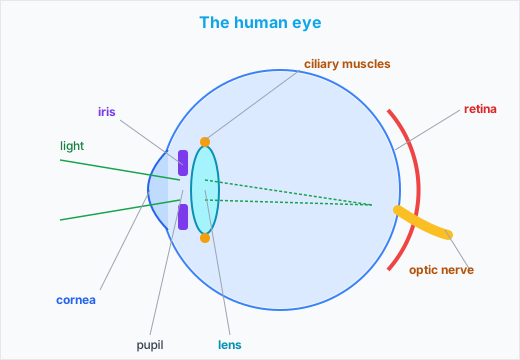
- Cornea — the transparent front bulge; most of the light’s bending happens here.
- Iris — the coloured ring; a muscle that controls the pupil.
- Pupil — the opening that lets light in; it widens in dim light and narrows in bright light.
- Crystalline lens — a flexible convex lens that fine-tunes the focus.
- Retina — the light-sensitive screen at the back, packed with cells that turn light into electrical signals.
- Optic nerve — carries those signals to the brain.
The image formed on the retina is real and inverted — your brain flips it the right way up.
Power of accommodation
The eye’s superpower is accommodation — its ability to change its lens’s focal length so objects at different distances all stay in focus.
- Looking at something distant: ciliary muscles relax, the lens gets thin, focal length increases.
- Looking at something near: ciliary muscles contract, the lens gets thick, focal length decreases.
But the lens can’t thicken forever. The closest point it can focus on comfortably is the near point (about 25 cm for a normal young eye) — also called the least distance of distinct vision. The farthest is the far point (infinity for a normal eye). So a normal eye sees clearly from 25 cm out to infinity.
Why can't you read this text clearly if you hold it just 5 cm from your eyes?
To focus on something so close, the eye lens would need to become thicker than it physically can — its focal length can’t drop below a certain minimum. Beyond the near point (~25 cm), the image can’t be brought onto the retina, so it looks blurred and your eyes strain.
Defects of vision and their correction
When accommodation fails, the image lands in the wrong place. There are three common defects:
| Defect | Problem | Image forms | Corrected with |
|---|---|---|---|
| Myopia (near-sighted) | Can't see distant objects | In front of the retina | Concave lens |
| Hypermetropia (far-sighted) | Can't see near objects | Behind the retina | Convex lens |
| Presbyopia (ageing) | Can't see near; weak accommodation | Behind the retina (near objects) | Convex / bi-focal lens |
- Myopia — the eyeball is too long or the lens too curved, so distant rays focus before the retina. A concave (diverging) lens spreads the rays out a little so they reach the retina.
- Hypermetropia — the eyeball is too short or the lens too weak, so near rays would focus behind the retina. A convex (converging) lens adds focusing power.
- Presbyopia — comes with age as the ciliary muscles weaken; the near point recedes. Someone with both myopia and presbyopia uses bi-focal lenses (concave top for distance, convex bottom for reading).
Myopia means you can only see things far away (you're 'far-sighted').
'Myopia' is an unfamiliar technical word, and 'near-sighted' is easily misread as 'sees things that are near' — i.e. far away — so students guess the meaning backwards.
The name is about what works, not what's wrong: myopia = near-sighted means near vision is fine but distant objects are blurred → fixed with a concave lens. Hypermetropia (far-sighted): clear far away, blurry up close → fixed with a convex lens.
A myopic person's far point is 80 cm — they can't see anything clearly beyond that. What lens power corrects their vision?
- The job of the lens: take light from infinity (a distant object) and make it appear to come from the person’s far point, 80 cm, where they can focus. So the lens must form a virtual image of a distant object at 80 cm.
- Object at infinity: u = −∞. Image at the far point on the same side: v = −80 cm = −0.80 m.
- Lens formula: 1/f = 1/v − 1/u = 1/(−0.80) − 1/(−∞) = −1.25 − 0 = −1.25. So f = −0.80 m.
- Power P = 1/f = 1/(−0.80) = −1.25 D.
- So a concave lens of power −1.25 D is needed — the negative power confirms it’s diverging, exactly right for myopia.
Refraction and dispersion through a prism
A glass slab bends light in then back out, so the emergent ray stays parallel to the original. A prism is different: its two faces are tilted towards each other, so the ray bends the same way at both surfaces and comes out deviated by an angle of deviation.
The magic is that the amount of bending depends on colour. When white light enters a prism, each colour bends by a slightly different amount — violet bends most, red bends least — so white light fans out into a band of seven colours: VIBGYOR (Violet, Indigo, Blue, Green, Yellow, Orange, Red). This splitting is called dispersion, and the band is a spectrum.
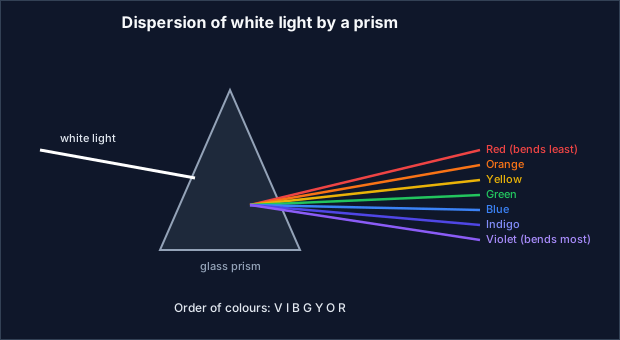
Newton proved white light is genuinely a mixture: he split it with one prism, then used a second, inverted prism to recombine the colours back into white light.
A rainbow is nature’s prism show: tiny raindrops each refract, internally reflect, and refract sunlight again, dispersing it into colours. That’s why a rainbow always appears opposite the Sun (with the Sun behind you).
Atmospheric refraction
The air isn’t uniform — it has layers of different density (and hence different refractive index). Light bends as it passes through them, causing several effects:
- Twinkling of stars. Starlight bends continuously through the ever-shifting atmosphere. A star is so far away it’s a point source, so these tiny changes make its light flicker — brighter, fainter, brighter. Planets don’t twinkle because they’re closer and look like little discs (many points); the flickers of all those points average out.
- Advanced sunrise and delayed sunset. Refraction bends the Sun’s light over the horizon, so we see the Sun about 2 minutes before it actually rises and 2 minutes after it sets.
Why does a star twinkle but a planet shine steadily?
A star is so distant it’s effectively a single point of light; atmospheric refraction shifts that point’s apparent position and brightness constantly, so it twinkles. A planet is much closer and appears as a tiny disc — a collection of many points — whose individual flickers cancel out, giving steady light.
Scattering — why the sky is blue and sunsets are red
When light hits very small particles (air molecules), it gets scattered — thrown off in all directions. How much depends on colour: shorter wavelengths (blue) scatter much more than longer ones (red).
- Blue sky: sunlight passing through the air gets its blue light scattered all over the sky, so the whole sky glows blue. (No atmosphere → no scattering → black sky, which is why astronauts see a dark sky even in daytime.)
- Red sunrise/sunset: near the horizon, sunlight travels through much more air. Almost all the blue is scattered away long before it reaches you, leaving mostly red and orange to come through.
- Danger signals are red because red scatters least and travels farthest through fog and smoke without being lost.
The sky is blue because it reflects the blue colour of the sea.
The sea and the sky are both blue and meet at the horizon, so it looks as though one is simply mirroring the other.
It's not a reflection — the sky is blue over deserts too, far from any ocean. Air molecules scatter the short-wavelength blue part of sunlight in all directions far more than red, so blue light reaches your eyes from every direction.
Common Mistakes
A convex lens is used to correct myopia because convex lenses are 'stronger'.
Convex lenses are the ones in magnifying glasses, so they feel 'stronger', and a stronger lens seems like it should fix poorer eyesight.
It's the direction of bending that matters, not power. Myopia focuses light too early (in front of the retina), so it needs a diverging concave lens to push the focus back; hypermetropia needs a converging convex lens to pull the focus forward onto the retina.
Red light scatters the most, which is why sunsets are red.
You actually see red at sunset, so it feels natural to think red is the colour being scattered toward you.
It's the opposite: blue scatters most (→ blue sky), red least. Sunsets are red because the blue has been scattered away over the long path through the atmosphere, leaving the red that scatters least to reach you (which is also why red is used for danger/stop lights).
Quick Check
In which part of the eye is the image of an object formed?
The lens system focuses light to form a real, inverted image on the retina — the light-sensitive screen at the back of the eye — which sends signals to the brain.
A student sitting in the last row cannot read the blackboard clearly. What is the likely defect and its correction?
Trouble seeing distant objects (the far blackboard) is myopia (near-sightedness), corrected with a diverging concave lens.
Why does the sky appear dark to an astronaut instead of blue?
The blue sky is caused by air molecules scattering sunlight. At very high altitudes there’s almost no air to scatter light, so the sky looks dark.
Practice Problems
A person needs a lens of power −5.5 D for distant vision and +1.5 D for near vision. Find the focal length of each lens.
Use P = 1/f, so f = 1/P (in metres).
Distant vision: f = 1/(−5.5) = −0.18 m = −18.2 cm (a concave lens, for myopia).
Near vision: f = 1/(+1.5) = +0.67 m = +66.7 cm (a convex lens, for the reading part — hypermetropia/presbyopia).
The two different lenses (one diverging, one converging) are exactly why such a person would use bi-focal spectacles.
The far point of a myopic person is 80 cm in front of the eye. Find the nature and power of the lens needed to correct it.
To correct myopia, the lens must take a distant object (at infinity) and form its image at the person’s far point so they can see it.
Signs: object at infinity → u = −∞; image at far point on the same side → v = −80 cm = −0.80 m.
Lens formula: 1/f = 1/v − 1/u = 1/(−0.80) − 1/(−∞) = −1.25 − 0 = −1.25 m⁻¹, so f = −0.80 m.
Power: P = 1/f = −1.25 D.
The negative sign means a concave (diverging) lens of power −1.25 D — correct for myopia.
The near point of a hypermetropic eye is 1 m. What is the power of the lens needed so the person can read at the normal near point of 25 cm?
The person can’t focus closer than 1 m, but wants to read at 25 cm. The corrective lens must take an object at 25 cm and form a virtual image at the person’s near point, 1 m, where their eye can focus.
Signs: object at the normal reading distance → u = −25 cm = −0.25 m; image at the person’s near point on the same side → v = −1 m = −1.0 m.
Lens formula: 1/f = 1/v − 1/u = 1/(−1.0) − 1/(−0.25) = −1 + 4 = +3 m⁻¹, so f = +1/3 m ≈ +0.33 m.
Power: P = 1/f = +3.0 D.
A convex (converging) lens of power +3.0 D — correct for hypermetropia. (The positive power confirms a converging lens, which adds the focusing the weak eye lacks.)
Summary
- The eye focuses light through the cornea and a flexible lens to form a real, inverted image on the retina; the optic nerve carries the signal to the brain.
- Accommodation is the eye’s ability to change its focal length. The near point is ~25 cm and the far point is infinity for a normal eye.
- Myopia (image before the retina) → concave lens; hypermetropia (image behind the retina) → convex lens; presbyopia (ageing) → convex/bi-focal lens.
- A prism deviates light and disperses white light into the spectrum VIBGYOR (violet bends most, red least). A rainbow is dispersion + internal reflection in raindrops.
- Atmospheric refraction causes the twinkling of stars (planets don’t twinkle) and advanced sunrise / delayed sunset.
- Scattering of light makes the sky blue (blue scatters most) and the sunset red (blue scattered away, red survives). No atmosphere → dark sky.
What’s Next
You’ve now finished the optics arc — light bending, focusing, splitting and scattering. The next chapters switch to a completely different force that quietly powers almost everything around you: electricity. In Chapter 11: Electricity, you’ll learn what electric current really is, how voltage pushes it, what resistance holds it back, and Ohm’s law — the simple relationship that lets you calculate current, voltage and the heat and power in any circuit, from a torch bulb to your home wiring.