Light — Reflection and Refraction
Why This Matters
Look into the back of a steel spoon and you’re upright but tiny. A pencil dipped in a glass of water looks snapped at the surface. A coin at the bottom of a bucket seems shallower than it really is. Your car’s side mirror warns that “objects are closer than they appear.”
Every one of these is light doing exactly two things: bouncing off surfaces (reflection) and bending as it passes between materials (refraction). And the remarkable part is that both follow precise rules — so precise that you can calculate exactly where an image will form, how big it will be, and whether it’s upright or inverted, using just two formulas.
This chapter is the toolkit behind torches, shaving mirrors, magnifying glasses, cameras, telescopes and the spectacles millions of people wear. Get the sign convention right and the rest is careful arithmetic.
The Big Idea
Light travels in straight lines until it meets a surface. At a mirror it reflects (angle of incidence = angle of reflection); passing into a new medium it refracts (bends) because its speed changes. Curved mirrors and lenses use these rules to bring rays together (or spread them) and form images — which we locate with the mirror formula and lens formula.
Two ideas carry the whole chapter:
- Reflection bends light back; refraction bends light through. Refraction happens only because light moves at different speeds in different materials.
- To handle the maths without getting lost in “is this positive or negative?”, we use one strict bookkeeping system — the New Cartesian Sign Convention. Master it once and every numerical becomes mechanical.
Let’s Break It Down
Reflection and the two laws
When light hits a polished surface it bounces off following two laws of reflection:
- The angle of incidence equals the angle of reflection (both measured from the normal — the line perpendicular to the surface at the point where the ray hits).
- The incident ray, the reflected ray, and the normal all lie in the same plane.
A plane (flat) mirror gives an image that is virtual, erect, the same size as the object, as far behind the mirror as the object is in front, and laterally inverted (left↔right swapped — that’s why “AMBULANCE” is written mirror-reversed on the front of the vehicle).
Spherical mirrors — the vocabulary
A spherical mirror is a slice of a shiny sphere. There are two kinds:
- Concave mirror — reflecting surface curves inward (like the inside of a spoon). It converges light.
- Convex mirror — reflecting surface curves outward (the back of a spoon). It diverges light.
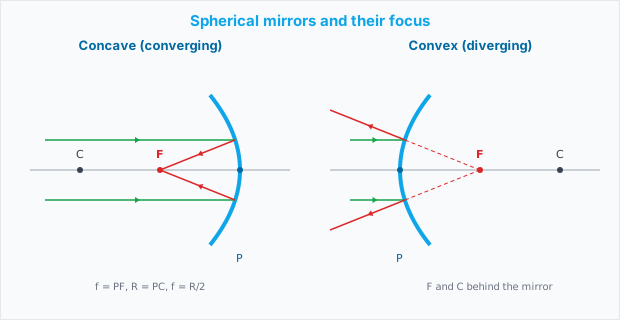
Learn these five terms — every problem uses them:
- Pole (P): the centre of the mirror’s surface.
- Centre of curvature (C): the centre of the sphere the mirror is part of.
- Radius of curvature (R): the distance PC.
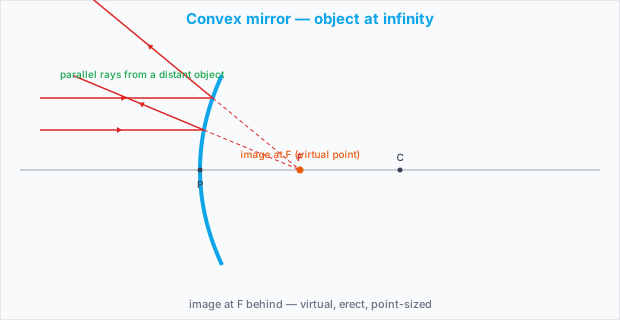
- Principal focus (F): where rays parallel to the axis converge (concave) or seem to come from (convex).
- Focal length (f): the distance PF.
The one relationship you must remember: f = R/2. The focus sits exactly halfway between the pole and the centre of curvature.
Why a curved mirror reflects the way it does
Here’s the bit students find unintuitive: how do you know which way a ray bounces off a curved mirror? The reassuring answer is that a curved mirror obeys the exact same law of reflection as a flat one — angle of incidence = angle of reflection — you just have to find the normal at the point where the ray actually strikes.
For a spherical mirror that normal is wonderfully easy to find: it is the radius drawn from the hit point back to the centre of curvature C. A radius always meets a sphere at right angles, so it is the perpendicular — the normal — at that point. Once you have the normal, reflect the incident ray so that i = r, and the reflected direction is fixed. No guessing.
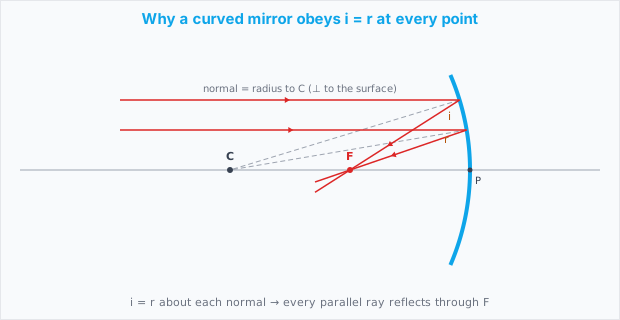
Try it for several parallel rays: each one’s normal tilts a little more as you go off-axis, so each reflects a little more steeply, and they all cross at F. That is why a concave mirror converges light. A convex mirror is the mirror image of this — its centre of curvature is behind the surface, so the normals point outward and the reflected rays spread apart (appearing to come from F behind). So whenever you’re unsure which way a ray goes off a curved mirror: draw the normal toward C first, then apply i = r.
Real and virtual images — what’s the difference?
You’ll meet the words real and virtual in every row of the table below, so let’s pin down what they actually mean. When a mirror or lens redirects light, the rays either actually meet at a point or only appear to come from one:
- A real image forms where the reflected (or refracted) rays physically cross. Real light is genuinely arriving there, so you can catch it on a screen. From a single mirror or lens a real image comes out upside-down (inverted).
- A virtual image forms where the rays don’t meet — they spread apart, and only their backward extensions (the dashed lines in the diagrams) seem to meet, behind the mirror or on the object’s side of a lens. No light actually reaches that spot, so you can’t catch it on a screen — you can only see it by looking into the mirror/lens. A virtual image is the right way up (erect).
The one-line test: if you could hold a paper screen where the image is and a sharp picture landed on it, it’s real; if not, it’s virtual.
Real images around you:
- The picture a cinema projector throws on the screen. (Notice the film inside is loaded upside-down — because the real image it makes is inverted.)
- The image your camera forms on its sensor, and the one your eye forms on your retina — both real and inverted (your brain quietly flips it the right way up).
Virtual images around you:
- Your reflection in the flat bathroom mirror. It looks like you standing the same distance behind the glass — but there’s only a wall back there; no light reaches that point, and you could never catch it on a screen. Virtual (and upright).
- The enlarged word under a magnifying glass, and the wide view in a convex rear-view / shop mirror — both virtual, both upright.
A neat link to the maths coming up: a negative magnification m means real and inverted; a positive m means virtual and erect. That single sign tells the whole story.
Images in a concave mirror
A concave mirror is the interesting one — its image changes completely depending on where you put the object. Here’s the full picture:
| Object position | Image position | Size | Nature |
|---|---|---|---|
| At infinity | At F | Point-sized | Real, inverted |
| Beyond C | Between F and C | Diminished | Real, inverted |
| At C | At C | Same size | Real, inverted |
| Between C and F | Beyond C | Enlarged | Real, inverted |
| At F | At infinity | Highly enlarged | Real, inverted |
| Between P and F | Behind the mirror | Enlarged | Virtual, erect |
Notice the pattern: as the object moves closer to the mirror, the image moves farther away and gets bigger — until the object passes the focus, at which point the image flips to virtual, erect and enlarged (this is the shaving-mirror / make-up-mirror position).
To locate the image of a nearby object you only need two rays from the top of the object: one drawn parallel to the axis (which reflects through F), and one drawn to the pole P (which reflects symmetrically about the axis). Where the two reflected rays cross is the tip of the image.
One case is special and doesn’t fit the “two rays from the tip” recipe: a very distant object, whose light reaches the mirror as a parallel beam rather than as rays fanning out from a near tip (the first diagram below).
Object at infinity → a point image at F
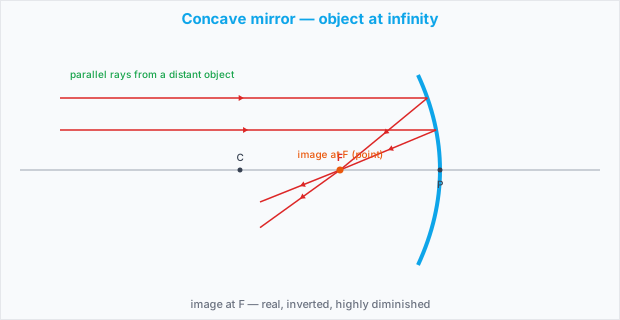
Why parallel rays from object at infinity? Every point of an object throws light out in all directions — but the farther away the object, the less those rays have fanned out by the time they reach the mirror. From something very far — the Sun, a distant hilltop, a star — the rays arriving from a point have travelled so far that they’re effectively parallel (it’s the same reason we treat sunlight as parallel beams). So for an “object at infinity” we don’t draw two rays from a visible top; we draw a bundle of parallel rays, and the concave mirror brings them all together at a single point at F.
Real-life use: this is the principle of a reflecting telescope and a solar cooker / solar furnace — a big concave mirror gathers near-parallel rays from a faraway source and concentrates them at the focus.
Object beyond C → image between F and C
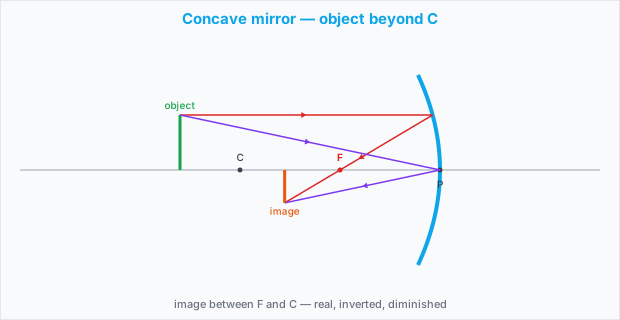
Real-life use: this is the small, upside-down version of yourself you see when you stand well back from a concave shaving mirror — and the same diminished, real image of a far-off scene is what a reflecting telescope’s main mirror forms before the eyepiece magnifies it.
Object at C → image at C (same size)
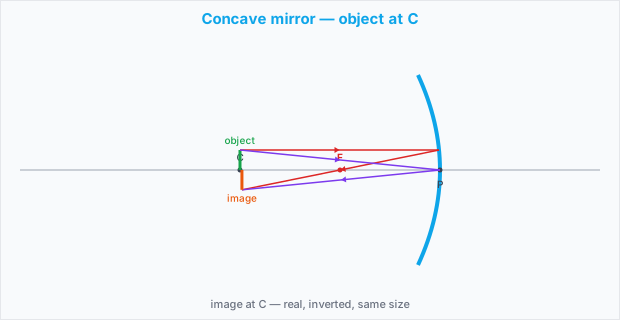
Real-life use: because the object and its image sit together at C, this is the neat trick used in the lab to measure a concave mirror’s radius of curvature — slide a screen until the sharp image lands right beside the object, and that distance is R (so f = R/2).
Object between C and F → image beyond C
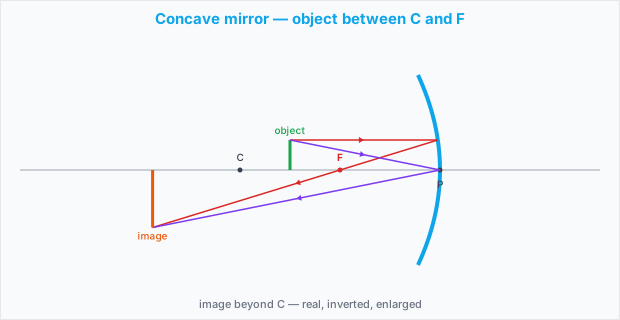
Real-life use: a real and magnified image is what you want for a solar concentrator (the dish in a solar cooker forms an enlarged, intense image of the Sun’s heat) and for the big bright spot a reflecting projector / floodlight reflector throws onto a distant surface.
Object at F → image at infinity
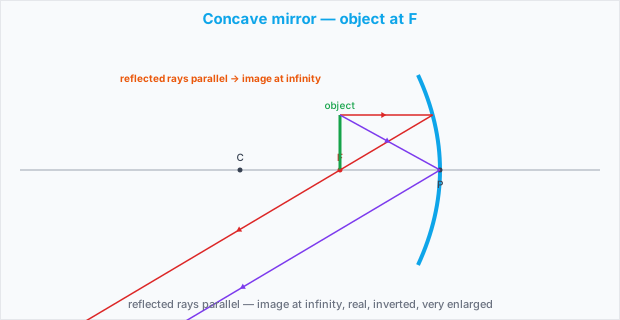
So is there an image, or not? When the reflected rays come out exactly parallel, they never actually cross — they would only “meet” infinitely far away. That is all “image at infinity” means: no real image forms that you could catch on a screen at any ordinary distance. It’s the knife-edge case sitting between a real image (object beyond F) and a virtual one (object inside F). The payoff is the reverse trip — a bright bulb placed at F sends light out as that parallel beam — and if you look into such a mirror, your relaxed eye focuses the parallel rays onto your retina, so the source appears to sit infinitely far away.
Real-life use: run this case backwards — put a bulb exactly at the focus and the mirror sends every ray out as one strong parallel beam that barely spreads with distance. That is exactly how torches, car headlights, searchlights and lighthouse reflectors throw a far-reaching beam.
Object between P and F → image behind the mirror
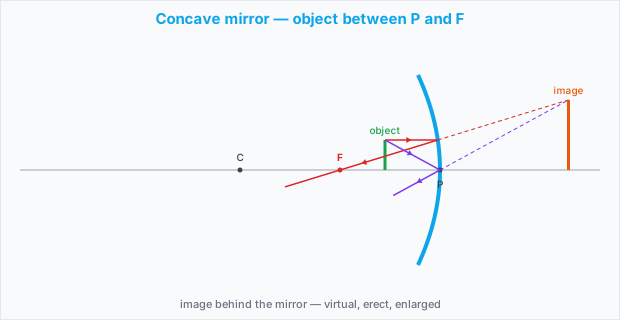
Real-life use: you need a right-way-up and bigger view of your own face from close range — so this is the shaving / make-up mirror position, and the same upright-magnified trick lets a dentist’s mirror show an enlarged view of a tooth.
Images in a convex mirror
A convex mirror is simpler: whatever you do, the image is always virtual, erect, and diminished, sitting between P and F behind the mirror. That wide, shrunk-down view is exactly why it’s used as a vehicle’s rear-view mirror — it shows a large area, though things look smaller (and therefore “closer than they appear”).
Object at infinity → a point image at F (behind)
Object at a finite distance → image between P and F (behind)
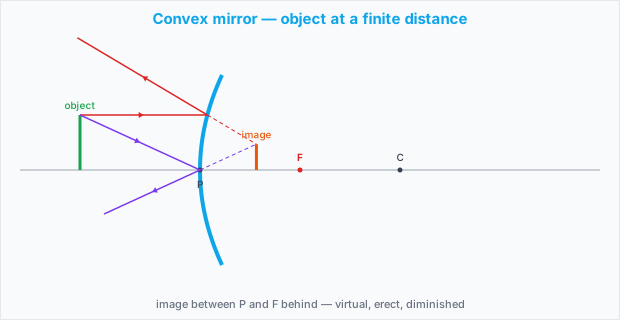
Real-life use: because the image is always shrunk and upright, a convex mirror squeezes a very wide area into a small glass — perfect for vehicle rear-view / side mirrors (you see several lanes at once), shop anti-theft mirrors, and mirrors at blind road/corridor corners. The cost of that wide view is that things look smaller and therefore farther, which is why the side mirror warns “objects are closer than they appear.”
Why is a concave mirror used in a torch or car headlight, but a convex mirror used as a side-view mirror?
A torch bulb is placed at the focus of a concave mirror, so the reflected rays come out parallel — a strong, far-reaching beam. A convex mirror always gives an erect, diminished image and has a wide field of view, letting a driver see a large area of traffic behind — safety over size.
The New Cartesian Sign Convention
Before any calculation, fix the bookkeeping. Put the pole at the origin and the principal axis along the x-axis:
- The object always sits on the left, so light travels left → right.
- Distances measured against the incoming light (to the left) are negative; distances measured along it (to the right) are positive.
- Heights above the axis are positive; below are negative.
Consequences you’ll use constantly: object distance u is always negative. A concave mirror’s focal length is negative (F is in front); a convex mirror’s is positive (F is behind). For lenses, a convex lens f is positive, a concave lens f is negative.
Plugging the object distance into a formula as a positive number, e.g. u = +25 cm.
You measure the object distance as a plain length on a ruler — 25 cm — so writing it as a positive +25 feels completely natural.
In the sign convention the object sits to the left of the mirror/lens, against the incident light, so its distance is negative: always write u = −25 cm for a real object. Then let the formula decide the signs of v and m.
Mirror formula and magnification
The mirror formula links the three distances:
1/v + 1/u = 1/f
where u = object distance, v = image distance, f = focal length. Magnification tells you how big the image is compared to the object:
m = h′/h = −v/u
Here h is object height, h′ is image height. A negative m means a real, inverted image; a positive m means a virtual, erect image.
An object 4.0 cm tall is placed 25.0 cm in front of a concave mirror of focal length 15.0 cm. Find the image distance, nature and size.
- Write down values with signs. Object on the left: u = −25.0 cm. Concave mirror: f = −15.0 cm. Object height h = +4.0 cm.
- Use the mirror formula to find v. From 1/v + 1/u = 1/f, we get 1/v = 1/f − 1/u = 1/(−15.0) − 1/(−25.0) = −1/15 + 1/25.
- Take LCM (75): 1/v = (−5 + 3)/75 = −2/75, so v = −37.5 cm. The minus sign means the image is 37.5 cm in front of the mirror — it’s real.
- Find magnification: m = −v/u = −(−37.5)/(−25.0) = −1.5. Negative → real and inverted. The image is 1.5× taller, so h′ = −1.5 × 4.0 = −6.0 cm.
- So a real, inverted image 6.0 cm tall forms 37.5 cm in front of the mirror — exactly where you’d place a screen to catch it.
Refraction — why light bends
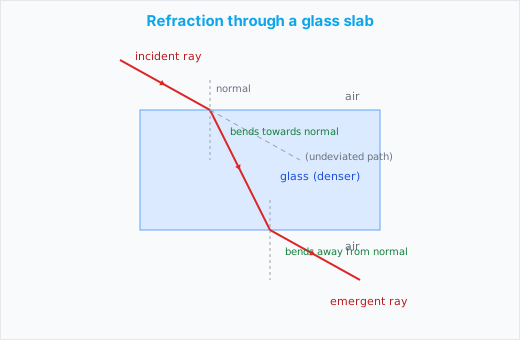
Now to the bending. When light passes from one transparent medium into another at an angle, it changes direction. Why? Because its speed changes. Light is fastest in vacuum (3 × 10⁸ m/s) and slows down in glass or water.
- Going from a rarer medium to a denser one (air → glass), light slows and bends towards the normal.
- Going from denser to rarer (glass → air), it speeds up and bends away from the normal.
But why does a change in speed make light turn?
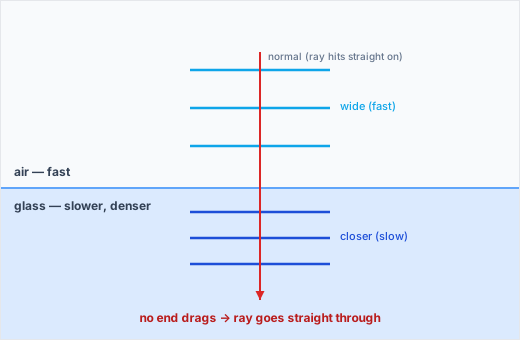
Slowing down by itself doesn’t make something turn — a car braking in a straight line just goes slower, not sideways. Light bends only when it crosses the boundary at an angle, and the reason is wonderfully simple once you stop picturing a single thin ray and instead picture a wide front advancing together — like a row of soldiers marching in step, shoulder to shoulder.
Now march that row at an angle off a hard road onto soft mud (mud = the slower, denser medium). They don’t all hit the mud at the same instant: the soldiers at one end reach it first and slow down, while the others are still striding fast on the road. With one end dragging and the other racing ahead, the whole row swings round — it changes direction, pivoting toward the mud. Step back onto firm road later and the first ones to reach it speed up again, swinging the row back the other way.
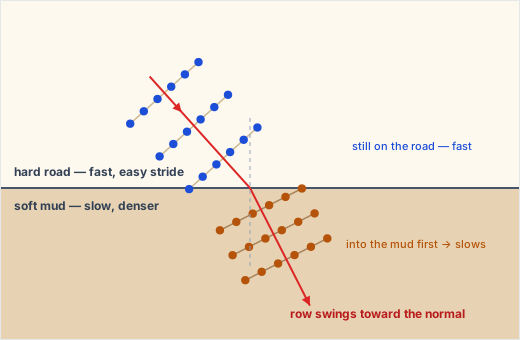
Light’s wavefront does exactly this. Picture the front as the line of soldiers: the edge that enters the denser medium first slows first, so the front pivots — toward the normal going into a slower medium, away from it coming back out. The fronts even crowd closer together in the slower medium (a shorter wavelength), just like the bunched-up soldiers.
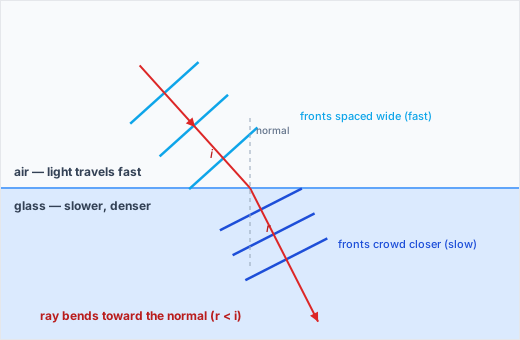
It even explains a special case: if light hits the surface head-on (straight along the normal), the whole front slows at the same instant, nothing drags, and the ray goes straight through with no bend at all — which is just what you see looking straight down into a pond.
This is exactly why a pencil in water looks bent, why a pond looks shallower than it is, and why a coin “rises” when water is poured over it — light from underwater bends as it leaves the surface, so the object appears shifted.
Snell’s law and refractive index
The amount of bending follows the laws of refraction:
- The incident ray, refracted ray and normal all lie in one plane.
- Snell’s law: sin i / sin r = constant for a given pair of media. That constant is the refractive index (n).
The refractive index compares speeds. The (absolute) refractive index of a medium is:
n = (speed of light in vacuum) / (speed of light in the medium) = c/v
So water’s n = 1.33 means light travels 1.33× faster in vacuum than in water. A higher refractive index = optically denser = light slows more = bends more.
Why a diamond’s huge n = 2.42 makes it sparkle
Diamond’s refractive index of 2.42 is among the highest of any everyday material, and that single number is the reason a diamond flashes the way a piece of glass never can. Two effects work together:
- Light gets trapped inside it. When light inside a dense material tries to escape back out into air, there’s a limit: past a certain steepness — the critical angle — it can’t get out at all and instead reflects completely back inside. (This is called total internal reflection, and you’ll study it properly in Chapter 10.) The bigger the refractive index, the smaller this critical angle: for diamond it is only about 24°, against roughly 42° for glass. So almost any ray that enters a diamond hits a back face too steeply to leave, bounces around inside, and finally comes back out the top toward your eye. A diamond is cut at carefully chosen facet angles precisely so that this trapped light is funnelled straight back up — that bright white return is its brilliance.
- It splits white light into colours. A high index also bends different colours by different amounts (violet slows and bends the most, red the least). So each time light refracts through the diamond, white light fans out into a tiny spectrum — the rainbow glints jewellers call a diamond’s fire.
Glass (n ≈ 1.5) does both of these far more weakly — its critical angle is larger, so more light just leaks out instead of bouncing back — which is why cut glass twinkles a little but never matches a real diamond.
An optically denser medium must be heavier (greater mass density).
In everyday language 'dense' means heavy, and the two often do rise together — glass is both heavier and optically denser than air — so it feels natural to assume 'optically denser' just means 'more mass packed in'.
Optical density is about how much a medium slows light, not its mass per unit volume. Kerosene has a higher refractive index than water (it's optically denser) yet it's lighter and floats on water. So optically denser = larger refractive index = slows light more, with nothing to do with mass density.
Light goes from air into glass of refractive index 1.50. Does it bend towards or away from the normal, and what is its speed in the glass? (c = 3 × 10⁸ m/s)
Air → glass is rarer → denser, so light slows and bends towards the normal. Its speed is v = c/n = (3 × 10⁸)/1.50 = 2 × 10⁸ m/s.
Lenses — converging and diverging
A lens is transparent material with at least one curved surface. Two types:
- Convex (converging) lens — thicker in the middle; brings parallel rays together at the focus. (A magnifying glass.)
- Concave (diverging) lens — thinner in the middle; spreads parallel rays so they appear to come from the focus.
A convex lens has two foci (F₁ and F₂, one on each side) and a point at its centre, the optical centre (O), through which a ray passes undeviated.
Why a lens bends light the way it does
A lens works by refraction, and the rule is the same one you met with the glass slab: entering the glass light slows and bends toward the normal; leaving it, light speeds up and bends away from the normal. The normal at any point on a lens surface is simply the line perpendicular to the surface there — so on a curved surface it tilts from point to point, which is what makes the lens steer different rays by different amounts.
The fastest way to see the result is to picture the lens as a stack of prisms. The top half of a convex lens is shaped like a prism with its base toward the axis, and the bottom half like a prism with its base toward the axis from below. Since a prism always bends light toward its thicker base, the top half turns rays downward and the bottom half turns them upward — both toward the axis — so the rays converge at F. A concave lens is the opposite: its prisms have their bases pointing outward, so it spreads light apart.
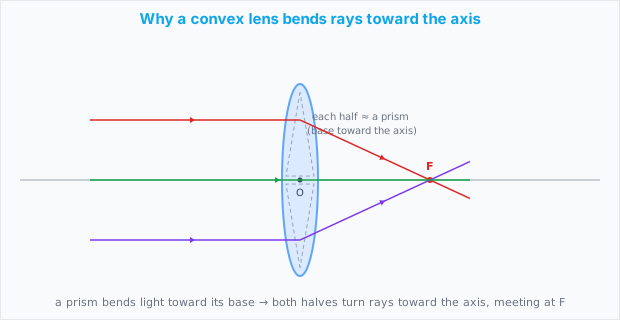
So, just like the mirror, you never have to guess: find the normal to the surface, apply the bending rule (toward the normal into glass, away coming out), and a convex lens always nudges rays toward the axis.
Images in a convex lens
Use two rays from the top of the object: one parallel to the axis (which bends to pass through F₂), and one through the optical centre O (which goes straight). Where they cross is the image.
Object at infinity → a point image at F₂
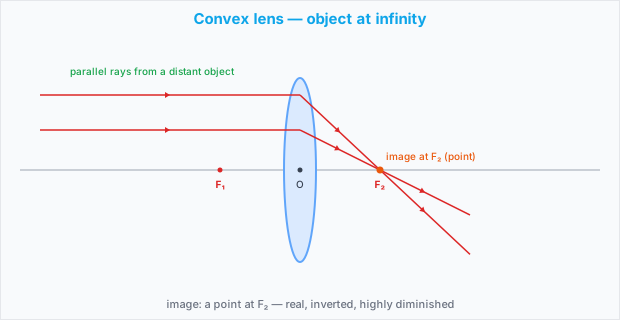
Real-life use: the objective lens of a refracting telescope (and of binoculars) collects the almost-parallel light from a distant star, planet or hill and brings it to a sharp real image at its focus, which the eyepiece then magnifies. The same focusing of parallel rays lets a burning glass or a converging solar concentrator gather the Sun’s rays onto one tiny spot hot enough to char paper or boil water. Because the source is so far away, the image is essentially a point — that’s the cost of squeezing all that light into one place.
Object beyond 2F₁ → image between F₂ and 2F₂
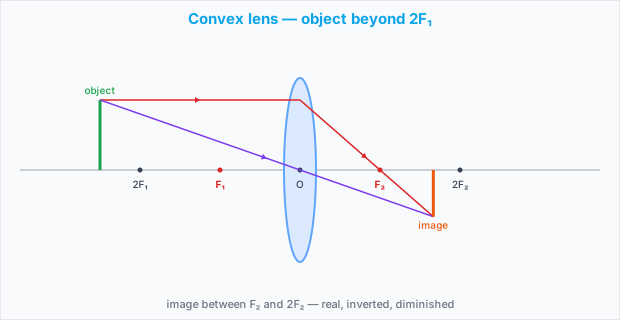
Real-life use: the camera — and the lens in your phone and even your own eye (Chapter 10). The scene is far larger than the sensor, film or retina, so you need a real image (one that actually lands on the sensor) that is shrunk to fit. Since the exact image distance shifts a little as the subject moves nearer or farther, the camera re-focuses by sliding its lens — and your eye does the same job by changing the shape of its lens.
Object at 2F₁ → image at 2F₂ (same size)
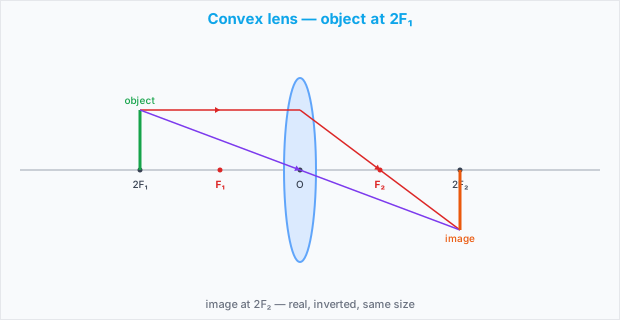
Real-life use: a photocopier or scanner set to 1:1, where the copy must come out exactly the same size as the original. This special position is also the standard lab arrangement for measuring a convex lens’s focal length: slide the object and screen until the image is real, inverted and the same size — the object distance you then read off is 2f, so f is half of it.
Object between F₁ and 2F₁ → image beyond 2F₂
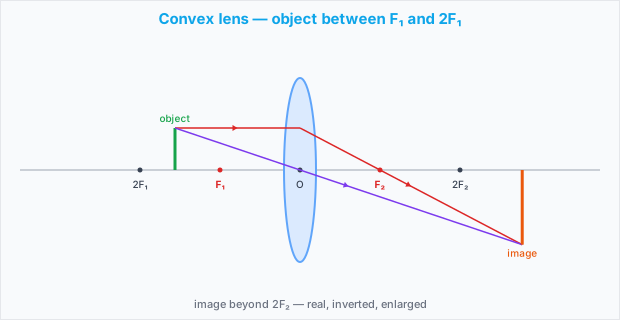
Real-life use: the slide / film projector, the cinema projector, the overhead projector and a photographic enlarger — all need a real image (so it can be caught on a distant screen or sheet of paper) that is bigger than the small original. Because the image is inverted, slides and film are deliberately loaded upside-down so the picture lands the right way up on the screen. The nearer the slide creeps toward F₁, the larger — and farther away — the projected image grows, which is why you move the projector back to fill a bigger screen.
Object at F₁ → image at infinity
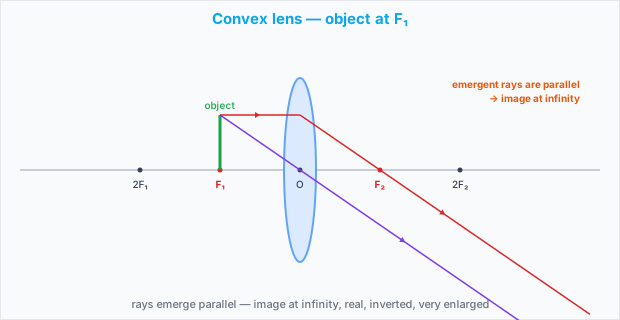
Real-life use: run this case backwards. Put a bright source exactly at F₁ and the rays leave the lens as a parallel beam that barely spreads however far it travels — the principle behind a searchlight, spotlight or lighthouse beam built with a lens, and behind the collimator / condenser that feeds a steady parallel beam into spectrometers and other optical instruments. It is the lens twin of placing a bulb at a concave mirror’s focus.
Object within F₁ → image on the same side (magnifying glass)
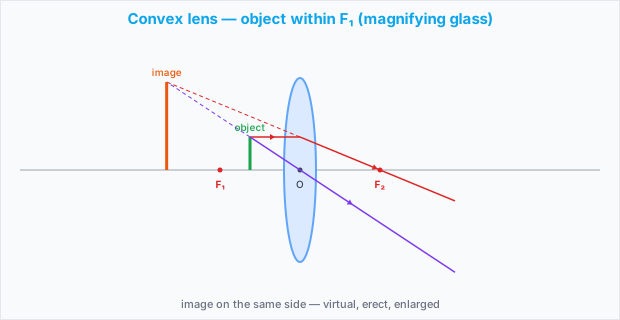
Real-life use: the magnifying glass and the jeweller’s loupe — hold the lens close so the object sits just inside F and you see an upright, enlarged image you can look straight at. Nothing is projected here: the magnified image is virtual, on the same side as the object, so it can only be viewed, never caught on a screen. The very same “object just inside the focus” trick is how the eyepiece of a microscope or telescope enlarges the real image made by the first lens, and how a clip-on macro lens for a phone camera works.
Images in a concave lens
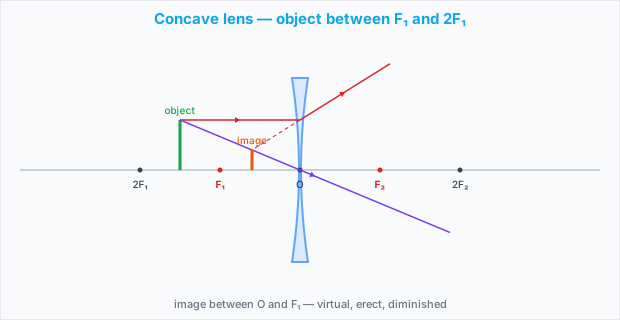
A concave (diverging) lens is the simplest of all: wherever you put the object, the image is virtual, erect and diminished, sitting between the lens and F₁ on the same side as the object. It barely changes as the object moves — only shrinking a little and creeping toward the lens. The same two rays construct it (parallel ray diverges as if from F₁; central ray goes straight), and the image sits where their backward extensions cross.
Object at infinity → a point image at F₁
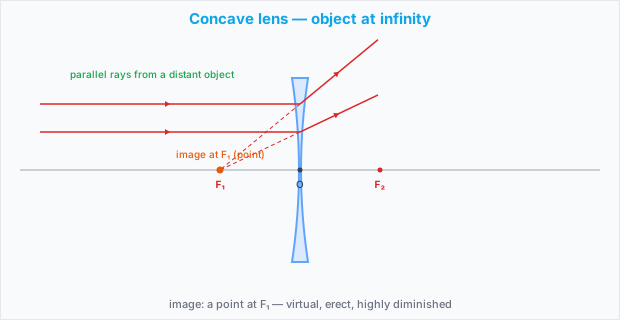
Object beyond 2F₁ → image between O and F₁
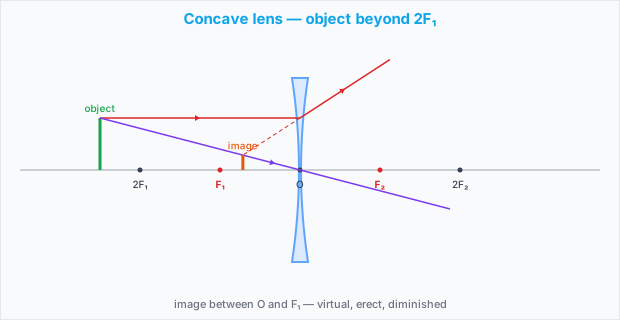
Object at 2F₁ → image between O and F₁
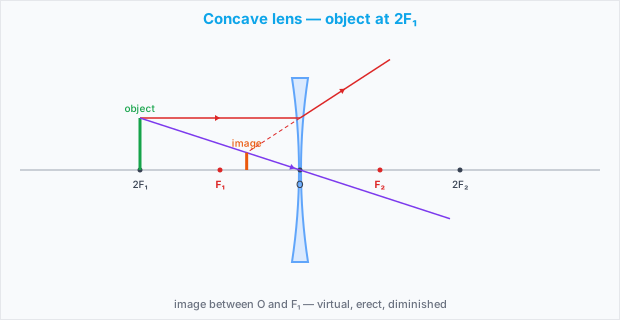
Object between F₁ and 2F₁ → image between O and F₁
Object within F₁ → image very close to the lens
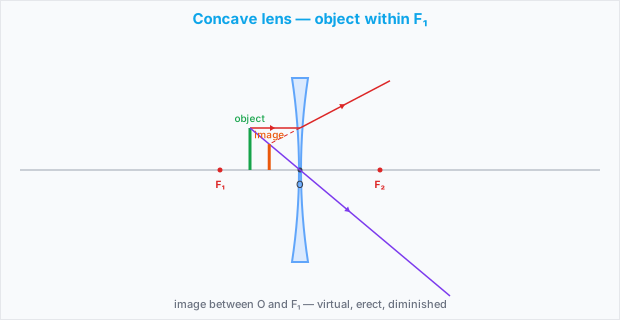
Real-life uses — the same at every object position. Because a concave lens makes the same kind of image — virtual, erect and diminished — no matter where the object sits, all its jobs rely on that one property rather than on object distance:
- Spectacles for short sight (myopia). A short-sighted eye bends light too strongly and focuses distant objects in front of the retina. A concave lens diverges the incoming rays a little first, so the relaxed eye then focuses them correctly on the retina. (You’ll meet this correction again in Chapter 10.)
- Door peephole / “door viewer”. Its wide, shrunken, always-upright image squeezes a whole hallway into a small porthole, so you can see a broad view of who is outside without opening the door.
- Eyepiece of a Galilean telescope (and old opera glasses). A diverging eyepiece gives an upright view — unlike the inverted view of a simple convex eyepiece — which is what you want for looking at distant objects on Earth.
- Beam-spreading in optical systems. A concave lens is used to widen a narrow beam (a “beam expander” in laser and projector optics) and as a correcting element inside good camera and binocular lenses to keep the final image sharp.
In short, reach for a concave lens whenever you want a compact, upright, wide-but-smaller view, or simply to spread light apart.
Lens formula, magnification and power
The lens formula looks like the mirror formula but with a minus:
1/v − 1/u = 1/f
And magnification for a lens is m = h′/h = v/u (note: no minus sign here, unlike mirrors).
A 2.0 cm tall object is placed 15 cm in front of a convex lens of focal length 10 cm. Find the image position, nature and size.
- Signs: u = −15 cm, f = +10 cm (convex), h = +2.0 cm.
- Lens formula: 1/v − 1/u = 1/f, so 1/v = 1/f + 1/u = 1/10 + 1/(−15) = 1/10 − 1/15.
- LCM (30): 1/v = (3 − 2)/30 = 1/30, so v = +30 cm. Positive → image is on the far side of the lens → real.
- Magnification: m = v/u = 30/(−15) = −2. Negative → real, inverted. Image height h′ = m × h = −2 × 2.0 = −4.0 cm.
- So a real, inverted image 4.0 cm tall forms 30 cm beyond the lens — twice the object’s size. This is how a projector throws an enlarged image on a screen.
Finally, the power of a lens measures how strongly it bends light:
P = 1/f (with f in metres), measured in dioptres (D).
A convex lens has positive power, a concave lens negative. A +2.0 D lens is convex with f = +0.50 m. When lenses are placed together, powers simply add: P = P₁ + P₂ + … — which is exactly how opticians stack test lenses to find your prescription.
Common Mistakes
Using f = +15 cm for a concave mirror because 15 is a positive number.
15 is written as a positive number and f looks like just a length, so it feels natural to plug it straight in as +15.
The sign of f comes from the convention, not from the number you're given. A concave mirror's focus is in front of it (left, against the light), so f is negative: concave mirror and concave lens → f negative, convex mirror and convex lens → f positive. Decide the sign before substituting.
Reusing the mirror's magnification formula m = −v/u for a lens.
Both mirrors and lenses use the same symbols m, v and u, and their formulas look almost identical, so it's easy to assume the same one works for both.
They differ: mirror m = −v/u, but lens m = v/u. Likewise the mirror formula adds (1/v + 1/u) while the lens formula subtracts (1/v − 1/u).
Quick Check
The radius of curvature of a concave mirror is 20 cm. What is its focal length?
f = R/2 = 20/2 = 10 cm. The focus is always halfway between the pole and the centre of curvature.
No matter how far you stand from a certain mirror, your image is always erect. What kind of mirror could it be?
A concave mirror gives an inverted (real) image for distant objects, so it’s ruled out. Both plane and convex mirrors always give erect (virtual) images for any object position.
Which lens would you choose to read tiny dictionary print?
You need a magnifier → a convex lens (converging), used with the object inside its focus to get an enlarged, erect, virtual image. The shorter focal length (5 cm) gives greater magnification.
Practice Problems
A convex mirror used as a rear-view mirror has a radius of curvature of 3.00 m. A bus is 5.00 m away. Find the position, nature and size factor of the image.
Signs: convex mirror, so f = +R/2 = +3.00/2 = +1.50 m. Object: u = −5.00 m.
Mirror formula: 1/v = 1/f − 1/u = 1/1.50 − 1/(−5.00) = 1/1.50 + 1/5.00.
Common denominator: 1/v = (5.00 + 1.50)/7.50 = 6.50/7.50, so v = +1.15 m. Positive → image is 1.15 m behind the mirror → virtual.
Magnification: m = −v/u = −(1.15)/(−5.00) = +0.23. Positive → virtual and erect; 0.23 → image is shrunk to about a quarter size.
So the image is virtual, erect and diminished — just what a rear-view mirror gives.
An object 5 cm long is held 25 cm from a converging (convex) lens of focal length 10 cm. Find the position, size and nature of the image.
Signs: u = −25 cm, f = +10 cm (convex), h = +5 cm.
Lens formula: 1/v = 1/f + 1/u = 1/10 + 1/(−25) = 1/10 − 1/25.
LCM (50): 1/v = (5 − 2)/50 = 3/50, so v = +50/3 ≈ +16.7 cm. Positive → real image on the far side.
Magnification: m = v/u = (16.7)/(−25) = −0.67. Negative → real, inverted. Image height h′ = m × h = −0.67 × 5 = −3.3 cm.
So a real, inverted, diminished image about 3.3 cm tall forms ~16.7 cm beyond the lens. (Object beyond 2F → image between F and 2F, diminished — matches the table.)
An object of size 7.0 cm is placed 27 cm in front of a concave mirror of focal length 18 cm. Where should a screen be placed for a sharp image? Find the size and nature of the image.
Signs: concave mirror, f = −18 cm. Object: u = −27 cm, h = +7.0 cm.
Mirror formula: 1/v = 1/f − 1/u = 1/(−18) − 1/(−27) = −1/18 + 1/27.
LCM (54): 1/v = (−3 + 2)/54 = −1/54, so v = −54 cm. Negative → image is 54 cm in front of the mirror, so place the screen there — it’s a real image.
Magnification: m = −v/u = −(−54)/(−27) = −54/27 = −2.0. Negative → real and inverted. Image height h′ = m × h = −2.0 × 7.0 = −14.0 cm.
A real, inverted, enlarged image 14 cm tall forms 54 cm in front of the mirror. (Object between C and F — here C = 36 cm, F = 18 cm, and 27 lies between — so the image is beyond C and enlarged, as the table predicts.)
Summary
- Light reflects off mirrors (angle of incidence = angle of reflection) and refracts (bends) when passing between media because its speed changes.
- Concave mirrors converge light; convex mirrors diverge it. For both, the focal length f = R/2.
- A concave mirror’s image varies with object position (real/inverted in most positions, virtual/erect/enlarged when the object is inside F). A convex mirror’s image is always virtual, erect, diminished.
- Mirror formula: 1/v + 1/u = 1/f, magnification m = −v/u. Use the New Cartesian Sign Convention (object distance negative; concave f negative, convex f positive).
- Light bends towards the normal entering a denser medium, away leaving it. Refractive index n = c/v; higher n = optically denser = bends more.
- Convex lenses converge (positive f), concave lenses diverge (negative f). Lens formula: 1/v − 1/u = 1/f, magnification m = v/u.
- Power P = 1/f (f in metres), in dioptres; convex positive, concave negative; powers of lenses in contact add.
What’s Next
You now understand how a single mirror or lens bends light to form an image. But the most sophisticated optical instrument you own is your eye — a living convex lens that focuses automatically. In Chapter 10: The Human Eye and the Colourful World, you’ll see how the eye forms images, why some people need the very spectacle lenses you just studied (to fix myopia and hypermetropia), and how refraction paints the sky blue, the sunset red, and splits white light into a rainbow through a prism.