Electricity
Why This Matters
Flick a switch and a room lights up. Plug in a charger and your phone fills back up. Almost everything around you — fans, fridges, phones, trains — runs on the same invisible thing flowing through wires. But what is actually flowing? And why does a heater coil glow red-hot while the wire feeding it stays cool?
This chapter answers exactly that. You’ll learn what electric current really is, what pushes it along (voltage), what holds it back (resistance), and the one neat rule — Ohm’s law — that ties all three together. Once you have that, you can predict what any simple circuit will do.
And it’s not just theory. Why does a fuse “blow”? Why are house appliances wired in parallel and not in series? Why is your electricity bill measured in “units”? By the end, all of these will make complete sense.
The Big Idea
Current is the flow of electric charge. A potential difference (voltage) pushes that charge through a wire, and resistance opposes it. Ohm’s law links them: V = IR. Push harder (more V) and you get more current; resist more (more R) and you get less.
Picture water in a pipe. The voltage is like the pressure difference that makes water flow; the current is how much water flows per second; the resistance is how narrow or clogged the pipe is. The whole chapter is really just this one picture, made precise — and then applied to combinations of resistors, heating, and power.
Let’s Break It Down
Electric current
When electric charge flows through a conductor (like a metal wire), we say there’s an electric current in it. Current is the rate of flow of charge — how much charge passes a point each second.
If a charge Q flows past a cross-section in time t, the current I is:
I = Q / t
The SI unit of charge is the coulomb (C) — roughly the charge of 6 × 10¹⁸ electrons (each electron carries 1.6 × 10⁻¹⁹ C). The SI unit of current is the ampere (A): one ampere is one coulomb of charge flowing per second (1 A = 1 C/s). Small currents are measured in milliamperes (1 mA = 10⁻³ A) or microamperes (1 µA = 10⁻⁶ A).
Current is measured by an ammeter, which is always connected in series in the circuit.
One quirk worth knowing: in a metal wire, it’s actually negatively-charged electrons that move. But electrons weren’t known when current was first studied, so by convention the direction of current is taken as the direction positive charge would move — i.e. opposite to the electron flow, from the + terminal of the cell to the − terminal through the circuit.
A bulb filament draws 0.5 A for 10 minutes. How much charge flows through it?
- First, get everything into SI units: I = 0.5 A, t = 10 min = 600 s.
- Use I = Q/t, rearranged to Q = I × t.
- Q = 0.5 A × 600 s = 300 C.
Potential difference (voltage)
Charge doesn’t flow on its own, just as water won’t flow through a level pipe. You need a “push” — a difference in electric pressure, called the potential difference. A cell or battery creates this push using chemical energy, even before any current is drawn.
The potential difference V between two points is the work done (W) to move a unit charge (Q) from one point to the other:
V = W / Q
The SI unit is the volt (V). One volt is the potential difference when 1 joule of work moves 1 coulomb of charge:
1 V = 1 J/C
Potential difference is measured by a voltmeter, always connected in parallel across the two points.
How much work moves a charge of 2 C across a potential difference of 12 V?
- Given: Q = 2 C, V = 12 V.
- From V = W/Q, rearrange to W = V × Q.
- W = 12 V × 2 C = 24 J.
Circuit diagrams
Drawing every battery and bulb realistically is slow, so we use standard symbols. A continuous, closed path is an electric circuit; break it anywhere and current stops.
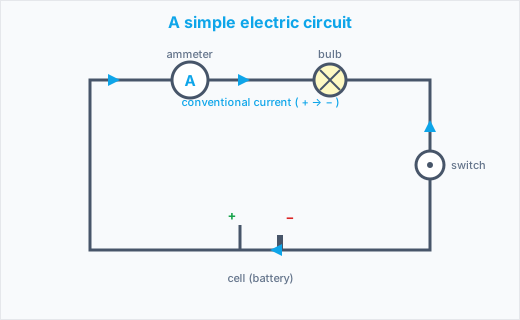
The most common symbols: a cell (long line +, short line −), a battery (several cells), a switch/plug key (open or closed), a resistor (a zig-zag or rectangle), a rheostat (variable resistance), an ammeter (circle with A) and a voltmeter (circle with V).
Ohm’s law
Here’s the key relationship. In 1827 Georg Simon Ohm found that the potential difference V across a metallic conductor is directly proportional to the current I through it, as long as temperature stays the same:
V ∝ I, so V = IR
The constant R is the resistance of the conductor — its tendency to oppose the flow of charge. Its SI unit is the ohm (Ω).
R = V / I and I = V / R
If 1 V drives 1 A, the resistance is 1 Ω. Notice the last form: for a fixed voltage, more resistance means less current — double the resistance and the current halves. A device that adjusts resistance to control current (without changing the source) is a rheostat.
A graph of V (y-axis) against I (x-axis) for such a conductor is a straight line through the origin — that straight line is Ohm’s law, and its slope is R.
A 220 V source connects to (a) a bulb of resistance 1200 Ω, (b) a heater coil of 100 Ω. Find each current.
- Use I = V/R.
- Bulb: I = 220 V / 1200 Ω = 0.18 A.
- Heater: I = 220 V / 100 Ω = 2.2 A. The low-resistance heater draws far more current from the same source — that’s why it heats up.
What resistance depends on
Experiments show the resistance of a uniform wire depends on three things:
- It’s directly proportional to length (l) — a longer wire resists more.
- It’s inversely proportional to area of cross-section (A) — a thicker wire resists less.
- It depends on the material of the wire.
Combining these:
R = ρ × (l / A)
where ρ (rho) is the resistivity of the material — a property of the substance itself, measured in Ω m. Good conductors (silver, copper) have very low resistivity (~10⁻⁸ Ω m); insulators (glass, rubber) have enormous resistivity (10¹² Ω m or more).
A couple of useful facts: alloys (like nichrome) have higher resistivity than pure metals and don’t oxidise easily when hot — that’s why heating elements in toasters and irons are made of alloys. Tungsten is used for bulb filaments (high melting point), while copper and aluminium carry electricity in transmission lines (low resistivity).
A wire has resistance 4 Ω. What is the resistance of another wire of the same material with half the length (l/2) and double the area (2A)?
- Use R = ρl/A.
- For the new wire: R₂ = ρ(l/2)/(2A) = (1/4) × ρl/A.
- Since ρl/A = 4 Ω for the first wire, R₂ = (1/4) × 4 Ω = 1 Ω.
Resistors in series
When resistors are joined end to end (series), the same current flows through each one, and the voltages add up. The equivalent resistance is just the sum:
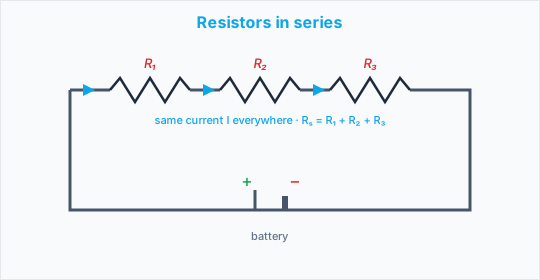
Rₛ = R₁ + R₂ + R₃
The total resistance in series is larger than any individual resistor. Drawback: if one component fails, the whole circuit breaks (think of old fairy-light strings going dark from one dead bulb).
A 20 Ω lamp and a 4 Ω conductor are in series across a 6 V battery. Find the total resistance, the current, and the voltage across each.
- Total resistance: R = 20 + 4 = 24 Ω.
- Current (same everywhere in series): I = V/R = 6 V / 24 Ω = 0.25 A.
- Voltage across lamp = 20 Ω × 0.25 A = 5 V; across conductor = 4 Ω × 0.25 A = 1 V. Check: 5 + 1 = 6 V ✓.
Resistors in parallel
When resistors are joined side by side between the same two points (parallel), the voltage across each is the same, and the currents through them add up. The equivalent resistance follows the reciprocal rule:
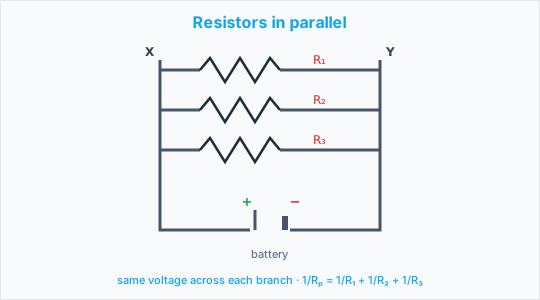
1/Rₚ = 1/R₁ + 1/R₂ + 1/R₃
The total resistance in parallel is smaller than the smallest individual resistor. This is why home appliances are wired in parallel: each gets the full 220 V, each can be switched on or off independently, and one failing doesn’t kill the rest.
R₁ = 5 Ω, R₂ = 10 Ω, R₃ = 30 Ω are connected across a 12 V battery. Find the current in each, the total current, and the total resistance.
- Each resistor has the full 12 V across it, so use I = V/R for each.
- I₁ = 12/5 = 2.4 A; I₂ = 12/10 = 1.2 A; I₃ = 12/30 = 0.4 A. Total current I = 2.4 + 1.2 + 0.4 = 4 A.
- Total resistance: 1/Rₚ = 1/5 + 1/10 + 1/30 = 6/30 + 3/30 + 1/30 = 10/30 = 1/3, so Rₚ = 3 Ω — smaller than every branch. (Check: 12 V / 3 Ω = 4 A ✓.)
Heating effect and electric power
To keep current flowing, the source spends energy. In a purely resistive circuit, all of it turns into heat — the heating effect of current. The heat produced is:
H = VIt = I²Rt
This is Joule’s law of heating: heat is proportional to the square of the current, to the resistance, and to the time. It’s behind heaters, irons, toasters, bulbs — and the fuse, a thin wire that melts and breaks the circuit if the current gets dangerously high.
The rate at which energy is used is electric power:
P = VI = I²R = V²/R
The SI unit is the watt (W): 1 W = 1 V × 1 A. Energy = power × time. The commercial unit of electrical energy is the kilowatt-hour (kW h) — the “unit” on your electricity bill:
1 kW h = 3.6 × 10⁶ J
A 400 W fridge runs 8 hours a day for 30 days, at ₹3.00 per kW h. Find the cost.
- First find the total energy in kW h.
- Energy = 400 W × 8 h/day × 30 days = 96000 W h = 96 kW h.
- Cost = 96 kW h × ₹3.00 = ₹288.00.
Common Mistakes
Current flows from the − terminal to the + terminal, because electrons move that way.
Electrons — the real moving charges — do flow from − to +, so it's perfectly reasonable to assume 'current' follows the actual particles.
By long-standing convention, current is defined in the opposite direction to electron flow: from the + terminal, through the circuit, to the − terminal.
An ammeter goes in parallel and a voltmeter in series.
Both are meters that look alike and connect with two leads, so there's nothing obvious to stop you swapping their connection rules.
It's the other way round: ammeter in SERIES (so all the current passes through it), voltmeter in PARALLEL (across the two points whose difference you want). A wrong connection can damage the meter.
Adding resistors always increases the total resistance.
'Adding more of something gives you more of it' is everyday intuition, and the series case — which you meet first — reinforces it.
That's only true in series, where R adds up. In parallel, each extra resistor gives the current another path, so 1/R adds up and the total Rₚ is smaller than the smallest branch.
A thicker wire has more resistance because there's more metal.
'More metal means more material to push through' feels intuitive, and it's easy to muddle thickness with length — a longer wire really does add resistance.
Resistance is inversely proportional to area, so a thicker (larger-area) wire has LESS resistance — more cross-section gives charge more room to flow. Length is the opposite: a longer wire has more resistance.
Quick Check
What is the SI unit of electric charge, and roughly how many electrons make it up?
A conductor obeys Ohm's law. If you double the potential difference across it (temperature unchanged), the current through it will:
Three 6 Ω resistors are connected in parallel. What is their equivalent resistance?
Why are heating elements (in toasters and irons) made of an alloy like nichrome rather than a pure metal?
Your home appliances are all connected in parallel across 220 V. Give two reasons why parallel is better than series for this.
Two reasons: (1) Each appliance gets the full 220 V it’s designed for (in series, the voltage would be divided among them). (2) Each can be switched on/off independently, and if one fails the others keep working — in series, one broken component breaks the whole circuit. (A bonus reason: parallel gives a lower total resistance, allowing the larger total current many appliances need.)
Practice Problems
A current of 0.5 A flows for 4 minutes. How much charge passes through the circuit?
Convert time: t = 4 min = 240 s. Then Q = I × t = 0.5 A × 240 s = 120 C.
When a 12 V battery is connected across an unknown resistor, a current of 2.5 mA flows. Find the resistance.
Convert current: I = 2.5 mA = 2.5 × 10⁻³ A = 0.0025 A. Then R = V/I = 12 V / 0.0025 A = 4800 Ω (4.8 kΩ).
A battery of 9 V is connected in series with resistors of 0.2 Ω, 0.3 Ω, 0.4 Ω, 0.5 Ω and 12 Ω. How much current flows through the 12 Ω resistor?
In series, the same current flows through every resistor, so just find the total resistance and use Ohm’s law. Total R = 0.2 + 0.3 + 0.4 + 0.5 + 12 = 13.4 Ω. Current I = V/R = 9 V / 13.4 Ω ≈ 0.67 A. This is the current through the 12 Ω resistor (and through every other resistor too).
How can three resistors, each of 6 Ω, be connected to give a total resistance of (i) 9 Ω, (ii) 4 Ω?
(i) 9 Ω: Put two 6 Ω resistors in parallel, then that combination in series with the third 6 Ω. Parallel pair: 1/R = 1/6 + 1/6 = 2/6, so R = 3 Ω. In series with 6 Ω: 3 + 6 = 9 Ω ✓.
(ii) 4 Ω: Put two 6 Ω in series (= 12 Ω), then that combination in parallel with the third 6 Ω. 1/R = 1/12 + 1/6 = 1/12 + 2/12 = 3/12, so R = 4 Ω ✓.
An electric iron of resistance 20 Ω takes a current of 5 A. Calculate the heat developed in 30 s.
Use Joule’s law: H = I²Rt. H = (5)² × 20 × 30 = 25 × 20 × 30 = 25 × 600 = 15000 J (15 kJ).
Two lamps, one rated 100 W and the other 60 W, both at 220 V, are connected in parallel to a 220 V supply. What total current is drawn from the line?
Each lamp gets the full 220 V, so find each current from P = VI, i.e. I = P/V. Lamp 1: I₁ = 100 W / 220 V ≈ 0.45 A. Lamp 2: I₂ = 60 W / 220 V ≈ 0.27 A. In parallel the currents add: I = I₁ + I₂ ≈ 0.45 + 0.27 = 0.73 A. (Alternatively: total power = 160 W, so I = 160/220 ≈ 0.73 A.)
A hot plate connected to 220 V has two coils A and B, each 24 Ω, which can be used separately, in series, or in parallel. Find the current in all three cases.
Use I = V/R for each arrangement. One coil alone (24 Ω): I = 220 / 24 ≈ 9.2 A. In series (24 + 24 = 48 Ω): I = 220 / 48 ≈ 4.6 A (lowest current → least heat). In parallel: 1/R = 1/24 + 1/24 = 2/24, so R = 12 Ω. I = 220 / 12 ≈ 18.3 A (highest current → most heat). So a single hot plate gives three heat settings just by switching how the coils are connected.
Summary
- Current I = Q/t is the rate of flow of charge; SI unit ampere (A). Conventional current flows opposite to electron flow. Measured by an ammeter in series.
- Potential difference V = W/Q is the push that drives current; SI unit volt (V) (1 V = 1 J/C). Measured by a voltmeter in parallel.
- Ohm’s law: V = IR. Resistance R (in ohms, Ω) opposes current. The V–I graph is a straight line through the origin.
- Resistance R = ρl/A — directly proportional to length, inversely to area, and depends on the material’s resistivity ρ.
- Series: same current; Rₛ = R₁ + R₂ + R₃ (larger than any one). Parallel: same voltage; 1/Rₚ = 1/R₁ + 1/R₂ + 1/R₃ (smaller than the smallest).
- Heating effect: H = I²Rt (Joule’s law). Used in heaters, bulbs, and the protective fuse.
- Electric power: P = VI = I²R = V²/R, in watts. Energy is sold in kilowatt-hours (1 kW h = 3.6 × 10⁶ J).
What’s Next
You now know how current flows and how resistance and voltage control it. But electricity does something else remarkable — a current-carrying wire creates a magnetic field around it, and a moving magnet can create a current. That two-way link between electricity and magnetism is what runs every electric motor and generates almost all the electricity you use.
In Chapter 12: Magnetic Effects of Electric Current, you’ll explore magnetic field lines, the field around a wire and a coil, how a motor spins, electromagnetic induction, and how a generator turns motion into electricity.