Magnetic Effects of Electric Current
Why This Matters
In 1820 a Danish teacher named Hans Christian Oersted was setting up an experiment when he noticed something odd: every time he switched on a current in a wire, a nearby compass needle twitched. That tiny twitch was one of the biggest discoveries in physics — electricity and magnetism are two sides of the same coin. A current doesn’t just heat a wire; it surrounds it with a magnetic field.
That single idea runs the modern world. Every electric motor — in your fan, your mixer, an electric train — spins because a current sitting in a magnetic field feels a push. Every loudspeaker, every MRI machine, every electromagnet in a scrapyard crane uses it.
This chapter shows you the link both ways: how a current creates a magnetic field, and how a magnetic field pushes on a current. By the end, the diagram of the wiring in your own house — live, neutral, earth, fuse — will make complete sense too.
The Big Idea
A moving charge (current) creates a magnetic field around it. And a current placed in a magnetic field feels a force. Two simple hand rules tell you the directions: the right-hand thumb rule for the field a current makes, and Fleming’s left-hand rule for the force a field puts on a current.
Keep those two halves separate in your head. First half: wire → field (use your right hand). Second half: wire-in-a-field → force (use your left hand). Almost everything in the chapter is one of these two, applied to different shapes — a straight wire, a loop, a solenoid.
Let’s Break It Down
Magnetic field and field lines
A magnet has a region around it where its force can be felt — its magnetic field. We picture this field using field lines. A compass placed in the field lines up along these lines, and its north pole points along the field direction.
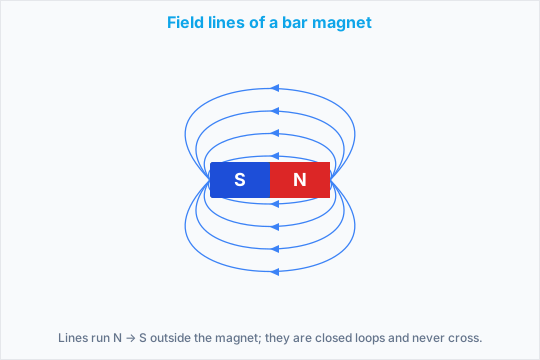
Three rules about field lines you should know:
- They run from the north pole to the south pole outside the magnet (and S to N inside it), so they form closed loops.
- Crowded lines mean a stronger field — the field is strongest near the poles.
- Two field lines never cross. If they did, a compass at that point would have to point in two directions at once — impossible.
The field around a straight current-carrying wire
When current flows through a straight wire, the magnetic field around it forms concentric circles centred on the wire. Move further from the wire and the circles get larger and the field gets weaker; increase the current and the field gets stronger.
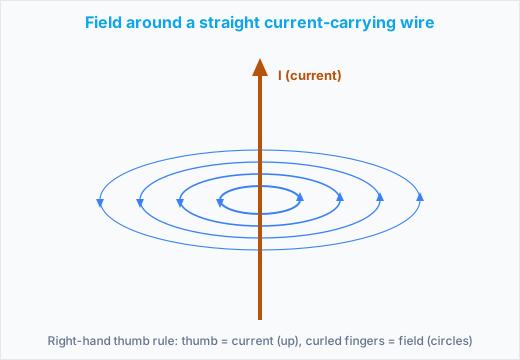
To find which way the field circles, use the right-hand thumb rule: imagine gripping the wire in your right hand with your thumb pointing in the direction of the current. Your curled fingers then point in the direction of the field lines.
A horizontal power line carries current from east to west. What is the direction of the magnetic field at a point directly below it?
- Point the right thumb along the current — toward the west.
- Curl the fingers around the wire. Below the wire, the fingers sweep in one direction; above the wire, the opposite.
- Viewed from the east end, the field circles clockwise in the plane perpendicular to the wire; from the west end it appears anti-clockwise. So below and above the wire the field points in opposite directions.
The field due to a circular loop and a solenoid
Bend the wire into a circular loop and the field lines, which were circles around each bit of wire, add up at the centre to give a field straight through the loop. A coil of n turns gives n times the field of one turn, because each turn’s contribution adds in the same direction.
Wind many such turns closely into a cylinder and you get a solenoid. The field of a current-carrying solenoid looks exactly like a bar magnet’s: one end acts as a north pole, the other as a south pole, and inside it the field is uniform (parallel, evenly-spaced lines).
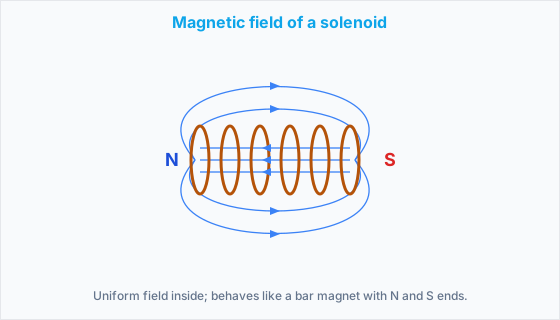
Place a piece of soft iron inside a solenoid and the strong field magnetises it — this is an electromagnet. Unlike a permanent magnet, it can be switched on and off and made very strong, which is why cranes, electric bells and many machines use them.
Force on a current-carrying conductor
Now the reverse link. Oersted showed a current makes a field; Ampère reasoned that a magnet must therefore push back on a current. It does: a current-carrying wire placed in a magnetic field feels a force.
The force is largest when the current is at right angles to the field, and it reverses if you reverse either the current or the field. To find its direction, use Fleming’s left-hand rule:
Stretch the thumb, forefinger and middle finger of your left hand so all three are mutually perpendicular. ForeFinger → Field, Middle finger → Current (the “Middle” current), and the Thumb → Thrust (the force/motion).
This is the principle behind the electric motor, loudspeakers and microphones — a current in a field is made to move.
An electron moves straight down the page through a magnetic field that points to the right (in the plane of the page). Which way is the force on the electron?
- First, fix the current direction: conventional current is opposite to electron motion, so the current points up.
- Set up Fleming’s left hand: forefinger along the field, middle finger along the current (up).
- The thumb then points into the page — that’s the direction of the force on the electron. (Reversing current or field would flip it.)
Domestic electric circuits
The electricity reaching your home comes on two main wires: a live wire (red insulation, at +220 V on average in India) and a neutral wire (black). A third earth wire (green) connects the metal body of appliances to a metal plate buried in the ground.
- Appliances are wired in parallel across live and neutral, so each gets the full 220 V and its own switch.
- The earth wire is a safety wire: if a fault makes the metal body of an appliance live, current escapes safely to earth instead of through you.
- A fuse (in series) protects the circuit. If the current gets too high, the fuse wire heats up (Joule heating) and melts, breaking the circuit.
- Overloading = too much current, from too many appliances on one socket or a voltage spike. Short-circuiting = the live and neutral wires touch directly (e.g. damaged insulation), causing a sudden huge current. The fuse cuts off both.
A 2 kW oven runs on a 220 V circuit rated for 5 A. Will it work?
- First find the current the oven draws using P = VI, so I = P/V.
- I = 2000 W / 220 V ≈ 9.1 A.
- 9.1 A is more than the 5 A rating, so the current is too high — the fuse will melt and break the circuit. The oven needs the 15 A circuit instead.
Common Mistakes
Use the right hand for everything — finding the field AND the force.
You learn the right-hand thumb rule first and it works for field direction, so it's tempting to reach for the same familiar hand on every magnetism problem.
They need different hands: RIGHT hand (thumb rule) → direction of the field a current makes; LEFT hand (Fleming's) → direction of the force on a current in a field.
Magnetic field lines start at the north pole and just end at the south pole.
Diagrams only draw the arrows outside the magnet (N to S), so the part inside is invisible and the lines look as if they start and stop at the poles.
Field lines are CLOSED curves: N to S outside the magnet, and S to N inside it. They never simply begin or end.
The earth wire and the neutral wire do the same job.
Both wires sit at nearly zero potential compared with the live wire, and both ultimately connect to the ground, so they seem to do the same job.
The NEUTRAL completes the normal circuit (carries the return current). The EARTH wire is a safety path for fault current, connecting the metal body to the ground — normally it carries no current.
In Fleming's left-hand rule, the middle finger is the field.
The three fingers have no obvious link to field, current and force, so it's easy to attach the wrong quantity to the middle finger.
Forefinger = Field, Middle finger = Current (Middle = Current), Thumb = Thrust/force. Remember 'F-C-T' on fore-middle-thumb.
Quick Check
What does the magnetic field around a long straight current-carrying wire look like?
The magnetic field inside a long current-carrying solenoid is:
To find the direction of the force on a current-carrying conductor in a magnetic field, you use:
What is the main purpose of the earth wire in a household circuit?
A current-carrying solenoid and a bar magnet produce very similar field patterns. Give one big advantage the solenoid (electromagnet) has over the bar magnet.
The electromagnet can be switched on and off — it’s only a magnet while current flows. You can also control its strength (more current or more turns = stronger field) and reverse its poles by reversing the current. A bar magnet’s magnetism is fixed and always on. (That on/off control is why cranes, electric bells and relays use electromagnets.)
Practice Problems
List two properties of magnetic field lines.
Any two of: (1) They run from north to south outside the magnet (and form closed loops). (2) They never cross/intersect each other. (3) They are crowded where the field is strong (near the poles) and spread out where it is weak. (4) A compass needle placed on a line aligns along it.
List two methods of producing a magnetic field.
(1) Using a permanent magnet (like a bar magnet). (2) Passing an electric current through a conductor — a straight wire, a circular loop, or a solenoid (electromagnet). (A changing electric field also produces one, but the current method is the key one here.)
A current through a horizontal power line flows from east to west. Using the right-hand thumb rule, describe the magnetic field directly below and directly above the wire.
Point the right thumb along the current (toward the west) and curl the fingers around the wire. The field forms circles around the wire. Below the wire the field points in one horizontal direction (toward the north) and above the wire it points the opposite way (toward the south) — the lines circle the wire. Equivalently: viewed from the east the field is clockwise, viewed from the west it is anti-clockwise.
An electron beam moves horizontally from the back wall toward the front wall of a room and is deflected to your right by a magnetic field. What is the direction of the magnetic field?
Use Fleming’s left-hand rule, but first fix the current direction. The electron moves toward the front, so the conventional current points toward the back (opposite to electron motion). Thumb (force/thrust) = to the right; middle finger (current) = toward the back. Orient your left hand so these match, and the forefinger (field) points downward. So the magnetic field is directed vertically downward.
A 2 kW electric oven is plugged into a 220 V domestic circuit that has a current rating of 5 A. What will happen, and why?
Find the current the oven draws: I = P/V = 2000 W / 220 V ≈ 9.1 A. This is much greater than the 5 A rating of the circuit. The excess current overheats the fuse, which melts and breaks the circuit. So the oven will not run safely on this circuit — it should be on the higher-rated (15 A) circuit meant for high-power appliances.
When does an electric short circuit occur, and what is the function of the earth wire?
Short circuit: when the live wire and neutral wire come into direct contact (e.g. their insulation is damaged or there’s a fault), the resistance of the path drops almost to zero, so the current rises abruptly to a very large value. Earth wire: it connects the metal body of an appliance to the ground through a low-resistance path. If a fault makes the body live, the current is carried safely to earth, keeping the body at earth’s potential so the user doesn’t get a severe shock.
Summary
- A current-carrying wire produces a magnetic field around it (Oersted). Electricity and magnetism are linked.
- A magnetic field is shown by field lines: N to S outside the magnet, closed loops, never crossing, crowded where the field is strong.
- The field around a straight wire is concentric circles; direction from the right-hand thumb rule (thumb = current, fingers = field).
- A circular loop gives a field through its centre; a solenoid behaves like a bar magnet with a uniform field inside. A soft-iron core makes an electromagnet (switchable, adjustable).
- A current in a magnetic field feels a force, greatest when current ⟂ field. Direction from Fleming’s left-hand rule (Forefinger = Field, Middle = Current, Thumb = Thrust). This drives electric motors.
- Domestic circuits: live (red), neutral (black), earth (green). Appliances in parallel at 220 V. The fuse melts on excess current; the earth wire protects against shocks. Overloading and short-circuiting cause dangerous currents.
What’s Next
You’ve now seen the heating effect (Chapter 11) and the magnetic effect of electric current. With both halves of physics covered, the syllabus turns from the lab to the living world around you.
In Chapter 13: Our Environment, you’ll explore how energy and matter flow through ecosystems — food chains and food webs, trophic levels and the 10% rule, the roles of producers, consumers and decomposers, and how human activities like waste and ozone-layer damage disturb the delicate balance of nature.