Our Environment
Why This Matters
Every blade of grass, every insect, every tiger, and the soil, air and sunlight around them are tied together in a giant web of give-and-take. Pull one thread and the whole web shivers. That web is what we call the environment — and you are part of it, not a visitor.
This chapter is where biology meets the news. Why do pesticides sprayed on a field end up concentrated in the fish you eat? Why was there a worldwide panic about a “hole in the ozone layer”? Why does a plastic wrapper outlast you by centuries while a banana peel vanishes in weeks? These aren’t separate stories — they’re all about how energy and matter move through nature, and what happens when humans disturb that flow.
Understanding it isn’t just exam material. It’s the difference between throwing a wrapper on the ground and thinking twice — because now you know exactly where it goes.
The Big Idea
An ecosystem is living things (biotic) and their non-living surroundings (abiotic) interacting as one system. Energy flows through it in one direction — from the Sun, to producers, to consumers — losing about 90% at each step (only ~10% passes on). Matter, however, is recycled by decomposers. When humans disrupt this — with pesticides, CFCs, or non-biodegradable waste — the whole system suffers.
Two flows to keep separate in your head: energy flows through and is lost (one-way, Sun → plants → animals → heat), while nutrients cycle round and round (soil → plants → animals → decomposers → soil). Everything else in the chapter hangs off these two ideas.
Let’s Break It Down
What is an ecosystem?
An ecosystem is all the interacting organisms in an area plus the non-living things around them, working as one unit.
- Biotic components — the living parts: plants, animals, microorganisms.
- Abiotic components — the physical parts: temperature, rainfall, wind, soil, minerals.
A garden, a forest, a pond, a lake — all ecosystems. Natural ones (forest, pond) run themselves; artificial ones (a garden, a crop field, an aquarium) are made and maintained by humans.
Based on how they get food, organisms fall into three roles:
- Producers — green plants and some bacteria that make their own food from sunlight by photosynthesis. They sit at the base of everything.
- Consumers — organisms that eat producers or other consumers. They include herbivores (plant-eaters), carnivores (meat-eaters), omnivores (both) and parasites.
- Decomposers — bacteria and fungi that break down dead remains and waste into simple substances, returning nutrients to the soil for plants to reuse.
Food chains, food webs and trophic levels
A food chain is a series of organisms feeding one on another: grass → deer → tiger. Each step is a trophic level:
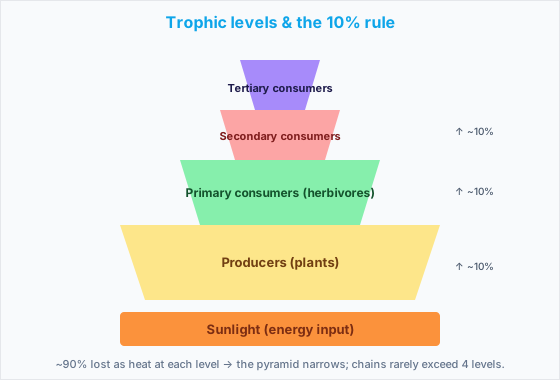
- 1st level — Producers (autotrophs): capture about 1% of the sunlight hitting their leaves and turn it into food energy.
- 2nd level — Primary consumers (herbivores).
- 3rd level — Secondary consumers (small carnivores).
- 4th level — Tertiary consumers (large carnivores).
The crucial fact is the 10% rule: when one level is eaten by the next, only about 10% of the energy is passed on — the other ~90% is lost as heat, used in digestion, movement and life processes. Because so little energy survives each jump, food chains rarely have more than three or four steps.
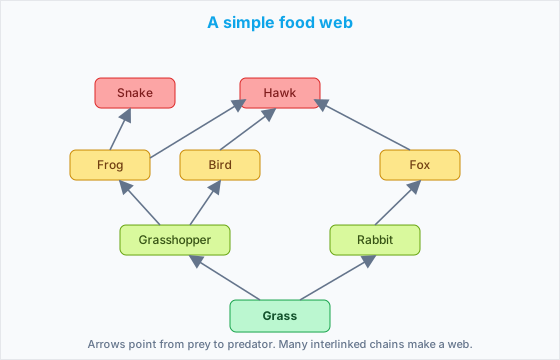
In reality an organism is eaten by several others and eats several others, so straight-line chains branch and interconnect into a food web.
Producers in a field capture 10,000 units of energy. Using the 10% rule, how much reaches a tertiary consumer (4th trophic level)?
- Each step passes only 10% (one-tenth) of its energy to the next.
- Producers → primary consumer: 10% of 10,000 = 1,000 units. Primary → secondary: 10% of 1,000 = 100 units.
- Secondary → tertiary: 10% of 100 = 10 units. From 10,000 down to 10 in just three jumps — that’s why top carnivores are few and chains are short.
Energy flow is one-way
Two features define the flow of energy:
- It is unidirectional — energy goes Sun → producers → consumers and never comes back. Once it passes a level it’s gone from that level for good.
- It diminishes at every level, because ~90% is lost at each step. That’s the very reason the pyramid narrows and chains are short.
Biological magnification
Here’s a darker twist. Pesticides and other chemicals sprayed on crops wash into soil and water, get absorbed by plants, and enter the food chain. Many of these chemicals don’t break down — so at each trophic level they accumulate in greater concentration. Since humans sit at the top of food chains, the maximum concentration ends up in us. This progressive build-up is called biological magnification (or biomagnification). It’s why grains, vegetables, fruit and even meat carry pesticide residues that washing can’t fully remove.
Ozone layer and its depletion
Ozone (O₃) is a molecule of three oxygen atoms. Down where we breathe, ozone is a poison — but high in the atmosphere it does a vital job: it shields Earth from the Sun’s harmful ultraviolet (UV) rays, which cause skin cancer and other damage.
High up, UV light splits ordinary oxygen (O₂) into free O atoms, which join O₂ to form ozone:
O₂ → (UV) → O + O, then O + O₂ → O₃
In the 1980s ozone levels dropped sharply. The culprit: synthetic chlorofluorocarbons (CFCs), used in refrigerators and fire extinguishers. In 1987 the UN forged an agreement (the Montreal Protocol) to freeze and phase out CFC production; CFC-free fridges are now mandatory worldwide.
Biodegradable and non-biodegradable waste
Enzymes are specific — each only breaks down a particular substance. That’s why we can’t digest coal, and why bacteria can’t break down many human-made materials.
- Biodegradable substances can be broken down by biological processes (bacteria, decomposers): vegetable peels, paper, leftover food, leather, wood.
- Non-biodegradable substances cannot be broken down this way: plastics, glass, metals. They persist in the environment for a very long time and can harm ecosystems.
Sort this waste into biodegradable and non-biodegradable: banana peel, plastic bottle, newspaper, broken glass, leftover rice.
- Ask of each item: can bacteria/fungi break it down?
- Biodegradable (yes, decomposers act on them): banana peel, newspaper, leftover rice.
- Non-biodegradable (no, they persist): plastic bottle, broken glass. These need recycling or careful disposal — burying them just hides them for centuries.
Common Mistakes
Energy cycles around an ecosystem the way nutrients do.
Energy and nutrients are taught together as things that 'flow through the food chain', so it's natural to assume they behave the same way.
They don't: ENERGY flows one-way and is steadily lost as heat (Sun → producers → consumers), whereas MATTER/nutrients are recycled round and round by decomposers.
Ozone is always harmful, so losing the ozone layer is good.
Students mostly hear 'ozone' as a harmful gas in smog and pollution, so that bad reputation gets stretched to the ozone layer too.
Ozone's effect depends on where it is: high in the atmosphere it shields us from harmful UV rays, so depleting that layer is dangerous — it lets more UV reach Earth, causing skin cancer and other harm. (Only ground-level ozone is a pollutant.)
Biological magnification means the chemical gets diluted as it moves up the food chain.
A tiny amount of chemical spread through a huge food chain intuitively feels as if it would get shared out and diluted — and 'magnification' isn't an obvious word for 'concentrating'.
It's the opposite: non-biodegradable chemicals ACCUMULATE and become MORE concentrated at each higher trophic level — so top consumers (like humans) get the most.
Anything natural-looking, like a kulhad or paper cup, is automatically good for the environment.
Earthy, biodegradable-looking things like a kulhad or paper cup feel harmless by appearance, so 'looks natural' gets equated with 'good for the planet'.
Judge by the full impact, not appearance — making clay kulhads on a huge scale destroys fertile topsoil. Reducing and reusing usually beats any disposable, however 'natural' it looks.
Quick Check
In a food chain, roughly what fraction of energy is passed from one trophic level to the next?
What is the role of decomposers in an ecosystem?
Why is the depletion of the ozone layer a serious concern?
Which group contains only biodegradable items?
Humans sit at the top of most food chains. Use the idea of biological magnification to explain why this is risky when crops are sprayed with non-degradable pesticides.
Non-degradable pesticides don’t break down, so they don’t leave the body of an organism that absorbs them. As you move up the food chain, each level eats many organisms from the level below, so the chemical accumulates and concentrates at every step (biological magnification). Since humans are at the top, we receive the highest concentration of these chemicals — built up through everything we eat (grains, vegetables, fruit, meat). That’s why pesticide residues in our food are a real health concern and can’t simply be washed off.
Practice Problems
What are trophic levels? Give an example of a food chain and name the trophic levels in it.
A trophic level is each feeding step in a food chain — a position based on what an organism eats. Example food chain: grass → grasshopper → frog → snake.
- Grass = producer (1st trophic level)
- Grasshopper = primary consumer / herbivore (2nd)
- Frog = secondary consumer (3rd)
- Snake = tertiary consumer (4th)
Give two ways in which non-biodegradable substances affect the environment.
Any two of: (1) They persist for a very long time, piling up as litter and filling landfills. (2) They can harm or kill organisms — e.g. animals choking on plastic, or chemicals entering the food chain. (3) Non-degradable chemicals undergo biological magnification, concentrating up the food chain. (4) They can pollute soil and water, reducing fertility and harming aquatic life.
What will happen if we kill all the organisms in one trophic level?
The whole ecosystem is disturbed, because the levels are interdependent.
- If you remove the producers, every level above starves — the entire chain collapses.
- If you remove a herbivore level, the producers (their food) overgrow unchecked, while the carnivores above lose their prey and starve.
- If you remove the top carnivores, the herbivores below multiply unchecked and overgraze the producers. So removing any one level upsets the balance — populations below tend to explode and those above tend to starve.
Producers in an ecosystem trap 20,000 J of energy. How much energy is available to a secondary consumer? (Use the 10% rule.)
Apply 10% at each step from producers upward.
- Producers → primary consumer: 10% of 20,000 = 2,000 J.
- Primary → secondary consumer: 10% of 2,000 = 200 J. So a secondary consumer gets only 200 J out of the original 20,000 J.
Why is damage to the ozone layer a cause for concern, and what step has been taken to limit it?
Concern: The ozone layer high in the atmosphere absorbs the Sun’s harmful ultraviolet (UV) radiation. UV causes skin cancer, cataracts and damage to crops and marine life. If the ozone layer thins, more UV reaches Earth’s surface, harming living things. Step taken: CFCs were identified as the main cause. In 1987 the UN (UNEP) reached an agreement — the Montreal Protocol — to freeze and phase out CFC production. Manufacturing CFC-free refrigerators is now mandatory worldwide.
If all the waste we generated were biodegradable, would there be no impact on the environment? Explain.
No — there would still be an impact, for several reasons:
- Large amounts of biodegradable waste take time to decompose, and meanwhile they pile up, smell, and become breeding grounds for flies, mosquitoes and disease-causing microbes.
- Decomposition uses up oxygen; in water bodies this can suffocate aquatic life (low dissolved oxygen).
- Rotting waste releases gases like methane (a greenhouse gas) and can pollute groundwater. So even biodegradable waste must be managed (e.g. composting) — “biodegradable” doesn’t mean “harmless.”
Summary
- An ecosystem = biotic (living) + abiotic (non-living) components interacting as one. Natural (forest, pond) or artificial (garden, aquarium).
- Organisms are producers (make food), consumers (eat others), and decomposers (recycle dead matter back to soil).
- A food chain links feeding steps (trophic levels); branching, interconnected chains form a food web.
- Energy flow is one-way and decreasing: only ~10% passes to each next level (the 10% rule), so chains are limited to 3–4 steps. Matter is recycled by decomposers.
- Biological magnification: non-degradable chemicals (pesticides) concentrate up the food chain — humans at the top get the most.
- The ozone layer shields Earth from UV; CFCs depleted it, prompting the 1987 UN agreement to phase them out.
- Waste is biodegradable (broken down by decomposers) or non-biodegradable (persists, harms the environment). Both need responsible management.
What’s Next
That’s the end of your Class 10 Science journey — from the chemistry of carbon and reactions, through life processes and how organisms reproduce and inherit, into light, electricity and magnetism, and finally out to the whole living planet you’re part of.
Notice how the last chapter ties everything together: photosynthesis (Life Processes) builds the producers, energy (Electricity, Sources of Energy) flows and degrades, chemistry explains why CFCs and plastics behave as they do. Science isn’t a set of separate boxes — it’s one connected way of understanding the world. Keep asking why, keep noticing the links, and you’ll keep learning long after the syllabus ends.