Metals and Non-metals
Why This Matters
Look around right now and metals are doing the quiet work everywhere: the steel in the building, the copper in the wires, the aluminium of a cooking pan, the gold in a wedding ring, the bronze of a temple bell. We chose each metal for a reason — copper carries current, aluminium spreads heat, gold never tarnishes, steel bears weight.
But here’s the puzzle. A gold ornament from 2,000 years ago still glitters, while an iron gate left in the monsoon wears a flaky brown coat within months. Sodium is so eager to react that it’s stored under kerosene so it doesn’t catch fire in air — yet platinum sits in the earth as shiny lumps, untouched. Why are some metals so reactive and others so calm? And why are there so few non-metals, behaving in nearly the opposite way?
This chapter answers all of that with one organising idea — the reactivity series — and uses it to explain everything from why iron rusts, to how we win metals out of rock, to why your stainless-steel spoon doesn’t dissolve in curd.
The Big Idea
Metals and non-metals are opposites in one deep way — what they do with electrons:
Metals lose electrons to form positive ions (cations); non-metals gain electrons to form negative ions (anions). How easily a metal gives up its electrons is its reactivity.
Atoms “want” a full outer shell (like the noble gases). A sodium atom (2,8,1) reaches that by losing its lone outer electron → Na⁺. A chlorine atom (2,8,7) reaches it by gaining one → Cl⁻. So when a metal meets a non-metal, electrons get handed over, and the oppositely-charged ions stick together as an ionic compound (like NaCl).
Rank the metals by how readily they lose electrons and you get the reactivity series — and that single list quietly predicts almost the whole chapter: which metals burn or fizz, which displace which from solution, how we extract each one from its ore, and which ones corrode. Learn the series, and the rest follows.
Let’s Break It Down
Physical properties: how to spot a metal
Most metals share a familiar set of physical traits:
- Lustre — a shiny surface when freshly cut or polished.
- Malleable — can be hammered into thin sheets (gold and silver are the most malleable).
- Ductile — can be drawn into wires (gold is the most ductile — 1 g can be drawn into a 2 km wire!).
- Good conductors of heat and electricity (silver and copper are best).
- Sonorous — ring when struck (that’s why bells are metal).
- Hard, high melting points, and solid at room temperature.
Non-metals are mostly the opposite: dull, brittle (not malleable or ductile), poor conductors, and are solids, liquids or gases.
But nature loves exceptions — don’t rely on physical properties alone:
- Mercury is a metal but a liquid at room temperature.
- Sodium/potassium are metals so soft you can cut them with a knife; gallium and caesium melt in your palm.
- Iodine is a non-metal but lustrous.
- Carbon has allotropes: diamond (hardest natural substance) and graphite (a non-metal that conducts electricity).
| Property | Metals | Non-metals |
|---|---|---|
| Lustre | Shiny | Usually dull (except iodine) |
| Malleable / ductile | Yes | No — brittle |
| Conduct heat & electricity | Good | Poor (except graphite) |
| Sound when struck | Sonorous | Not sonorous |
| State at room temp | Solid (except mercury) | Solid, liquid or gas |
Name a metal that is liquid at room temperature, one you can cut with a knife, the best conductor of heat, and a poor conductor of heat.
- Liquid metal: mercury.
- Cut with a knife: sodium (or potassium).
- Best conductor of heat: silver.
- Poor conductor of heat: lead (or mercury).
Chemical properties of metals
Physical traits have too many exceptions, so we classify metals more reliably by how they react.
With oxygen → metal oxides (mostly basic)
Almost every metal combines with oxygen to give a metal oxide:
Metal + Oxygen → Metal oxide 2Cu + O₂ → 2CuO (black) | 4Al + 3O₂ → 2Al₂O₃
Metal oxides are usually basic (recall from Chapter 2: they react with acids to give salt + water). A few — like Al₂O₃ and ZnO — react with both acids and bases, so they’re called amphoteric oxides:
Al₂O₃ + 6HCl → 2AlCl₃ + 3H₂O Al₂O₃ + 2NaOH → 2NaAlO₂ + H₂O (sodium aluminate)
A few oxides (Na₂O, K₂O) even dissolve in water to give alkalis (Na₂O + H₂O → 2NaOH).
Reactivity towards oxygen varies hugely: Na, K react so violently they catch fire in air (so they’re stored under kerosene); Mg, Al, Zn grow a thin protective oxide layer (this is why aluminium pans resist corrosion — anodising thickens this layer on purpose); Cu just gets a black coat; Ag, Au don’t react even when hot.
With water → hydroxide/oxide + hydrogen (only some metals)
2Na + 2H₂O → 2NaOH + H₂ + heat (so violent the H₂ catches fire) Ca + 2H₂O → Ca(OH)₂ + H₂ (calcium floats — H₂ bubbles cling to it)
- K, Na react violently with cold water; Ca less so.
- Mg reacts only with hot water.
- Al, Zn, Fe react only with steam (e.g. 3Fe + 4H₂O → Fe₃O₄ + 4H₂).
- Pb, Cu, Ag, Au don’t react with water at all.
With dilute acids → salt + hydrogen
Metal + dilute acid → Salt + Hydrogen Mg + 2HCl → MgCl₂ + H₂
The vigour follows the order Mg > Al > Zn > Fe; copper does not react with dilute HCl at all. (Dilute nitric acid is the odd one out — it’s an oxidising agent and usually gives nitrogen oxides instead of H₂.)
With salt solutions → displacement
A more reactive metal pushes a less reactive one out of its salt solution:
Metal A + salt of B → salt of A + Metal B Fe + CuSO₄ → FeSO₄ + Cu (iron is more reactive than copper)
These displacement experiments are the cleanest way to rank metals.
The reactivity series — the master list
Put all of that together and metals line up from most to least reactive:
K > Na > Ca > Mg > Al > Zn > Fe > Pb > (H) > Cu > Hg > Ag > Au
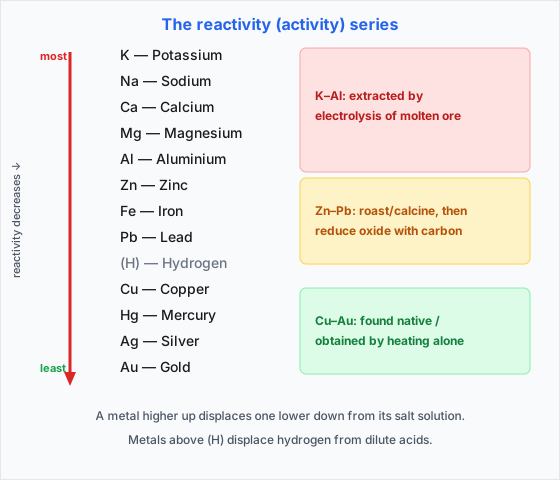
Where a metal sits predicts its behaviour: anything above hydrogen displaces H₂ from dilute acids; any metal displaces those below it from their salts.
Four metals A, B, C, D give these results: A displaces Cu but not Fe; B displaces Fe (and Cu); C displaces only Ag; D displaces nothing. Rank them and predict what B does in copper sulphate.
-
D reacts with nothing → least reactive (below even Cu/Ag).
-
C displaces only silver → it’s just above Ag but below Cu (only the least-reactive salt gives way).
-
A displaces copper but not iron → A sits below Fe but above Cu.
-
B displaces iron (and copper) → B is above Fe, the most reactive here.
-
Order (most → least): B > A > C > D. Since B is above copper, adding B to copper sulphate displaces copper — the blue fades and copper deposits.
How metals and non-metals actually bond: ionic compounds
Why do metals form positive ions? To reach a stable full outer shell by losing electrons; non-metals reach it by gaining them. When sodium meets chlorine, the electron is simply handed over:
Na → Na⁺ + e⁻ | Cl + e⁻ → Cl⁻ ⟹ Na⁺ and Cl⁻ attract → NaCl
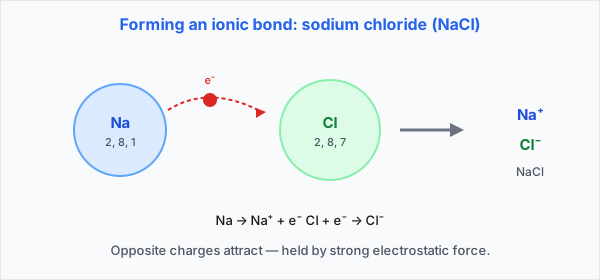
Compounds formed by this transfer of electrons from a metal to a non-metal are ionic (electrovalent) compounds. They share a recognisable set of properties:
| Property | What it looks like | Why |
|---|---|---|
| Physical state | Hard, brittle solids | Strong attraction between + and − ions |
| Melting/boiling points | High | Lots of energy needed to break ionic bonds |
| Solubility | Soluble in water; not in petrol/kerosene | Water pulls the ions apart |
| Conducting electricity | Conduct when molten or dissolved, not as solid | Ions can move only when free |
Why do ionic compounds conduct electricity when molten or dissolved, but not in the solid state?
Ionic compounds contain ions either way, but conduction needs the ions to move. In the solid, strong forces hold them in a fixed lattice. Melting or dissolving overcomes those forces, so the ions move freely and carry current.
Where metals come from, and how we extract them (metallurgy)
Metals occur in the earth’s crust as minerals; a mineral rich enough to extract a metal profitably is an ore. Ores come mixed with earthy impurities called gangue, which is removed first (enrichment). How we get the metal out then depends entirely on its reactivity:
- Low reactivity (Cu, Ag, Au, Hg): found native, or the oxide/sulphide is reduced by heating alone — e.g. cinnabar: 2HgS + 3O₂ → 2HgO + 2SO₂, then 2HgO → 2Hg + O₂.
- Middle (Zn, Fe, Pb, Cu): the sulphide/carbonate ore is first turned into
an oxide — roasting (sulphide, in excess air) or calcination
(carbonate, limited air) — then the oxide is reduced with carbon:
ZnO + C → Zn + CO Highly reactive metals can also reduce oxides — the thermit reaction (Fe₂O₃ + 2Al → 2Fe + Al₂O₃ + heat) is so exothermic the iron comes out molten, used to weld railway tracks.
- High reactivity (K, Na, Ca, Mg, Al): too reactive for carbon, so extracted by electrolysis of the molten ore (e.g. molten NaCl → Na at cathode, Cl₂ at anode).
The crude metal is then purified, usually by electrolytic refining (impure metal as anode, pure metal as cathode, a salt solution as electrolyte; pure metal deposits on the cathode, impurities fall as anode mud).
| Reactivity | Metals | How it's extracted |
|---|---|---|
| High | K, Na, Ca, Mg, Al | Electrolysis of molten ore |
| Medium | Zn, Fe, Pb, Cu | Roast/calcine to oxide, then reduce with carbon |
| Low | Cu, Hg, Ag, Au | Found native / reduced by heating alone |
Corrosion and alloys
When a metal is slowly eaten away by its surroundings, that’s corrosion: iron rusts (reddish-brown) in moist air, silver tarnishes black, copper grows a green coat. The classic experiment shows iron needs both air and water to rust:
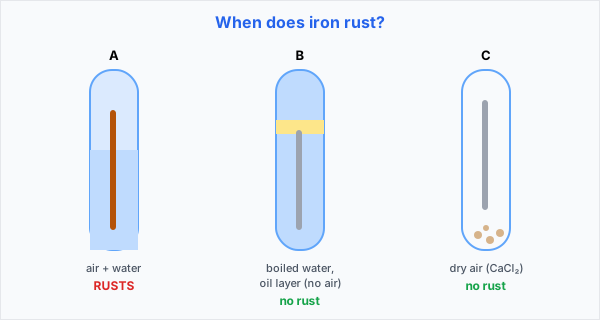
We fight rusting by painting, oiling/greasing, galvanising (a zinc coat — it protects iron even if scratched, because zinc is more reactive and corrodes first), chrome-plating, or alloying.
An alloy is a homogeneous mixture of a metal with other metals or a non-metal, made to improve properties:
- Steel = iron + a little carbon (hard, strong); stainless steel = iron + nickel + chromium (doesn’t rust).
- Brass = copper + zinc; bronze = copper + tin; solder = lead + tin (low melting point — for joining wires).
- An alloy containing mercury is an amalgam. Alloys conduct less and melt lower than the pure metal.
Common Mistakes
Metals gain electrons in reactions, like everything wants more electrons.
We hear atoms 'want a full shell', and gaining feels like the way to get there.
Metals LOSE their few outer electrons to form positive ions (Na → Na⁺). It's the NON-metals that gain electrons to form negative ions (Cl → Cl⁻). The metal is the electron donor.
All metals react with water and acids to give hydrogen.
The pattern 'metal + acid → salt + hydrogen' is taught as a rule, so it seems universal.
Only metals ABOVE hydrogen in the reactivity series do. Copper, silver and gold (below H) don't displace hydrogen from dilute acids, and many metals don't react with cold water at all.
Highly reactive metals like sodium and aluminium are extracted by reducing their oxides with carbon, like iron.
Carbon reduction is the famous method, so it feels like it should work for everyone.
Metals high in the series (K, Na, Ca, Mg, Al) hold oxygen too tightly for carbon to take it. They're extracted by ELECTROLYSIS of the molten ore. Carbon reduction works for the middle metals (Zn, Fe...).
Ionic compounds conduct electricity in the solid state.
They're made of charged ions, so it seems they should conduct anytime.
The ions must be free to MOVE. In a solid they're locked in a rigid lattice, so it doesn't conduct. Only when molten or dissolved in water can the ions move and carry current.
Nitric acid + metal gives hydrogen gas, like other acids.
Every other dilute acid + metal gives H₂, so the rule seems to extend.
Dilute HNO₃ is a strong oxidising agent — it usually oxidises any H₂ formed to water and itself becomes a nitrogen oxide. So metals with nitric acid generally do NOT release hydrogen (a couple of exceptions, like very dilute HNO₃ with Mg/Mn).
Quick Check
Which pair will give a displacement reaction?
A reaction happens only if the added metal is more reactive than the one in the salt. Copper is above silver, so copper displaces silver from AgNO₃. In the others the added metal is less reactive (Cu below Na; Al below Mg; Ag below Fe), so no reaction.
Food cans are coated with tin and not zinc because:
Zinc is more reactive than tin. A more reactive coating could react with the acidic food and contaminate it, so the less-reactive tin is used inside food cans.
What are amphoteric oxides?
Amphoteric oxides behave as both acidic and basic — they react with acids and with bases to form salt and water. Aluminium oxide (Al₂O₃) and zinc oxide (ZnO) are the classic examples.
Practice Problems
Try each before tapping “Show Solution.” These are written by Curriv and are completely free.
Easy
Name two metals that displace hydrogen from dilute acids, and two that do not.
Displace hydrogen (above H in the series): magnesium, zinc (also Al, Fe).
Do not (below H): copper, silver (also gold).
Why is sodium stored immersed in kerosene oil?
Sodium is extremely reactive — it reacts vigorously with the oxygen and moisture in air and can catch fire. Storing it under kerosene keeps air and water away, preventing the reaction (and accidental fires).
Medium
Write the balanced equation for iron reacting with dilute sulphuric acid, and name the gas produced and how to test it.
Metal + dilute acid → salt + hydrogen:
Fe + H₂SO₄ → FeSO₄ + H₂ ✓
The gas is hydrogen. Test: bring a burning splint near it — it burns with a ‘pop’ sound.
Galvanising coats iron with zinc. Why does it protect the iron even if the zinc layer gets scratched?
Because zinc is more reactive than iron. Even with a scratch exposing the iron, the zinc corrodes preferentially (it gives up electrons more readily), so it keeps protecting the iron — this is called sacrificial protection. The iron rusts only after the zinc is used up.
Challenge
A fake goldsmith dipped a lady's gold bangles in a solution; they sparkled but lost weight. What was the solution, and why?
The solution was aqua regia — a 3:1 mixture of concentrated hydrochloric acid and nitric acid. It’s one of the few reagents that can dissolve gold. Dipping the bangles dissolved a thin outer layer of gold (cleaning/sparkling them) but removed real metal, so they lost weight. The dissolved gold stayed behind in the goldsmith’s solution.
Why is copper used for hot-water tanks but not steel (an alloy of iron)?
Because iron (and steel) reacts with hot water/steam, forming iron oxide and hydrogen — over time it would corrode and weaken the tank. Copper does not react with cold or hot water (it’s below hydrogen in the reactivity series), so it stays intact. Copper is also a good heat conductor, ideal for a hot-water tank.
Summary
You should now be able to explain each of these in your own words:
- Metals are lustrous, malleable, ductile, sonorous, good conductors, solid (except mercury); non-metals are mostly the opposite (graphite conducts; iodine is lustrous) — but physical properties have many exceptions.
- Metals lose electrons → positive ions; non-metals gain electrons → negative ions. Their reactions are best ranked chemically.
- Metals react with oxygen (→ oxides, mostly basic; some amphoteric like Al₂O₃, ZnO), water and dilute acids (→ salt + H₂), and with salt solutions (displacement) — to differing degrees.
- The reactivity series (K > Na > … > Cu > Hg > Ag > Au) predicts displacement, who frees hydrogen from acids, and how each metal is extracted.
- Metal + non-metal → ionic (electrovalent) compounds (electron transfer); these are hard, high-melting, water-soluble, and conduct only when molten or dissolved.
- Metallurgy: ore → enrichment → extraction by reactivity (electrolysis for the most reactive; roast/calcine + carbon reduction for the middle; heating for the least) → refining (often electrolytic).
- Corrosion (rusting needs air + water) is fought by painting, oiling, galvanising and alloying; alloys (steel, stainless steel, brass, bronze, solder, amalgam) tune a metal’s properties.
What’s Next
You’ve now seen the two great families of elements and the ionic bonds metals and non-metals make together. But one non-metal breaks all the rules: carbon. It doesn’t hand over or grab electrons — it shares them, and that one trick lets it build millions of compounds, from the fuel in a stove to the proteins in your body. In Chapter 4: Carbon and its Compounds, you’ll meet covalent bonding and the astonishing chemistry that makes carbon the element of life.