Acids, Bases and Salts
Why This Matters
Eat one samosa too many and your stomach complains — that burning “acidity.” Reach for a spoon of baking soda in water and the discomfort eases. Bite a lemon and your face scrunches at the sourness. Touch a slip of soap and it feels oddly slippery and bitter. A drop of curry on your white shirt turns reddish-brown the moment soap touches it, then yellow again after a rinse.
Every one of these is the same small drama playing out: a tug-of-war between two opposite kinds of substances — acids and bases. Acids are behind the sour and the sting; bases behind the bitter and the slippery. And the reason baking soda calms acidity is that a base can cancel out an acid.
This chapter hands you the rulebook for that tug-of-war: how to tell acids and bases apart, how they react with metals and with each other, the single idea that makes an acid acidic, the pH number that measures it, and the everyday salts — table salt, baking soda, washing soda, Plaster of Paris — that are born from these reactions. It’s the chemistry of your kitchen, your stomach, and your toothpaste.
The Big Idea
Strip away the details and the whole chapter rests on one pair of ideas:
An acid releases hydrogen ions, H⁺(aq) (really H₃O⁺), when dissolved in water. A base releases hydroxide ions, OH⁻(aq). When they meet, the H⁺ and OH⁻ join to make water — so an acid and a base neutralise each other.
That’s it. Sourness, the litmus colour change, the fizz with metals, the relief from an antacid — all of it traces back to H⁺ and OH⁻ ions. Two consequences follow and power the rest of the chapter:
- Because acids = H⁺ and bases = OH⁻, mixing them always gives the same core reaction: H⁺ + OH⁻ → H₂O. The leftover ions pair up into a salt. So acid + base → salt + water (a neutralisation).
- Because it’s all about how much H⁺ (or OH⁻) is floating around, we can put a number on it — the pH scale from 0 to 14.
Keep “acid = H⁺, base = OH⁻” in your pocket and everything else is detail.
Let’s Break It Down
Telling acids and bases apart: indicators
You should never taste or touch lab chemicals to identify them — so we use indicators: substances that change colour (or smell) in acids vs bases.
- Litmus (a natural purple dye from lichen): acids turn blue litmus red; bases turn red litmus blue.
- Phenolphthalein: colourless in acid, pink in base.
- Methyl orange: red in acid, yellow in base.
- Olfactory indicators — substances whose smell changes, like onion or vanilla (their smell vanishes in a base). Useful for visually-impaired students.
- Natural indicators: turmeric (the curry-stain trick — turns reddish-brown with basic soap), red cabbage, coloured petals (Hydrangea, Petunia, Geranium).
| Indicator | In acid | In base |
|---|---|---|
| Blue litmus | Turns red | Stays blue |
| Red litmus | Stays red | Turns blue |
| Phenolphthalein | Colourless | Pink |
| Methyl orange | Red | Yellow |
| Turmeric | Stays yellow | Reddish-brown |
You have three test tubes — distilled water, an acid, and a base — and ONLY red litmus paper. How do you identify all three?
Dip red litmus in each. The one that turns it blue is the base. For the other two, the red litmus stays red — so take the blue litmus you just made (the base-turned strip) or simply use the now-blue paper: dip it into the remaining two; the one that turns it back to red is the acid, and the one that leaves it unchanged is distilled water (neutral).
How acids and bases react
Acids with metals → salt + hydrogen
Drop zinc into dilute sulphuric acid and bubbles stream off the metal. Catch the gas and bring a burning splint near it — it burns with a sharp “pop”, the classic test for hydrogen.
Acid + Metal → Salt + Hydrogen gas Zn(s) + H₂SO₄(aq) → ZnSO₄(aq) + H₂(g)
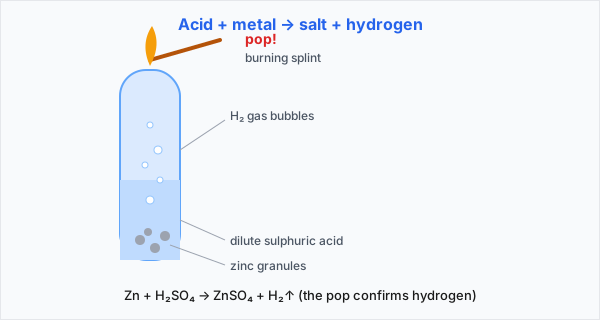
The metal displaces hydrogen from the acid (just like the displacement reactions from Chapter 1).
Bases with metals → salt + hydrogen (only some metals)
Some metals also release hydrogen from a base. Hot sodium hydroxide with zinc:
2NaOH(aq) + Zn(s) → Na₂ZnO₂(s) + H₂(g) (sodium zincate)
Here the salt’s negative part (zincate) is made of the metal and oxygen. This doesn’t happen with all metals — it’s special to metals like zinc and aluminium.
Acids with metal carbonates / hydrogencarbonates → salt + CO₂ + water
Add dilute HCl to sodium carbonate (or baking soda) and it fizzes — that gas is carbon dioxide. Bubble it through lime water and the lime water turns milky (a white precipitate of calcium carbonate). That milkiness is the test for CO₂.
Na₂CO₃(s) + 2HCl(aq) → 2NaCl(aq) + H₂O(l) + CO₂(g) NaHCO₃(s) + HCl(aq) → NaCl(aq) + H₂O(l) + CO₂(g) Ca(OH)₂(aq) + CO₂(g) → CaCO₃(s)↓ + H₂O(l) (lime water turns milky)
Metal carbonate / hydrogencarbonate + Acid → Salt + Carbon dioxide + Water
Acids with bases → salt + water (neutralisation)
Take NaOH with a drop of phenolphthalein (pink). Add HCl drop by drop — the pink disappears when the base is neutralised. Add NaOH again and pink returns. The acid and base cancel each other:
NaOH(aq) + HCl(aq) → NaCl(aq) + H₂O(l) Base + Acid → Salt + Water (a neutralisation reaction)
Metal oxides + acid, and non-metal oxides + base
Copper oxide (black) in dilute HCl dissolves to a blue-green solution of copper chloride:
CuO(s) + 2HCl(aq) → CuCl₂(aq) + H₂O(l)
Because a metal oxide reacts with an acid just like a base does (giving salt + water), metal oxides are basic. The mirror image: a non-metal oxide like CO₂ reacts with a base (lime water) to give salt + water — so non-metal oxides are acidic.
A metal compound A reacts with dilute HCl to give fizzing; the gas puts out a burning candle, and one product is calcium chloride (CaCl₂). Identify A and write the balanced equation.
-
A gas that puts out a flame and fizzes from an acid is carbon dioxide — so A is a carbonate (or hydrogencarbonate).
-
One product is CaCl₂, so the metal is calcium. A carbonate of calcium is calcium carbonate, CaCO₃. So A = CaCO₃.
-
Write it: CaCO₃ + HCl → CaCl₂ + H₂O + CO₂.
-
Balance chlorine (2 in CaCl₂): put 2 in front of HCl → CaCO₃(s) + 2HCl(aq) → CaCl₂(aq) + H₂O(l) + CO₂(g). ✓
What makes an acid an acid? (It’s the H⁺ ion)
All acids behave alike — they all fizz hydrogen with metals — which hints at something common. That something is the hydrogen ion, H⁺.
Pass electricity through dilute HCl and a bulb in the circuit glows — the solution conducts. But glucose and alcohol solutions (which also contain hydrogen) do not conduct and are not acidic. So it isn’t just having hydrogen — acids release hydrogen as H⁺ ions that carry current.
Crucially, H⁺ ions appear only in water. Dry HCl gas does not turn dry litmus red; only HCl solution does. Water pulls the H⁺ off:
HCl + H₂O → H₃O⁺ + Cl⁻
Hydrogen ions can’t float alone — they latch onto water as the hydronium ion (H₃O⁺). So we write H⁺(aq) or H₃O⁺. Bases that dissolve in water release OH⁻:
NaOH(s) →[water] Na⁺(aq) + OH⁻(aq)
A water-soluble base is called an alkali (e.g. NaOH, KOH). All bases aren’t alkalis — many don’t dissolve.
Why does dry HCl gas not turn dry blue litmus red, but HCl solution does?
Because acidity comes from H⁺ ions, and HCl only releases H⁺ in the presence of water (HCl + H₂O → H₃O⁺ + Cl⁻). Dry gas with dry paper has no water, so no H⁺ ions form, so no colour change.
⚠️ Always add acid to water, never water to acid. Dissolving a concentrated acid (or base) in water is strongly exothermic — lots of heat. Adding acid slowly to water lets the heat spread safely. Adding water to acid can make the mixture spit and the heat can crack the glass.
Measuring strength: the pH scale
We can put a number on “how acidic.” A universal indicator (a mix of dyes) shows a different colour at each hydrogen-ion concentration, mapped onto the pH scale, 0 to 14:
- pH 7 = neutral (pure water).
- pH below 7 = acidic (lower pH ⇒ more H⁺ ⇒ stronger acid).
- pH above 7 = basic/alkaline (higher pH ⇒ more OH⁻).
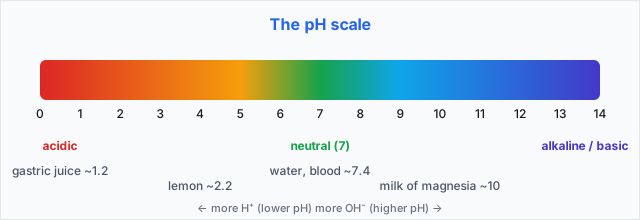
A key subtlety — strong vs weak: at the same concentration, a strong acid (HCl) releases far more H⁺ than a weak acid (acetic acid, CH₃COOH). More H⁺ → lower pH → “stronger.” Same idea for bases with OH⁻.
| Property | Acids | Bases |
|---|---|---|
| Taste (never test by tasting!) | Sour | Bitter |
| Litmus | Blue → red | Red → blue |
| Ion in water | H⁺ (H₃O⁺) | OH⁻ |
| pH | Less than 7 | More than 7 |
| With metals | Give H₂ gas | Some give H₂ gas |
Why pH matters in everyday life
- Your body works in a narrow pH band (~7.0–7.8). Acid rain (rain with pH below 5.6) lowers river pH and harms aquatic life.
- Digestion: your stomach makes HCl to digest food. Too much → acidity; an antacid (a mild base like milk of magnesia, Mg(OH)₂) neutralises the excess.
- Tooth decay: mouth bacteria turn leftover sugar into acid; below pH 5.5 the enamel starts to corrode. Brushing with (basic) toothpaste neutralises it.
- Stings: a bee sting injects an acid (relieved by baking soda); nettle hair injects methanoic acid.
- Soil: plants want a particular pH range; farmers add bases like quick lime (CaO), slaked lime (Ca(OH)₂) or chalk (CaCO₃) to fix acidic soil.
Solution A has pH 6 and solution B has pH 8. Which is correct?
pH 6 is below 7 → acidic (weakly, since it’s close to 7); pH 8 is above 7 → weakly basic. Lower pH means more H⁺, so A has the higher hydrogen-ion concentration.
More about salts
A salt is what’s left when an acid’s H⁺ is replaced by a metal (or ammonium) ion — the product of neutralisation. Salts come in families sharing an ion: NaCl, Na₂SO₄, NaNO₃ are the sodium family; NaCl, KCl, CaCl₂ the chloride family.
The pH of a salt depends on the acid and base it came from:
| Made from | Nature of salt | pH | Example |
|---|---|---|---|
| Strong acid + strong base | Neutral | 7 | NaCl |
| Strong acid + weak base | Acidic | Less than 7 | NH₄Cl |
| Weak acid + strong base | Basic | More than 7 | Na₂CO₃ |
Common salt — the parent of many chemicals
Sodium chloride (NaCl), from seawater and rock-salt deposits, is the raw material for a whole family of useful chemicals.
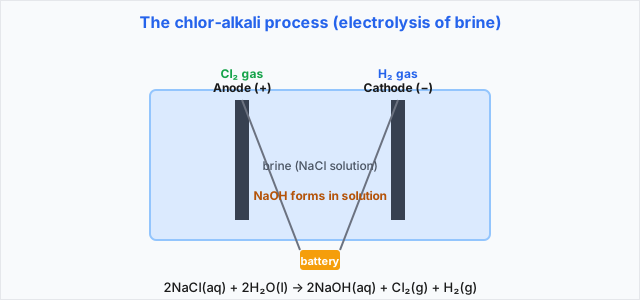
Chlor-alkali process — passing electricity through brine (NaCl solution):
2NaCl(aq) + 2H₂O(l) → 2NaOH(aq) + Cl₂(g) + H₂(g)
All three products are useful: Cl₂ (water treatment, PVC, bleaching powder), H₂ (fuel, ammonia), NaOH (soaps, paper).
Bleaching powder, Ca(ClO)₂ — chlorine on dry slaked lime; used to bleach cloth/paper, as an oxidiser, and to disinfect drinking water:
Ca(OH)₂ + Cl₂ → CaOCl₂ + H₂O
Baking soda, NaHCO₃ (sodium hydrogencarbonate) — a mild, non-corrosive basic salt. On heating it gives the CO₂ that makes cakes rise:
2NaHCO₃ →[heat] Na₂CO₃ + H₂O + CO₂
It’s used in baking powder (with a mild edible acid), in antacids, and in soda-acid fire extinguishers.
Washing soda, Na₂CO₃·10H₂O — from sodium carbonate (made by heating baking soda) re-crystallised with water. Used in glass/soap/paper industries and to remove permanent hardness of water.
Are “dry” salt crystals really dry? — Water of crystallisation
Heat blue copper sulphate crystals and they turn white, with water droplets appearing on the tube — then add water and the blue returns. Those crystals held water of crystallisation: a fixed number of water molecules in each formula unit. Copper sulphate is CuSO₄·5H₂O (5 waters); that’s why washing soda is written Na₂CO₃·10H₂O.
Plaster of Paris (PoP), CaSO₄·½H₂O — made by gently heating gypsum (CaSO₄·2H₂O) at 373 K. Mixed with water it sets back into hard gypsum — which is why doctors use it to set fractured bones, and why it must be stored dry:
CaSO₄·½H₂O + 1½H₂O → CaSO₄·2H₂O (PoP + water → gypsum, sets hard)
(The “½” looks odd — it just means two formula units of CaSO₄ share one water molecule.)
Why must Plaster of Paris be kept in a moisture-proof container?
PoP (CaSO₄·½H₂O) reacts with water to form solid gypsum (CaSO₄·2H₂O). Even moisture from the air would slowly set it into a hard, useless lump — so it’s stored sealed and dry.
Common Mistakes
A higher pH number means more acidic / a stronger acid.
Bigger number 'feels' like more of something, so people read pH 10 as 'more acidic' than pH 4.
It's the opposite. pH below 7 is acidic and LOWER pH = more H⁺ = stronger acid. pH above 7 is basic. pH 4 is acidic; pH 10 is basic.
Any compound that contains hydrogen is an acid.
Acids have hydrogen, and so do glucose (C₆H₁₂O₆) and alcohol — so it seems they should be acids too.
An acid must release that hydrogen as H⁺ ions in water. Glucose and alcohol have hydrogen but don't release H⁺ — their solutions don't conduct electricity and aren't acidic.
When diluting, you can add water to a concentrated acid.
Diluting just means 'mix with water', so the order shouldn't matter.
Always add ACID TO WATER, slowly, with stirring. The process is strongly exothermic; adding water to acid can make it spit dangerously and crack the container.
Strong acid and weak acid mean concentrated and dilute.
'Strong' sounds like 'a lot of it'.
Strong/weak is about how fully the acid releases H⁺, not how much acid there is. At the same concentration, HCl (strong) gives far more H⁺ than acetic acid (weak). Concentrated/dilute is a separate idea (amount of acid in the water).
All bases are alkalis.
The words get used interchangeably.
An alkali is a base that DISSOLVES in water (like NaOH, KOH). Many bases don't dissolve, so they're bases but not alkalis.
Quick Check
An acid reacts with a metal. Which gas is released, and how do you test it?
Acid + metal → salt + hydrogen. Bring a burning splint to the gas and it burns with a characteristic pop. (Carbon dioxide is what you get from a carbonate, and it turns lime water milky.)
A solution turns red litmus blue. Its pH is most likely:
Turning red litmus blue means the solution is basic, so its pH must be above 7. Of the choices, only 10 is basic.
Equal lengths of magnesium ribbon are added to HCl (tube A) and acetic acid (tube B), same concentration. Where does it fizz more vigorously?
HCl is a strong acid and releases more H⁺ than the weak acetic acid at the same concentration. More H⁺ → faster reaction → more vigorous fizzing in tube A.
Practice Problems
Try each before tapping “Show Solution.” These are written by Curriv and are completely free.
Easy
Write the balanced equation for dilute hydrochloric acid reacting with magnesium ribbon.
Acid + metal → salt + hydrogen:
Mg + 2HCl → MgCl₂ + H₂ ✓ (Mg: 1=1, H: 2=2, Cl: 2=2)
The bubbles are hydrogen gas.
Which medicine treats indigestion: antibiotic, analgesic, antacid or antiseptic? Why?
An antacid. Indigestion is caused by excess acid (HCl) in the stomach. An antacid is a mild base (e.g. milk of magnesia) that neutralises the excess acid, relieving the pain.
Medium
Five solutions A, B, C, D, E have pH 4, 1, 11, 7, 9. Which is neutral, strongly acidic, strongly alkaline, weakly acidic, weakly alkaline? Arrange in increasing order of H⁺ concentration.
- Neutral: D (pH 7)
- Strongly acidic: B (pH 1)
- Strongly alkaline: C (pH 11)
- Weakly acidic: A (pH 4)
- Weakly alkaline: E (pH 9)
H⁺ concentration is highest at low pH. Increasing H⁺ means decreasing pH, so order of increasing H⁺ concentration = order of decreasing pH:
C (11) < E (9) < D (7) < A (4) < B (1)
Fresh milk has pH 6. (a) How does its pH change as it turns to curd? (b) A milkman adds a little baking soda to fresh milk — why, and why does the milk then take longer to set as curd?
(a) Curdling produces lactic acid, which adds H⁺ ions, so the pH drops below 6 (becomes more acidic).
(b) Baking soda is a mild base; it shifts the milk from pH 6 to slightly alkaline (above 7). Since curdling needs the milk to become acidic, starting from an alkaline pH means it takes longer for enough acid to build up — so it sets slowly. (It also keeps the milk fresh longer.)
Challenge
Why does distilled water not conduct electricity, while rain water does?
Conduction needs ions. Distilled water is pure — it has almost no ions, so it doesn’t conduct.
Rain water dissolves gases from the air, especially CO₂ (and pollutants like SO₂, NO₂), forming small amounts of acids (e.g. carbonic acid). These acids release H⁺ and other ions into the water, so rain water conducts electricity.
What is a neutralisation reaction? Give two examples, and explain why heating baking soda makes it useful in cooking.
A neutralisation reaction is one between an acid and a base that gives a salt and water (the H⁺ and OH⁻ combine to form water):
- NaOH + HCl → NaCl + H₂O
- Ca(OH)₂ + 2HCl → CaCl₂ + 2H₂O
Baking soda in cooking: on heating, baking soda decomposes and releases carbon dioxide gas:
2NaHCO₃ →[heat] Na₂CO₃ + H₂O + CO₂
The trapped CO₂ bubbles make the batter (bread, cake, pakoras) rise and turn soft and spongy.
Summary
You should now be able to explain each of these in your own words:
- Indicators (litmus, phenolphthalein, methyl orange, turmeric, olfactory) tell acids from bases by a colour or smell change.
- Acidity comes from H⁺(aq) ions; basicity from OH⁻(aq) ions — and these only appear in water (dry HCl gas isn’t acidic).
- Reaction patterns: acid + metal → salt + H₂; **carbonate/hydrogencarbonate
- acid → salt + CO₂ + water**; metal oxide + acid and non-metal oxide + base → salt + water; acid + base → salt + water (neutralisation).
- Metal oxides are basic, non-metal oxides are acidic. Acidic/basic solutions conduct electricity (they carry ions).
- The pH scale (0–14) measures H⁺: 7 neutral, below 7 acidic, above 7 basic; lower pH = more H⁺ = stronger acid. Strong/weak ≠ concentrated/dilute.
- pH rules everyday life: digestion & antacids, tooth decay (below 5.5), acid rain, soil treatment, stings.
- Salts come from neutralisation; their pH depends on the parent acid/base. Common salt yields NaOH, Cl₂, H₂ (chlor-alkali), bleaching powder, baking soda and washing soda.
- Water of crystallisation (e.g. CuSO₄·5H₂O); Plaster of Paris (CaSO₄·½H₂O) sets to gypsum and must be kept dry.
- Mixing concentrated acids/bases with water is strongly exothermic — add acid to water, never the reverse.
What’s Next
You’ve now seen that metals tend to make basic oxides while non-metals make acidic ones — a hint that metals and non-metals are fundamentally different characters. In Chapter 3: Metals and Non-metals, you’ll meet those two families head-on: why metals shine, conduct and bend while non-metals don’t, how reactive metals are ranked, how we win metals from their ores, and why iron rusts but gold doesn’t.