Carbon and its Compounds
Why This Matters
Look down at yourself: the food you ate, the clothes you wear, this page, the medicine in the cabinet, the petrol in a scooter, the plastic of your pen — and you, every cell of you. One element runs through all of it: carbon.
Here’s the astonishing part. Carbon is rare — barely 0.02% of the earth’s crust and 0.03% of the air. Yet chemists know millions of carbon compounds — more than all the compounds of every other element combined. How can one scarce element build so much, from diamond to DNA?
The answer is in how carbon bonds. In Chapter 3 metals gave away electrons and non-metals grabbed them. Carbon does neither — it shares. And that one habit, plus carbon’s knack for linking to itself endlessly, is why carbon is the element of life and of almost everything useful around you. This chapter is the grammar of that chemistry.
The Big Idea
Carbon shares electrons instead of giving or taking them — forming covalent bonds. Because carbon has 4 outer electrons (tetravalent) and can bond to other carbon atoms in endless chains (catenation), it builds a near-infinite variety of stable molecules.
Carbon has 4 electrons in its outer shell. To reach a stable octet it would have to gain 4 (too hard for a small nucleus to hold) or lose 4 (needs huge energy). So it takes the third path: share all four, forming four covalent bonds. Sharing means no ions form — which is why carbon compounds have low melting/boiling points and don’t conduct electricity (unlike the ionic compounds of Chapter 3).
Two properties make carbon special:
- Catenation — carbon-carbon bonds are strong, so carbon links to itself in long chains, branches and rings.
- Tetravalency — four bonds means carbon can also attach to H, O, N, S, Cl… building endless families with specific properties.
Grasp “carbon shares four bonds and links to itself” and the whole chapter opens up.
Let’s Break It Down
Covalent bonds: sharing to fill the shell
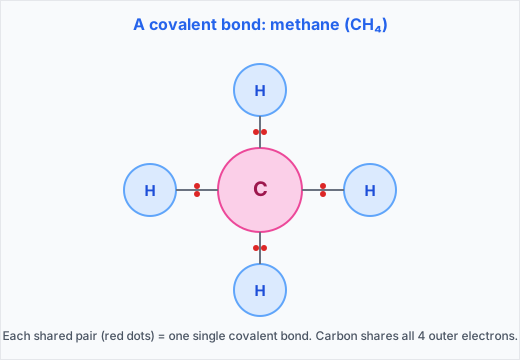
Atoms become stable with a full outer shell. Two hydrogen atoms each need one electron, so they share a pair → a single bond (H–H). Oxygen atoms share two pairs → a double bond (O=O); nitrogen shares three pairs → a triple bond (N≡N). Carbon shares its four electrons with four hydrogens to make methane, CH₄.
Carbon even comes in different pure forms — allotropes — depending on how its atoms bond: diamond (each C bonded to 4 others, a rigid 3-D lattice — hardest natural substance), graphite (each C bonded to 3 in flat sheets — soft, slippery, and a conductor), and fullerenes (C-60, a football shape).
Why carbon makes millions of compounds
Saturated compounds have only single C–C bonds (e.g. ethane, C₂H₆) — fairly unreactive. Unsaturated compounds have double or triple C–C bonds (ethene C₂H₄; ethyne C₂H₂) — more reactive. Carbon chains can be straight, branched, or in rings (cyclohexane, benzene).
Compounds with the same molecular formula but different structures are structural isomers — e.g. butane (C₄H₁₀) can be a straight chain or a branched one.
Compounds of only carbon + hydrogen are hydrocarbons:
| Family | Bonds | General formula | Example |
|---|---|---|---|
| Alkanes | All single (saturated) | CₙH₂ₙ₊₂ | Methane CH₄ |
| Alkenes | ≥1 double bond | CₙH₂ₙ | Ethene C₂H₄ |
| Alkynes | ≥1 triple bond | CₙH₂ₙ₋₂ | Ethyne C₂H₂ |
Functional groups and homologous series
Replace a hydrogen in a hydrocarbon with a heteroatom (or group), and you get a functional group that gives the molecule its character — no matter how long the carbon chain:
| Class | Functional group | Name suffix/prefix |
|---|---|---|
| Halo (chloro/bromo) | –Cl, –Br | prefix chloro-/bromo- |
| Alcohol | –OH | suffix -ol |
| Aldehyde | –CHO | suffix -al |
| Ketone | –CO– | suffix -one |
| Carboxylic acid | –COOH | suffix -oic acid |
A homologous series is a family where each member differs from the next by a –CH₂– unit (and ~14 u in mass). For example the alcohols CH₃OH, C₂H₅OH, C₃H₇OH… all behave chemically alike (same –OH group); only physical properties (melting/boiling point) change gradually.
Naming (nomenclature): count the carbons (1→meth, 2→eth, 3→prop, 4→but, 5→pent, 6→hex), then add the suffix/prefix for the functional group. A double bond → -ene, triple → -yne. If a suffix starts with a vowel, drop the final ‘e’ (propane → propan + one → propanone).
What are the two properties of carbon that lead to the huge number of carbon compounds?
Catenation (carbon’s ability to bond to other carbon atoms forming long chains, branches and rings) and tetravalency (its four valence electrons let it bond with four other atoms — carbon, H, O, N, S, Cl…). Together they build a near-endless variety of stable compounds.
Ethane (C₂H₆) has how many covalent bonds?
Ethane is H₃C–CH₃. Count the bonds: 6 C–H bonds (3 on each carbon) + 1 C–C bond = 7 covalent bonds.
Chemical reactions of carbon compounds
- Combustion: carbon compounds burn in oxygen to give CO₂ + water + heat & light (CH₄ + 2O₂ → CO₂ + 2H₂O). Saturated hydrocarbons give a clean blue flame; unsaturated ones (or a limited air supply) give a sooty yellow flame — that’s why a blocked-air stove blackens the vessel.
- Oxidation: alcohols can be oxidised to carboxylic acids by oxidising agents like alkaline KMnO₄ or acidified K₂Cr₂O₇ (ethanol → ethanoic acid).
- Addition: unsaturated hydrocarbons add hydrogen over a Ni/Pd catalyst to become saturated — this is hydrogenation, used to turn liquid vegetable oils into solid fats (vanaspati). (Unsaturated oils are healthier than saturated animal fats.)
- Substitution: saturated hydrocarbons are unreactive, but in sunlight chlorine replaces hydrogens one by one: CH₄ + Cl₂ →[sunlight] CH₃Cl + HCl.
Two important compounds: ethanol and ethanoic acid
Ethanol (C₂H₅OH) — “alcohol”: a liquid, good solvent (cough syrups, tinctures), the active part of alcoholic drinks. It reacts with sodium (giving H₂), and dehydrates with hot conc. H₂SO₄ to ethene. (Methanol is deadly even in small amounts — it causes blindness.)
Ethanoic acid (CH₃COOH) — “acetic acid”: a weak carboxylic acid; its 5–8% solution is vinegar; pure acid freezes in winter (“glacial” acetic acid). It:
- reacts with a base → salt + water (neutralisation),
- reacts with carbonates/hydrogencarbonates → salt + CO₂ + water,
- reacts with ethanol (+ acid catalyst) → a sweet-smelling ester (esterification; used in perfumes/flavours).
Soaps and detergents — the chemistry of cleaning
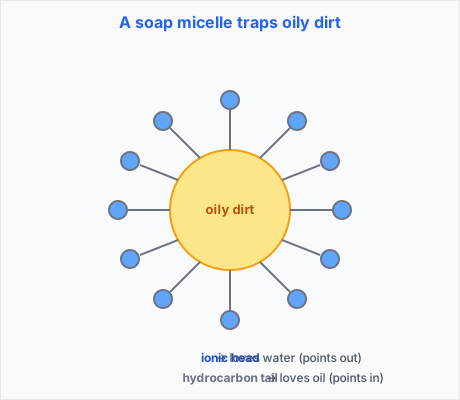
A soap molecule is the sodium/potassium salt of a long-chain carboxylic acid. It has two ends: a hydrophilic (water-loving) ionic head and a hydrophobic (water-hating) hydrocarbon tail. Dirt is usually oily, and oil won’t dissolve in water — so soap’s tails bury into the oil while the heads face the water, forming a ball called a micelle that lifts the dirt away.
In hard water (rich in Ca²⁺/Mg²⁺), soap forms an insoluble scum instead of lather. Detergents (salts of sulphonic acids) don’t form scum, so they work even in hard water — which is why they’re used in shampoos and washing powders.
While cooking, the bottom of the vessel turns black. This means:
A black deposit is soot (carbon) from incomplete combustion — the air holes are blocked, so the fuel burns with a sooty flame and is wasted.
Common Mistakes
Carbon forms ions (C⁴⁺ or C⁴⁻) like metals and non-metals do.
Chapter 3 said atoms gain or lose electrons, so carbon should too.
Carbon SHARES its four electrons (covalent bonds) — gaining or losing four would need too much energy. No ions form, which is why carbon compounds don't conduct electricity.
Any two compounds with the same formula are the same compound.
Same formula feels like same substance.
They can be structural ISOMERS — same molecular formula, different arrangement (e.g. straight vs branched butane, both C₄H₁₀), with different properties.
A homologous series is held together by similar physical properties.
Members do look similar.
What's constant is the FUNCTIONAL GROUP (so chemical properties match) and each member differs by –CH₂–. Physical properties (melting/boiling point) actually change gradually down the series.
Saturated and unsaturated mean 'full of hydrogen' vs 'not full' — and both react the same.
The words sound like fullness.
Saturated = only single C–C bonds (unreactive, clean flame); unsaturated = has double/triple bonds (more reactive, sooty flame, undergoes addition reactions like hydrogenation).
Quick Check
Which of these undergoes addition reactions?
Only unsaturated hydrocarbons (with double/triple bonds) undergo addition. Ethyne (C₂H₂) has a triple bond. The others are saturated alkanes.
Butanone is a four-carbon compound with which functional group?
The suffix -one signals a ketone (the –CO– group). “Butan-one” = a 4-carbon chain with a ketone group.
Practice Problems
These are written by Curriv and are completely free. Try before revealing.
Easy
Name these: (i) CH₃–CH₂–Br (ii) a 3-carbon chain ending in –COOH.
(i) Bromoethane (2-carbon chain “eth-” + bromo group).
(ii) Propanoic acid (3 carbons “propan-” + carboxylic acid “-oic acid”).
Give a test to tell a saturated hydrocarbon from an unsaturated one.
Burn them: a saturated hydrocarbon gives a clean blue flame, while an unsaturated one gives a yellow, sooty flame. (Chemically, an unsaturated compound also decolourises bromine water by addition; a saturated one doesn’t.)
Medium
Why is the conversion of ethanol to ethanoic acid called an oxidation reaction?
Because oxygen is added to the ethanol (an oxidising agent like alkaline KMnO₄ supplies it), converting the –CH₂OH group to –COOH:
CH₃CH₂OH →[alkaline KMnO₄ + heat] CH₃COOH
Adding oxygen (or removing hydrogen) is oxidation, so the reagent is an oxidising agent.
How can you distinguish ethanol from ethanoic acid by a simple chemical test?
Add a pinch of sodium hydrogencarbonate (baking soda) to each:
- Ethanoic acid is an acid → it fizzes, releasing CO₂ (which turns lime water milky).
- Ethanol is neutral → no fizzing.
(Litmus also works: ethanoic acid turns blue litmus red; ethanol doesn’t.)
Challenge
Why does soap form a scum in hard water, and how do detergents solve this?
Hard water contains calcium and magnesium ions (Ca²⁺, Mg²⁺). Soap (a sodium/potassium salt of a carboxylic acid) reacts with these to form an insoluble precipitate — scum — so it lathers poorly and wastes soap.
Detergents are sodium salts of sulphonic acids; their charged ends do not form insoluble salts with Ca²⁺/Mg²⁺, so they stay soluble and clean effectively even in hard water.
A mixture of oxygen and ethyne is used for welding, but not a mixture of ethyne and air. Why?
Burning ethyne in pure oxygen gives complete combustion and a very hot, clean flame (hot enough to weld metals). Burning it in air (only ~21% oxygen) gives incomplete combustion — a sooty flame that isn’t hot enough and produces soot. So the oxy-acetylene (oxygen + ethyne) flame is used, not ethyne + air.
Summary
- Carbon forms covalent bonds (shared electron pairs) — single, double or triple — so its compounds have low melting/boiling points and don’t conduct.
- Carbon’s huge variety comes from catenation (C–C chains/branches/rings) and tetravalency (4 bonds). Allotropes: diamond, graphite, fullerenes.
- Saturated (alkanes, single bonds) vs unsaturated (alkenes/alkynes, double/triple bonds, more reactive); structural isomers share a formula but differ in structure.
- Functional groups (–OH, –CHO, –CO–, –COOH, –Cl/–Br) set a compound’s chemistry; a homologous series keeps the group constant and changes by –CH₂–.
- Reactions: combustion (clean blue vs sooty flame), oxidation (alcohol → acid), addition/hydrogenation (unsaturated → saturated), substitution (with Cl₂ in sunlight).
- Ethanol (solvent, reacts with Na, dehydrates to ethene) and ethanoic acid (vinegar; neutralisation, with carbonates → CO₂, esterification).
- Soaps/detergents clean via micelles (hydrophobic tail in oil, hydrophilic head in water); soap forms scum in hard water, detergents don’t.
What’s Next
You’ve now toured the chemistry of life’s element. From here, Curriv turns from chemistry to biology: how living things actually run. In Chapter 5: Life Processes, you’ll see how the carbon compounds you just met — food, glucose, fats — are taken in, broken down and used: nutrition, respiration, transport and excretion, the four jobs every living body must do to stay alive.