Life Processes
Why This Matters
How do you know a dog is alive while a stone is not? You’d say it moves, it breathes. But a plant standing perfectly still is also alive, and a sleeping person who’s barely moving is alive too. So “visible movement” isn’t the real test of life.
The real test is hidden. Every living body is a beautifully ordered structure — organs made of tissues, tissues of cells, cells of molecules. The environment is constantly trying to break that order down (think of how everything tends to decay). To stay alive, a body must keep repairing and rebuilding itself, all day, every day — even while you sleep. That repair work needs energy and raw material from outside, and it needs the wastes cleared out.
The jobs that keep this maintenance going are the life processes. This chapter is about the four big ones — nutrition, respiration, transportation and excretion — and how your body, a plant, and even a single-celled Amoeba each pull them off.
The Big Idea
A living body is an ordered structure that constantly tends to break down. To stay alive it must keep maintaining itself — which needs food (nutrition), energy release (respiration), a way to move things around the body (transportation), and a way to remove wastes (excretion).
In a tiny single-celled organism, the whole surface touches the environment, so food, gases and wastes can just diffuse in and out. But in a big multi-cellular body like yours, most cells are deep inside — diffusion is far too slow to reach them. That single problem is why complex organisms evolved specialised systems: a digestive system, lungs, a heart-and-blood transport system, and kidneys.
Keep that one thread in mind — order must be maintained, and diffusion alone can’t do it in a big body — and every system in this chapter makes sense.
Let’s Break It Down
Nutrition: getting food
All organisms need energy and raw material; they just get it differently.
- Autotrophs (“self-feeders”) make their own food from simple inorganic things — CO₂ and water — using sunlight. Green plants and some bacteria.
- Heterotrophs (“other-feeders”) take in ready-made complex food and break it down. Animals and fungi. They depend, directly or indirectly, on autotrophs.
Photosynthesis is how autotrophs make food:
6CO₂ + 12H₂O →[chlorophyll, sunlight] C₆H₁₂O₆ + 6O₂ + 6H₂O
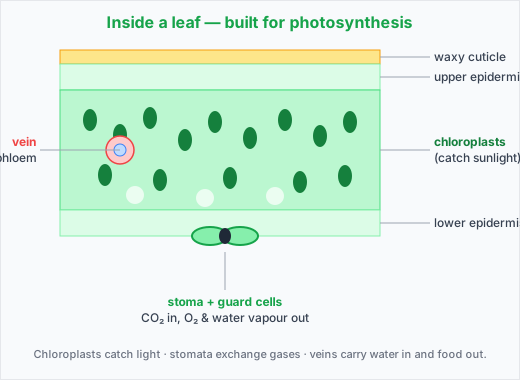
Three things happen: chlorophyll absorbs light, that energy splits water (releasing O₂), and CO₂ is reduced to carbohydrate (glucose), stored as starch. CO₂ enters through tiny leaf pores called stomata, opened and closed by guard cells; water comes up from the roots.
Nutrition in human beings
Food travels down one long tube — the alimentary canal — and gets broken down step by step:
| Place | What happens | Key juice / enzyme |
|---|---|---|
| Mouth | Teeth crush food; saliva wets it and starts digesting starch | Salivary amylase (starch → sugar) |
| Stomach | Muscular walls churn; acid kills germs & activates enzyme | HCl + pepsin (proteins) + mucus |
| Small intestine | Complete digestion of carbs, proteins & fats; absorption | Bile (emulsifies fat), pancreatic juice (trypsin, lipase), intestinal juice |
| Large intestine | Absorbs water from the leftover | — |
The small intestine is the main site of digestion and absorption. Bile from the liver makes the food alkaline and breaks fat globules into tiny droplets (emulsification — just like soap on grease in Chapter 4). Its inner wall is covered in finger-like villi that hugely increase surface area, so digested food passes quickly into the blood.
Respiration: releasing the energy
Food has energy locked inside; respiration releases it as ATP, the cell’s energy “currency.” The first step always breaks glucose (6-carbon) into pyruvate (3-carbon) in the cytoplasm. What happens next depends on oxygen:
| Pathway | Where / when | Products | Energy |
|---|---|---|---|
| Aerobic (with O₂) | Mitochondria | CO₂ + water | A lot |
| Anaerobic — fermentation | Yeast cells | Ethanol + CO₂ | Less |
| Anaerobic — in our muscles | Muscle cells, low O₂ | Lactic acid | Less |
That lactic acid build-up during hard exercise is what gives you muscle cramps.
Breathing brings the oxygen in. In humans, air goes through the nostrils → throat (kept open by rings of cartilage) → lungs, ending in millions of tiny balloon-like alveoli. Their huge surface (about 80 m² if spread out!) and rich blood supply let O₂ pass into the blood and CO₂ pass out. Oxygen is carried by haemoglobin in red blood cells; CO₂ (more soluble) is carried mostly dissolved in plasma. Fish, with far less oxygen available in water, breathe faster through gills.
Why is diffusion alone not enough to supply oxygen to all the cells of a large animal like a human?
In a big body, most cells are buried deep inside, far from the surface where air is. Diffusion is far too slow over such distances — it’s estimated a molecule would take ~3 years to diffuse from lungs to toes! So large animals need a transport system (blood + haemoglobin) to carry oxygen quickly to every cell.
In which order does glucose get broken down to release energy with oxygen?
Glucose is first split into pyruvate in the cytoplasm (same for everyone). With oxygen, pyruvate is then broken down in the mitochondria into CO₂ and water, releasing a lot of energy (aerobic respiration).
Transportation in human beings
Blood is a fluid tissue: plasma (carries food, CO₂, wastes in dissolved form) plus cells (red cells carry O₂; platelets plug leaks by clotting).
The heart is a muscular pump with four chambers so oxygen-rich and oxygen-poor blood never mix:
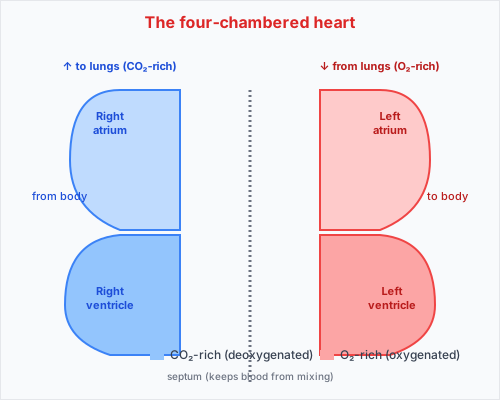
Follow the blood: O₂-rich blood from the lungs → left atrium → left ventricle → pumped to the whole body. CO₂-rich blood from the body → right atrium → right ventricle → pumped to the lungs. Because blood passes through the heart twice in one full round, this is double circulation. It keeps oxygenated and deoxygenated blood separate — essential for warm-blooded animals (birds, mammals) with high energy needs.
- Arteries carry blood away from the heart — thick, elastic walls (high pressure).
- Veins carry blood back to the heart — valves stop backflow.
- Capillaries are one-cell thick, where exchange with cells happens.
Transportation in plants
Plants move materials slowly (they don’t move and have many dead cells, so low energy needs) but sometimes over great heights. Two separate pipelines do it:
- Xylem carries water and minerals up from roots. Root cells actively take in ions, water follows by osmosis (root pressure), but the main pull comes from transpiration — water evaporating from leaves creates a suction that drags the water column up.
- Phloem carries food (sugars) made in leaves to the rest of the plant (this is translocation). It uses energy (ATP) and can move food up or down, as the plant needs.
Excretion: removing wastes
Breaking down proteins leaves nitrogenous wastes (like urea) that are toxic and must be removed. In humans the excretory system is a pair of kidneys, two ureters, a urinary bladder and a urethra.
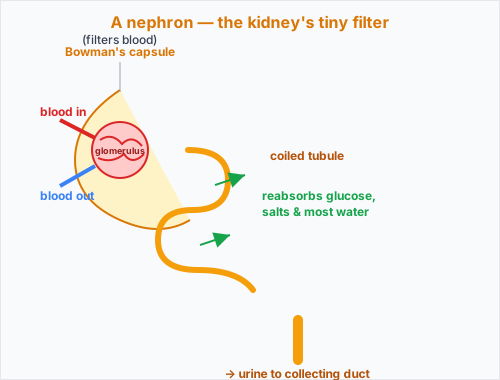
Each kidney has millions of tiny filters called nephrons. Blood is filtered in a cluster of capillaries (glomerulus) inside a cup (Bowman’s capsule). As the filtrate flows along the tubule, useful things — glucose, amino acids, salts and most of the water — are reabsorbed. What’s left (urea + excess water + salts) is urine. When kidneys fail, an artificial kidney (dialysis) can clean the blood.
Plants excrete differently: O₂ is a “waste” of photosynthesis; excess water leaves by transpiration; other wastes are stored in vacuoles, in leaves that fall off, or as resins and gums, or released into the soil.
In a nephron, why is glucose normally absent from the urine of a healthy person?
Glucose is filtered into the nephron at the glomerulus, but as the filtrate flows along the tubule, useful substances like glucose are selectively reabsorbed back into the blood — so healthy urine contains no glucose.
Common Mistakes
Plants only respire during the day and only photosynthesise — they don't really 'breathe'.
We're taught plants 'take in CO₂ and give out O₂', so it sounds like the opposite of breathing.
Plants respire ALL the time (day and night), just like us. During the day photosynthesis is so fast it uses up the respired CO₂ and releases extra O₂, hiding the respiration — but it's always happening.
Arteries always carry oxygen-rich blood and veins always carry oxygen-poor blood.
It's true for most vessels, so it gets over-generalised.
It's about direction, not oxygen: arteries carry blood AWAY from the heart, veins carry it BACK. The pulmonary artery carries CO₂-rich blood (heart → lungs) and the pulmonary vein carries O₂-rich blood (lungs → heart) — the exceptions.
Xylem carries food and phloem carries water.
The two are easy to swap.
Xylem carries WATER and minerals UP from roots (driven by transpiration). Phloem carries FOOD (sugar) made in leaves to all parts (translocation, using energy). Mnemonic: phloem = food.
Bile is a digestive enzyme that breaks down fat.
Bile acts on fat, so it sounds like an enzyme.
Bile has NO enzymes. It makes the food alkaline (so pancreatic enzymes can work) and emulsifies fat — breaks big fat globules into tiny droplets so the enzyme lipase can act on them faster.
Quick Check
Why is the small intestine longer in herbivores than in carnivores?
Grass is rich in cellulose, which is difficult to digest, so herbivores need a longer small intestine to do it. Meat is digested more easily, so carnivores like tigers have a shorter one.
The contraction-and-relaxation waves that push food along the alimentary canal are called:
The muscular lining of the gut contracts rhythmically in waves called peristaltic movements (peristalsis), pushing food forward through the whole digestive tube.
Practice Problems
These are written by Curriv and are completely free. Try before revealing.
Easy
What is the role of saliva in the digestion of food?
Saliva wets the food so it slides down easily, and it contains the enzyme salivary amylase, which begins digesting starch into simple sugar right in the mouth. The tongue also mixes food with saliva while chewing.
Name the parts of the human excretory system in the order urine passes through them.
Kidneys (make urine) → ureters (carry it down) → urinary bladder (stores it) → urethra (releases it out of the body).
Medium
What are the differences between aerobic and anaerobic respiration? Name an organism that uses anaerobic respiration.
- Aerobic respiration uses oxygen, takes place in the mitochondria, and breaks glucose fully into CO₂ + water, releasing a lot of energy.
- Anaerobic respiration happens without oxygen, in the cytoplasm, and gives products like ethanol + CO₂ (or lactic acid in our muscles), releasing much less energy.
An organism using anaerobic respiration: yeast (during fermentation).
Why is it necessary to separate oxygenated and deoxygenated blood in mammals and birds?
Mammals and birds are warm-blooded — they constantly use energy to keep their body temperature steady, so they have high energy needs. Keeping the two blood streams separate (with a four-chambered heart) means cells always get fully oxygenated blood, giving the most efficient supply of oxygen for that high energy demand.
Challenge
How is the small intestine designed to absorb digested food efficiently? Give two features.
- It is very long and coiled, giving food a long time and a large area to be absorbed.
- Its inner wall has millions of finger-like villi, which hugely increase the surface area for absorption. The villi are richly supplied with blood vessels that carry the absorbed food away to every cell of the body.
Compare the alveoli in the lungs and the nephrons in the kidneys — how are they similar in design?
Both are tiny units, present in huge numbers, designed to maximise surface area for exchange, and both work closely with a fine network of thin-walled blood capillaries:
- Alveoli exchange gases — O₂ into the blood, CO₂ out.
- Nephrons filter the blood — removing nitrogenous waste while reabsorbing useful substances.
So both are surface-area-maximising exchange/filtration units wrapped in capillaries — alveoli for gases, nephrons for liquid wastes.
Summary
- Life processes keep a living body’s order maintained: nutrition, respiration, transportation, excretion. Big bodies need specialised systems because diffusion alone is too slow.
- Nutrition: autotrophs make food by photosynthesis (CO₂ + water + sunlight → glucose, via chlorophyll; stomata let gases in/out). Heterotrophs eat ready-made food. In humans, food is digested along the alimentary canal (amylase in mouth → HCl + pepsin in stomach → bile + pancreatic + intestinal juices in the small intestine, absorbed by villi).
- Respiration: glucose → pyruvate (cytoplasm); then aerobic (mitochondria, O₂ → CO₂ + water, lots of ATP) or anaerobic (yeast → ethanol+CO₂; muscles → lactic acid → cramps). Breathing uses alveoli + haemoglobin.
- Transport in humans: four-chambered heart, double circulation; arteries (away), veins (back), capillaries (exchange).
- Transport in plants: xylem (water up, by transpiration pull); phloem (food, by translocation, using energy).
- Excretion: kidneys’ nephrons filter blood and reabsorb the useful parts; dialysis replaces failed kidneys. Plants use vacuoles, falling leaves, resins, gums and the soil.
What’s Next
You’ve now seen how a body runs itself — taking in food, releasing energy, moving things around and clearing wastes. But how does it coordinate all this, and respond to the world around it? In Chapter 6: Control and Coordination, you’ll meet the nervous system, reflexes, the brain, and the hormones that quietly run the show — how a living body senses, decides and acts.