Surface Areas and Volumes
Why This Matters
Look around you. Almost nothing is a simple, single shape. A medicine capsule is a cylinder with a rounded cap on each end. A circus tent is a cylinder with a cone on top for the roof. An ice-cream cone with a scoop is a cone plus a hemisphere (half a ball). A water tanker is a cylinder with two rounded ends.
None of these is one of the simple solids you learnt in Class 9. Each one is two or three of those solids stuck together. We call this a combination of solids.
So how much cloth does the tent need? How much medicine fits in the capsule? How much paint covers the toy? You already know the surface area and volume of every simple solid. This chapter teaches you just one new skill: how to combine those known answers when the solids are joined together.
There is a second nice idea too. When you melt a metal ball and pour the liquid metal into a mould to make a wire, the metal does not disappear. The amount of metal stays the same, so its volume stays the same. This one fact (“volume is conserved”) lets you solve a whole set of “melt-and-remake” problems. You do not need any new formula for them at all.
The Big Idea
When solids are joined together, you use two different rules. For surface area, add up only the outer surfaces you can still see. The surfaces hidden inside the join are gone, so you do not add the full surface areas of the separate pieces. For volume, simply add the volumes of all the pieces — nothing is lost at a join. And when one solid is melted and remade into another shape, the volume stays the same: volume before = volume after, even though the shape (and the surface area) is now completely different.
Let’s Break It Down
First, the basic formulas you’ll combine
Before any new ideas, let’s lock in three things you’ll lean on constantly: what area and volume really mean, the units each one uses, and that handy number π.
Every problem in this chapter is made from these five simple solids. In the table, r is the radius, h is the height, and l is the slant height of a cone (we explain slant height a little later, and it equals l = √(r² + h²)).
Two short forms will appear again and again:
- CSA means curved surface area. This is only the rounded side of a solid — not its flat top or bottom. For example, the CSA of a tin can is just the curved label part wrapped around it.
- TSA means total surface area. This is every face added up — the curved side plus all the flat ends.
All of these formulas come from Class 9. Keep this table close while you work.
| Solid | CSA | TSA | Volume |
|---|---|---|---|
| Cylinder | 2πrh | 2πrh + 2πr² | πr²h |
| Cone | πrl | πrl + πr² | (1/3)πr²h |
| Sphere | 4πr² | 4πr² | (4/3)πr³ |
| Hemisphere | 2πr² | 2πr² + πr² = 3πr² | (2/3)πr³ |
| Cube / Cuboid | — | 6a² / 2(lb+bh+hl) | a³ / l×b×h |
Two things are worth noticing here.
First, a hemisphere (half a ball) has two different surface numbers. Its curved dome part is 2πr². Its flat circular face (the cut side) is πr². So its total surface is 2πr² + πr² = 3πr². Which one you use depends on whether that flat face is showing or is hidden inside a join. Keep this in mind — it trips up a lot of students.
Second, a sphere (a full ball) has the same CSA and TSA, because a ball has no flat face at all.
Now, why is the cylinder’s curved surface 2πrh? Here is an easy way to see it, shown in Figure 12.1 below. Imagine peeling the paper label off a tin and laying it flat on the table. The curved side opens out into a plain rectangle. The height of that rectangle is just the cylinder’s height h. The width of the rectangle is how far the label had to go around the tin — that is the circle’s circumference, which is 2πr. Area of a rectangle is length × breadth, so the curved surface = h × 2πr = 2πrh. The two flat ends are just two circles, πr² each.

Next, let’s understand the cone’s slant height l. The slant height is the distance along the sloping side of the cone — from the pointed tip straight down to the edge of the base circle. It is not the same as the height h. The height h goes straight up the middle, while the slant height l runs along the outside slope, so l is always a bit longer than h.
To work out l from r and h, we’ll borrow one old rule about right-angled triangles. Here’s a quick refresher.
Here is how to find it, drawn in Figure 12.2 below. Cut the cone open down the middle and you get a right-angled triangle. The height h stands straight up the middle. The radius r runs flat along the base. The slant height l is the sloping side that joins the tip to the rim. Because h and r meet at a right angle (90°), we can use Pythagoras: l² = r² + h². Taking the square root gives l = √(r² + h²).

Try that formula yourself before reading on — here’s a cone with friendly numbers.
A cone has base radius 3 cm and height 4 cm. What is its slant height l?
And now, where does the cone’s curved surface πrl come from? It is the same peeling trick we used for the cylinder, shown in Figure 12.3 below. Take a paper cone (like the cone of a party hat) and cut straight up its slope from rim to tip. The curved side opens out flat into a pie slice — a slice of a bigger circle. That bigger circle has radius l, the slant height, because every point on the cone’s slope is exactly l away from the tip. The curved edge of the slice is the cone’s base rim, so its length is the base circumference, 2πr. A full circle of radius l has area πl² and an outline of 2πl. Our slice is only a fraction of that full circle — the same fraction as its curved edge is of the full outline, that is 2πr ÷ 2πl = r/l. So the slice’s area = (r/l) × πl² = πrl. That is the cone’s curved surface area.

Surface area of a combination — add only the exposed parts
When you stick two solids together, the surfaces that touch at the join disappear from the outside. Think about it: you can’t paint a face that is hidden inside, pressed against the other solid. So here is the rule: add the surface areas of only the parts you can still see from outside.
Take a “rocket” shape — a cone sitting on top of a cylinder, as in Figure 12.4 below. The flat top circle of the cylinder is now hidden under the cone. The cone has no separate base of its own either, because it sits right on the cylinder. So what is left showing on the outside? Just the curved surface of the cone plus the curved surface of the cylinder. (And if you also want to paint the very bottom, you add the cylinder’s base circle too.)
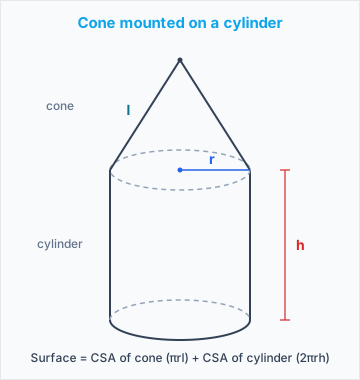
Let’s put that rule to work on a real circus tent and see how much canvas it actually needs.
A tent is a cylinder topped by a cone. The cylindrical part is 2.1 m high with diameter 4 m, and the slant height of the conical top is 2.8 m. Find the area of canvas needed (the floor is not covered). Take π = 22/7.
- First find the radius. Diameter is 4 m, so radius r = 4/2 = 2 m. Cylinder height h = 2.1 m and cone slant height l = 2.8 m. The canvas covers only the cone’s curved surface and the cylinder’s curved surface. We leave out the floor (not covered) and the hidden join.
- CSA of cone = πrl = (22/7) × 2 × 2.8 = (22 × 5.6)/7 = 123.2/7 = 17.6 m².
- CSA of cylinder = 2πrh = 2 × (22/7) × 2 × 2.1 = (2 × 22 × 4.2)/7 = 184.8/7 = 26.4 m².
- Canvas area = 17.6 + 26.4 = 44 m².
Sometimes a piece is scooped out instead of stuck on. Say you carve a bowl-shaped (hemispherical) hole into the top of a cube. This removes the flat circle from the cube’s top face, but it adds the curved inside surface of the hollow. It is the same idea as before — you just keep track of which surfaces appear and which disappear.
Watch this play out below: when a dome sits on a cube, one circle vanishes and another curved surface takes its place.
A decorative block is a cube of edge 5 cm with a hemisphere of diameter 4.2 cm fixed on top. Find the total surface area of the block. Take π = 22/7.
- The cube on its own has TSA = 6a² = 6 × 5 × 5 = 150 cm². But the hemisphere sits on the top face. It hides a circle of radius r = 4.2/2 = 2.1 cm under it.
- So we take the cube’s surface, remove the hidden circle, and add the hemisphere’s dome. Surface of block = TSA of cube − base circle of hemisphere + curved surface of hemisphere = 6a² − πr² + 2πr². The two πr² terms simplify: −πr² + 2πr² = +πr². So it becomes 6a² + πr².
- Now find πr² = (22/7) × 2.1 × 2.1 = (22 × 4.41)/7 = 97.02/7 = 13.86 cm².
- Total surface area = 150 + 13.86 = 163.86 cm². (Note: this is NOT 150 plus the hemisphere’s full surface. We first subtracted the hidden circle, then added the dome.)
Volume of a combination — just add the volumes
Volume is easier than surface area. When you join solids, no volume is lost at the join. So the total volume is simply the sum of the volumes of the pieces. And if a part is hollowed out (scooped away), you subtract that part’s volume.
Before that, one formula deserves a “why”. The cone’s volume is (1/3)πr²h — but where does that 1/3 come from? Notice it is exactly one third of the cylinder’s volume πr²h. That is not a coincidence: a cone holds exactly one third of what the cylinder of the same base and same height holds. You can see this for yourself with water, as Figure 12.5 below shows. Take a cone and a cylinder with the same radius and the same height. Fill the cone with water and pour it into the cylinder. It only reaches a third of the way up. Do it again — two thirds. A third pour fills the cylinder right to the brim. So three cones make one cylinder, which means one cone is 1/3 of the cylinder: cone volume = (1/3) × πr²h.

Picture the classic toy in Figure 12.6 below — a cone standing on a rounded base — to see both rules (add for volume, count only outer parts for surface) on one solid.
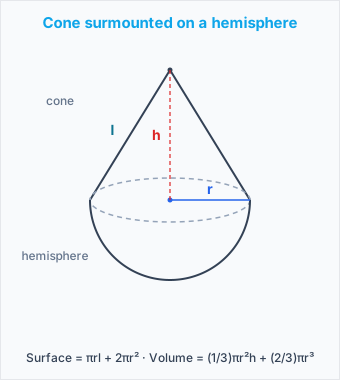
Let’s measure how much space such a toy fills by adding the two volumes.
A toy is a hemisphere with a cone on top. The cone's height is 2 cm and the common base diameter is 4 cm. Find the volume of the toy. Take π = 3.14.
- Radius r = 4/2 = 2 cm. The cone and hemisphere share this same radius. Cone height h = 2 cm. Since they are joined, total volume = volume of cone + volume of hemisphere.
- Volume of cone = (1/3)πr²h = (1/3) × 3.14 × 2² × 2 = (1/3) × 3.14 × 8 = 25.12/3 ≈ 8.37 cm³.
- Volume of hemisphere = (2/3)πr³ = (2/3) × 3.14 × 2³ = (2/3) × 3.14 × 8 = 50.24/3 ≈ 16.75 cm³.
- Total volume = 8.37 + 16.75 = 25.12 cm³. (It comes out neat here because (1/3 + 2/3) × 3.14 × 8 = 3.14 × 8 = 25.12 exactly.)
Now the opposite case: instead of adding a piece, a hollow is pushed into a solid, so we subtract. Here’s a glass with a raised bottom.
A glass is a cylinder of inner diameter 5 cm and height 10 cm, but its bottom has a hemispherical raised portion that reduces capacity. Find the actual capacity. Take π = 3.14.
- Radius r = 5/2 = 2.5 cm. If we ignore the dome, the glass looks like a plain cylinder — call that the “apparent capacity”. But the dome pushes up into the glass and takes up some space. So the actual capacity = cylinder’s volume − hemisphere’s volume.
- Apparent capacity = πr²h = 3.14 × 2.5 × 2.5 × 10 = 3.14 × 62.5 = 196.25 cm³.
- Volume of hemisphere = (2/3)πr³ = (2/3) × 3.14 × 2.5³ = (2/3) × 3.14 × 15.625 = 98.125 × 2/3 ≈ 32.71 cm³.
- Actual capacity = 196.25 − 32.71 = 163.54 cm³.
One more everyday combination worth seeing is the medicine capsule in Figure 12.7 below, where a neat shortcut hides in plain sight.
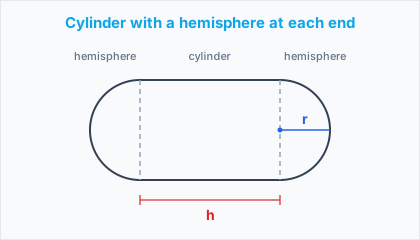
Conversion of solids — volume is conserved
Here is the second big idea. Suppose you take a lump of clay (or melt some metal) and reshape it into something else. The amount of material does not change — only its shape changes. So:
Volume of the original solid = Volume of the new solid.
This one fact solves every “a sphere is melted and remade into a wire / into smaller balls / into a cone” problem. You just write the two volumes as equal, then solve for the dimension you don’t know. The surface area does change when the shape changes — but the volume stays the same, and that is the link that connects the old shape to the new one.
Let’s see it in action: melt a metal ball, pour it into a cylindrical mould, and find how tall the cylinder turns out.
A solid metal sphere of radius 4.2 cm is melted and recast into a solid cylinder of radius 6 cm. Find the height of the cylinder. Take π = 22/7.
- No metal is gained or lost in melting, so volume of sphere = volume of cylinder. That is (4/3)πR³ = πr²h, where R = 4.2 cm is the sphere’s radius and r = 6 cm is the cylinder’s radius.
- π appears on both sides, so we can cancel it. That leaves (4/3) × 4.2³ = 6² × h, which is (4/3) × 74.088 = 36h.
- (4/3) × 74.088 = 98.784, so 98.784 = 36h.
- h = 98.784 / 36 = 2.744 cm. The shape changed completely, but the volume stayed the same — and that one equation was all we needed.
The same volume rule answers a “how many?” question too — melt one big ball and count how many tiny balls you can pour from it.
A spherical ball of radius 3 cm is melted and recast into small spherical balls each of radius 0.5 cm. How many small balls are made?
- All the metal is reused, so volume of the big sphere = total volume of all the small balls. That total is just the number of balls times the volume of one ball. Let the number be n. So volume of big sphere = n × volume of one small ball.
- (4/3)π × 3³ = n × (4/3)π × (0.5)³. The part (4/3)π is the same on both sides, so it cancels — this always happens when both shapes are spheres.
- 3³ = n × 0.5³ → 27 = n × 0.125.
- n = 27 / 0.125 = 216 small balls.
Quick gut-check before moving on — make sure you’ve grasped what melting keeps fixed and what it changes.
A solid is melted and remade into a different shape. Which one is sure to stay the same — its volume or its surface area?
Common Mistakes
These four slip-ups cost the most marks in this chapter. Read each one and notice why the wrong way feels so tempting.
For a joined solid, the surface area is just the total surface areas of the separate pieces added up.
Each piece has a neat TSA formula, so adding TSA + TSA feels like the obvious way to put them together.
The faces where the pieces meet are hidden, so do NOT count them. Add only the surfaces you can still see — usually the curved parts, plus any flat faces still showing. For a cone on a cylinder, that is πrl + 2πrh. It is NOT (πrl + πr²) + (2πrh + 2πr²).
Always use 2πr² for a hemisphere's surface, in every problem.
2πr² is the formula you memorised for a hemisphere, so it feels like the one answer to use everywhere.
A hemisphere has a curved dome (2πr²) AND a flat circular face (πr²). Use 2πr² when only the dome shows. Use 3πr² (dome + flat) when the flat face also shows. And subtract πr² when that flat face gets hidden inside a join.
When melting one solid into another, make their surface areas equal.
The objects look about the same size after remaking, and surface area is what you practised all chapter, so setting it equal feels right.
Melting keeps the VOLUME the same, not the surface area. Always write 'volume before = volume after'. The surface area changes when the shape changes, so it is not the thing that stays equal.
You can add a length in cm to a length in m, or mix cm³ with m³, as long as the numbers look right.
The calculator still gives an answer, so a units mistake is easy to miss.
Change everything to ONE unit before you calculate. 1 m = 100 cm, so 1 m³ = 100 × 100 × 100 = 1,000,000 cm³ (not 100). Also remember to halve the diameter to get the radius first — many mistakes are really just 'used d instead of r'.
Quick Check
Test the two big rules — exposed surfaces and conserved volume — on these four quick questions.
A cone is mounted on a cylinder of the same radius (a rocket shape). Which gives the area of canvas/paint on the outside (excluding the base)?
A solid hemisphere rests flat-side-down on a table, so only its dome shows. Which is its exposed surface area?
A metal cube is melted and recast into a sphere. What stays the same?
To find the VOLUME of a capsule (a cylinder with a hemisphere stuck on each end), you should:
Practice Problems
Try each one on your own first, then tap to reveal the full worked solution. They climb from easy warm-ups to exam-level challenges.
Easy
Two cubes each of volume 64 cm³ are joined end to end. Find the surface area of the resulting cuboid.
Each cube has volume 64 = a³. To get the edge, take the cube root: a = 4 cm.
Place two cubes side by side, end to end, and you get a cuboid. Its length is 4 + 4 = 8 cm, its breadth is 4 cm, and its height is 4 cm.
Surface area = 2(lb + bh + hl) = 2(8×4 + 4×4 + 4×8) = 2(32 + 16 + 32) = 2 × 80 = 160 cm².
(Notice it is not 2 × 96 = 192 cm², which would be the two cubes’ surface areas added up. The two faces that touch in the middle are hidden, so they disappear.)
A toy is a cone of radius 3.5 cm mounted on a hemisphere of the same radius. The total height of the toy is 15.5 cm. Find its total surface area. Take π = 22/7.
Radius r = 3.5 cm. A hemisphere’s height is the same as its radius, so the hemisphere is 3.5 cm tall. The rest of the toy’s height belongs to the cone: cone height h = 15.5 − 3.5 = 12 cm.
Slant height l = √(r² + h²) = √(3.5² + 12²) = √(12.25 + 144) = √156.25 = 12.5 cm.
Total surface area = CSA of cone + CSA of hemisphere = πrl + 2πr² = (22/7) × 3.5 × 12.5 + 2 × (22/7) × 3.5 × 3.5 = (22/7) × 3.5 × (12.5 + 2 × 3.5) = (22/7) × 3.5 × 19.5 = 11 × 19.5 = 214.5 cm².
Medium
A vessel is a hollow hemisphere mounted by a hollow cylinder. The diameter of the hemisphere is 14 cm and the total height of the vessel is 13 cm. Find the inner surface area of the vessel. Take π = 22/7.
Radius r = 14/2 = 7 cm. The hemisphere’s depth is the same as its radius, so it is 7 cm deep. That leaves the cylinder’s height as h = 13 − 7 = 6 cm.
The inside surface = curved inner surface of cylinder + curved inner surface of hemisphere = 2πrh + 2πr² = 2 × (22/7) × 7 × 6 + 2 × (22/7) × 7 × 7 = 2 × (22/7) × 7 × (6 + 7) = 2 × 22 × 13 = 572 cm².
A cylindrical container of radius 6 cm and height 15 cm is full of ice cream, which is distributed into 10 identical cones, each having a hemispherical top of the same radius. If the height of each cone is 12 cm, find the radius of the ice-cream cone. Take π = 22/7.
All the ice cream is moved across, so none is lost: volume of cylinder = 10 × (volume of one cone + one hemisphere).
Volume of cylinder = πR²H = π × 6² × 15 = π × 36 × 15 = 540π cm³.
One cone + hemisphere (radius r, cone height 12) = (1/3)πr²(12) + (2/3)πr³ = 4πr² + (2/3)πr³.
So 540π = 10 × [4πr² + (2/3)πr³]. Cancel π: 540 = 40r² + (20/3)r³.
Try r = 3: 40(9) + (20/3)(27) = 360 + 180 = 540 ✓.
So the radius of each ice-cream cone is 3 cm.
Challenge
A gulab jamun is shaped like a cylinder with a hemisphere at each end. Its total length is 5 cm and its diameter is 2.8 cm. It contains sugar syrup up to about 30% of its volume. Find approximately how much syrup is in 45 such gulab jamuns. Take π = 22/7.
Radius r = 2.8/2 = 1.4 cm. Each hemisphere sticks out by its radius, 1.4 cm, so the two ends together take up 2 × 1.4 = 2.8 cm of the length. The straight middle (the cylinder) is what’s left: h = 5 − 2.8 = 2.2 cm.
Volume of one gulab jamun = πr²h + (4/3)πr³ (two hemispheres = one sphere) = (22/7) × 1.4² × 2.2 + (4/3) × (22/7) × 1.4³ = (22/7) × 1.96 × 2.2 + (4/3) × (22/7) × 2.744 = 13.55 + 11.50 ≈ 25.05 cm³.
Volume of 45 gulab jamuns ≈ 45 × 25.05 = 1127.25 cm³.
Syrup is 30% of this: 0.30 × 1127.25 ≈ 338 cm³ (about 338 cm³ of syrup).
A solid cone of height 120 cm and radius 60 cm stands on a hemisphere of radius 60 cm. This solid is placed upright in a cylinder full of water (radius 60 cm, height 180 cm) so that it touches the bottom. Find the volume of water left in the cylinder. Take π = 3.14.
The solid pushes water out and sits in the cylinder. The water left over fills the space the solid does not take up. So water left = cylinder’s volume − solid’s volume.
Volume of cylinder = πr²h = 3.14 × 60² × 180 = 3.14 × 3600 × 180 = 2,034,720 cm³.
Volume of solid = cone + hemisphere = (1/3)πr²h + (2/3)πr³ = (1/3) × 3.14 × 60² × 120 + (2/3) × 3.14 × 60³ = (1/3) × 3.14 × 3600 × 120 + (2/3) × 3.14 × 216000 = 452,160 + 452,160 = 904,320 cm³.
Water left = 2,034,720 − 904,320 = 1,130,400 cm³ (= 1.1304 m³).
Summary
You should now be able to explain:
- A combination of solids is two or more simple solids (cuboid, cube, cylinder, cone, sphere, hemisphere) joined together.
- Surface area of a combination = add up only the surfaces you can still see. The faces at the join are hidden, so you add the curved surfaces (and any flat faces still showing) — not the full TSAs.
- Volume of a combination = add up the volumes of all the pieces. If a part is scooped out, subtract its volume.
- A hemisphere has a curved dome (2πr²) and a flat face (πr²), giving a total of 3πr². Pick the right one based on which faces are showing.
- Key base formulas: cylinder πr²h, 2πrh; cone (1/3)πr²h, πrl with l = √(r² + h²); sphere (4/3)πr³, 4πr²; hemisphere (2/3)πr³, 2πr².
- Converting solids: melting and remaking keeps the volume the same — set volume before = volume after to find a missing length or a count.
- Always change everything to one unit, and use the radius (not the diameter) before you calculate.
What’s Next
In this chapter you measured shapes. Next, in Statistics, you will move from shapes to data — long lists of numbers — and learn how to sum them up using a single number that stands for the whole list. You will find the mean, median and mode of grouped data. It builds on the same careful, step-by-step calculation you practised here.
Frequently Asked Questions
How do you find the surface area of a combination of solids?
Add only the surfaces that are actually visible (exposed) on the outside. When two solids are joined, the surfaces at the join are hidden inside and must not be included. For example, if a cone sits on top of a cylinder, the top circular face of the cylinder is covered by the cone's base, so you exclude it. The total surface area = curved surface area of cone + curved surface area of cylinder + one circular base of the cylinder.
How is the volume of a combination of solids calculated?
Simply add the volumes of all the individual parts. Volume, unlike surface area, does not change at a join — material is never lost where two solids meet. So for a circus tent that is a cylinder with a cone on top, total volume = volume of cylinder + volume of cone.
What is the key principle when a solid is melted and recast into a new shape?
When you melt a solid and pour the material into a new mould, the amount of material (and therefore the volume) stays exactly the same. So: volume of original solid = volume of new solid. Use this single equation to find the unknown dimension of the new shape. The surface area usually changes, but the volume never does.
What are the CSA and TSA formulas for a cone and a cylinder?
For a cylinder of radius r and height h: CSA (curved surface area) = 2πrh, TSA (total surface area) = 2πrh + 2πr² = 2πr(h + r). For a cone of radius r, height h and slant height l = √(r² + h²): CSA = πrl, TSA = πrl + πr² = πr(l + r). 'Curved' means only the rounded side; 'total' includes the flat circular base(s) too.
If many small spheres are melted and recast into one large sphere, how do you find the radius of the large sphere?
Total volume of small spheres = volume of large sphere. If there are n small spheres each of radius r, then n × (4/3)πr³ = (4/3)πR³. Cancel (4/3)π from both sides to get n × r³ = R³, so R = r × ∛n. For example, 8 small spheres of radius 3 cm give R = 3 × ∛8 = 3 × 2 = 6 cm.