Areas Related to Circles
Why This Matters
Think about a clock. Every few minutes, its minute hand sweeps across a slice of a circle. A car wiper cleans a curved patch of glass. A goat tied to a peg can eat grass only in a pie-shaped piece of a field. A lighthouse shines its light across a fan-shaped piece of sea.
All of these are really the same shape — a slice of a circle. And in each case, someone needs to measure that slice’s area.
You already know how to find the area of a whole circle (πr²) and the length of its boundary (2πr). But in real life you rarely get whole circles. You get slices. One kind of slice is a wedge between two radii (a sector). Another kind is the curved cap between a straight line across the circle and the arc above it (a segment). Don’t worry about these words yet — we’ll explain each one slowly.
This chapter is short and easy, because it rests on one simple idea: a slice is just a fraction of the whole circle. Imagine a pizza cut into a full 360°. Take a 60° wedge from it. That wedge is 60/360 = one-sixth of the pizza. So it has one-sixth of the area and one-sixth of the crust. Once you get this fraction idea, every formula in this chapter almost writes itself.
The Big Idea
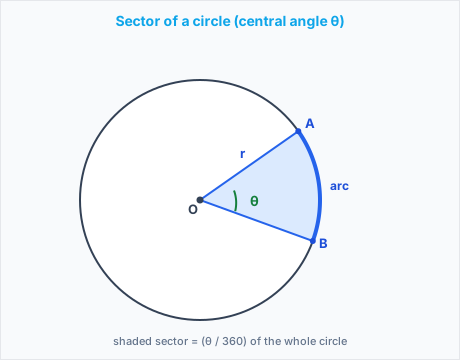
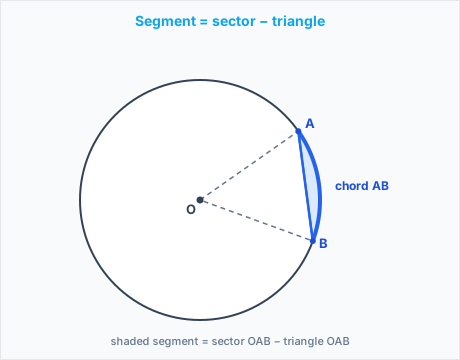
A sector is the wedge between two radii and the arc that joins their ends. The angle at the centre is called θ. A whole circle is just a sector with angle 360°. So a sector of angle θ is the fraction θ/360 of the whole circle. That one fraction gives you both things you need: its area, (θ/360) × πr², and its arc length, (θ/360) × 2πr. A segment is the region between a chord and its arc. To find it, take the sector and cut away the triangle made by the two radii — segment = sector − triangle.
Let’s Break It Down
Recall: the whole circle (area and circumference)
Before we slice anything, let’s quickly name the parts of a circle you’ll keep using — centre, radius, diameter and that special number π.
Before we cut any slices, let’s lock in two facts about the whole circle of radius r:
- Circumference (the distance all the way around the edge) = 2πr
- Area (the flat space inside) = πr²
Here π (say “pi”) is a fixed number, about 3.14159… In this chapter we use π = 22/7, unless a problem tells us to use something else (sometimes it says π = 3.14).
Let’s pin down exactly what each of those two facts means, and a quick worked number for both.
Keep these two facts separate in your mind. Circumference is a length, so we measure it in cm or m. Area is a region, so we measure it in cm² or m² — notice the little square. A quick tip: if a problem gives you the diameter d (the full width across), first cut it in half to get the radius, since r = d/2. Do this before putting numbers into any formula.
These two formulas were probably just handed to you in earlier classes. But where do they actually come from? Let’s not leave them as magic — both have a simple, satisfying reason behind them.
Why is the circumference 2πr? It comes straight from what the number π means. Suppose you take any circle and measure all the way around its edge with a string. Then you measure straight across it (the diameter). When you divide the edge length by the diameter, you always get the same number — about 3.14159… — no matter how big or small the circle is. We give that fixed number the name π. So by its very definition, π = (distance around) ÷ (distance across) = circumference ÷ d.
Turn that around and it says: circumference = π × d. In other words, the edge of any circle is just a little over 3 diameters long. And since the diameter is two radii (d = 2r), we can write circumference = π × 2r = 2πr. That’s all 2πr is — π diameters, written using the radius.
Figure 11.1 below shows it: unroll the round edge into a straight line, and that line is exactly π (about 3.14) copies of the diameter.

Why is the area πr²? Here is a lovely picture-proof you are rarely shown. Take the circle and cut it into many thin wedges (slices), like a pizza. Each wedge is almost a thin triangle, with its point at the centre and its curved edge on the rim. Now open the wedges out and slot them together side by side, turning each one alternately point-up, point-down, point-up, point-down. They lock together into a shape that is almost a rectangle.
Look at that rectangle. Its height is the length of one wedge from the centre to the rim — that is just the radius, r. Its width is made from all the curved edges of the wedges lying along the top and bottom. Half the wedges face up and half face down, so the top is built from half of the total rim. The total rim is the circumference 2πr, so half of it is πr. That gives a rectangle of width πr and height r.
The wedges only got rearranged — no paper was added or thrown away — so the rectangle has the same area as the circle. And a rectangle’s area is just width × height:
Area of circle = πr × r = πr²
The thinner you slice the wedges, the more perfectly they make a true rectangle. Figure 11.2 below shows the whole idea, step by step:

Here’s a neat twist: sometimes you’re given the edge and asked for the space inside. Let’s work backwards from circumference to area.
A circular brooch is made from silver wire of length 44 cm bent into a circle. Find its area. (Use π = 22/7.)
- The wire is bent into the edge of the circle, so its length is the circumference. That means 2πr = 44.
- Now find r. Put π = 22/7: 2 × (22/7) × r = 44, so (44/7) × r = 44. Divide both sides by 44/7 and you get r = 7 cm.
- Now use the area formula: area = πr² = (22/7) × 7 × 7 = 22 × 7 = 154 cm².
Sector: the area and the arc length (and why θ/360)
A sector is the pie-slice you get when you draw two radii and keep the arc (the curved edge) between their ends. Picture a wedge: its sharp point sits at the centre O, and its curved side lies on the circle. The angle at the centre, ∠AOB, is called the angle of the sector. We write it as θ (the Greek letter “theta”). For example, a quarter-slice of a circle has θ = 90°.
Figure 11.3 below shows one — see how the wedge sits with its point at O and its curved side on the circle.
Everything that follows rests on one fact about angles: a full turn around the centre is 360°. Let’s make sure that’s solid first.
Why the fraction θ/360 works — this one idea is the heart of the whole chapter. Take it slowly.
Go all the way around the centre once, and you turn through 360°. That full turn covers the whole circle — all of its area πr² and all of its edge 2πr. So you can say: a full circle “uses up” 360° of angle.
Now ask a simpler question. How much does just 1° cover? Since 360° covers the whole thing, 1° covers 1/360 of it. And θ degrees cover θ times as much — that is, θ/360 of the circle.
This way of thinking is called the unitary method: first find the value for one unit (here, 1°), then multiply up to get θ. So:
- Area of a sector of angle θ = (θ/360) × πr²
- Length of its arc = (θ/360) × 2πr
It’s the same fraction in both, but you multiply it by a different “whole” each time. For area, the whole is πr². For arc length, the whole is the circumference 2πr.
Here’s a nice check. Put θ = 360 into the formulas. The fraction becomes 360/360 = 1, so you get back πr² and 2πr — the whole circle. That makes sense, and it tells you the formulas are right.
If the θ/360 idea still feels abstract, Figure 11.4 below makes it concrete — imagine the circle chopped into 360 tiny one-degree slivers.

Let’s put both formulas to work at once — finding a sector’s area and its arc length from the same fraction.
Find the area of a sector of a circle of radius 4 cm whose angle is 30°. Also find the length of its arc. (Use π = 3.14.)
- First find the fraction of the circle: θ/360 = 30/360 = 1/12. So this sector is one-twelfth of the circle.
- For the area, multiply that fraction by πr²: Area = (1/12) × 3.14 × 4 × 4 = (1/12) × 50.24 = 4.19 cm² (about).
- For the arc, multiply the same fraction by 2πr: Arc length = (1/12) × 2 × 3.14 × 4 = (1/12) × 25.12 = 2.09 cm (about).
- So the sector has area about 4.19 cm², and its curved edge is about 2.09 cm long.
When you cut out a small wedge, the bigger leftover wedge has a name too: the major sector. Its angle is whatever is left, which is 360° − θ. You can find its area the same way, using the fraction (360 − θ)/360. Or use a shortcut: major sector = πr² − minor sector. This works because the two wedges together make the whole circle.
Try a quick one yourself before moving on — a quarter-circle slice.
A sector has angle 90° in a circle of radius 14 cm (π = 22/7). What fraction of the circle is it, and what is its area?
Segment: sector minus triangle
First, what is a chord? A chord is a straight line that joins two points on the circle (for example, points A and B). A segment is the region trapped between a chord and the arc above it. Think of it as the curved “cap” you would slice off if you cut straight across the circle with a knife in one stroke. The chord AB and the arc APB are its two edges.
How do we find its area? Here’s the trick. Take the sector OAPB (the wedge with its point at the centre O). Now cut away the triangle OAB (the flat, straight-sided part that has O as one corner). Whatever is left is exactly the cap between the chord and the arc — and that is the segment. Figure 11.5 below shows this.
So the formula is simply:
Area of segment = Area of sector − Area of triangle OAB = (θ/360) × πr² − area of △OAB
Since the new piece here is the triangle, let’s refresh how to find a triangle’s area before we use it.
You already know how to find the sector area. So the only new thing to find is the triangle’s area. This triangle has two sides equal to r (they are the two radii), with the angle θ sitting between them. There are two easy ways to get its area:
- Use the formula (1/2) × r² × sin θ.
- Or drop a straight line from O down to the chord so it meets the chord at a right angle. This line is the height. It also cuts the chord exactly in half. Then use the usual triangle rule: area = (1/2) × base × height.
For the common exam angles (60°, 90°, 120°), the numbers work out cleanly, so don’t worry.
Let’s see the whole “sector minus triangle” idea play out on a real problem.
In a circle of radius 21 cm, a chord AB subtends an angle of 120° at the centre. Find the area of the corresponding minor segment. (Use π = 22/7, √3 = 1.73.)
- Start with the sector OAB. Its fraction is 120/360 = 1/3, so area = (1/3) × (22/7) × 21 × 21 = (1/3) × 1386 = 462 cm².
- Now find the triangle OAB. Drop a line OM from O straight down to the chord AB so it meets AB at a right angle. Since OA = OB, this line splits AB into two equal halves and also splits the angle in half, giving 120°/2 = 60° on each side. With OA = 21: OM = OA × cos 60° = 21 × (1/2) = 10.5 cm, and AM = OA × sin 60° = 21 × (√3/2).
- The full chord AB is twice AM, so AB = 21√3 cm. Now the triangle area = (1/2) × base × height = (1/2) × AB × OM = (1/2) × 21√3 × 10.5 = (441√3)/4 cm².
- Put √3 = 1.73: (441 × 1.73)/4 = 762.93/4 ≈ 190.73 cm². Finally, segment = sector − triangle = 462 − 190.73 ≈ 271.3 cm².
It works just like sectors. A chord splits the circle into two segments: the small cap is the minor segment, and the larger leftover part is the major segment. And again, major segment = πr² − minor segment.
Figure 11.6 below shows both kinds of cut side by side, so you can see minor and major at a glance.

Sector and segment are easy to mix up, so here they are laid out side by side.
| Feature | Sector | Segment |
|---|---|---|
| Bounded by | two radii + the arc | a chord + the arc |
| Shape | a wedge / pie-slice | a curved cap |
| Touches the centre? | yes (point at O) | no (only the chord and arc) |
| Area | (θ/360) × πr² | sector − triangle OAB |
Common Mistakes
These are the slips that cost easy marks in this chapter. The first one mixes up arc length with sector area, since they share the same fraction.
Arc length and sector area are basically the same sum.
Both start with the same fraction θ/360, so it feels like one formula wearing two names.
The fraction is the same, but you multiply it by a different whole each time. For arc length, the whole is the circumference 2πr, which is a length (in cm). For area, the whole is πr², which is a region (in cm²). One has r, the other has r². One gives a length, the other gives an area.
A segment is just another name for a sector.
In the figure the segment sits right inside the sector, so the two shapes look almost the same.
A sector is the wedge made by two RADII and the arc, so it touches the centre. A segment is made by a CHORD and the arc, so it does NOT touch the centre. To get the segment, you take the sector and remove the triangle between the two radii. So the segment is always the smaller piece.
To get the segment, subtract the triangle's sides (its perimeter) from the sector's area.
People remember the rule as the words 'sector minus triangle', and the most obvious thing about a triangle is its three sides, so subtracting lengths feels natural.
You must subtract an AREA from an AREA: segment area = sector area − triangle AREA. The triangle's area is (1/2) × r² × sin θ, or (1/2) × base × height. You can never subtract a length from an area — even the units don't match (cm vs cm²).
You can put the diameter straight into the sector formulas in place of r.
Many problems give the diameter, so it's tempting to just plug that number into πr² or 2πr.
The formulas need the RADIUS, not the diameter. If the problem gives the diameter d, first cut it in half: r = d/2. If you forget, your area comes out 4 times too big and your arc 2 times too big.
Quick Check
A few fast questions to test that the fraction idea has clicked. Start with the arc length of a sector.
A sector has central angle θ in a circle of radius r. What is the length of its arc?
A 90° sector is cut from a circle. What fraction of the circle's area is it?
How do you find the area of a segment of a circle?
A sector of angle 60° has area 24 cm². What is the area of the whole circle?
Practice Problems
Easy
Find the area of a sector of a circle of radius 6 cm if the angle of the sector is 60°. (Use π = 22/7.)
Fraction of the circle = θ/360 = 60/360 = 1/6.
Area = (θ/360) × πr² = (1/6) × (22/7) × 6 × 6 = (1/6) × (22/7) × 36 = (22 × 36)/(7 × 6) = 792/42 = 132/7 cm² ≈ 18.86 cm².
The minute hand of a clock is 14 cm long. Find the length of the arc its tip travels in 15 minutes. (Use π = 22/7.)
In one full hour the minute hand goes all the way round, which is 360°. In 15 minutes it covers 15/60 = 1/4 of that turn. So it turns through 1/4 of 360° = 90°. As it turns, the tip moves along an arc of radius r = 14 cm (the hand’s length).
Arc length = (θ/360) × 2πr = (90/360) × 2 × (22/7) × 14 = (1/4) × 2 × 22 × 2 = (1/4) × 88 = 22 cm.
Medium
Find the area of a quadrant of a circle whose circumference is 22 cm. (Use π = 22/7.)
First find r from the circumference. We know 2πr = 22, so 2 × (22/7) × r = 22, which gives (44/7) × r = 22. Solving, r = 22 × 7/44 = 7/2 = 3.5 cm.
A quadrant is a 90° sector, so its fraction is 90/360 = 1/4 of the circle.
Area = (1/4) × πr² = (1/4) × (22/7) × (7/2) × (7/2) = (1/4) × (22/7) × (49/4) = (1/4) × (22 × 7)/4 = (1/4) × (154/4) = 154/16 = 77/8 cm² ≈ 9.625 cm².
In a circle of radius 21 cm, an arc subtends an angle of 60° at the centre. Find (i) the length of the arc and (ii) the area of the sector. (Use π = 22/7.)
Fraction = θ/360 = 60/360 = 1/6.
(i) Arc length = (1/6) × 2πr = (1/6) × 2 × (22/7) × 21 = (1/6) × 2 × 22 × 3 = (1/6) × 132 = 22 cm.
(ii) Sector area = (1/6) × πr² = (1/6) × (22/7) × 21 × 21 = (1/6) × 22 × 3 × 21 = (1/6) × 1386 = 231 cm².
Challenge
A chord of a circle of radius 10 cm subtends a right angle (90°) at the centre. Find the area of the corresponding minor segment. (Use π = 3.14.)
Here r = 10 cm and θ = 90°.
First the sector. Sector area = (θ/360) × πr² = (90/360) × 3.14 × 10 × 10 = (1/4) × 314 = 78.5 cm².
Now the triangle OAB. Its two sides are the radii, each 10 cm, and the angle between them is 90°. So it is a right-angled triangle with the right angle at O. We can use the two radii as the base and the height: area = (1/2) × 10 × 10 = 50 cm².
Finally, segment = sector − triangle = 78.5 − 50 = 28.5 cm².
(Quick check: the major segment would be πr² − 28.5 = 314 − 28.5 = 285.5 cm². That is much bigger, which is exactly what we expect.)
Summary
You should now be able to explain:
- For a whole circle of radius r: circumference = 2πr (a length) and area = πr² (a region). Use π = 22/7 or 3.14. If you are given the diameter, cut it in half first to get r.
- A sector is the wedge between two radii and the arc. The angle at the centre is called θ.
- A sector is the fraction θ/360 of the whole circle. This is because one full turn (360°) covers the whole circle, so 1° covers 1/360 of it, and θ° covers θ/360.
- Area of a sector = (θ/360) × πr², and arc length = (θ/360) × 2πr. Same fraction — just multiply it by the area for one, and by the circumference for the other.
- The major sector or segment is simply the whole circle minus the minor one.
- A segment is the region between a chord and its arc. Segment area = sector area − triangle OAB area. Always subtract area from area, never lengths.
What’s Next
So far everything has been flat — areas of shapes you can draw on paper. Next, in Surface Areas and Volumes, these shapes lift off the page and become solid 3D objects: cubes, cylinders, cones and spheres. You will learn to find the surface area (the outside skin you would paint) and the volume (the space packed inside). You’ll also join solids together — a cone sitting on a cylinder, a half-ball on top of a cube — just like the way we combined circle slices into bigger shapes here.
Frequently Asked Questions
What is the formula for the area of a sector and why does it use θ/360?
The area of a sector with radius r and central angle θ° is (θ/360) × πr². The reason is simple: a full circle has angle 360° and area πr². A sector of angle θ is just the fraction θ/360 of the full circle, so it has that same fraction of the area. For example, a 90° sector is one-quarter of the circle and has area πr²/4.
What is the difference between a sector and a segment of a circle?
A sector is the 'pie-slice' region between two radii and the arc joining their ends — like a slice of pizza. A segment is the region between a chord and the arc it cuts off — like the curved piece left when you slice straight through a circle. To find the area of a segment, calculate the area of the sector that contains it and then subtract the area of the triangle formed by the two radii.
How do you find the length of an arc of a sector?
The arc length is (θ/360) × 2πr, where θ is the central angle and r is the radius. A full circle's circumference is 2πr (angle 360°). An arc of angle θ is the fraction θ/360 of the full circumference. For example, the arc length of a 60° sector of radius 7 cm is (60/360) × 2π × 7 = (1/6) × 44 ≈ 7.33 cm (using π = 22/7).
How do you find the area of a segment when the triangle is not a standard angle?
Area of segment = area of sector − area of triangle. The sector area is (θ/360) × πr². The triangle formed by the two radii has sides r, r and the chord. If θ is a standard angle (30°, 60°, 90°, 120°), you can use the formula ½ × r² × sin θ for the triangle's area. For 90°, sin 90° = 1, so triangle area = ½r². For 60°, sin 60° = √3/2, so triangle area = (√3/4)r².
In a combination problem with circles and other shapes, how do you avoid double-counting area?
Identify exactly which regions are shaded or required. Break the total region into parts you can calculate separately, then add them. When a shape overlaps the circle, be careful not to add an area twice. Draw and label every region clearly. For example, if you want the area of a square minus an inscribed circle, simply subtract πr² from the square's area — no overlap issue because the circle fits entirely inside.