Circles
Why This Matters
Watch a bicycle wheel roll along the road. At every moment, the wheel touches the ground at just one point. The road acts like a line that lightly brushes the round wheel. Now picture a rope going over a pulley at a well. Each side of the rope leaves the wheel along a line that touches it at a single point.
These touching lines have a special name — tangents. A tangent is a straight line that touches a circle at exactly one point. They follow two neat rules that show up again and again in geometry, physics and design.
In Class 9 you learned what a circle is. It is all the points that are the same distance from a fixed centre. That fixed distance is called the radius. Now we ask a sharper question. When a straight line and a circle are drawn on the same flat surface, how can they meet?
Before we answer that, let us quickly bring back the circle words you met in Class 9 — centre, radius, chord and the rest — since we will lean on them all chapter.
There are only three possibilities. The line can miss the circle completely. It can cut straight through it at two points. Or it can just touch it at one point. That last case — the tangent — is what this whole chapter is about.
By the end you will know two facts you can use forever. First, a tangent always makes a perfect right angle (90°) with the radius drawn to the touch point. Second, if you draw two tangents from one point outside the circle, they are exactly equal in length. We won’t just state these rules. We’ll prove them. That way you know they are really true, not just “what the picture looks like”.
The Big Idea
When a line and a circle are drawn on the same flat surface, they can meet in only three ways. The line can miss the circle (no common point — a non-intersecting line). It can cut it at two points (a secant). Or it can touch it at exactly one point (a tangent). Think of a tangent as a secant whose two cutting points have slowly slid together until they became one. At that single touch point, the radius and the tangent always meet at a right angle (they are perpendicular). And from any point outside the circle you can draw exactly two tangents — and those two tangents are equal in length.
Let’s Break It Down
A line and a circle: three possibilities
Take a circle and a straight line PQ on the same flat surface. Now slide the line around. Only three things can ever happen:
- No common point — the line stays away from the circle. It does not touch it at all. This is called a non-intersecting line.
- Two common points — the line goes into the circle and comes out, cutting it at two points A and B. This line is a secant.
- Exactly one common point — the line just touches the circle. This line is a tangent. The single point where they meet is called the point of contact.
There is no fourth case. The word tangent comes from the Latin word tangere, which means “to touch”.
Figure 10.1 below lays out all three cases side by side so you can see the difference at a glance.

A tangent is really just a secant pushed to its edge. Picture a secant that cuts the circle at two points. Now slide it slowly outward, keeping it pointing the same way. The two cutting points come closer and closer. At one moment they meet and become a single point. Right then, the secant has turned into a tangent.
A tangent is a special kind of secant. It is what you get when the two points where the secant cuts the circle come together into one single point.
Quick test before we move on — can you tell a secant and a tangent apart just from how many points they share with the circle?
A line meets a circle at two distinct points. What is this line called, and is it a tangent?
How many tangents pass through a given point?
How many tangents you can draw depends on where the point sits:
- Point inside the circle — every line you draw through it cuts the circle at two points. So you get no tangent from a point inside the circle.
- Point on the circle — there is exactly one tangent at that point.
- Point outside the circle — you can draw exactly two tangents to the circle from that point.
Figure 10.2 below draws out all three spots, so you can see why the count jumps from none to one to two.

The same three counts are worth memorising, so here they are in one tidy table.
| Where the point is | Number of tangents |
|---|---|
| Inside the circle | none (0) |
| On the circle | exactly one (1) |
| Outside the circle | exactly two (2) |
Take a point P outside the circle and draw a tangent from it. The length of the tangent line, measured from P up to the point of contact, is called the length of the tangent from P. We’ll soon prove a nice fact about it.
Theorem 1 — The tangent is perpendicular to the radius at the point of contact
Statement. The tangent at any point of a circle is perpendicular to the radius through the point of contact.
Figure 10.3 below sets up the picture we will reason about — a tangent touching at P, with the radius OP and one extra point Q to compare distances.
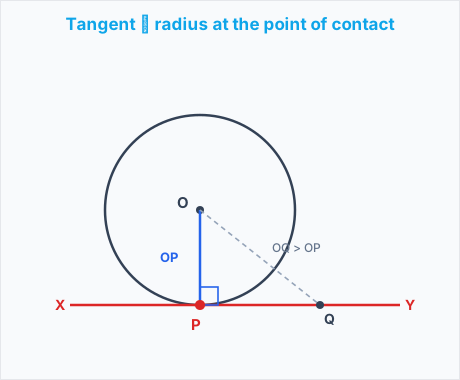
Given. A circle with centre O and a tangent XY touching the circle at the point P.
To prove. OP ⊥ XY.
Proof. Pick any point Q on the line XY, as long as it is not P. Now join O to Q.
Where can this point Q be? It cannot be on the circle. If it were, the line XY would meet the circle at two points (P and Q), which would make it a secant, not a tangent. Q also cannot be inside the circle, for the same reason — a line that passes through a point inside a circle always cuts the circle at two points. So the only choice left is that Q lies outside the circle.
Since Q is outside the circle, it is farther from the centre than the circle’s edge. So OQ is longer than the radius:
OQ > OP.
This is true for every point Q on the line XY, except for P itself. So out of all the points on the line XY, P is the one that is closest to O. In other words, OP is the shortest distance from O to the line XY.
To turn that “shortest distance” idea into a right angle, recall exactly what perpendicular means and why the shortest path to a line is always the perpendicular one.
Now here is the key idea. The shortest distance from a point to a line is always the perpendicular distance (the straight-down distance that makes a 90° angle). Since OP is that shortest distance, OP must be perpendicular to XY.
But why is the shortest path to a line always the perpendicular one? Let us prove that small fact too, so nothing in our argument is left as “just believe it”. Suppose the shortest path from O to the line landed at some point M, but did not make a right angle. Pick any other point N on the line and look at the triangle OMN. If OM is not perpendicular, then the angle at M is not 90°, so the 90° (right) angle of the triangle sits somewhere else — at N. The side opposite a triangle’s right angle is its hypotenuse, and the hypotenuse is always the longest side. Figure 10.4 below makes this clear.

So the perpendicular path OM is shorter than every slanted path ON. That is exactly why the shortest distance from a point to a line is the perpendicular one. Applying this to our circle: OP is the shortest distance from O to XY, so OP must be the perpendicular.
OP ⊥ XY. ∎
Two handy extra facts:
- At any point on a circle there is one and only one tangent.
- The line along the radius at the point of contact is sometimes called the normal to the circle at that point.
That right angle turns every radius-and-tangent picture into a right triangle, so our next worked example will lean on Pythagoras. Here is a quick refresher on it.
A tangent PQ at a point P of a circle of radius 5 cm meets a line through the centre O at a point Q so that OQ = 12 cm. Find the length PQ.
- P is the point of contact, so OP is a radius. That means OP = 5 cm. By Theorem 1, the tangent PQ is perpendicular to the radius OP. So the angle at P is 90°, that is ∠OPQ = 90°.
- This means △OPQ is a right triangle, and the right angle is at P. The side opposite the right angle is the longest side, called the hypotenuse. Here that side is OQ. The other two sides, OP and PQ, are the legs.
- Use the Pythagoras theorem: hypotenuse² = leg² + leg², so OQ² = OP² + PQ². We want PQ, so rearrange: PQ² = OQ² − OP² = 12² − 5² = 144 − 25 = 119.
- So PQ = √119 cm ≈ 10.9 cm. (Watch out: 5 and 12 are not a neat Pythagoras pair here, because 12 is the hypotenuse, not a leg. That is why the answer is √119 and not a whole number.)
Theorem 2 — The two tangents from an external point are equal
Statement. The lengths of the tangents drawn from an external point to a circle are equal.
Figure 10.5 below shows the set-up we will prove from — point P outside, two tangents touching at A and B, and the helper lines OA, OB and OP that split it into two matching triangles.
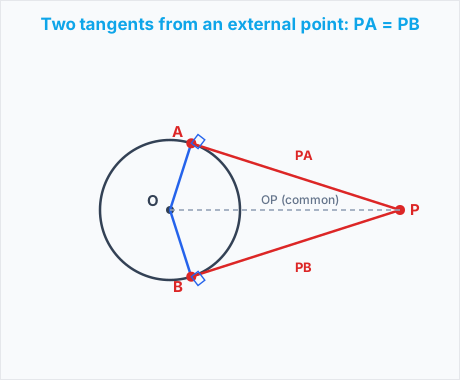
Given. A circle with centre O, a point P lying outside the circle, and two tangents PA and PB drawn from P, touching the circle at A and B respectively.
To prove. PA = PB.
Proof. Join OA, OB and OP.
PA is a tangent and OA is the radius to its point of contact A. So by Theorem 1, ∠OAP = 90°. In the same way, PB is a tangent and OB is its radius, so ∠OBP = 90°. This means △OAP and △OBP are both right-angled triangles. In each one, the right angle is at the point of contact.
Now let us compare the two right triangles △OAP and △OBP:
- OA = OB — both are radii of the same circle, so they are equal.
- OP = OP — this side belongs to both triangles, so it is shared. (It is the hypotenuse of each.)
- ∠OAP = ∠OBP = 90° — both have a right angle.
These three matching parts are exactly the pattern that proves two right triangles identical. Let us recall that rule — RHS congruence — and the CPCT step that follows from it.
So we have a right angle, an equal hypotenuse, and one more equal side in each triangle. This matches the RHS congruence rule (Right angle – Hypotenuse – Side). So △OAP ≅ △OBP, meaning the two triangles are exactly the same shape and size.
When two triangles are congruent, their matching parts are equal. This rule is called CPCT (Corresponding Parts of Congruent Triangles). The side PA in one triangle matches the side PB in the other. So:
PA = PB. ∎
A quicker way using Pythagoras. In each right triangle, PA² = OP² − OA² and PB² = OP² − OB². But OA = OB (they are radii). So PA² = PB², which gives PA = PB.
A bonus fact. From the congruence we also get ∠OPA = ∠OPB. This means OP cuts the angle ∠APB into two equal halves (it bisects the angle between the two tangents). So the centre always lies on the line that bisects the angle between the two tangents.
Let us put Theorem 2 to work on a favourite exam question — a four-sided shape wrapped snugly around a circle.
A quadrilateral ABCD is drawn so that all four of its sides touch a circle (the circle is inscribed in it). Prove that AB + CD = AD + BC.
- Let the circle touch the sides AB, BC, CD and DA at the points P, Q, R and S. Look at any vertex, say A. The two sides that meet at A both touch the circle, so they are both tangents drawn from A. The same is true at every vertex.
- By Theorem 2, the two tangents from a point are equal. So at each vertex the two tangent lengths are equal: from A, AP = AS; from B, BP = BQ; from C, CR = CQ; from D, DR = DS.
- Now add all four equations together. Add the left sides, then the right sides: (AP + BP) + (CR + DR) = (AS + BQ) + (CQ + DS). On the left, AP + BP is the full side AB, and CR + DR is the full side CD. So the left side is AB + CD. On the right, regroup the terms: (AS + DS) is the side AD, and (BQ + CQ) is the side BC. So the right side is AD + BC.
- So AB + CD = AD + BC. In any quadrilateral that wraps around a circle, the two pairs of opposite sides add up to the same total. ∎
Here is one more, this time tying both theorems together to link the angle at the outside point with an angle inside the figure.
Two tangents TP and TQ are drawn to a circle with centre O from an external point T. Prove that ∠PTQ = 2 ∠OPQ.
- Call the angle at T as θ, so ∠PTQ = θ. By Theorem 2, the two tangents are equal, so TP = TQ. A triangle with two equal sides is called isosceles. So △TPQ is isosceles.
- In an isosceles triangle, the two base angles (the angles opposite the equal sides) are equal. Also, all three angles of any triangle add up to 180°. So the two equal base angles share what is left after taking away θ: ∠TPQ = ∠TQP = ½(180° − θ) = 90° − ½θ.
- By Theorem 1, the radius OP is perpendicular to the tangent TP. So the angle ∠OPT = 90°.
- The angle ∠OPQ is what is left of ∠OPT after we remove ∠TPQ: ∠OPQ = ∠OPT − ∠TPQ = 90° − (90° − ½θ) = ½θ. Since θ = ∠PTQ, this says ∠OPQ = ½∠PTQ. Multiply both sides by 2 to get ∠PTQ = 2 ∠OPQ. ∎
Common Mistakes
These are the slip-ups that trip up most students on circles. Read each one and check you would not have fallen for it.
A tangent and the radius at the touch point meet at some angle that changes from circle to circle.
Circles come in different sizes and tangents point in different directions, so it feels like the angle should be different each time.
The angle is ALWAYS exactly 90°, for every circle and every tangent. Theorem 1 proves that the radius to the touch point is the shortest distance from the centre to the tangent line. And the shortest distance is always perpendicular, which means 90°.
In the radius-tangent right triangle, since OQ² = OP² + PQ², you can find PQ by adding the squares.
Students remember the rule as 'Pythagoras means add the squares' and use it without first checking which side is the hypotenuse.
The right angle is at the touch point P (because radius ⊥ tangent). So the line to the centre, OQ, is the longest side, the HYPOTENUSE. To find a shorter side you must SUBTRACT: PQ² = OQ² − OP². If you add instead, you get a wrong, too-big answer.
You can draw two tangents to a circle from any point, whether it is inside or outside.
The 'two equal tangents' rule is so easy to remember that it feels like it works everywhere.
Two tangents come only from a point OUTSIDE the circle. From a point ON the circle there is exactly one tangent. From a point INSIDE there are none, because every line through an inside point cuts the circle at two points.
The two tangents from an outside point only look equal in clean textbook figures. In a crooked drawing they would be different.
A rough or tilted drawing can make PA look longer than PB, so the equality feels like it only happens because of careful drawing.
PA = PB is a proven theorem (RHS congruence of △OAP and △OBP). It is true for EVERY outside point and EVERY circle, no matter how messy the drawing is. The centre even lies on the line that splits the angle between the two tangents into equal halves.
Quick Check
A straight line touches a circle at exactly one point. What is the line called?
The tangent at a point P of a circle with centre O makes what angle with the radius OP?
From a point Q the length of the tangent to a circle is 24 cm and the distance of Q from the centre is 25 cm. What is the radius of the circle?
Tangents PA and PB are drawn from an external point P to a circle. Which statement is always true?
Practice Problems
Easy
The length of a tangent from a point A at distance 5 cm from the centre of a circle is 4 cm. Find the radius of the circle.
Let the centre be O and let the tangent touch the circle at B. The radius OB is perpendicular to the tangent AB, so the triangle △OBA has a right angle at B.
The right angle is at B, so the side opposite it, OA = 5 cm, is the hypotenuse. AB = 4 cm is one leg. By Pythagoras, subtract to find the other leg:
OB² = OA² − AB² = 5² − 4² = 25 − 16 = 9.
So the radius OB = 3 cm.
How many tangents can be drawn to a circle from (i) a point inside it, (ii) a point on it, (iii) a point outside it?
(i) From a point inside the circle: 0 tangents. Every line you draw through a point inside the circle cuts the circle at two points, so none of them can be a tangent.
(ii) From a point on the circle: exactly 1 tangent.
(iii) From a point outside the circle: exactly 2 tangents (and they are equal in length).
Medium
Two concentric circles have radii 5 cm and 3 cm. Find the length of the chord of the larger circle which touches the smaller circle.
Both circles share the same centre O. The chord AB belongs to the larger circle, and it touches the smaller circle at a point P. So AB is a tangent to the smaller circle. That means OP, which is a radius of the smaller circle, is perpendicular to AB. So OP ⊥ AB and OP = 3 cm.
There is a rule from Class 9: a line drawn from the centre perpendicular to a chord cuts the chord into two equal halves. Let us see why this is true, with a fresh chord AB and the foot of the perpendicular called M, so we are not just trusting the rule. Join the radii OA and OB. Now compare the two right triangles OMA and OMB. They have OA = OB (both are radii of the same circle, so they are the equal hypotenuses), OM is shared, and the angle at M is 90° in each. That is the RHS pattern, so △OMA ≅ △OMB. By CPCT the matching sides MA and MB are equal — so M is the midpoint and the chord is cut in half. Figure 10.6 below shows this set-up.

Applying that here: since OP comes from the centre and is perpendicular to AB, it bisects AB. So P is the midpoint of AB, which means AP = PB.
In the right triangle OPA, the right angle is at P, so OA = 5 cm (the radius of the larger circle) is the hypotenuse. Subtract to find AP:
AP² = OA² − OP² = 5² − 3² = 25 − 9 = 16, so AP = 4 cm.
The full chord is AB = 2 × AP = 2 × 4 = 8 cm.
Prove that the tangents drawn at the two ends of a diameter of a circle are parallel.
Let AB be a diameter of a circle with centre O. Draw the tangent at A and the tangent at B.
By Theorem 1, the tangent at A is perpendicular to the radius OA. In the same way, the tangent at B is perpendicular to the radius OB. Now, AB is a diameter, so it passes straight through the centre. That means OA and OB both lie along the same straight line, which is AB.
So both tangents are perpendicular to the same line, AB. There is a simple rule: if two lines are each perpendicular to the same line, then those two lines are parallel to each other.
So the tangents at the two ends of a diameter are parallel. ∎
Challenge
PQ is a chord of length 8 cm of a circle of radius 5 cm. The tangents at P and Q intersect at a point T. Find the length TP.
Join OT, where O is the centre. The two tangents are equal, so TP = TQ. A triangle with two equal sides is isosceles, so △TPQ is isosceles. In such a triangle, the line TO splits the top angle ∠PTQ into two equal halves. This same line is also perpendicular to the base PQ and cuts it into two equal parts. Let it meet PQ at the point R. Then PR = RQ = 4 cm (half of the 8 cm chord).
In the right triangle OPR, the right angle is at R, so OP = 5 cm is the hypotenuse. Subtract to find OR: OR² = OP² − PR² = 5² − 4² = 25 − 16 = 9, so OR = 3 cm.
Now let us look at some angles. In the right triangle △OPT, the radius OP is perpendicular to the tangent TP, so ∠OPT = 90°. The angle ∠OPT is made up of two smaller angles, ∠TPR and ∠RPO, so ∠TPR + ∠RPO = 90°. In the right triangle △TPR, the right angle is at R, so its other two angles add to 90°: ∠TPR + ∠PTR = 90°. Both equations contain ∠TPR. Comparing them tells us ∠RPO = ∠PTR.
So the two right triangles △TRP and △PRO have two equal angles each (a right angle and the pair we just found). When two triangles have two equal angles, they are similar (this is AA similarity). In similar triangles, matching sides are in the same ratio. Matching the sides:
TP / PO = RP / RO, that is TP / 5 = 4 / 3. So TP = 20/3 cm ≈ 6.67 cm.
(You can check this with Pythagoras. Let TP = x and TR = y. From △PRT we get x² = y² + 16. From △OPT we get x² + 25 = (y + 3)². Subtracting the first from the second gives y = 16/3. Then x² = (16/3)² + 16 = 400/9, so x = 20/3 cm. ✓)
Summary
You should now be able to explain:
- A straight line drawn near a circle does one of three things. It misses the circle, it cuts it at two points (a secant), or it touches it at exactly one point (a tangent). The touch point is called the point of contact.
- A tangent is just a secant whose two cutting points have merged into one.
- How many tangents you can draw from a point: none from inside the circle, exactly one from a point on the circle, and exactly two from a point outside it.
- Theorem 1: the tangent at any point is perpendicular to the radius drawn to the point of contact. We proved this because that radius is the shortest distance from the centre to the tangent line.
- Theorem 2: the two tangents from a point outside the circle are equal in length. We proved this using RHS congruence of the two right triangles. Also, the centre lies on the line that splits the angle between the two tangents into equal halves.
- Whenever a radius and a tangent make a right triangle, the line going to the centre is the hypotenuse. So you subtract the squares (not add) to find a tangent length.
What’s Next
You now know how lines touch circles. Next, in Areas Related to Circles, you’ll measure the circle itself. You’ll find its area and its circumference (the distance around it). Then you’ll find the length of an arc (a part of the edge), and the areas of sectors and segments. A sector is a pizza-slice shape, and a segment is a bow shape. Put those formulas together with the tangent facts from this chapter, and you can find the area of many curved shapes you see in design and real life.
Frequently Asked Questions
What is a tangent to a circle and how is it different from a secant?
A tangent is a straight line that touches the circle at exactly one point, called the point of contact. A secant is a line that cuts through the circle at two points. You can think of a tangent as a secant whose two cutting points have slid closer and closer together until they merged into one.
Why is the tangent to a circle always perpendicular to the radius at the point of contact?
The radius from the centre O to any point on the circle is the shortest distance from O to that point on the circle. The tangent line touches the circle at one point but otherwise sits entirely outside it. This means the point of contact is the closest point on the tangent line to the centre O. The shortest distance from a point to a line is always the perpendicular, so OT must be perpendicular to the tangent.
How many tangents can be drawn to a circle from a point, and does it depend on where the point is?
It depends on the position of the point relative to the circle. From a point inside the circle, no tangent can be drawn. From a point on the circle, exactly one tangent can be drawn (at that point). From a point outside the circle, exactly two tangents can always be drawn.
Why are the two tangents drawn from an external point equal in length?
If PA and PB are the two tangents from external point P to a circle with centre O, then triangles OAP and OBP are congruent by RHS (OA = OB as radii, OP is common, and both angles OAP and OBP are 90°). Congruent triangles have equal corresponding sides, so PA = PB.
How do you find the length of a tangent from an external point if you know the radius and the distance to the centre?
In the right triangle formed by the centre O, the external point P, and the point of tangency T, the right angle is at T. By the Pythagoras theorem, PT² = OP² − OT² = OP² − r², so PT = √(OP² − r²). For example, if OP = 13 cm and radius r = 5 cm, the tangent length is √(169 − 25) = √144 = 12 cm.