Some Applications of Trigonometry
Why This Matters
How tall is the Qutub Minar? How wide is a river you cannot cross? How high is a kite, or a cloud, or a mountain peak?
You cannot run a measuring tape up a 70-metre tower. You cannot stretch one across flowing water either. But here is the good news: you do not have to.
Instead, you stand at a spot. You measure how far you are from the bottom of the object. Then you point at the top and measure one angle. This is the angle that your line of sight makes with the ground.
That one angle, plus the one distance you can measure, is enough. Together they give you the exact height.
This is trigonometry coming out of the textbook and into real life. In the last chapter you learned the ratios sin, cos and tan for an angle in a right triangle. Now you get to use them. Every “how tall / how far / how high” question turns into a right triangle. In that triangle you know one side and one angle. The side you want is just one ratio away.
The best part is this: you never need a special angle-measuring tool. Every question uses the standard angles 30°, 45° and 60°. You already know the ratios for these by heart. So build one simple habit — draw the right triangle first — and these problems become almost like clockwork.
The Big Idea
To find a height or distance you cannot reach, turn the situation into a right triangle. The line of sight is the straight line from your eye to the object you are looking at. Look at the angle this line makes with the horizontal (the flat, level direction). When you look up at something above your eye, that angle is the angle of elevation. When you look down at something below your eye, that angle is the angle of depression. Once you know one side and one of the standard angles (30°, 45° or 60°), a single trig ratio — usually tan — gives you the unknown side.
Let’s Break It Down
The line of sight and the angle of elevation
Imagine you are standing on the ground. You look up at the top of a tower. The straight line from your eye to the top of the tower is the line of sight.
Now think of looking straight ahead, flat and level. That level direction is called the horizontal.
When the object is above your eye, you have to raise your head to see it. The angle between your line of sight and the horizontal is the angle of elevation. For example, if you look up at a kite high in the sky, your eyes “rise” by some angle — that angle is the angle of elevation. Figure 9.1 below shows this set-up.
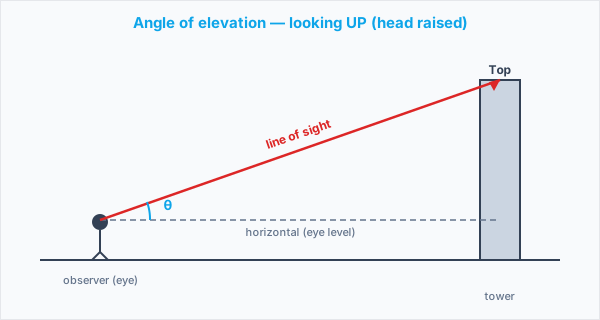
Now let us turn this into a right triangle. The vertical side is the height of the object (the part above your eye). The horizontal side is the distance from you to the bottom of the object. The line of sight is the slanting side, which is the hypotenuse. The right angle (90°) is at the bottom, where the vertical and horizontal meet.
But wait — why is that corner at the foot exactly 90°? We keep saying “draw the right triangle”, yet the whole method only works if that angle is a true right angle. Here is the simple reason, and it is the quiet fact every one of these problems stands on.
A tower, a pole, a building or a tree is built to stand straight up. “Straight up” is what we call vertical — the direction a hanging weight on a string points to. The ground it stands on is flat and level — that direction is called horizontal. Now, “straight up” and “flat across” are at a perfect 90° to each other. They have to be: vertical means pointing directly away from a level surface, and “directly away from level” is the definition of a right angle. So the moment a vertical object sits on level ground, the corner where they meet is a right angle — no extra reason needed. Figure 9.2 below makes this plain.

This single fact is what licences everything else. Trig ratios (sin, cos, tan) are only defined inside a right triangle. Because the foot is guaranteed to be 90°, every “how tall / how far” picture is automatically a right triangle, and the ratios are ready to use.
The angle of elevation sits at your eye. Looking from that angle, the height is the side opposite to it, and the distance is the side next to it (the adjacent side). The ratio that uses opposite and adjacent is the tangent. So tan θ = height / distance.
If words like opposite, adjacent and tangent feel hazy, here is a quick rewind to the three ratios from the last chapter before we lean on them.
The angle of depression
Now imagine you climb to the top of a building. You look down at something on the ground — a car, a boat, or a flower pot. This time your line of sight slopes downward.
The horizontal is still the level direction at your eye. The angle between the horizontal and your downward line of sight is the angle of depression. So “depression” simply means you are looking down. For example, when you stand on a terrace and look down at a dog on the road, your eyes “drop” by some angle — that is the angle of depression. Figure 9.3 below shows this.
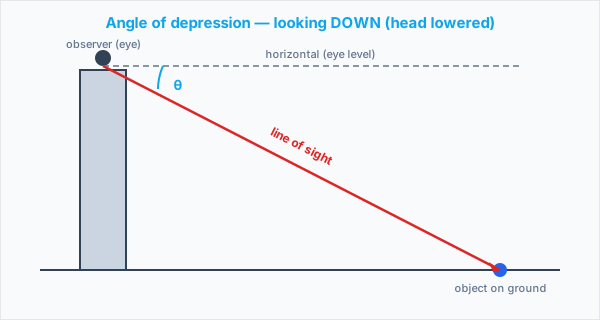
Here is the most useful fact about depression problems. The horizontal line at your eye and the flat ground are both level, so they are parallel to each other. The line of sight cuts across both of them, so it acts like a transversal.
When a transversal cuts two parallel lines, the alternate angles are equal (you learned this in earlier classes). So the angle of depression at the top equals the angle of elevation measured from the object on the ground looking back up at you. In short, the angle at the top and the angle at the bottom are the same. Figure 9.4 below shows why.

The depression angle “drops down” and becomes an equal angle at the bottom of your triangle. This is handy. It lets you place the known angle inside the right triangle, where it is easy to work with.
Try this quick one to lock in that “depression equals elevation” idea before moving on.
An angle of depression of 40° is measured from the top of a cliff to a boat. What is the angle of elevation of the cliff-top from the boat?
Choosing the right ratio
In almost every problem there are three things: the height (vertical side, opposite the angle), the distance to the foot (horizontal side, adjacent to the angle), and the line of sight (the hypotenuse). You will usually know two of them and want to find the third.
The trick is to pick the ratio that connects what you know to what you want. Use this small table to choose: find the row that matches your two sides, and use that ratio.
| You know / want | Use | Formula (angle θ at the observer) |
|---|---|---|
| height & distance | tan θ | tan θ = height / distance |
| height & line of sight | sin θ | sin θ = height / hypotenuse |
| distance & line of sight | cos θ | cos θ = distance / hypotenuse |
And here are the standard-angle values you will use again and again. Keep them ready:
| θ | sin θ | cos θ | tan θ |
|---|---|---|---|
| 30° | 1/2 | √3/2 | 1/√3 |
| 45° | 1/√2 | 1/√2 | 1 |
| 60° | √3/2 | 1/2 | √3 |
Wondering why it is always these three angles, and how to remember which value goes where? This refresher clears that up.
Worked problems
Let us start with the simplest case. We have a tower and a known distance, and we want to find the height. Figure 9.5 below sets it up as a right triangle.
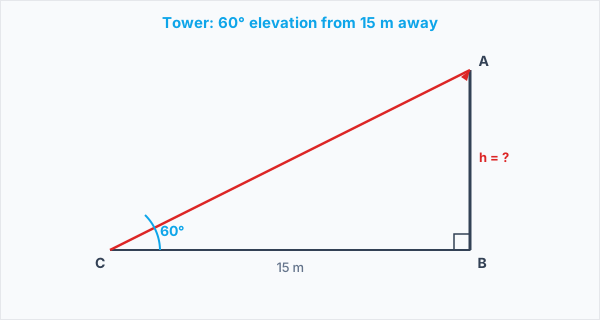
With that triangle drawn, watch how a single tan ratio turns the 15 m and the 60° into the tower’s height.
A tower stands vertically on the ground. From a point on the ground 15 m away from its foot, the angle of elevation of the top is 60°. Find the height of the tower.
- First, draw the right triangle ABC. AB is the tower, standing straight up. B is its foot, where the right angle is. C is the point on the ground, 15 m away, so CB = 15 m. The angle of elevation at C is 60°.
- We know the distance (the adjacent side = 15 m). We want the height (the opposite side = AB). The ratio that links opposite and adjacent is the tangent. So we use tan 60° = AB / CB.
- Rearrange to find AB: AB = CB × tan 60° = 15 × √3. (Remember, tan 60° = √3.)
- So the height of the tower is 15√3 m ≈ 25.98 m.
Next, let us look at a case where the line of sight itself (the hypotenuse) is the unknown. When the hypotenuse is what we want, we use sin.
An electrician must reach a point 1.3 m below the top of a 5 m pole. Her ladder leans at 60° to the horizontal. How long must the ladder be, and how far from the pole's foot should she place it? (Take √3 = 1.73.)
- The pole is 5 m tall, and she must reach a point 1.3 m below the top. So the point she reaches is at height BD = 5 − 1.3 = 3.7 m up the pole. The ladder BC is the slanting side, so it is the hypotenuse. The 60° angle is at the ground point C, and the right angle is at the pole’s foot D.
- Here we know the height (opposite = 3.7 m) and we want the ladder (hypotenuse). The ratio that links opposite and hypotenuse is sine. So sin 60° = BD / BC. Rearranging: BC = BD / sin 60° = 3.7 / (√3/2) = (3.7 × 2) / √3.
- Now put in √3 = 1.73: BC = 7.4 / 1.73 ≈ 4.28 m. So the ladder must be about 4.28 m long.
- The second question asks how far the foot of the ladder is from the pole. That is the distance DC. Now we know the height (opposite) and want the distance (adjacent), so we use the tangent. tan 60° = BD / DC, so DC = BD / tan 60° = 3.7 / √3 = 3.7 / 1.73 ≈ 2.14 m from the pole’s foot.
Now a small but important point. So far we pretended the observer’s eyes were right on the ground. But real people have a height. Their eyes are above the ground. When this happens, the triangle gives you only the height above eye level. So you must add the observer’s own height at the end to get the full height.
An observer 1.5 m tall stands 28.5 m from a chimney. The angle of elevation of the chimney's top from her eyes is 45°. Find the height of the chimney.
- Her eyes are 1.5 m above the ground. Draw the triangle from her eyes, not from the ground. Let AE be the part of the chimney above her eye level. The horizontal distance at eye level is DE = 28.5 m, and the 45° angle is at her eye.
- We know the distance and want the height above her eyes, so we use tangent. tan 45° = AE / DE, so AE = DE × tan 45° = 28.5 × 1 = 28.5 m. (Remember, tan 45° = 1.) This is only the part of the chimney above her eyes.
- To get the full chimney height, add back her eye height: full height = (part above eyes) + (her eye height) = AE + 1.5.
- Full height = 28.5 + 1.5 = 30 m.
Many exam problems give you two angles for the same object. Do not panic. Just treat them as two right triangles that share a side. Write an equation for each triangle, then solve them together.
From a point P on the ground the angle of elevation of the top of a 10 m building is 30°. A flag is hoisted on top, and the elevation of the flag's top from P is 45°. Find the length of the flagstaff and the distance of P from the building. (Take √3 = 1.732.)
- Let A be the foot of the building, B its top, and D the top of the flag. Let PA be the horizontal distance from P to the building. Start with the first triangle PAB (just the building). We know the building is 10 m and the angle is 30°. Using tangent: tan 30° = AB / PA = 10 / PA.
- Since tan 30° = 1/√3, we get 1/√3 = 10 / PA. Cross-multiply: PA = 10√3 = 10 × 1.732 = 17.32 m. This is the distance of P from the building.
- Now the flagstaff. Let its length DB = x. Then the total height from the ground to the flag’s top is AD = 10 + x. Use the second triangle PAD (building plus flag), where the angle is 45°. tan 45° = AD / PA, so 1 = (10 + x) / (10√3).
- Since tan 45° = 1, we get 10 + x = 10√3 = 17.32. So x = 17.32 − 10 = 7.32 m. That is the length of the flagstaff.
Before that, one idea that shadow problems quietly assume: a tall object and the shadow it casts already form a right triangle, all on their own — no observer needed. It is worth seeing exactly why, because the “angle” in a shadow problem is not measured by a person but set by the Sun.
Think about a pole standing in sunlight. The Sun is so far away that its rays reaching us are, for all purposes, parallel — they all slant down at the same angle. One of those rays just grazes the top of the pole and carries on to land on the ground. The spot where it lands is exactly where the pole’s shadow ends — because beyond that point the pole no longer blocks the light. So three lines close up into a triangle: the pole (going straight up), its shadow (lying flat on the ground), and that grazing sun ray from the top of the pole to the shadow’s tip.
This is a right triangle for the same reason as before: the pole is vertical and the shadow is horizontal, so the corner at the foot is 90°. The angle the sun ray makes with the ground (at the tip of the shadow) is called the Sun’s altitude. Figure 9.6 below shows the whole set-up.

So a shadow problem is just a tower problem in disguise: the height is the opposite side, the shadow is the adjacent side, and the Sun’s altitude is the angle. That gives tan θ = height / shadow straight away. Notice what this means: a lower Sun (smaller altitude) makes a longer shadow, which is why shadows stretch out near sunrise and sunset. The next problem uses exactly this.
The shadow of a tower on level ground is 40 m longer when the Sun's altitude is 30° than when it is 60°. Find the height of the tower.
- When the Sun is high (60°), the shadow is short. When the Sun is low (30°), the shadow is long. Let the tower height be h. Let the shorter shadow (at 60°) be x. Then the longer shadow (at 30°) is x + 40, since it is 40 m longer.
- For the shorter shadow at 60°: tan 60° = h / x, so √3 = h / x, which gives h = x√3. Call this equation (1).
- For the longer shadow at 30°: tan 30° = h / (x + 40), so 1/√3 = h / (x + 40), which gives h = (x + 40)/√3. Call this equation (2).
- Both equations equal h, so set them equal: x√3 = (x + 40)/√3. Multiply both sides by √3 to clear the fraction: 3x = x + 40. So 2x = 40, which gives x = 20. Now find h: h = x√3 = 20√3. So the tower is 20√3 m ≈ 34.64 m tall.
Now let us try a depression problem with two angles. Watch how each depression angle drops down into the triangle and becomes an equal angle there. Figure 9.7 below shows the layout.
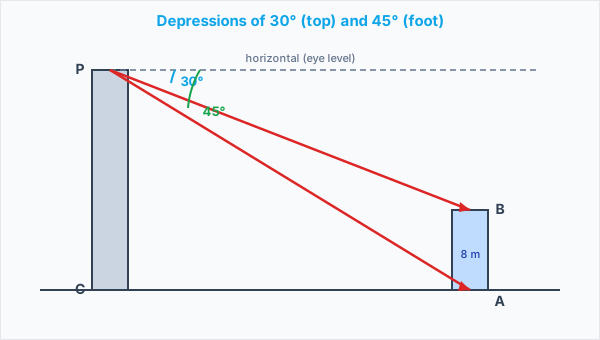
Using that figure, let us split it into an upper and a lower triangle and solve for both the tall building’s height and the gap between them.
From the top of a multi-storeyed building, the angles of depression of the top and bottom of an 8 m tall building are 30° and 45°. Find the height of the multi-storeyed building and the distance between the two buildings.
- Let P be the top of the tall building and C its foot. Let A be the foot and B the top of the short 8 m building. The horizontal line at P is parallel to the ground. So by alternate angles, the 30° depression to B becomes a 30° angle at B, and the 45° depression to A becomes a 45° angle at A. Let PD be the part of the tall building that is above B’s level. Let the gap between the buildings be AC = BD = d (these are equal because they are opposite sides of a rectangle).
- Look at the lower triangle PAC (the full tall building). tan 45° = PC / AC, and tan 45° = 1, so PC = AC = d. This means the full height PC is equal to the distance d.
- Now the upper triangle PBD (above the short building’s roof). tan 30° = PD / BD, so 1/√3 = PD / d, which gives PD = d/√3. We also know PC = PD + DC. Here DC is the height of the short building, which is 8 m. So d = d/√3 + 8.
- Now solve for d. Move the d/√3 over: d − d/√3 = 8. Take d common: d(1 − 1/√3) = 8. Combine the bracket: d(√3 − 1)/√3 = 8. So d = 8√3/(√3 − 1). Rationalising gives d = 4(3 + √3) = (12 + 4√3) m ≈ 18.93 m. This is both the height of the tall building and the distance between the two buildings.
One more example. Here we find the width of a river by standing on a bridge and using two depression angles.
From a point on a bridge across a river, the angles of depression of the banks on opposite sides are 30° and 45°. The bridge is 3 m above the banks. Find the width of the river.
- Let P be the point on the bridge. Drop a straight line down from P to the water level; call its foot D, so PD = 3 m (the height of the bridge). Let A and B be the two banks on either side. By alternate angles, the two depression angles become the angles at A and B. So angle A = 30° and angle B = 45°.
- Take the triangle PAD on one side. We know the height (3 m) and want the distance AD, so use tangent. tan 30° = PD / AD, so 1/√3 = 3 / AD, which gives AD = 3√3 m.
- Now the triangle PBD on the other side. tan 45° = PD / BD, so 1 = 3 / BD, which gives BD = 3 m.
- The river’s full width is AB = AD + BD = 3√3 + 3 = 3(√3 + 1) m ≈ 8.20 m.
Common Mistakes
These four slips trip up almost everyone in heights-and-distances problems. The first is about where the angle of depression actually lives.
The angle of depression is measured up from the ground at the object.
In the picture the object sits on the ground. So it feels natural to mark the angle there, between the ground and the line going up to the observer.
The angle of depression is measured at the OBSERVER'S eye, going DOWN from the horizontal. You are allowed to move it to the bottom of the triangle, but only because it equals the angle of elevation at the object (alternate angles). So draw the horizontal line at the eye first, then mark the angle just below it.
Always use sin θ to find a height.
Height is the 'vertical' side, and sin uses the 'opposite' side, which is often the height. So sine starts to feel like the 'height ratio'.
The ratio you pick depends on the OTHER side you know. If you know the horizontal distance, use tan θ = height / distance. Use sin θ only when the hypotenuse (the line of sight) is the side you know or want. If you pick the wrong ratio, you pull an unknown hypotenuse into the problem and get stuck.
When the observer has a height, the triangle gives the object's full height directly.
The trig ratio gives a clean number. So it is tempting to call that number 'the answer' without thinking about where the eye actually is.
A triangle drawn from the EYE gives only the height ABOVE eye level. You must add the observer's height (for example 1.5 m) at the end to get the true height of the object. Forgetting this step is the most common slip in these problems.
tan 30° = √3 and tan 60° = 1/√3.
Both 30° and 60° use √3, so it is easy to mix them up. Also √3 feels 'bigger', so people wrongly hand it to the smaller angle.
The correct values are tan 30° = 1/√3 and tan 60° = √3. Think of it this way: a small angle gives a small tangent, and a big angle gives a big tangent. So the bigger angle, 60°, gets the bigger value, √3. Quick check: a steeper line of sight means a bigger angle and a bigger tan.
Quick Check
You stand on the ground and look up at the top of a tower. The angle your line of sight makes with the horizontal is the angle of…
A point is 30 m from the foot of a tower and the angle of elevation of the top is 30°. The height of the tower is…
From the top of a cliff the angle of depression of a boat is 35°. The angle of elevation of the cliff-top from the boat is…
A 1.5 m tall person finds the part of a pole above her eye level is 8 m (from her trig triangle). The pole's height is…
Practice Problems
Easy
A circus artist climbs a 20 m long rope tied from the top of a vertical pole to the ground. The rope makes 30° with the ground. Find the height of the pole.
The rope is the hypotenuse (20 m), the pole is the opposite side (height), and the angle at the ground is 30°.
sin 30° = height / 20 → height = 20 × sin 30° = 20 × (1/2) = 10 m.
A kite flies at a height of 60 m. The string from the kite is tied to a point on the ground, making 60° with the ground, with no slack. Find the length of the string.
The string is the hypotenuse, the height (60 m) is opposite the 60° angle.
sin 60° = 60 / string → string = 60 / sin 60° = 60 / (√3/2) = 120/√3 = 40√3 ≈ 69.28 m.
Medium
A tree breaks in a storm; the broken top bends so it touches the ground 8 m from the foot, making 30° with the ground. Find the original height of the tree.
When the tree breaks, the bottom part stays standing straight up. The top part bends over and its tip touches the ground. So the standing part and the leaning part together made up the original tree.
Let the standing part be h. Let the broken, leaning part be the slanting side (hypotenuse) of length L. The distance from the foot of the tree to where the tip touches the ground is 8 m. This 8 m is the side next to the 30° angle (adjacent).
For the standing part, use tangent: tan 30° = h / 8, so h = 8 × (1/√3) = 8/√3 = 8√3/3 m.
For the leaning part, we know the adjacent (8 m) and want the hypotenuse, so use cosine: cos 30° = 8 / L, so L = 8 / (√3/2) = 16/√3 = 16√3/3 m.
The original height is the standing part plus the leaning part: h + L = 8√3/3 + 16√3/3 = 24√3/3 = 8√3 m ≈ 13.86 m.
A 1.5 m tall boy stands away from a 30 m building. As he walks towards it, the elevation of the top rises from 30° to 60°. How far did he walk?
The top of the building is 30 − 1.5 = 28.5 m above his eyes. Let his two distances (from the building) be d₁ (at 30°) and d₂ (at 60°).
At 30°: tan 30° = 28.5 / d₁ → d₁ = 28.5 / (1/√3) = 28.5√3.
At 60°: tan 60° = 28.5 / d₂ → d₂ = 28.5 / √3 = 28.5/√3 = 9.5√3.
Distance walked = d₁ − d₂ = 28.5√3 − 9.5√3 = 19√3 ≈ 32.9 m.
Challenge
Two equal poles stand on opposite sides of an 80 m wide road. From a point between them on the road, the elevations of the two tops are 60° and 30°. Find the height of the poles and the distances of the point from each pole.
Let the common height be h, and let the point be x m from the first pole (the 60° one). Then it is (80 − x) m from the second pole (the 30° one).
First pole: tan 60° = h / x → h = x√3. … (1)
Second pole: tan 30° = h / (80 − x) → h = (80 − x)/√3. … (2)
Set (1) = (2): x√3 = (80 − x)/√3. Multiply by √3: 3x = 80 − x → 4x = 80 → x = 20.
So the point is 20 m from the first pole and 60 m from the second.
Height h = x√3 = 20√3 ≈ 34.64 m.
From the top of a 7 m building, the angle of elevation of the top of a cable tower is 60° and the angle of depression of its foot is 45°. Find the height of the tower.
Let the horizontal distance between the building and the tower be d. From the building’s top, looking at the tower’s foot, the depression is 45°; by alternate angles the bottom part of the tower below the building’s roof level equals 7 m.
Depression to foot (45°): the foot is 7 m below the roof level, so tan 45° = 7 / d → d = 7 m.
Elevation to top (60°): the part of the tower ABOVE the roof level, call it a, satisfies tan 60° = a / d → a = d × √3 = 7√3 m.
Total tower height = (part below roof level) + (part above) = 7 + 7√3 = 7(1 + √3) ≈ 19.12 m.
Summary
You should now be able to explain:
- The line of sight is the straight line from an observer’s eye to the object being viewed.
- The angle of elevation is the angle the line of sight makes with the horizontal when the object is above eye level (you look up); the angle of depression is the angle when the object is below eye level (you look down).
- A height/distance problem becomes a right triangle: vertical = height (opposite), horizontal = distance (adjacent), line of sight = hypotenuse.
- Choose the ratio that links what you know to what you want: tan (height & distance), sin (height & line of sight), cos (distance & line of sight).
- The angle of depression equals the angle of elevation from the object back to the observer (alternate angles), so you can move it into the triangle.
- If the observer has a height, the triangle gives only the height above eye level — add the observer’s height at the end.
- Problems with two angles split into two right triangles sharing a side; set up the equations and combine.
What’s Next
So far all our shapes have been triangles. Next, in Circles, the star shape is the round one. The key new idea is the tangent: a line that just touches a circle at exactly one point. You will learn two neat facts. First, a tangent is always perpendicular (at 90°) to the radius at the point where it touches. Second, if you draw two tangents to a circle from the same outside point, they are exactly equal in length. These are clean, surprising facts. You will first prove them, and then use them to solve problems.
Frequently Asked Questions
What is the angle of elevation and how is it different from the angle of depression?
The angle of elevation is the angle your line of sight makes with the horizontal when you look UP at something above your eye level — for example, looking up at a tower. The angle of depression is the angle your line of sight makes with the horizontal when you look DOWN at something below your eye level — for example, looking down from a cliff at a boat. Both angles are measured from the horizontal, not from the vertical.
How do you find the height of a tower using trigonometry?
Stand at a known distance d from the base of the tower. Measure the angle of elevation θ to the top. The tower height h and the distance d form the two legs of a right triangle, with θ at the base. Since tan θ = opposite/adjacent = h/d, you get h = d × tan θ. For standard angles (30°, 45°, 60°) you can substitute the exact tan value without a calculator.
Why is tan the most used trigonometric ratio in heights and distances problems?
In a heights-and-distances problem you usually know the horizontal distance and the angle, and you want the vertical height — or vice versa. The horizontal distance is the 'adjacent' side and the vertical height is the 'opposite' side. tan = opposite/adjacent connects exactly these two, making it the natural choice. sin and cos involve the hypotenuse (the slant line of sight), which you rarely measure directly.
What does it mean when two angles of elevation from different points give different heights for the same object?
It means you are looking from two different horizontal distances. The closer you are, the steeper the angle (larger angle of elevation). Setting up two equations — one for each observation point — lets you solve for two unknowns, usually the height and one of the distances. This is a classic 'two-equation' problem in this chapter.
How do you set up the right triangle in an angle of depression problem?
When you look down from a height at an object below, the angle of depression is measured from the horizontal at your eye level downward to the line of sight. Draw a horizontal line at eye level. The vertical drop to the object is one leg and the horizontal distance to the object is the other leg. By the alternate interior angles rule (parallel lines), the angle of depression at the top equals the angle of elevation from the bottom — so you can use the same triangle formula.