Introduction to Trigonometry
Why This Matters
How tall is the Qutub Minar? It is about 73 metres high. You cannot just climb up and drop a measuring tape down its side. But there is a clever way. Stand some distance away from it. Measure how far you are standing. Then look up at the top and measure the angle your eyes make as you look up. From just these two numbers, you can find the height. You never have to climb anything.
The same trick works in many places. How wide is a river you cannot cross? Use the same idea. How high is a hot-air balloon floating in the sky? Same idea again.
The tool behind all of this is called trigonometry. The word comes from Greek: tri means three, gon means sides, and metron means measure. So the word literally means “measuring triangles”. Here is its big discovery. In a right triangle (a triangle with one 90° angle), the angles and the sides are tied together in a fixed way. Once you know one angle, the shape of the triangle is fixed. And if the shape is fixed, then the ratio of any two sides is fixed too. This stays true whether you draw the triangle tiny or huge.
Long ago, astronomers used exactly this idea to measure the distances to stars and planets they could never visit. Today the same ratios are used in engineering, physics, GPS, and computer graphics. This chapter builds the base for all of it. You will learn six ratios, their exact values at the most useful angles, and three identities that link them together. And it all comes from one old friend you already know: the Pythagoras theorem.
The Big Idea
In a right triangle, pick one acute angle (an angle smaller than 90°). The three sides now get names based on that angle. The side facing the angle is the opposite. The side that runs along the angle (the one touching it that is not the hypotenuse) is the adjacent. The longest slanting side is the hypotenuse. The six trigonometric ratios (sin, cos, tan, and their flipped versions cosec, sec, cot) are simply ratios made from these sides. Here is the key magic. These ratios depend only on the angle, not on how big the triangle is. Why? Because all right triangles with the same acute angle have the same shape — they are similar — so their sides always stay in the same proportion.
Let’s Break It Down
The six trigonometric ratios
Before we name any ratios, three words have to be rock-solid: right triangle, hypotenuse, and acute angle. Here is a quick refresher.
Take a right triangle and pick one acute angle. We will call it θ. (θ is the Greek letter theta. Mathematicians often use it to stand for an angle.) Now stand at θ and look across the triangle. Figure 8.1 below shows how to name the three sides from there:
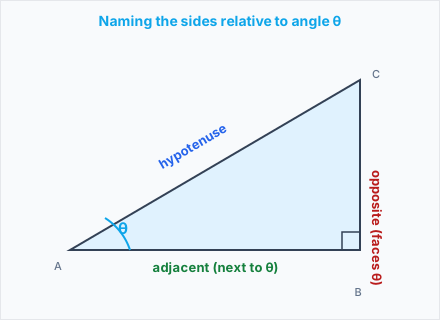
Now the definitions. The first three are the main ratios:
- sin θ = opposite / hypotenuse
- cos θ = adjacent / hypotenuse
- tan θ = opposite / adjacent
The other three are just the reciprocals of the first three. A reciprocal means you flip the fraction upside down. For example, the reciprocal of 2/3 is 3/2.
- cosec θ = 1 / sin θ = hypotenuse / opposite
- sec θ = 1 / cos θ = hypotenuse / adjacent
- cot θ = 1 / tan θ = adjacent / opposite
Two more useful facts come straight from these definitions. They are worth learning by heart:
tan θ = sin θ / cos θ and cot θ = cos θ / sin θ
Let us check the first one. sin θ / cos θ = (opp/hyp) / (adj/hyp). The “hyp” parts cancel out, and you are left with opp/adj, which is exactly tan θ.
A memory hook for the big three: “SOH-CAH-TOA” — Sin = Opp/Hyp, Cos = Adj/Hyp, Tan = Opp/Adj. Figure 8.2 below puts the triangle and the mnemonic together.

One important note about how we write this. sin θ is one single thing. It means “the sine of θ”. It does not mean “sin” multiplied by θ. In fact, “sin” written all by itself means nothing at all. It must always have an angle next to it. Also, when we write sin²θ, we mean (sin θ)² — that is, first find sin θ, then square that number. The same goes for cos²θ, tan²θ, and the rest.
Why the ratios depend only on the angle
The explanation hinges on one idea from earlier classes — similar triangles — so let us bring it back to mind first.
Here is the idea that makes the whole of trigonometry work. Draw two right triangles that share the same acute angle θ. Make one tiny and one huge. Each triangle has a right angle, and each has the angle θ. So they share two equal angles. By the AA similarity rule (two equal angles means similar triangles), the two triangles are similar. And similar triangles have sides in the same proportion. So opp/hyp gives the same number in both triangles. Every other ratio matches too. This is why sin θ, cos θ, and the rest are fixed numbers that belong to the angle. The size of the triangle does not change them at all. Figure 8.3 below shows this with real numbers.

This also gives us a quick and useful fact. The hypotenuse is always the longest side of a right triangle. So when you divide the opposite (a shorter side) by the hypotenuse, you get a number smaller than 1. The same is true for adjacent divided by hypotenuse. This means sin θ and cos θ can never be more than 1.
In the worked example coming up we will need to find a missing side, and that calls for one old tool. Let us dust it off.
Here is a neat payoff: knowing just one ratio is enough to find all six. Watch how Pythagoras fills in the missing side and unlocks the rest.
In a right triangle, tan A = 4/3. Find the other five trigonometric ratios of A.
- We know tan A = opposite/adjacent = 4/3. So let the opposite side be 4k and the adjacent side be 3k. Here k is just some positive number. We use k because we do not know the real lengths, only that they are in the ratio 4 to 3. The ratios will come out the same whatever k is.
- Now find the hypotenuse using Pythagoras: hyp² = (4k)² + (3k)² = 16k² + 9k² = 25k². Taking the square root, hyp = 5k.
- Now read off the main ratios. The k cancels each time: sin A = opp/hyp = 4k/5k = 4/5, and cos A = adj/hyp = 3k/5k = 3/5.
- The other three are just the reciprocals (flipped fractions): cosec A = 1/sin A = 5/4, sec A = 1/cos A = 5/3, cot A = 1/tan A = 3/4. So sin A = 4/5, cos A = 3/5, tan A = 4/3, cosec A = 5/4, sec A = 5/3, cot A = 3/4.
Quick test of the flip rule before moving on — try this one in your head.
If sin θ = 1/3 in a right triangle, what is cosec θ?
Trigonometric ratios of special angles
Some angles show up again and again in problems: 0°, 30°, 45°, 60° and 90°. For 30°, 45° and 60°, we can find exact values. We get them from two special triangles that you can draw with just a ruler and compass.
The 45° angle. Take a right triangle where the two acute angles are both 45°. If two angles are equal, the two sides opposite them are equal too. So the two legs (the two shorter sides) are equal. Let us call each of them 1.
But why must equal angles force equal sides? Figure 8.4 below makes the reason obvious.

Drop a straight line from the top corner down to the middle of the base, so it makes a right angle there. Now fold the triangle along that line. The two base angles are equal, and the two halves of the base are equal, so the two halves of the triangle land exactly on top of each other. If they match perfectly, the two slanting sides must be the same length. That is the rule: equal angles always sit opposite equal sides. So in our 45°-45° triangle, the two legs are equal. Figure 8.5 below shows this triangle with its side lengths.
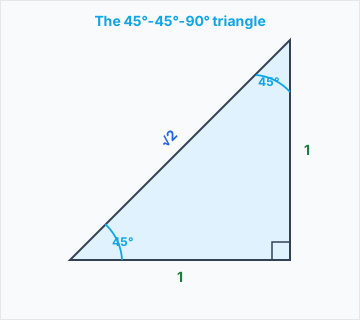
By Pythagoras, hyp² = 1² + 1² = 2, so hyp = √2. Now pick either 45° angle. For it, opposite = 1, adjacent = 1, and hyp = √2. Read off the ratios:
- sin 45° = opp/hyp = 1/√2
- cos 45° = adj/hyp = 1/√2
- tan 45° = opp/adj = 1/1 = 1
The 30° and 60° angles. Start with an equilateral triangle. (Equilateral means all three sides equal and all three angles equal to 60°.) Let each side be 2. Now drop a straight line from the top corner down to the middle of the base, making a right angle with the base. This line cuts the base exactly in half. It also splits the triangle into two identical right triangles. Look at one of them. It has a 60° angle at the bottom, a 30° angle at the top, a base = 1 (half of 2), and a hypotenuse = 2 (this is the original side of the big triangle). Figure 8.6 below shows that one half-triangle with all three sides.
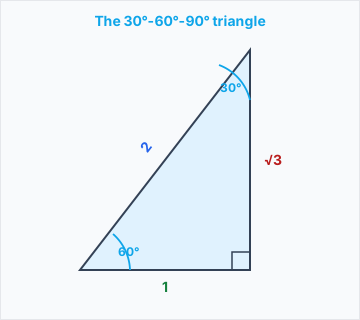
Now find the vertical side using Pythagoras: it is √(2² − 1²) = √(4 − 1) = √3. We now have all three sides. Let us read off the ratios for both angles.
For the 60° angle, the opposite = √3, the adjacent = 1, and the hyp = 2:
- sin 60° = √3/2, cos 60° = 1/2, tan 60° = √3/1 = √3.
For the 30° angle, the opposite and adjacent swap places. Now opposite = 1, adjacent = √3, and hyp = 2:
- sin 30° = 1/2, cos 30° = √3/2, tan 30° = 1/√3.
The 0° and 90° angles. These two are special, so we think about them a little differently. We cannot draw a real triangle with a 0° corner, so instead we watch what happens as the angle gets close to 0°. Figure 8.7 below shows three right triangles, all with the same long side, where the angle is squeezed smaller and smaller.

Imagine slowly squeezing angle A down towards 0°. As you do, the opposite side gets shorter and shorter until it almost disappears, while the hypotenuse and the adjacent side become almost the same length. So opposite/hyp goes to 0 and adjacent/hyp goes to 1, which gives sin 0° = 0 and cos 0° = 1. Now imagine the opposite — opening angle A up towards 90°. This time the adjacent side shrinks away instead. That gives sin 90° = 1 and cos 90° = 0. From these we get tan 0° = 0/1 = 0. But tan 90° = 1/0, and you can never divide by 0, so tan 90° is not defined. (Whenever a ratio asks you to divide by 0, we say it is “not defined”.)
Here are all the values together in one table. Learn it, but also notice a neat pattern. The sin row goes 0, 1/2, 1/√2, √3/2, 1. The cos row is the very same list, just read backwards.
This is not a coincidence — there is a clean reason behind it, and it is worth seeing. It comes from the two acute angles of a right triangle, which always add up to 90°. Figure 8.8 below shows how the two angles share the same sides.

Look at the figure. The two acute angles add up to 90°, so if one is A, the other is 90° − A. Now here is the swap. The side that is opposite to A is the same side that is adjacent to the other angle. And the side adjacent to A is opposite the other angle. Since cos uses adjacent and sin uses opposite, this swap means cos A = sin(90° − A). So cos of an angle equals sin of its “partner” angle. As the angle climbs from 0° to 90°, its partner falls from 90° to 0° — so the cos values are just the sin values in reverse order. That is exactly why the cos row is the sin row read backwards.
| ∠A | 0° | 30° | 45° | 60° | 90° |
|---|---|---|---|---|---|
| sin A | 0 | 1/2 | 1/√2 | √3/2 | 1 |
| cos A | 1 | √3/2 | 1/√2 | 1/2 | 0 |
| tan A | 0 | 1/√3 | 1 | √3 | not defined |
| cosec A | not defined | 2 | √2 | 2/√3 | 1 |
| sec A | 1 | 2/√3 | √2 | 2 | not defined |
| cot A | not defined | √3 | 1 | 1/√3 | 0 |
Let us put that table straight to work. Here is a typical exam expression built from these values.
Evaluate sin 60° cos 30° + sin 30° cos 60°.
- First, look up each value in the table: sin 60° = √3/2, cos 30° = √3/2, sin 30° = 1/2, cos 60° = 1/2.
- Now work out each product. The first product: sin 60° cos 30° = (√3/2)(√3/2) = 3/4. The second product: sin 30° cos 60° = (1/2)(1/2) = 1/4.
- Finally, add the two products: 3/4 + 1/4 = 4/4 = 1.
The table also works in reverse: give it a ratio and it hands back the angle. Here is that idea in action.
In a right triangle, the side opposite an acute angle is half the hypotenuse. What is that angle?
- Remember that opposite/hypotenuse is exactly the sine of the angle. The problem says the opposite is half the hypotenuse, so opposite/hypotenuse = 1/2. That means sin (angle) = 1/2.
- Now we ask: which acute angle has a sine of 1/2? Look in the table. It is 30°.
- So the angle is 30°.
Trigonometric identities — proved from Pythagoras
An identity is an equation that stays true for every allowed value of the angle. (This is different from a normal equation, which is true for only some values.) There are three famous trigonometric identities. The amazing part is that all three come from just one place: the Pythagoras theorem. Take a right triangle ABC with the right angle at B. Let us name the sides for angle A: a = adjacent (AB), b = opposite (BC) and h = hypotenuse (AC). Then Pythagoras tells us:
a² + b² = h² … (★)
We will take this one equation and divide it by three different things. Each time, we get one identity.
Identity 1: sin²A + cos²A = 1. Divide every term of (★) by h²:
a²/h² + b²/h² = h²/h²
This is the same as (a/h)² + (b/h)² = 1. Now notice that a/h = cos A and b/h = sin A. Putting these in, we get
cos²A + sin²A = 1, which is the same as sin²A + cos²A = 1.
This is true for every angle A from 0° up to 90°.
Identity 2: 1 + tan²A = sec²A. This time, divide every term of (★) by a²:
a²/a² + b²/a² = h²/a²
This is the same as 1 + (b/a)² = (h/a)². Now b/a = tan A and h/a = sec A. So we get
1 + tan²A = sec²A.
(This works for 0° ≤ A < 90°. We leave out 90° because both tan and sec are not defined there.)
Identity 3: 1 + cot²A = cosec²A. This time, divide every term of (★) by b²:
a²/b² + b²/b² = h²/b²
This is the same as (a/b)² + 1 = (h/b)². Now a/b = cot A and h/b = cosec A. So we get
1 + cot²A = cosec²A.
(This works for 0° < A ≤ 90°. We leave out 0° because both cot and cosec are not defined there.)
That is the whole engine of this chapter. We took one Pythagoras equation and divided it three different ways. Each way gave us one identity. These identities are very handy. They let you jump between ratios: if you know any one ratio, you can find all the others.
Let us see identity 1 actually hold up with real numbers from a real triangle.
In a right triangle right-angled at C, AB = 29 and BC = 21, with angle B = θ. Show that cos²θ + sin²θ = 1.
- First, find the third side AC using Pythagoras: AC = √(AB² − BC²) = √(29² − 21²) = √(841 − 441) = √400 = 20.
- Now name the sides for angle B (which is θ): opposite = AC = 20, adjacent = BC = 21, hypotenuse = AB = 29. So sin θ = 20/29 and cos θ = 21/29.
- Now put these into the identity: sin²θ + cos²θ = (20/29)² + (21/29)² = (400 + 441)/29² = 841/841 = 1. This is exactly what the identity says it should be.
That was the identity confirming a known answer. Now let us lean on it the practical way — to find ratios we do not yet know, with no triangle drawn at all.
Given sin A = 3/5, find cos A and tan A using the identities (A acute).
- Start from identity 1 and rearrange it to get cos²A on its own: cos²A = 1 − sin²A = 1 − (3/5)² = 1 − 9/25 = 16/25.
- Take the square root to get cos A. Since A is acute, cos A is a positive number, so we keep only the positive root: cos A = √(16/25) = 4/5.
- Now use tan A = sin A / cos A = (3/5) / (4/5) = 3/4. So cos A = 4/5 and tan A = 3/4.
Exam questions often ask you to prove an identity rather than use one. The trick is almost always the same — turn everything into sin and cos. Here is that move step by step.
Prove that sec A (1 − sin A)(sec A + tan A) = 1.
- A good first move in any proof like this is to write everything using only sin and cos. We know sec A = 1/cos A and tan A = sin A/cos A. So the left side becomes (1/cos A)(1 − sin A)(1/cos A + sin A/cos A).
- Look at the last bracket. Both its terms already share cos A on the bottom, so we can add them: 1/cos A + sin A/cos A = (1 + sin A)/cos A. So now the expression is (1/cos A)(1 − sin A)(1 + sin A)/cos A.
- Multiply the two brackets (1 − sin A)(1 + sin A). This is the (x − y)(x + y) pattern, which equals x² − y². So it gives 1 − sin²A. Now we have (1 − sin²A)/cos²A.
- Here is the key step. By identity 1, 1 − sin²A = cos²A. So (1 − sin²A)/cos²A = cos²A/cos²A = 1. That matches the right side, so the proof is done.
Common Mistakes
A handful of slip-ups trip up almost every student here. The very first one is treating “sin A” as a multiplication.
sin A means 'sin' times A, so you can cancel the 'sin' from both sides of an equation.
It looks like a product, sin × A. And in algebra we cancel common factors all the time. So it feels like 'sin' is just a factor sitting next to A that you can remove.
sin A is one whole symbol. You cannot break it apart. It means 'the sine of angle A'. The word 'sin' by itself has no value, so you can never cancel it. To simplify, you must use real ratio values or the identities, never by 'cancelling sin'.
The opposite and adjacent sides have fixed labels, so they stay the same no matter which angle you use.
Once you label a triangle's sides for angle A, the labels look permanent. The hypotenuse really is fixed, so it feels like the others should be too.
Only the hypotenuse is fixed. It is always the side opposite the right angle. But 'opposite' and 'adjacent' depend on which angle you choose. If you switch from angle A to angle C, they swap places. The side that is opposite to A is the adjacent for C.
The identity is sin²A + cos²A = 1, so sin A² + cos A² = 1 means the same thing.
The little 2 is sitting near the same letters either way, so its exact spot looks like it should not matter.
It matters a lot. sin²A means (sin A)² — you find sin A first, then square that number. But 'sin A²' means 'the sine of (A²)' — the sine of a squared angle. That is a totally different thing and it does not belong here. Always square the whole ratio: write it as (sin A)².
Since sin θ and cos θ are just ratios, a value like sin θ = 3/2 is fine for some angle.
sin is 'just a ratio', and 3/2 looks like a perfectly normal ratio. So it seems okay at first glance.
Remember that sin θ = opposite/hypotenuse, and the hypotenuse is the LONGEST side. So this ratio can never be more than 1. The same is true for cos θ. A value like 3/2 is bigger than 1, so it is impossible for a sine or a cosine.
Quick Check
In a right triangle, which ratio equals adjacent / hypotenuse?
What is the exact value of tan 60°?
Which of these is the identity that comes from dividing a² + b² = h² by the adjacent side squared?
If cos A = 4/5 for an acute angle A, what is sin A?
Practice Problems
Easy
In a right triangle ABC right-angled at B, AB = 24 cm and BC = 7 cm. Find sin A and cos A.
First find the hypotenuse: AC = √(AB² + BC²) = √(24² + 7²) = √(576 + 49) = √625 = 25 cm.
Now name the sides for angle A: opposite = BC = 7, adjacent = AB = 24, hypotenuse = AC = 25.
So sin A = 7/25 and cos A = 24/25. (Quick check using identity 1: (7/25)² + (24/25)² = (49 + 576)/625 = 625/625 = 1 ✓.)
Evaluate 2 tan²45° + cos²30° − sin²60°.
First, get the values from the table: tan 45° = 1, cos 30° = √3/2, sin 60° = √3/2.
Now work out each part. 2 tan²45° = 2 × 1² = 2.
cos²30° = (√3/2)² = 3/4, and sin²60° = (√3/2)² = 3/4.
So cos²30° − sin²60° = 3/4 − 3/4 = 0.
Add everything up: 2 + 0 = 2.
Medium
Given 15 cot A = 8, find sin A and sec A (A acute).
15 cot A = 8 means cot A = 8/15. And cot A is adjacent/opposite, so adjacent/opposite = 8/15.
So let adjacent = 8k and opposite = 15k. Find the hypotenuse: √((8k)² + (15k)²) = √(64 + 225) k = √289 k = 17k.
Now read off: sin A = opposite/hypotenuse = 15/17. And sec A = hypotenuse/adjacent = 17/8, so sec A = 17/8.
If sin(A − B) = 1/2 and cos(A + B) = 1/2, where 0° < A + B ≤ 90° and A > B, find A and B.
We are told sin(A − B) = 1/2. The acute angle whose sine is 1/2 is 30°. So A − B = 30° … (1).
We are also told cos(A + B) = 1/2. The angle whose cosine is 1/2 is 60°. So A + B = 60° … (2).
Now solve these two simple equations together. Add (1) and (2): the B terms cancel, giving 2A = 90°, so A = 45°. Subtract (1) from (2): the A terms cancel, giving 2B = 30°, so B = 15°.
So A = 45° and B = 15°.
If 3 cot A = 4, find whether (1 − tan²A)/(1 + tan²A) equals cos²A − sin²A.
3 cot A = 4 gives cot A = 4/3, so tan A = 3/4 (the flip). Let opposite = 3k and adjacent = 4k. The hypotenuse = √(9 + 16) k = 5k.
So sin A = 3/5 and cos A = 4/5.
Now work out the left side. tan²A = 9/16, so (1 − 9/16)/(1 + 9/16) = (7/16)/(25/16) = 7/25.
Now the right side: cos²A − sin²A = 16/25 − 9/25 = 7/25.
Both sides come out to 7/25. So yes, the two expressions are equal here.
Challenge
In a right triangle OPQ, right-angled at P, OP = 7 cm and OQ − PQ = 1 cm. Find sin Q and cos Q.
OQ is the hypotenuse, so by Pythagoras: OQ² = OP² + PQ². We are told OQ − PQ = 1, so OQ = 1 + PQ. Put this in.
So (1 + PQ)² = 7² + PQ². Open the bracket: 1 + 2PQ + PQ² = 49 + PQ². The PQ² appears on both sides, so it cancels: 1 + 2PQ = 49. Then 2PQ = 48, so PQ = 24 cm.
Then OQ = 1 + 24 = 25 cm.
Now name the sides for angle Q: opposite = OP = 7, adjacent = PQ = 24, hypotenuse = OQ = 25.
So sin Q = 7/25 and cos Q = 24/25.
Prove that (cot A − cos A)/(cot A + cos A) = (cosec A − 1)/(cosec A + 1).
Start with the left side. The plan is to write everything in sin and cos, so we use cot A = cos A/sin A.
Top (numerator): cot A − cos A = cos A/sin A − cos A. Take out the common factor cos A: this is cos A(1/sin A − 1) = cos A(1 − sin A)/sin A.
Bottom (denominator): cot A + cos A = cos A/sin A + cos A = cos A(1/sin A + 1) = cos A(1 + sin A)/sin A.
Now divide top by bottom. The common factor cos A/sin A appears in both, so it cancels:
(cot A − cos A)/(cot A + cos A) = (1 − sin A)/(1 + sin A).
Now we want to bring back cosec A. Divide the top and bottom by sin A: (1 − sin A)/(1 + sin A) = (1/sin A − 1)/(1/sin A + 1).
Since 1/sin A = cosec A, this becomes (cosec A − 1)/(cosec A + 1), which is exactly the right side. Proved.
Summary
You should now be able to explain:
- In a right triangle, for a chosen acute angle: sin = opposite/hypotenuse, cos = adjacent/hypotenuse, tan = opposite/adjacent. The flipped versions are cosec = 1/sin, sec = 1/cos, cot = 1/tan. Also tan = sin/cos and cot = cos/sin.
- The ratios depend only on the angle, not on the size of the triangle. This is because right triangles with the same angle are similar (by AA), so their sides stay in the same proportion.
- The hypotenuse is the longest side, so sin and cos can never go above 1.
- The exact values for 0°, 30°, 45°, 60°, 90°. These come from the 45-45-90 triangle (sides 1, 1, √2) and the 30-60-90 triangle (sides 1, √3, 2).
- The three identities, all found by dividing a² + b² = h²: sin²A + cos²A = 1 (divide by h²), 1 + tan²A = sec²A (divide by a²), 1 + cot²A = cosec²A (divide by b²).
- How to find every ratio when you know just one of them, and how to prove an identity by changing everything into sin and cos.
What’s Next
You now know the six ratios and the three identities. Next, in Some Applications of Trigonometry, you will use them to solve the very problems we started with: heights and distances. You will meet the angle of elevation (the angle when you look up at the top of a tower) and the angle of depression (the angle when you look down at a boat from a cliff). With just one trig ratio, you will be able to find a height or distance that you could never measure with a tape.
Frequently Asked Questions
What are the six trigonometric ratios and how are they defined?
In a right triangle, pick one acute angle A. Label the side opposite to A as 'opposite', the side next to A (not the hypotenuse) as 'adjacent', and the longest slanting side as 'hypotenuse'. Then: sin A = opposite/hypotenuse, cos A = adjacent/hypotenuse, tan A = opposite/adjacent. The other three are their reciprocals: cosec A = 1/sin A, sec A = 1/cos A, cot A = 1/tan A.
Why do trigonometric ratios depend only on the angle and not the size of the triangle?
All right triangles with the same acute angle have the same shape — they are similar triangles. In similar triangles, matching sides are always in the same ratio. So no matter how big or small you draw the triangle, the ratio of any two sides (like opposite/hypotenuse) stays exactly the same as long as the angle stays the same. That is why sin 30° is always 1/2, regardless of the triangle's size.
What are the exact values of sin, cos and tan for 0°, 30°, 45°, 60° and 90°?
For sin: 0, 1/2, 1/√2, √3/2, 1. For cos: 1, √3/2, 1/√2, 1/2, 0. For tan: 0, 1/√3, 1, √3, undefined. A quick memory trick: for sin, write 0, 1, 2, 3, 4 under the five angles, then take √(each)/2. The cos values are sin values read in reverse. tan = sin/cos.
What are the three Pythagorean trigonometric identities?
The three identities are: sin²A + cos²A = 1, 1 + tan²A = sec²A, and 1 + cot²A = cosec²A. All three come from the Pythagoras theorem (opposite² + adjacent² = hypotenuse²) by dividing both sides by hypotenuse², adjacent², or opposite² respectively. They are called 'identities' because they are true for every angle A.
How do you prove trigonometric identities in exams?
Always start with the more complicated side (usually the left-hand side). Convert everything to sin and cos if you get stuck. Use the identity sin²A + cos²A = 1 in the form 1 − sin²A = cos²A or 1 − cos²A = sin²A to replace parts of the expression. Work step by step until you reach the other side. Never move terms across the = sign — prove one side equals the other without 'cross-multiplying'.