Statistics
Why This Matters
Imagine your school collects the marks of 200 students. Or a city writes down its temperature every single day for a year. That is a huge pile of numbers. You learn nothing by staring at 200 figures one by one. What you really want is one number that speaks for the whole pile. A typical mark. A typical temperature. The size that shows up most often.
In Class 9 you found the mean, median and mode of a short list. The list was small enough to read each number on its own. But real data is usually too big to list like that. So we squeeze it into a table of class intervals. For example: “10 to 25 marks: 2 students, 25 to 40 marks: 3 students, and so on.” A class interval is just a range of values bunched together. Once the exact values are hidden inside these ranges, the old Class 9 formulas don’t work directly anymore.
This chapter shows you how to pull the three main “middle” numbers — mean, mode and median — out of grouped data. (Grouped data just means data arranged in class intervals.) You’ll learn three ways to find the mean, and why all three give the exact same answer. You’ll learn a formula that finds the mode inside the busiest interval. And you’ll learn a formula that finds the exact middle value. These tools turn a wall of numbers into one clear, useful summary.
Before we touch grouped data, let’s warm up with what these three averages meant back in Class 9, when the data was just a short list.
And here is a quick refresher on the words those ranges come wrapped in — frequency, class intervals, and the grouped table itself.
The Big Idea
Grouped data hides the exact values inside class intervals. So for each interval we use its mid-point (called the class mark) as a stand-in for every value in it. The mean is the average of these mid-points, where each mid-point counts as many times as there are values in its class. You can find it three ways — direct, assumed-mean or step-deviation. They differ only in how easy the arithmetic is, never in the final answer. The mode sits inside the class with the highest frequency (called the modal class). The median sits inside the class where the running total of frequencies first reaches the halfway point (called the median class). Each of these has its own formula that locates the exact value inside that class.
Let’s Break It Down
First, a quick word on class marks, because everything in this chapter is built on them. In grouped data we don’t know the exact values inside a class. So we make a simple assumption: every value in a class sits right at its centre. That centre is the class mark. It is just the average of the two limits of the class:
class mark = (lower limit + upper limit) / 2
For example, take the class 10 to 25. Its lower limit is 10 and its upper limit is 25. So the class mark is (10 + 25) / 2 = 17.5. From now on, this one number, 17.5, stands for the whole class 10–25.
Why the middle, and not, say, the lower limit? Because we have no idea where each value really sits inside the class. The safest single guess is the centre. Pick the centre and some values will be a bit higher and some a bit lower — but the over-guesses and under-guesses roughly cancel out, so the total error stays as small as possible. Pick the lower limit (10) instead and you under-guess every value, so all the errors pile up the same way and your mean comes out too low. The mid-point is the only choice that doesn’t lean one way or the other.
Mean — the direct method
To find the mean of grouped data, you multiply each class mark by its frequency, add up all those products, and then divide by the total frequency:
x̄ = Σfᵢxᵢ / Σfᵢ
Here xᵢ is the class mark and fᵢ is the frequency (how many values are in that class). The symbol Σ (“sigma”) just means “add them all up”. So the recipe is simple. Add one extra column for the products fᵢxᵢ. Add that column up. Then divide by the total number of students.
Let’s see it with the marks of 30 students:
| Class interval | Frequency (fᵢ) | Class mark (xᵢ) | fᵢxᵢ |
|---|---|---|---|
| 10–25 | 2 | 17.5 | 35.0 |
| 25–40 | 3 | 32.5 | 97.5 |
| 40–55 | 7 | 47.5 | 332.5 |
| 55–70 | 6 | 62.5 | 375.0 |
| 70–85 | 6 | 77.5 | 465.0 |
| 85–100 | 6 | 92.5 | 555.0 |
| Total | Σfᵢ = 30 | Σfᵢxᵢ = 1860 |
Using the table above (marks of 30 students), find the mean marks by the direct method.
- Find each class mark using xᵢ = (lower + upper)/2. For 10–25 it is 17.5, for 25–40 it is 32.5, and so on. These are already filled in the table.
- Now multiply each class mark by its frequency to fill the fᵢxᵢ column: 2×17.5 = 35, 3×32.5 = 97.5, 7×47.5 = 332.5, and so on for every row.
- Add up the two columns we need. The frequencies add to Σfᵢ = 30. The products add to Σfᵢxᵢ = 35 + 97.5 + 332.5 + 375 + 465 + 555 = 1860.
- Put these into the formula: x̄ = Σfᵢxᵢ / Σfᵢ = 1860 / 30 = 62. So the mean marks is 62.
Mean — the assumed-mean method
When the class marks are big numbers (like 200, 300, 400), multiplying each one by its frequency is slow and easy to get wrong. So here is a clever shortcut. Guess a mean to start with. We call this guess the assumed mean, written a. Just pick any class mark near the middle of the table. Now, instead of working with the big numbers, work with how far each class mark is from your guess. That distance is the deviation, written dᵢ = xᵢ − a. These deviations are small numbers, so they are easy to handle.
Since we subtracted a from every value to get the deviations, we simply add a back at the end:
x̄ = a + (Σfᵢdᵢ / Σfᵢ)
This gives the exact same mean as the direct method. Why? Because if you lower every value by the same amount a, the average also drops by a. Adding a back at the end brings it right back to the true mean.
Figure 13.1 below shows this shift as a slide along a number line — watch the big class marks turn into small, friendly deviations.

Let’s use a = 47.5 for the same marks data:
| Class interval | fᵢ | xᵢ | dᵢ = xᵢ − 47.5 | fᵢdᵢ |
|---|---|---|---|---|
| 10–25 | 2 | 17.5 | −30 | −60 |
| 25–40 | 3 | 32.5 | −15 | −45 |
| 40–55 | 7 | 47.5 | 0 | 0 |
| 55–70 | 6 | 62.5 | 15 | 90 |
| 70–85 | 6 | 77.5 | 30 | 180 |
| 85–100 | 6 | 92.5 | 45 | 270 |
| Total | 30 | Σfᵢdᵢ = 435 |
For the same marks data, find the mean by the assumed-mean method, taking a = 47.5.
- Pick the assumed mean. Take a = 47.5, a class mark sitting near the centre of the table.
- Find each deviation dᵢ = xᵢ − a, which is just “class mark minus your guess”. For 10–25: 17.5 − 47.5 = −30. For 55–70: 62.5 − 47.5 = 15. Do this for every row.
- Multiply each deviation by its frequency to make the fᵢdᵢ column, then add it up: Σfᵢdᵢ = −60 − 45 + 0 + 90 + 180 + 270 = 435. The frequencies still add to Σfᵢ = 30.
- Put these into the formula: x̄ = a + (Σfᵢdᵢ / Σfᵢ) = 47.5 + (435 / 30) = 47.5 + 14.5 = 62. The same answer as the direct method.
Mean — the step-deviation method
Look at the deviations again: −30, −15, 0, 15, 30, 45. Notice something? They are all multiples of 15. And 15 is exactly the class size (the width of each interval). So we can make the numbers even smaller and easier. Divide each deviation by h, the class size. This gives tiny whole numbers like −2, −1, 0, 1, 2. We call this new value uᵢ = (xᵢ − a) / h.
Since we shrank every deviation by dividing by h, we must scale it back up by multiplying by h at the very end:
x̄ = a + h × (Σfᵢuᵢ / Σfᵢ)
| Class interval | fᵢ | xᵢ | uᵢ = (xᵢ − 47.5)/15 | fᵢuᵢ |
|---|---|---|---|---|
| 10–25 | 2 | 17.5 | −2 | −4 |
| 25–40 | 3 | 32.5 | −1 | −3 |
| 40–55 | 7 | 47.5 | 0 | 0 |
| 55–70 | 6 | 62.5 | 1 | 6 |
| 70–85 | 6 | 77.5 | 2 | 12 |
| 85–100 | 6 | 92.5 | 3 | 18 |
| Total | 30 | Σfᵢuᵢ = 29 |
For the same marks data, find the mean by the step-deviation method with a = 47.5 and h = 15.
- Pick a = 47.5 again, and note the class size h = 15 (each interval is 15 wide).
- For each class find uᵢ = (xᵢ − a)/h. For 10–25: (17.5 − 47.5)/15 = −30/15 = −2. For 70–85: (77.5 − 47.5)/15 = 30/15 = 2. Do this for every row.
- Make the fᵢuᵢ column and add it up: Σfᵢuᵢ = −4 − 3 + 0 + 6 + 12 + 18 = 29. The frequencies still add to Σfᵢ = 30.
- Put these into the formula: x̄ = a + h × (Σfᵢuᵢ / Σfᵢ) = 47.5 + 15 × (29/30) = 47.5 + 14.5 = 62. The same mean for the third time.
Why all three agree. They are really the same calculation, just dressed up differently. The assumed-mean method shifts every value down by a, then adds a back at the end. The step-deviation method does that same shift and also divides by h, then multiplies by h back at the end. Nothing is thrown away in either case. So the final mean has to come out the same. Pick whichever method makes the arithmetic easiest for that data:
| Method | Formula | Best when | Extra columns |
|---|---|---|---|
| Direct | x̄ = Σfᵢxᵢ / Σfᵢ | xᵢ and fᵢ are small | fᵢxᵢ |
| Assumed mean | x̄ = a + Σfᵢdᵢ / Σfᵢ | xᵢ are large | dᵢ, fᵢdᵢ |
| Step-deviation | x̄ = a + h × (Σfᵢuᵢ / Σfᵢ) | deviations share a common factor h | dᵢ, uᵢ, fᵢuᵢ |
The step-deviation method has one easy-to-forget last step. See if you can spot what goes wrong when it is skipped.
In the step-deviation method, you computed Σfᵢuᵢ but forgot to multiply by h at the end. Will your mean be too big, too small, or correct?
Mode of grouped data
The mode is all about finding the busiest class, and there is a Class 9 picture that makes “busiest” easy to see — the histogram and its tallest bar.
The mode is the value that shows up most often. In grouped data you can’t see the individual values. But you can find the class with the highest frequency. That class is called the modal class — simply the busiest interval. The mode is some value sitting inside that class, and this formula tells you exactly where:
Mode = l + [(f₁ − f₀) / (2f₁ − f₀ − f₂)] × h
Let’s name each part:
- l = lower limit of the modal class
- f₁ = frequency of the modal class (the busiest one)
- f₀ = frequency of the class just before the modal class
- f₂ = frequency of the class just after the modal class
- h = class size (the width of an interval)
The idea is this. The mode leans toward whichever neighbour is taller. If the class right after the modal class is busier than the one right before it, the mode shifts a little in that direction.
But why that exact fraction? Let’s build it from the picture instead of memorising it. The modal class is the tallest bar. Its frequency jumps up from the bar on its left by (f₁ − f₀), and then drops down to the bar on its right by (f₁ − f₂). These two numbers are the “step up” on the left and the “step down” on the right of the peak.
Now think about where the true peak really sits. If the step up on the left is small (the left neighbour was almost as tall), the data was already crowded near the left edge, so the peak hugs the left side. If the step down on the right is small instead (the right neighbour is almost as tall), the crowd leans right, so the peak shifts that way. In short, the peak sits closer to the side with the smaller step. The fair way to share the width between the two steps is to put the peak at the fraction (f₁ − f₀) out of the total of both steps, (f₁ − f₀) + (f₁ − f₂). And that total is exactly 2f₁ − f₀ − f₂ — which is why the formula has that on the bottom. Multiply that fraction by the width h and add it to the lower limit l, and you reach the mode.
Figure 13.2 below shows the two steps and how they pull the peak toward the gentler side.

Figure 13.3 below is a histogram of family sizes — see how one bar towers over the rest and gets crowned the modal class.
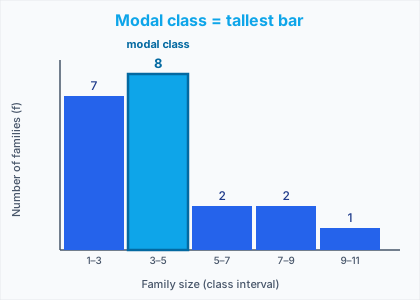
Family-size survey of 20 households:
| Family size | Number of families |
|---|---|
| 1–3 | 7 |
| 3–5 | 8 |
| 5–7 | 2 |
| 7–9 | 2 |
| 9–11 | 1 |
Find the mode of the family-size data above (the highest frequency is 8, in the class 3-5).
- Find the busiest class. The highest frequency is 8, so the modal class is 3–5. From it, read off l = 3 (its lower limit), h = 2 (its width), and f₁ = 8.
- Now look at its neighbours. The class just before (1–3) has f₀ = 7. The class just after (5–7) has f₂ = 2.
- Put these numbers into Mode = l + [(f₁ − f₀)/(2f₁ − f₀ − f₂)] × h = 3 + [(8 − 7)/(2×8 − 7 − 2)] × 2.
- Now simplify step by step: 3 + [1/(16 − 9)] × 2 = 3 + (1/7)×2 = 3 + 0.286 = 3.286. So the mode family size is about 3.29.
Median of grouped data
The median is the middle value. Half the data lies below it, and half lies above it. To find it in grouped data, you first build a new column called the cumulative frequency (cf). This is just a running total of the frequencies as you go down the table. The cumulative frequency of a class is its own frequency plus all the frequencies above it. In plain words, it answers: “how many values have we counted so far, up to the end of this class?”
For example, if the first three classes have frequencies 5, 3 and 4, their cumulative frequencies are 5, then 5+3 = 8, then 8+4 = 12.
Next, find the median class. This is the first class whose cumulative frequency reaches or crosses n/2, where n is the total frequency. The median sits inside this class, and the formula is:
Median = l + [(n/2 − cf) / f] × h
Let’s name each part:
- l = lower limit of the median class
- n = total frequency
- cf = cumulative frequency of the class just before the median class
- f = frequency of the median class
- h = class size
The bracket tells you how far past the start of the median class you must move to reach the middle value (the (n/2)-th observation).
But where does this formula come from? It is not something to just trust — it is a simple “walk”. Picture lining up all the data from smallest to largest. The median is the item right in the middle, the (n/2)-th one. By the time you reach the start of the median class, you have already counted cf items (everything in the classes before it). You still need to reach item number n/2. So you must walk forward by (n/2 − cf) more items.
Now here is the key idea. Those f items of the median class are spread evenly across its width h (we don’t know exactly where each one sits, so we assume they are equally spaced). If walking through all f items takes you across the whole width h, then walking through just (n/2 − cf) of them takes you across the matching fraction of the width: (n/2 − cf) / f of h. Start at the lower limit l and add that distance, and you land exactly on the median.
Figure 13.4 below zooms into the median class and shows this walk, step by step.

Marks of 53 students, with the cumulative-frequency column added:
| Marks | Frequency (f) | Cumulative frequency (cf) |
|---|---|---|
| 0–10 | 5 | 5 |
| 10–20 | 3 | 8 |
| 20–30 | 4 | 12 |
| 30–40 | 3 | 15 |
| 40–50 | 3 | 18 |
| 50–60 | 4 | 22 |
| 60–70 | 7 | 29 |
| 70–80 | 9 | 38 |
| 80–90 | 7 | 45 |
| 90–100 | 8 | 53 |
Plotting those running totals gives a rising curve. Figure 13.5 below shows how to read the median straight off it — start at halfway and walk across.

Find the median of the marks of 53 students using the cumulative-frequency table above.
- First find n/2. Here the total is n = 53, so n/2 = 26.5. We need the class whose cumulative frequency first reaches or crosses 26.5.
- Go down the cf column and watch the running total: …18, then 22, then 29. The value 22 is still below 26.5, but 29 crosses it. That 29 belongs to the class 60–70. So 60–70 is the median class.
- From the median class, read off l = 60, h = 10, and f = 7 (its own frequency). For cf, take the cumulative frequency of the class just before it, which is 22 (for class 50–60).
- Put it all in: Median = l + [(n/2 − cf)/f] × h = 60 + [(26.5 − 22)/7] × 10 = 60 + (4.5/7)×10 = 60 + 6.43 = 66.4. So about half the students scored below 66.4 and half scored above.
There is also a handy rule that links all three together: 3 Median = Mode + 2 Mean. It is only approximate, not exact. But it is useful for a quick check, or to find the third value when you already know the other two.
Common Mistakes
These are the slip-ups that quietly cost marks in statistics. Read each one now, and you won’t make it in the exam. The first is about which number actually stands for a class.
In the mean, use the class limits (like 10 and 25) instead of the class mark.
The limits are sitting right there in the table, so they look like the obvious numbers to multiply. The class mark takes one extra step to work out.
You must use the class MARK as xᵢ. That is the mid-point, (lower + upper)/2. We assume the whole class sits at its centre, so 17.5 (not 10 or 25) is what stands for the class 10–25.
The modal class is the class with the widest interval, or the one with the biggest class mark.
The word 'modal' sounds like it might mean size or position, and the widest interval or the last class looks important.
The modal class is the class with the highest FREQUENCY — the tallest bar. It has nothing to do with how wide the interval is or where it sits. Only the frequency (f) values decide it.
For the median, think that n/2 itself names the median class, or that cf in the formula means the cumulative frequency OF the median class.
n/2 lands inside the median class, so it feels right to read cf from that same row. And 'cumulative frequency' sounds like the total up to and including the median class.
The median class is the FIRST class whose cf reaches or crosses n/2. In the formula, cf is the cumulative frequency of the class JUST BEFORE the median class — everything you have already counted before entering it. Using the median class's own cf gives a wrong answer.
For mode and median, apply the formulas straight to inclusive classes like 118-126, 127-135.
The table already looks like neat class intervals, so it seems ready to use.
The mode and median formulas need CONTINUOUS classes (no gaps between them). Inclusive classes have gaps (118-126, then 127-135). You must first make them continuous (117.5-126.5, 126.5-135.5, and so on) by moving each limit by half the gap. Otherwise your l and h will be wrong.
Quick Check
Time to test the four big ideas — class marks, the three mean methods, the modal class, and the median class. Pick an answer before you peek at the explanation.
Which value represents a class interval when finding the mean of grouped data?
The direct, assumed-mean and step-deviation methods are applied to the same grouped data. How do their results compare?
In a grouped distribution, which class is the modal class?
For data with n = 40, the cumulative frequencies down the table are 5, 13, 19, 26, 34, 40. Which is the median class?
Practice Problems
Easy
Find the mean of the following data by the direct method.
| Class | Frequency (fᵢ) | Class mark (xᵢ) | fᵢxᵢ |
|---|---|---|---|
| 0–10 | 4 | 5 | 20 |
| 10–20 | 6 | 15 | 90 |
| 20–30 | 8 | 25 | 200 |
| 30–40 | 2 | 35 | 70 |
| Total | 20 | 380 |
x̄ = Σfᵢxᵢ / Σfᵢ = 380 / 20 = 19.
Find the modal class and the mode of: 0-10 (f=3), 10-20 (f=9), 20-30 (f=15), 30-40 (f=5), 40-50 (f=2).
The highest frequency is 15, so the modal class is 20–30. From it, read off l = 20, h = 10, f₁ = 15. The class before has f₀ = 9, and the class after has f₂ = 5.
Mode = l + [(f₁ − f₀)/(2f₁ − f₀ − f₂)] × h = 20 + [(15 − 9)/(30 − 9 − 5)] × 10 = 20 + (6/16)×10 = 20 + 3.75 = 23.75.
Medium
The percentage of female teachers in 35 states is below. Find the mean by the step-deviation method (take a = 50, h = 10).
| % female teachers | fᵢ | xᵢ | uᵢ = (xᵢ−50)/10 | fᵢuᵢ |
|---|---|---|---|---|
| 15–25 | 6 | 20 | −3 | −18 |
| 25–35 | 11 | 30 | −2 | −22 |
| 35–45 | 7 | 40 | −1 | −7 |
| 45–55 | 4 | 50 | 0 | 0 |
| 55–65 | 4 | 60 | 1 | 4 |
| 65–75 | 2 | 70 | 2 | 4 |
| 75–85 | 1 | 80 | 3 | 3 |
| Total | 35 | −36 |
x̄ = a + h × (Σfᵢuᵢ / Σfᵢ) = 50 + 10 × (−36/35) = 50 − 10.29 = 39.71.
(Let’s check using the assumed-mean method: Σfᵢdᵢ = 10 × (−36) = −360, so x̄ = 50 + (−360)/35 = 50 − 10.29 = 39.71. Same answer, as expected.)
Find the median of the weights (kg) of 30 students: 40-45 (2), 45-50 (3), 50-55 (8), 55-60 (6), 60-65 (6), 65-70 (3), 70-75 (2).
First build the cumulative frequencies (running totals): 2, 5, 13, 19, 25, 28, 30. The total is n = 30, so n/2 = 15.
Go down the cf list. The first value to reach or cross 15 is 19, which is the class 55–60. So the median class is 55–60. From it, read off l = 55, h = 5, f = 6. The class before it (50–55) has cf = 13.
Median = l + [(n/2 − cf)/f] × h = 55 + [(15 − 13)/6] × 5 = 55 + (2/6)×5 = 55 + 1.67 = 56.67 kg.
Challenge
The mean of the data below is ₹18. Find the missing frequency f. Classes (allowance in ₹): 11-13 (7), 13-15 (6), 15-17 (9), 17-19 (13), 19-21 (f), 21-23 (5), 23-25 (4).
Use the assumed-mean method with a = 18 (the class mark of 17–19). The class marks are 12, 14, 16, 18, 20, 22, 24. So the deviations dᵢ = xᵢ − 18 come out as −6, −4, −2, 0, 2, 4, 6.
| Class | fᵢ | dᵢ | fᵢdᵢ |
|---|---|---|---|
| 11–13 | 7 | −6 | −42 |
| 13–15 | 6 | −4 | −24 |
| 15–17 | 9 | −2 | −18 |
| 17–19 | 13 | 0 | 0 |
| 19–21 | f | 2 | 2f |
| 21–23 | 5 | 4 | 20 |
| 23–25 | 4 | 6 | 24 |
| Total | 44 + f | 2f − 40 |
Mean = a + Σfᵢdᵢ / Σfᵢ, so 18 = 18 + (2f − 40)/(44 + f).
Cancel the 18 on both sides. This forces (2f − 40)/(44 + f) = 0. A fraction is zero only when its top is zero, so 2f − 40 = 0, which gives f = 20.
The median of the distribution is 28.5 and the total frequency is 60. Find x and y. Classes: 0-10 (5), 10-20 (x), 20-30 (20), 30-40 (15), 40-50 (y), 50-60 (5).
First build the cumulative frequencies (running totals): 5, 5+x, 25+x, 40+x, 40+x+y, 45+x+y. The very last one must equal the total n = 60. So 45 + x + y = 60, which gives x + y = 15 … (1).
Now n/2 = 30. We are told the median is 28.5, and 28.5 lies in the class 20–30. So 20–30 is the median class. From it: l = 20, h = 10, f = 20. The class before it has cf = 5 + x.
Put these into Median = l + [(n/2 − cf)/f] × h: 28.5 = 20 + [(30 − (5 + x))/20] × 10 = 20 + (25 − x)/2.
So 28.5 − 20 = (25 − x)/2 → 8.5 × 2 = 25 − x → 17 = 25 − x → x = 8.
Then from equation (1): y = 15 − 8 = 7. So x = 8 and y = 7.
Summary
You should now be able to explain:
- In grouped data, each class is represented by its class mark = (lower + upper)/2.
- Mean — direct method: x̄ = Σfᵢxᵢ / Σfᵢ.
- Mean — assumed-mean method: x̄ = a + (Σfᵢdᵢ / Σfᵢ), where dᵢ = xᵢ − a. Use it when the class marks are large.
- Mean — step-deviation method: x̄ = a + h × (Σfᵢuᵢ / Σfᵢ), where uᵢ = (xᵢ − a)/h. Use it when the deviations all share the factor h.
- All three mean methods give the same answer. They only differ in how much arithmetic you do.
- Mode: the modal class is the one with the highest frequency. Then Mode = l + [(f₁ − f₀)/(2f₁ − f₀ − f₂)] × h.
- Median: find n/2, then find the median class (the first one whose cumulative frequency reaches n/2). Then Median = l + [(n/2 − cf)/f] × h, where cf comes from the class before the median class.
- A quick link between all three: 3 Median = Mode + 2 Mean.
- The mode and median formulas need continuous class intervals. Convert inclusive classes first.
What’s Next
So far you have learnt to summarise data that has already happened. The typical mark, the most common family size, the middle weight. Next, in Probability, you turn to the future. Instead of describing what did happen, you measure how likely something is to happen. From a single tossed coin to a deck of cards, you’ll learn to put a number between 0 and 1 on how sure or unsure we are about an outcome.
Frequently Asked Questions
What is the difference between mean, median and mode in statistics?
All three are 'averages' — a single number that represents a dataset. Mean is the sum of all values divided by how many there are; it is affected by extreme values. Median is the middle value when data is arranged in order; it is not affected by extremes. Mode is the value (or class) that appears most often. For grouped data, the formulas differ, but the meaning of each stays the same.
How do you find the mean of grouped data using the direct method?
For each class interval, find the midpoint (class mark) xᵢ by averaging the lower and upper limits. Multiply each midpoint by its frequency fᵢ to get fᵢxᵢ. Add all the fᵢxᵢ values and divide by the total frequency Σfᵢ. Mean = Σ(fᵢxᵢ) / Σfᵢ. This works but involves large multiplications when the midpoints are big numbers, which is why the assumed-mean method exists.
What is the assumed-mean method and why is it useful?
You pick a convenient middle value A (the assumed mean, usually the midpoint of the middle class). For each class, calculate the deviation dᵢ = xᵢ − A. Then Mean = A + Σ(fᵢdᵢ) / Σfᵢ. Because the deviations dᵢ are small numbers (positive and negative), the arithmetic is much easier than the direct method. The final answer is identical — only the calculation steps are simpler.
How do you find the mode of grouped data?
First identify the modal class — the class interval with the highest frequency. Then use the formula: Mode = l + [(f₁ − f₀) / (2f₁ − f₀ − f₂)] × h, where l is the lower limit of the modal class, f₁ is its frequency, f₀ is the frequency of the class before it, f₂ is the frequency of the class after it, and h is the class size. The mode lies inside the modal class, and the formula finds exactly where.
How do you find the median of grouped data using cumulative frequency?
Find the total frequency n and identify the class whose cumulative frequency first reaches or exceeds n/2 — this is the median class. Then use: Median = l + [(n/2 − cf) / f] × h, where l is the lower limit of the median class, cf is the cumulative frequency of the class before it, f is the frequency of the median class, and h is the class size. This formula interpolates (estimates) the exact position of the middle value inside the median class.
Why do the direct method, assumed-mean method and step-deviation method all give the same mean?
Because the three methods are mathematically equivalent — each is just an algebraic rearrangement of the same calculation. In the assumed-mean method, adding A back at the end cancels out the subtraction done at the start. In the step-deviation method, multiplying by h at the end cancels out the division by h done earlier. So all three are shortcuts for the same sum; they differ only in how easy the numbers are to work with.