Quadratic Equations
Why This Matters
Suppose a charity trust wants to build a prayer hall. The floor should have a carpet area of 300 square metres. They also want the length to be one metre more than twice the breadth. What should the dimensions be?
Let’s set it up. Call the breadth x metres. Then the length is (2x + 1) metres. Area is length times breadth, so the area is x(2x + 1). That gives us 2x² + x = 300.
Look at the x² in there. This is not a straight-line equation any more. In earlier chapters you could just rearrange and divide to find x. You can’t do that here. The squared term changes everything.
Equations like this are called quadratic equations. “Quadratic” just means the highest power of the unknown is 2 (an x², not an x³). They show up all over the place: the path of a thrown ball, the area of a field, the speed of a train that would arrive earlier if it went faster, the profit a shop makes depending on its price.
In Chapter 3, every equation drew a straight line on a graph. A quadratic is different. It draws a parabola — a smooth U-shaped curve. That curve is the reason a quadratic can have two answers, sometimes just one, and sometimes none at all.
This chapter gives you two reliable ways to solve quadratics: factorisation and the famous quadratic formula. It also gives you one special number, the discriminant, that tells you in advance how many real answers to expect. And the best part: you won’t just memorise the formula. You’ll watch it being built from scratch, step by step.
The Big Idea
A quadratic equation is any equation you can write in the form ax² + bx + c = 0, where a ≠ 0 (a is not zero). Its solutions are called roots. A root is a value of x that makes the left side equal to zero. These are the same as the zeroes of the polynomial ax² + bx + c. A quadratic polynomial has at most two zeroes, so a quadratic equation has at most two roots. You can find them in two ways: by factorising the quadratic into two linear pieces, or by the quadratic formula x = (−b ± √(b² − 4ac)) / 2a. The part under the square root, D = b² − 4ac, is called the discriminant. It decides the whole story: if D > 0 there are two roots, if D = 0 there is one repeated root, and if D < 0 there are none.
Let’s Break It Down
What counts as a quadratic equation
A quadratic equation in x has the standard form ax² + bx + c = 0. Here a, b, and c are real numbers, and a ≠ 0. Why must a not be zero? Because if a were 0, the x² term would disappear, and you’d be left with just a straight-line (linear) equation. Some examples of quadratic equations: 2x² + x − 300 = 0, 2x² − 3x + 1 = 0, and 1 − x² + 300 = 0.
Here’s the tricky part. Many equations look quadratic but actually aren’t. And some look cubic (with an x³) but are secretly quadratic. So never judge an equation by its first appearance. Always simplify it to standard form first. That means bringing every term to one side and combining like terms. Only then check the highest power.
If “moving every term to one side” feels rusty, here’s a quick refresher on the rules behind it.
Let’s put this “simplify first” warning to the test on two sneaky equations — one that looks quadratic but isn’t, and one that looks cubic but is.
Decide whether each is a quadratic equation: (i) x(x + 1) + 8 = (x + 2)(x − 2); (ii) (x + 2)³ = x³ − 4.
- (i) First, expand both sides. The left side x(x + 1) + 8 becomes x² + x + 8. The right side (x + 2)(x − 2) becomes x² − 4.
- Now bring everything to one side: x² + x + 8 = x² − 4. Subtract x² from both sides and it cancels. We are left with x + 12 = 0. The highest power of x is just 1, so this is not a quadratic equation.
- (ii) Expand the left side: (x + 2)³ = x³ + 6x² + 12x + 8. Now set it equal to the right side, x³ − 4.
- So x³ + 6x² + 12x + 8 = x³ − 4. Subtract x³ from both sides and it cancels. We get 6x² + 12x + 12 = 0. Divide every term by 6 to get x² + 2x + 2 = 0. This is a quadratic equation, even though it looked cubic at first. The lesson: always simplify before you judge.
Roots: what we’re hunting for
When we “solve” a quadratic, what are we actually looking for? The answer is its roots — and you’ve met this idea before under a different name.
A real number α is a root of ax² + bx + c = 0 if putting x = α into the equation makes it true. In other words, aα² + bα + c = 0. The words “root”, “solution”, and “zero of the polynomial” all mean the same thing here, so don’t let them confuse you. For example, x = 1 is a root of 2x² − 3x + 1 = 0. Let’s check: 2(1)² − 3(1) + 1 = 2 − 3 + 1 = 0. It works. Now remember one important limit: a quadratic equation has at most two roots. You will never get three.
But why exactly two at most — why not three or four? It’s worth seeing the reason, not just taking it on trust. Here’s a quick proof in plain words. Suppose, just to test it, that a quadratic had three different roots, call them p, q and r. Each root makes a linear factor: having p as a root means (x − p) divides the quadratic, and the same for (x − q) and (x − r). So the quadratic would have to contain (x − p)(x − q)(x − r) inside it. But multiply those three brackets out and the biggest power you get is x³ — that’s a cubic, not a quadratic. A quadratic only goes up to x². So three roots is impossible. The most a quadratic can hold is two linear factors, hence at most two roots.
The same fact has a clean picture. The graph of y = ax² + bx + c is a parabola — a single U-shaped curve. The roots are the spots where this U meets the x-axis. A U-shape simply cannot cross a straight line at three places: it comes down, turns once, and goes back up, so it can touch a line twice at most. Figure 4.1 below shows this.

This is exactly why every method in this chapter hunts for one or two answers, and never more.
Solving by factorisation (splitting the middle term)
This method rests on one simple fact: if you multiply two things and get zero, then at least one of them must be zero. Think about it. If a × b = 0, then either a is 0 or b is 0. There’s no other way to get zero from a product.
So here’s the plan. If we can write ax² + bx + c as a product of two linear factors (factors with just an x, no x²), say (px + q)(rx + s), then setting (px + q)(rx + s) = 0 forces px + q = 0 or rx + s = 0. These are two small, easy equations. We solve each one to get our two roots.
The whole method leans on a Class 9 skill: turning a three-term quadratic into a product. Here’s that recipe again before we use it.
How do we find these factors? We split the middle term bx into two parts. The two parts must satisfy two rules: their coefficients must multiply to a × c, and they must add up to b. One nice way to see why this works is the “box method”. After you split the middle term, the four pieces fit into a 2 by 2 grid, and the two factors read straight off its edges. Figure 4.2 below walks through it for 2x² − 5x + 3.

Let’s run the full recipe on that same equation, 2x² − 5x + 3 = 0, and read off its roots.
Find the roots of 2x² − 5x + 3 = 0.
- Read off the coefficients: a = 2, b = −5, c = 3. We need two numbers that multiply to a × c = 2 × 3 = 6 and add to b = −5. The numbers −2 and −3 do the job: −2 × −3 = 6, and −2 + (−3) = −5.
- Split the middle term −5x into −2x and −3x: 2x² − 2x − 3x + 3 = 0.
- Group the four terms in pairs and pull out the common factor from each pair. From 2x² − 2x take out 2x. From −3x + 3 take out −3. That gives 2x(x − 1) − 3(x − 1) = 0. Now (x − 1) is common, so factor it out: (2x − 3)(x − 1) = 0.
- Set each factor equal to zero. From 2x − 3 = 0 we get x = 3/2. From x − 1 = 0 we get x = 1. So the roots are x = 3/2 and x = 1. Quick check with x = 1: 2(1)² − 5(1) + 3 = 2 − 5 + 3 = 0 ✓.
Remember the prayer-hall puzzle we started with? Now we have the tool to crack it — the bigger numbers don’t change the recipe one bit.
The prayer hall has area 300 m² with length one metre more than twice the breadth: solve 2x² + x − 300 = 0 for the breadth x.
- Read off a = 2, b = 1, c = −300. We need two numbers that multiply to a × c = 2 × (−300) = −600 and add to b = 1. Those numbers are 25 and −24, because 25 × (−24) = −600 and 25 + (−24) = 1.
- Split the middle term x into 25x and −24x: 2x² + 25x − 24x − 300 = 0.
- Group in pairs and take out common factors: x(2x + 25) − 12(2x + 25) = 0. Now (2x + 25) is common, so factor it out: (2x + 25)(x − 12) = 0.
- Set each factor to zero. This gives x = −25/2 = −12.5 or x = 12. But a breadth can’t be a negative number, so we throw out −12.5. The answer is breadth = 12 m, and length = 2x + 1 = 2(12) + 1 = 25 m.
But what happens when the two factors turn out to be identical? Test your understanding of that special case.
When you factorise a quadratic and one factor repeats — like (3x − √2)² = 0 — how many distinct roots are there, and what do we call them?
Deriving the quadratic formula by completing the square
Factorisation is fast, but only when nice whole-number factors exist. Very often they don’t. So we need a method that always works, no matter how ugly the numbers are. That method is completing the square. The idea is to reshape ax² + bx + c so the x-part turns into a perfect square, something like (x + a number)². Once it’s a perfect square, we can undo it with a square root and solve for x.
Where does the name come from? It comes from an actual picture with shapes. Picture x² + bx as two pieces side by side: a square with side x, and next to it a strip that is b wide and x tall. Now cut that strip in half down its length. You get two thin strips, each b/2 wide. Wrap these two halves around two sides of the x square. Together they almost build a bigger square, but there’s one small corner left empty. The size of that empty corner is exactly (b/2)². So if we add (b/2)², we fill the gap and complete the square into one clean (x + b/2)² block. That’s the whole trick. Figure 4.3 below walks through the three steps; the algebra after it is just this same picture written in symbols.

Doing this with symbols is the proof of the quadratic formula. Let’s go through it slowly, one step at a time.
Theorem (Quadratic Formula). The roots of ax² + bx + c = 0 (with a ≠ 0) are x = (−b ± √(b² − 4ac)) / 2a, as long as b² − 4ac ≥ 0.
Proof. We start from ax² + bx + c = 0. We want the x² to have a coefficient of 1, so we divide every term by a. We’re allowed to do this because a is not zero. This gives:
x² + (b/a)x + c/a = 0.
Now focus on the part x² + (b/a)x. We want to turn it into a perfect square. Remember the identity (x + k)² = x² + 2kx + k². Compare the middle terms: our middle term is (b/a)x, and the identity’s middle term is 2kx. So 2k must equal b/a, which means k = b/(2a). To complete the square, we need to add k², which is b²/(4a²).
But we can’t just add a term out of nowhere, or we’d change the equation. So we add it and subtract it. Adding and subtracting the same thing is like adding zero, so the equation stays the same:
x² + (b/a)x + b²/(4a²) − b²/(4a²) + c/a = 0.
The first three terms x² + (b/a)x + b²/(4a²) now form a perfect square, equal to (x + b/(2a))². Move the other terms to the right side:
(x + b/(2a))² = b²/(4a²) − c/a.
Now tidy up the right side by putting it over a common denominator of 4a². This gives b²/(4a²) − c/a = (b² − 4ac) / (4a²). So:
(x + b/(2a))² = (b² − 4ac) / (4a²).
We’re about to undo that square by taking a square root — and that step is where the two roots are born, thanks to the ± sign. Here’s why.
If b² − 4ac ≥ 0, we can take the square root of both sides. The denominator 4a² is a perfect square, since 4a² = (2a)². Taking the square root gives:
x + b/(2a) = ± √(b² − 4ac) / (2a).
Finally, subtract b/(2a) from both sides and combine the two fractions (they already share the denominator 2a):
x = −b/(2a) ± √(b² − 4ac) / (2a) = (−b ± √(b² − 4ac)) / 2a.
And that is the formula. ∎ This one expression solves every quadratic that has real roots. It is credited to the Indian mathematician Sridharacharya (around 1025 CE), who found it using exactly this completing-the-square method.
Enough building — let’s drive the formula. Watch how plugging in a, b and c does all the work for you.
Solve x² + 7x − 60 = 0 using the quadratic formula.
- Identify the coefficients: a = 1, b = 7, c = −60.
- Work out the part under the root, b² − 4ac. That is 7² − 4(1)(−60) = 49 + 240 = 289. (Be careful with signs: −4 times −60 is +240.)
- 289 is not negative, so real roots exist. Plug into the formula: x = (−b ± √(b² − 4ac)) / 2a = (−7 ± √289) / 2. Since √289 = 17, this becomes (−7 ± 17) / 2.
- Now do the plus and the minus separately. Plus: x = (−7 + 17)/2 = 10/2 = 5. Minus: x = (−7 − 17)/2 = −24/2 = −12. The roots are x = 5 and x = −12.
The discriminant and the nature of the roots
Look at the formula again. Everything depends on b² − 4ac, the part under the square root. We give it a name: the discriminant, written D = b² − 4ac. The word “discriminate” means “to tell apart”, and that’s exactly what D does. It tells apart the three possible situations before you even finish solving. The reason is simple: you cannot take the square root of a negative number and get a real answer. So the sign of D controls everything.
Theorem (Nature of roots). For ax² + bx + c = 0 (with a ≠ 0) and D = b² − 4ac:
Proof. Start from the formula, x = (−b ± √D) / 2a, and check each case.
- If D > 0: √D is a positive real number. So −b + √D and −b − √D are two different numbers. That means (−b + √D)/2a and (−b − √D)/2a are two distinct real roots.
- If D = 0: √D = 0. So the ”± √D” part adds nothing. Both the plus and the minus give the same value, x = −b/2a. We count this as two equal real roots (a repeated root), both at x = −b/2a.
- If D < 0: there is no real number whose square is negative, so √D is not a real number. The formula then gives no real roots. ∎
Now picture this on a graph. The graph of y = ax² + bx + c is a parabola (a U-shaped curve). The real roots are exactly the points where this curve crosses the x-axis (where y = 0). The three cases above are just the three ways a parabola can sit next to the x-axis, shown side by side in Figure 4.4 below.
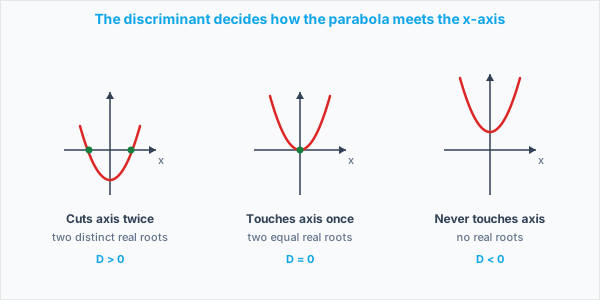
Here are all three cases side by side, so you can spot the pattern at a glance.
| Discriminant D = b² − 4ac | Nature of roots | Parabola vs x-axis |
|---|---|---|
| D > 0 | two distinct real roots | cuts the axis at two points |
| D = 0 | two equal real roots (one repeated) | just touches the axis |
| D < 0 | no real roots | never meets the axis |
Let’s try it: just one calculation of D can tell us the nature of the roots without solving the whole equation.
Find the discriminant of 2x² − 4x + 3 = 0 and state the nature of its roots.
- Read off the coefficients: a = 2, b = −4, c = 3.
- Find D = b² − 4ac = (−4)² − 4(2)(3) = 16 − 24 = −8.
- D = −8 is less than 0. A negative number has no real square root, so the equation has no real roots.
That last one had D < 0. Here’s the in-between case where D works out to exactly zero — and we can even pin down the single repeated root.
Find the discriminant of 3x² − 2x + 1/3 = 0, find the nature of its roots, and find them if real.
- Read off the coefficients: a = 3, b = −2, c = 1/3.
- Find D = (−2)² − 4 × 3 × (1/3) = 4 − 4 = 0. Since D = 0, there are two equal real roots.
- When D = 0, the repeated root is x = −b/2a. So x = −(−2)/(2 × 3) = 2/6 = 1/3.
- So both roots are the same: x = 1/3 and x = 1/3.
Quadratics in word problems
Lots of real-life situations turn into a quadratic equation. The recipe is the same every time. First, name the unknown (call it x). Second, turn the words into an equation of the form ax² + bx + c = 0. Third, solve it. Fourth, throw out any answer that doesn’t make sense in the real world. For example, a length, an age, a speed, or a count can never be negative, so reject negative answers in those cases.
The next problem leans on one geometry fact that we should not just assert: that the pole, sitting on the circle, makes a right angle with the two opposite gates. Here’s why that is always true, before we use it.
The two gates A and B are at the ends of a diameter. The pole P is any point on the circle. The claim is that angle APB is always 90°, wherever P sits on the curve. This is a famous result called the angle in a semicircle. Here is the short reason. Draw the radius OP from the centre O to P. Now OA, OB and OP are all radii, so they are all the same length. That gives two small triangles, OAP and OBP, that are each isosceles (two equal sides). In an isosceles triangle the two base angles are equal. Call the equal angles at A and P in the first triangle “p”, and the equal angles at B and P in the second triangle “q”. The three angles of the big triangle APB are: the angle at A (which is p), the angle at B (which is q), and the angle at P (which is p + q, the two pieces together). They must add to 180°, so p + q + (p + q) = 180°, that is 2(p + q) = 180°, so p + q = 90°. But p + q is exactly angle APB. So angle APB = 90°. Figure 4.5 below shows the set-up.

Now we can mix geometry and quadratics: we use that right angle and Pythagoras to build the equation, then solve it.
A pole is to be erected on the boundary of a circular park of diameter 13 m so that its distances from two diametrically opposite gates A and B differ by 7 m. Is it possible? If so, find the distances from each gate.
- Let the distance from gate B to the pole be BP = x m. The two distances differ by 7, so AP = (x + 7) m. Now here’s a useful geometry fact: AB = 13 m is a diameter, and a point P on the circle sees the diameter at a right angle, so angle APB = 90°. That makes triangle APB right-angled, so we can use Pythagoras: AP² + BP² = AB².
- Put in the values: (x + 7)² + x² = 13². Expand: x² + 14x + 49 + x² = 169. Combine and bring all terms to one side: 2x² + 14x − 120 = 0. Divide every term by 2 to keep it simple: x² + 7x − 60 = 0.
- Check D first: D = 7² − 4(1)(−60) = 49 + 240 = 289. Since 289 > 0, real roots exist. So yes, such a pole can be placed.
- Solve: x = (−7 ± √289)/2 = (−7 ± 17)/2, which gives x = 5 or x = −12. A distance can’t be negative, so x = 5. The pole is 5 m from gate B and 12 m from gate A.
Common Mistakes
These are the four traps that catch students most often in this chapter. Spot them now so they don’t cost you marks later.
An equation is quadratic as long as you can see an x² written somewhere in it.
The x² is easy to spot, so seeing it feels like enough. And in a tidy textbook equation, it usually is enough.
An equation is quadratic only if, after you simplify it to standard form, the x² coefficient is not zero (a ≠ 0). For example, (x + 2)(x − 2) = x² − 4 looks quadratic, but the x² cancels and it's really linear. And (x + 2)³ = x³ − 4 looks cubic, but the x³ cancels and it's really quadratic. Always simplify first, then decide.
To solve a quadratic, you can just divide both sides by x to cancel it out.
Cancelling worked all through your earlier algebra, so dividing by x feels like a normal, fair move.
Dividing by x secretly assumes that x is not zero. If you do this, you lose the root x = 0 completely. Take x² − 5x = 0. Don't divide by x. Instead factor it as x(x − 5) = 0, which keeps both roots: x = 0 and x = 5. Never divide an equation by the variable.
If a product equals any number, say (x − 2)(x − 3) = 6, then x − 2 = 6 or x − 3 = 6.
The 'set each factor equal' trick is so useful that it feels like it should work for any number on the right side, not only zero.
The zero-product rule needs a ZERO on one side. Only 'product = 0' forces one of the factors to be zero. So first expand and rearrange: (x − 2)(x − 3) = 6 becomes x² − 5x + 6 − 6 = 0, which is x² − 5x = 0. Now there's a zero on the right. ONLY THEN factorise and set each factor to zero.
If the discriminant is negative, the equation has no answer at all, so the problem can't be solved.
In Class 10, 'no real roots' and 'no solution' sound like the same thing, so a negative D feels like a dead end or a sign you made a mistake.
D < 0 means no REAL roots. It just means the parabola never touches the x-axis. This is a perfectly good and correct answer. For a word problem, it might mean 'no, such a rectangle cannot exist'. So a negative D tells you something is impossible with real numbers. It does not mean you did the working wrong.
Quick Check
Four quick questions to make sure the key ideas have stuck before you tackle the practice set.
Which of these is a quadratic equation in standard form ax² + bx + c = 0 with a ≠ 0?
To solve 6x² − x − 2 = 0 by splitting the middle term, which two numbers do you use (they multiply to a × c and add to b)?
The discriminant of a quadratic equation is D = 0. What is the nature of its roots?
In the quadratic formula, what is the expression under the square root sign?
Practice Problems
Easy
Find the roots of x² − 3x − 10 = 0 by factorisation.
We need two numbers that multiply to a × c = 1 × (−10) = −10 and add to b = −3. Those numbers are −5 and 2.
Split the middle term: x² − 5x + 2x − 10 = 0. Group in pairs: x(x − 5) + 2(x − 5) = 0. Factor out (x − 5): (x − 5)(x + 2) = 0.
Set each factor to zero: x − 5 = 0 or x + 2 = 0. This gives x = 5 and x = −2. Check with x = 5: 5² − 3(5) − 10 = 25 − 15 − 10 = 0 ✓.
Find the discriminant of 2x² − 3x + 5 = 0 and state the nature of its roots.
Read off a = 2, b = −3, c = 5.
D = b² − 4ac = (−3)² − 4(2)(5) = 9 − 40 = −31.
D = −31 is less than 0. A negative number has no real square root, so the equation has no real roots.
Medium
Find two consecutive positive integers, the sum of whose squares is 365.
Consecutive integers are one apart, so let them be x and x + 1. The sum of their squares is 365, so x² + (x + 1)² = 365.
Expand: x² + x² + 2x + 1 = 365. Combine and bring to one side: 2x² + 2x − 364 = 0. Divide every term by 2: x² + x − 182 = 0.
To factorise, we need two numbers that multiply to −182 and add to 1. Those are 14 and −13. So (x + 14)(x − 13) = 0, which gives x = −14 or x = 13.
We want positive integers, so x = 13. The numbers are 13 and 14. Check: 13² + 14² = 169 + 196 = 365 ✓.
Solve 3x² − 2√6·x + 2 = 0 by factorisation, and state the nature of its roots.
We split the middle term −2√6·x. The two parts must multiply to a × c = (3)(2) = 6 and add to −2√6. The parts −√6·x and −√6·x work, because √6 × √6 = 6 and the two add to −2√6.
So 3x² − √6·x − √6·x + 2 = 0. Group and factor: √3·x(√3·x − √2) − √2(√3·x − √2) = 0, which gives (√3·x − √2)(√3·x − √2) = 0.
The factor (√3·x − √2) appears twice. Set it to zero: √3·x − √2 = 0, so x = √2/√3.
Both roots are the same: x = √2/√3 and x = √2/√3. We can confirm this with the discriminant: D = (2√6)² − 4(3)(2) = 24 − 24 = 0, which means two equal real roots.
Challenge
A train travels 480 km at a uniform speed. If its speed had been 8 km/h less, it would have taken 3 hours more to cover the same distance. Find the speed of the train.
Let the speed be x km/h. Time is distance ÷ speed, so the time taken is 480/x hours.
If the speed were 8 less, it would be (x − 8) km/h, and the time would be 480/(x − 8). This slower time is 3 hours more than the original time. So:
480/(x − 8) = 480/x + 3.
Multiply every term by x(x − 8) to clear the fractions: 480x = 480(x − 8) + 3x(x − 8).
Expand the right side: 480x = 480x − 3840 + 3x² − 24x. The 480x on each side cancels, leaving 0 = 3x² − 24x − 3840. Divide every term by 3: x² − 8x − 1280 = 0.
To factorise, we need two numbers that multiply to −1280 and add to −8. Those are 32 and −40. So (x − 40)(x + 32) = 0, which gives x = 40 or x = −32.
Speed can’t be negative, so the train’s speed is 40 km/h. Check: 480/40 = 12 h, and 480/32 = 15 h. The difference is 15 − 12 = 3 h ✓.
Find the value of k for which the quadratic equation 2x² + kx + 3 = 0 has two equal roots.
“Two equal roots” is the clue. It means the discriminant must be zero, so D = b² − 4ac = 0.
Here a = 2, b = k, c = 3. So D = k² − 4(2)(3) = k² − 24.
Set D = 0: k² − 24 = 0, so k² = 24, which gives k = ±√24 = ±2√6.
So k = 2√6 or k = −2√6. For either of these values, the equation has two equal real roots.
Summary
You should now be able to explain:
- A quadratic equation is one that simplifies to ax² + bx + c = 0, where a, b, c are real and a ≠ 0. Always simplify to standard form first, then decide if it is quadratic.
- A root (which is the same as a solution, the same as a zero of the polynomial) is a value α that makes aα² + bα + c = 0. A quadratic has at most two roots.
- Factorisation: split the middle term bx into two parts that multiply to a × c and add to b, factor into two linear pieces, then set each factor to zero. Remember, this only works with a zero on one side.
- Quadratic formula: x = (−b ± √(b² − 4ac)) / 2a. We built it by completing the square. It always works whenever real roots exist.
- The discriminant D = b² − 4ac tells you the nature of the roots: D > 0 means two distinct real roots, D = 0 means two equal real roots, and D < 0 means no real roots. These match a parabola that cuts, touches, or misses the x-axis.
- In word problems, turn the words into a quadratic, solve it, and reject any answer that doesn’t fit the real world, like negative lengths, ages, or speeds.
What’s Next
Quadratics were all about one squared unknown. Next, in Arithmetic Progressions, we look at patterns of numbers that grow by a fixed step each time, like 5, 8, 11, 14, and so on (here the step is 3). We’ll find neat formulas for the nth term and for the sum of many terms. And here’s a fun surprise: adding up an AP often leads you straight back to a quadratic equation.
Frequently Asked Questions
What is the standard form of a quadratic equation?
The standard form is ax² + bx + c = 0, where a, b, c are real numbers and a ≠ 0. The condition a ≠ 0 is important: if a were zero, the x² term would disappear and you would just have a linear equation, not a quadratic.
How do you solve a quadratic equation by factorisation (splitting the middle term)?
Find two numbers whose product equals a × c and whose sum equals b. Split the middle term bx into two terms using these numbers, then group and factor. For example, for x² − 5x + 6 = 0, find two numbers with product 6 and sum −5: those are −2 and −3. So x² − 2x − 3x + 6 = x(x − 2) − 3(x − 2) = (x − 2)(x − 3) = 0, giving roots x = 2 and x = 3.
What is the quadratic formula and where does it come from?
The quadratic formula is x = (−b ± √(b² − 4ac)) / 2a. It is derived by completing the square on the standard form ax² + bx + c = 0 — a method of rewriting the equation so one side is a perfect square. The formula works for every quadratic equation, even when factorisation is not obvious.
What does the discriminant tell you about the roots of a quadratic equation?
The discriminant is D = b² − 4ac. If D > 0 the equation has two distinct real roots. If D = 0 there is exactly one real root (a repeated root). If D < 0 there are no real roots — because you cannot take the square root of a negative number in real numbers. Checking D first saves time when you only need to know how many roots exist.
Why can a quadratic equation have at most two roots?
A quadratic polynomial ax² + bx + c has degree 2, and a polynomial of degree n has at most n zeroes. So the equation ax² + bx + c = 0 can have at most 2 solutions. Geometrically, the parabola y = ax² + bx + c can cross the x-axis at most twice.