Pair of Linear Equations in Two Variables
Why This Matters
Lots of everyday puzzles hide two unknowns at the same time. Here are two examples. How many ₹50 notes and ₹100 notes make up ₹2000, if there are 25 notes in all? Or: 5 pencils and 7 pens cost ₹50, but 7 pencils and 5 pens cost ₹46 — what is the price of one pencil and one pen?
Notice the problem. You cannot find either unknown from just one fact. You need two facts, and a way to use them together.
That is exactly what a pair of linear equations is. It is two facts about two unknowns, each written as a straight-line equation. To “solve the pair” means to find the one pair of values (x, y) that makes both equations true at the same time.
This chapter gives you three tools to do that. It also shows you the picture behind them, which is just as important. Each equation is a straight line. Solving the pair is the same as asking: where do the two lines meet?
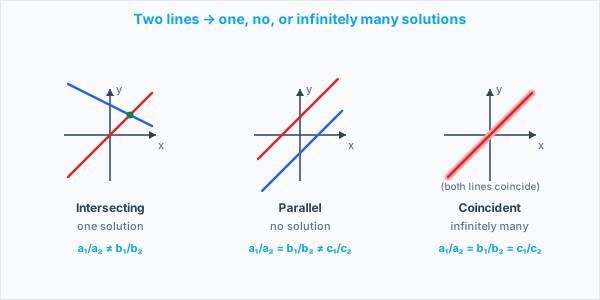
Two lines can meet in only three ways. They can cross at one point (so there is one answer). They can stay parallel and never meet (no answer). Or they can be the exact same line lying on top of each other (endless answers). Once you can see this, you can guess the type of answer even before doing any algebra. Then you use substitution or elimination to find the exact numbers.
The Big Idea
Every linear equation in x and y is a straight line. A solution of the pair is a point (x, y) that sits on both lines. So solving the pair means finding where the two lines meet. Two lines can meet at one point (a unique solution), never meet (they are parallel, so no solution), or lie exactly on top of each other (they are coincident, so infinitely many solutions). And here is the shortcut: the ratios of the numbers in front of x, y and the constant tell you which case you are in, before you draw anything.
Let’s Break It Down
What a pair of linear equations is
Before we put two equations together, let us be sure about what a single one means. Here is a quick refresher:
A linear equation in two variables is any equation of the form ax + by + c = 0. Here a, b and c are numbers, and a and b are not both zero. Its graph is always a straight line. (The numbers a, b, c are called coefficients — they are just the numbers multiplying x, y, and the constant on its own.)
A pair is simply two such equations together:
a₁x + b₁y + c₁ = 0 and a₂x + b₂y + c₂ = 0
The small numbers below (the ₁ and ₂) only label the first and second equation. So a₁ is the x-coefficient in the first equation, and a₂ is the x-coefficient in the second.
A solution is a pair of values (x, y) that makes both equations true. Here is an everyday example. Akhila goes to a fair. She takes x rides (₹3 each) and plays Hoopla y times (₹4 each), and spends ₹20 in total. She also plays half as many games as rides. From these two facts we get two equations: y = x/2 (games are half the rides) and 3x + 4y = 20 (total spent). Two equations, two unknowns.
The graphical method: where do the lines meet?
To draw lines we need a graph, so let us quickly recall how a graph works:
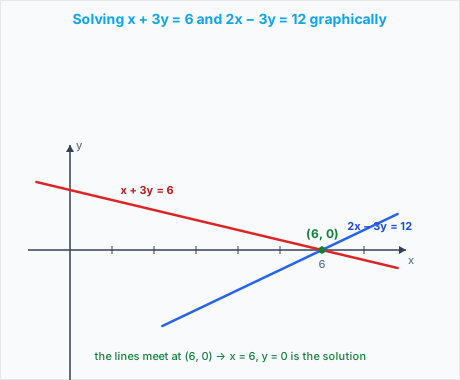
The idea is simple. Draw both lines on the same graph. Any point that both lines pass through is a solution.
But why is the crossing point the answer? This is the heart of the whole chapter, so let us not just take it on trust. Think about what a line really is. A line is not just a stroke of ink — it is the collection of all the points whose (x, y) make that equation true. Every dot on the line fits the equation; every dot off the line does not. So “the point lies on the line” and “its (x, y) makes the equation true” are the same thing said two ways. Now look at where two lines cross. That one point lies on the first line, so it makes the first equation true. It also lies on the second line, so it makes the second equation true. One point making both equations true at the same time — that is exactly the definition of a solution of the pair. That is the whole reason we hunt for the crossing point.
Figure 3.1 below shows this single shared point doing double duty:

Figure 3.2 below shows this with the lines x + 3y = 6 and 2x − 3y = 12.
Two straight lines can sit on a page in only three ways. So a pair of linear equations always falls into one of these three cases, shown side by side in Figure 3.3 below.
That ratio test keeps comparing fractions like a₁/a₂ with b₁/b₂, so let us make sure ratios are clear first:
Now you can read the three cases and their ratio tests side by side in one table:
| Lines | Solutions | Name | Ratio test |
|---|---|---|---|
| Intersecting | exactly one | consistent | a₁/a₂ ≠ b₁/b₂ |
| Parallel | none | inconsistent | a₁/a₂ = b₁/b₂ ≠ c₁/c₂ |
| Coincident | infinitely many | dependent (consistent) | a₁/a₂ = b₁/b₂ = c₁/c₂ |
To understand why that test works, we lean on two ideas from Class 9 — slope and y-intercept. A quick reminder of both:
Why the ratio test works. It is worth understanding this, not just memorising it. The slope of a line is how steeply it tilts. Take ax + by + c = 0 and rearrange it to make y the subject: y = (−a/b)x − c/b. Compare this with the standard line y = (slope)x + (intercept). So the slope is −a/b and the y-intercept is −c/b (the y-intercept is where the line crosses the y-axis).
Now think about what the ratios are really checking.
- If a₁/a₂ ≠ b₁/b₂, then the two slopes −a₁/b₁ and −a₂/b₂ come out different. Different slopes means the lines tilt in different directions. Two lines that tilt differently must cross at exactly one point (a unique solution).
- If a₁/a₂ = b₁/b₂, then the two slopes are equal. Lines with the same slope are either parallel, or they are the very same line. The constant decides which one. If c₁/c₂ is also equal, then one equation is just the other one multiplied by a number — so they are the same line (coincident). If c₁/c₂ is different, the lines have the same tilt but sit apart, so they are two separate parallel lines that never meet (no solution).
Figure 3.4 below ties it all together — turning each line into y = slope × x + intercept:

Let us put the ratio test to work on two pairs and read off the number of solutions — no graph needed:
Without drawing, decide how many solutions each pair has: (a) 9x + 3y + 12 = 0 and 18x + 6y + 24 = 0; (b) 2x − 3y = 8 and 4x − 6y = 9.
- (a) Work out the three ratios. a₁/a₂ = 9/18 = 1/2. b₁/b₂ = 3/6 = 1/2. c₁/c₂ = 12/24 = 1/2. All three come out equal.
- Since a₁/a₂ = b₁/b₂ = c₁/c₂, the lines are coincident (the same line), so there are infinitely many solutions.
- (b) First write both in the form ax + by + c = 0: that is 2x − 3y − 8 = 0 and 4x − 6y − 9 = 0. Now the ratios: a₁/a₂ = 2/4 = 1/2; b₁/b₂ = −3/−6 = 1/2 (a minus over a minus is a plus); c₁/c₂ = −8/−9 = 8/9.
- Here a₁/a₂ = b₁/b₂ (both 1/2), but this is not equal to c₁/c₂ (which is 8/9). So the lines are parallel, giving no solution (the pair is inconsistent).
The graphical method is great for seeing the answer. But it gets clumsy when the meeting point has messy coordinates, like (49/29, 19/29). You cannot read fractions like that off a graph accurately. For exact answers, we use algebra instead.
Before the two algebra methods, one worry is worth settling. When we multiply an equation, or add two equations, or replace x with something — are we still finding the same answer? Or could we accidentally change the puzzle and get a wrong point? It turns out the answer never changes, and there is a clean reason why.
Two safe moves are at the bottom of both methods:
- Scaling an equation (multiplying both sides by the same number) does not change which points fit it. If 3 + 12 = 15 is true, then 3×(3 + 12) = 3×15 is also true, and the other way round. So x + 2y = 5 and 3x + 6y = 15 are the very same line — same solutions.
- Adding (or subtracting) two equations. At the one point that solves the pair, both equations are true statements about real numbers. And if two number statements are both true, adding their left sides and their right sides keeps it true (true + true = true). So the new combined equation is still true at that shared point — we have not thrown the answer away, we have only made a simpler equation that the same point still satisfies.
Substitution rests on the same honesty. When we write x = 3 − 2y from one equation and slot it into the other, we are allowed to do that only because at the solution x genuinely equals 3 − 2y. We are swapping a quantity for something exactly equal to it, so the truth is preserved.
Figure 3.5 below walks through why the answer survives every step:

Method 1 — Substitution
Here is the idea. From one equation, write one variable in terms of the other one (for example, “x equals something with y in it”). Then put that into the second equation. Now the second equation has only one variable left, so you can solve it easily.
Figure 3.6 below lays out that idea as a four-step flow you can follow every time:

Let us run a real pair through those steps:
Solve 7x − 15y = 2 and x + 2y = 3.
- Pick the simpler equation, x + 2y = 3. Make x the subject by moving 2y to the other side: x = 3 − 2y.
- Now put this in place of x in the other equation, 7x − 15y = 2. That gives 7(3 − 2y) − 15y = 2. Open the bracket: 21 − 14y − 15y = 2. Combine the y-terms: 21 − 29y = 2.
- Move the 21 across: −29y = 2 − 21 = −19. Divide both sides by −29: y = 19/29.
- Now put this y value back into x = 3 − 2y. So x = 3 − 2(19/29) = 3 − 38/29. To subtract, write 3 as 87/29: x = (87 − 38)/29 = 49/29. So the answer is x = 49/29, y = 19/29.
Substitution works best when one variable already has a coefficient of 1 (like the x in x + 2y = 3). Then making it the subject is quick and there are no fractions to deal with.
Method 2 — Elimination
Here is the idea. Multiply the equations by suitable numbers so that one variable ends up with the same coefficient in both equations. Then add or subtract the two equations so that variable cancels out and disappears. You are left with one equation in one variable.
Figure 3.7 below shows the two moves on a real example:

Let us try it on a word problem about two people’s incomes:
The incomes of two people are in the ratio 9 : 7 and their expenditures in the ratio 4 : 3. Each saves ₹2000 a month. Find their incomes.
- The incomes are in the ratio 9 : 7, so write them as 9x and 7x. The expenditures are in the ratio 4 : 3, so write them as 4y and 3y. (Using x and y like this keeps the ratios correct.) Saving = income − expenditure = 2000. This gives 9x − 4y = 2000 … (1) and 7x − 3y = 2000 … (2).
- Let us make the y-coefficients match. The y-numbers are 4 and 3. Multiply equation (1) by 3 to get 27x − 12y = 6000. Multiply equation (2) by 4 to get 28x − 12y = 8000. Now both have −12y.
- Both have −12y (same sign), so subtract the first new equation from the second to cancel y: (28x − 27x) = 8000 − 6000, which gives x = 2000.
- Put x = 2000 back into equation (1): 9(2000) − 4y = 2000, so 18000 − 4y = 2000. Then 4y = 16000, so y = 4000. The incomes are 9x = 9 × 2000 = ₹18,000 and 7x = 7 × 2000 = ₹14,000.
Both algebra methods also show you the special cases by themselves. Sometimes, while solving, both variables cancel out completely. Then look at the statement you are left with. If it is true, like 18 = 18, the pair has infinitely many solutions (it is the same line). If it is false, like 0 = 9 or −4 = 0, the pair has no solution (the lines are parallel).
Here is what that looks like when it actually happens mid-solution:
Use elimination on 2x + 3y = 8 and 4x + 6y = 7.
- Make the x-coefficients equal. Multiply the first equation by 2 to get 4x + 6y = 16. The second equation is already 4x + 6y = 7.
- Subtract the second from the first. The x-terms cancel and the y-terms cancel: (4x − 4x) + (6y − 6y) = 16 − 7. This leaves 0 = 9.
- But 0 = 9 is false. So the lines are parallel and the pair has no solution (it is inconsistent). (Quick check with ratios: a₁/a₂ = b₁/b₂ = 1/2, but c₁/c₂ = 8/7. The c-ratio is different, which agrees with “no solution”.)
Equations that become linear
Some problems do not look linear at first. The variable is stuck in the bottom of a fraction, so it is not in the simple ax + by + c form. But a clever swap can fix this. Take 2/x + 3/y = 13 and 5/x − 4/y = −2. Let u = 1/x and v = 1/y. Now 2/x becomes 2u and 3/y becomes 3v, so the equations turn into 2u + 3v = 13 and 5u − 4v = −2. These are ordinary linear equations. Solve them for u and v, then flip back: since u = 1/x, we get x = 1/u, and similarly y = 1/v.
Common Mistakes
These are the slip-ups that trip up most students on this chapter. Watch out for each one:
A pair of linear equations always has exactly one solution.
Most practice problems are built to have one neat answer. So the 'no solution' and 'infinitely many' cases feel like rare exceptions you can ignore.
There are THREE possible outcomes: one solution (lines intersect), no solution (lines parallel), or infinitely many (lines coincident). Always check the coefficient ratios first. A pair can easily turn out to be inconsistent (no solution) or dependent (infinitely many).
When the algebra makes the variables vanish and you get 0 = 0, that means no solution.
Seeing '0 = something' with the variables gone looks like a dead end. So any such line feels like 'no solution'.
It depends on whether the leftover statement is TRUE or FALSE. A true statement like 0 = 0 or 18 = 18 means infinitely many solutions (it is the same line). A false statement like 0 = 9 means no solution (parallel lines). Always check: is the statement true or false?
For the ratio test, parallel lines satisfy a₁/a₂ = b₁/b₂ = c₁/c₂.
Parallel lines and coincident lines both begin with a₁/a₂ = b₁/b₂. So it is easy to mix up the last ratio.
Parallel (no solution) needs a₁/a₂ = b₁/b₂, but with c₁/c₂ DIFFERENT. If c₁/c₂ ALSO matches, the two equations are just multiples of each other — the SAME line (coincident, infinitely many). So the c-ratio is the one thing that separates 'never meet' from 'lie on top of each other'.
In elimination, when the coefficients are equal, you always subtract the equations.
Textbook examples often make same-sign coefficients equal. So students get into the habit of always subtracting.
Look at the signs. If the matching coefficients have OPPOSITE signs (like +6y and −6y), ADD the equations to cancel. If they have the SAME sign (like +6y and +6y), SUBTRACT to cancel. Just choose whichever one makes the variable disappear.
Quick Check
Two lines are parallel and distinct. How many solutions does the pair of equations have?
For 3x + 2y = 5 and 2x − 3y = 7, which describes the pair?
While solving a pair by elimination, all variables cancel and you get 18 = 18. What does this mean?
Which substitution turns 2/x + 3/y = 13 into a linear equation?
Practice Problems
Easy
Solve by substitution: x + y = 14 and x − y = 4.
From the second equation, x = 4 + y.
Substitute into the first: (4 + y) + y = 14 → 4 + 2y = 14 → 2y = 10 → y = 5.
Then x = 4 + 5 = 9. So x = 9, y = 5. (Check: 9 + 5 = 14 ✓, 9 − 5 = 4 ✓.)
Without solving, state whether 5x − 4y + 8 = 0 and 7x + 6y − 9 = 0 intersect, are parallel, or coincide.
a₁/a₂ = 5/7 and b₁/b₂ = −4/6 = −2/3.
Since 5/7 is not equal to −2/3, the two slopes are different. So the lines cross at one point and there is a unique solution.
Medium
The coach buys 7 bats and 6 balls for ₹3800; later 3 bats and 5 balls for ₹1750. Find the cost of each bat and ball.
Let a bat cost ₹x and a ball ₹y. Then 7x + 6y = 3800 … (1) and 3x + 5y = 1750 … (2).
Eliminate x: (1) × 3 → 21x + 18y = 11400; (2) × 7 → 21x + 35y = 12250.
Subtract: (35y − 18y) = 12250 − 11400 → 17y = 850 → y = 50.
Put y = 50 into (2): 3x + 5(50) = 1750 → 3x = 1500 → x = 500.
So a bat costs ₹500 and a ball ₹50.
A two-digit number plus the number with its digits reversed is 66, and the two digits differ by 2. Find all such numbers.
Let the tens digit be x and units digit y. The number is 10x + y; reversed it’s 10y + x.
Sum: (10x + y) + (10y + x) = 66 → 11(x + y) = 66 → x + y = 6 … (1).
Digits differ by 2: either x − y = 2 or y − x = 2.
With x − y = 2 and (1): adding gives 2x = 8 → x = 4, y = 2 → the number 42.
With y − x = 2 and (1): adding gives 2y = 8 → y = 4, x = 2 → the number 24.
So there are two such numbers: 42 and 24 (and indeed 42 + 24 = 66 ✓).
Challenge
For what value of k does the pair kx + 3y = k − 3 and 12x + ky = k have no solution?
“No solution” means the lines are parallel. For that we need a₁/a₂ = b₁/b₂, but with c₁/c₂ different.
First write down the three ratios. a₁/a₂ = k/12, b₁/b₂ = 3/k, and c₁/c₂ = (k − 3)/k.
Start by making the first two equal: k/12 = 3/k. Cross-multiply: k × k = 12 × 3, so k² = 36. That gives k = 6 or k = −6.
But we only want the cases where c₁/c₂ is different. So test both values of k.
- k = 6: then a₁/a₂ = b₁/b₂ = 6/12 = 1/2, and c₁/c₂ = (6 − 3)/6 = 3/6 = 1/2. All three are equal, which means coincident lines (infinitely many solutions), not “no solution”. So reject this one.
- k = −6: then a₁/a₂ = b₁/b₂ = −6/12 = −1/2, and c₁/c₂ = (−6 − 3)/(−6) = −9/−6 = 3/2. Here the first two match but the c-ratio is different. That is exactly parallel lines, so no solution. This works.
So k = −6.
Summary
You should now be able to explain:
- A pair of linear equations is two lines, a₁x + b₁y + c₁ = 0 and a₂x + b₂y + c₂ = 0. A solution is a point that lies on both lines.
- On a graph there are three cases: intersecting lines (one solution, consistent), parallel lines (no solution, inconsistent), and coincident lines, which lie on top of each other (infinitely many solutions, dependent/consistent).
- The ratio test tells you the case without drawing. If a₁/a₂ ≠ b₁/b₂, there is a unique solution. If a₁/a₂ = b₁/b₂ but this is not equal to c₁/c₂, there is no solution. If a₁/a₂ = b₁/b₂ = c₁/c₂, there are infinitely many. (It works because −a/b is the slope and −c/b is the y-intercept.)
- Substitution: make one variable the subject, then put it into the other equation.
- Elimination: make one variable’s coefficient the same in both equations, then add or subtract to cancel it.
- While doing the algebra, if the variables vanish and a true statement is left, there are infinitely many solutions. If a false statement is left, there is no solution.
- Some pairs that are not linear become linear with a swap like u = 1/x and v = 1/y.
What’s Next
So far every equation has been degree 1 — that means x and y appear by themselves, never squared, so the graph is always a straight line. Next, in Quadratic Equations, the variable gets squared, like ax² + bx + c = 0. This time there is one equation and one unknown. But because of the square, the graph is a curve called a parabola, not a line. So there can be two solutions, one, or none. You will also learn the famous quadratic formula that finds them every time.
Frequently Asked Questions
How do you tell if a pair of linear equations is consistent or inconsistent?
Compare the ratios of the coefficients. Write the pair as a₁x + b₁y + c₁ = 0 and a₂x + b₂y + c₂ = 0. If a₁/a₂ ≠ b₁/b₂, the lines intersect and there is exactly one solution (consistent). If a₁/a₂ = b₁/b₂ = c₁/c₂, the lines coincide and there are infinitely many solutions (also consistent). If a₁/a₂ = b₁/b₂ ≠ c₁/c₂, the lines are parallel and there is no solution (inconsistent).
What is the substitution method for solving a pair of linear equations?
Express one variable in terms of the other using one equation, then substitute that expression into the second equation. This reduces two equations in two unknowns to one equation in one unknown, which you can solve directly. Then put the value back to find the other variable.
What is the elimination method and when is it easier than substitution?
In the elimination method you multiply one or both equations by suitable numbers so that the coefficient of one variable becomes the same in both, then add or subtract to eliminate it. It is often faster than substitution when the coefficients are already simple whole numbers or when substitution would create messy fractions.
What does it mean graphically when a pair of linear equations has no solution?
Each linear equation in two variables is a straight line. No solution means the two lines are parallel — they never meet. Parallel lines have the same slope but different y-intercepts, so they satisfy a₁/a₂ = b₁/b₂ but c₁/c₂ is different.
Can a pair of linear equations have more than one solution?
Yes — infinitely many solutions are possible. This happens when both equations represent the exact same line (one is just a multiple of the other). Every point on the line is a solution, so there are endless solutions. You can spot this because a₁/a₂ = b₁/b₂ = c₁/c₂.