Polynomials
Why This Matters
Before we start, a few words from earlier classes turn up again and again here — variable, coefficient, constant term. A 30-second refresher so they’re fresh:
A polynomial is an expression made from a variable (like x) using only three things: adding, subtracting, and whole-number powers. For example, x² − 3x − 4 is a polynomial. Polynomials show up everywhere in maths and science. The path of a ball you throw is a polynomial. So is the area of a square garden as it grows bigger. So is the profit of a shop as it changes its price. They are one of the most useful tools you will learn.
The biggest question we ask about any polynomial is simple: for what value of x does it become 0? The x-values that make this happen are called its zeroes. Zeroes are hiding inside many real problems. The moment a ball hits the ground is a zero. The price at which a business neither gains nor loses money is a zero. Solving a real problem very often means finding a zero.
In this chapter you’ll see two lovely ideas. First, zeroes have a picture: they are the exact spots where the polynomial’s graph crosses the x-axis. Second, the zeroes are secretly connected to the coefficients (the numbers in front of x). Without solving anything, those numbers already tell you the sum and product of the zeroes. This hidden link will help you again and again.
The Big Idea
A zero of a polynomial p(x) is a value of x that makes p(x) equal to 0. On a graph, the zeroes are the x-intercepts — the points where the curve y = p(x) touches or crosses the x-axis. The zeroes are also linked to the coefficients. For a quadratic ax² + bx + c, the sum of the zeroes is −b/a and the product of the zeroes is c/a.
Let’s Break It Down
Polynomials, degree and zeroes
The degree of a polynomial is the highest power of the variable in it. For example, in x² − 3x − 4 the highest power is 2, so its degree is 2. We give polynomials names based on their degree:
| Degree | Name | General form | Example |
|---|---|---|---|
| 1 | Linear | ax + b | 2x − 3 |
| 2 | Quadratic | ax² + bx + c | x² − 3x − 4 |
| 3 | Cubic | ax³ + bx² + cx + d | 2x³ − 5x² − 14x + 8 |
(In every case a ≠ 0. If a were 0, the highest term would disappear and the degree would drop.) Expressions like 1/x or √x + 2 are not polynomials. This is because the powers in a polynomial must be whole numbers. Here 1/x means x to the power −1, and √x means x to the power 1/2 — neither is a whole number.
The value of p(x) at x = k is written p(k). You get it by putting k in place of x everywhere in the polynomial. We say a number k is a zero of p(x) when p(k) = 0. For example, take p(x) = x² − 3x − 4:
- p(−1) = (−1)² − 3(−1) − 4 = 1 + 3 − 4 = 0, and
- p(4) = 16 − 12 − 4 = 0,
Both inputs give an output of 0, so −1 and 4 are the zeroes of x² − 3x − 4.
For a linear polynomial ax + b, we find the zero by setting ax + b = 0 and solving for x. This gives one zero: x = −b/a. Notice that the zero is built from the coefficients a and b. That is an early hint that zeroes and coefficients are linked.
The geometrical meaning of a zero
To picture zeroes on a graph, you first need to be comfortable reading points off the x and y axes. Here’s a quick reminder of how that works:
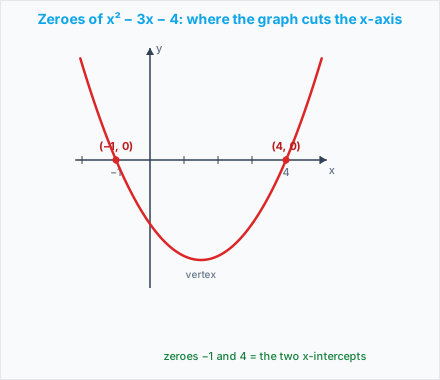
Here is the picture that makes everything clear. Suppose you draw the graph of y = p(x). The zeroes are the x-values where the graph crosses or touches the x-axis. Why? On the x-axis, y is always 0. So at those points y = p(x) = 0, which is exactly what a zero means.
A quadratic always makes a curve called a parabola — a smooth U-shape. It opens upward when a > 0 and downward when a < 0. Figure 2.1 below shows how the zeroes of x² − 3x − 4 (which we found to be −1 and 4) show up as the two points where the curve meets the x-axis:
A parabola can sit against the x-axis in only three ways. So a quadratic can have either two, one, or no real zeroes. Figure 2.2 below lays out all three side by side:
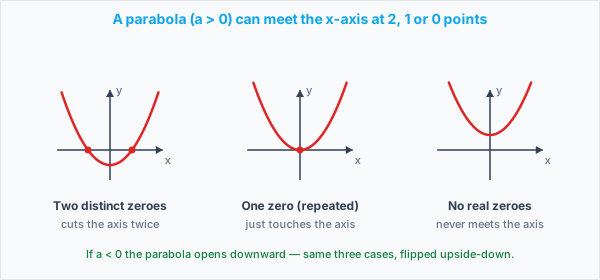
This picture explains a key fact:
A polynomial of degree n has at most n zeroes. So a quadratic (degree 2) has at most 2 zeroes, and a cubic (degree 3) has at most 3.
The graph shows this is believable — a parabola can only meet the axis up to twice. But why is the limit exactly the degree, and never more? Here is the real reason, and it doesn’t need a graph at all.
Each different zero quietly “uses up” one factor. We’ll prove this properly in a moment (it’s called the factor theorem), but the idea is short: if α is a zero, then (x − α) is a factor of the polynomial. Two different zeroes mean two different factors, like (x − α)(x − β). And factors multiply together, so their degrees add up — two linear factors make degree 2, three make degree 3, and so on.
Now watch what goes wrong if there were too many zeroes. Suppose a quadratic — degree 2 — had 3 different zeroes. Then it would have 3 factors, (x − α)(x − β)(x − γ), which is degree 3. But the polynomial is only degree 2. A polynomial can’t be degree 2 and degree 3 at the same time. So this is impossible. The most zeroes a degree-2 polynomial can have is 2. The same reasoning caps a cubic at 3, and a degree-n polynomial at n. Figure 2.3 below walks through this argument:

Let’s put that “at most n” rule to work on a cubic whose graph cuts the axis three times:
A graph of y = p(x) crosses the x-axis at exactly 3 points and p(x) is a cubic. How many zeroes does it have, and is that allowed?
- Zeroes are the x-intercepts, and the graph meets the x-axis at 3 points, so p(x) has 3 zeroes.
- A cubic has degree 3. A degree-n polynomial can have at most n zeroes. So a cubic can have at most 3 zeroes.
- This cubic has 3 zeroes, which is exactly the highest number allowed. So yes, it’s allowed — this cubic has as many zeroes as a cubic can ever have.
Zeroes are tied to the coefficients
Now for the surprise. Take any quadratic and factorise it. For example, p(x) = 2x² − 8x + 6 = 2(x − 1)(x − 3), so its zeroes are 1 and 3. Now look at what the coefficients already tell us:
- Sum of zeroes = 1 + 3 = 4. And −b/a = −(−8)/2 = 4. Same answer.
- Product of zeroes = 1 × 3 = 3. And c/a = 6/2 = 3. Same answer.
This is not luck. It is true for every quadratic, and we can prove it.
The proof leans on one quiet fact we keep using: if α is a zero of a polynomial, then (x − α) is a factor of it. This is called the factor theorem. It sounds like a big claim, so let’s see exactly why it must be true — it comes straight from ordinary division.

With the factor theorem in hand, the proof of the sum and product rules falls out — its very first step is just to write the zeroes as factors:
If α and β are the zeroes of p(x) = ax² + bx + c (a ≠ 0), show that α + β = −b/a and αβ = c/a.
- If α and β are the zeroes, then (x − α) and (x − β) are factors of the quadratic. So we can write ax² + bx + c = a(x − α)(x − β). The a in front keeps the leading coefficient correct.
- Open up the right side. First (x − α)(x − β) = x² − (α + β)x + αβ. Multiply by a to get ax² − a(α + β)x + aαβ.
- Now compare this with ax² + bx + c, term by term. The x-terms must match, so b = −a(α + β). The constant terms must match, so c = aαβ.
- Divide both sides by a in each equation. This gives α + β = −b/a and αβ = c/a. ∎ (Sum = −b/a, Product = c/a. These are worth memorising.)
That whole proof is just one simple idea. We wrote the same quadratic in two ways, placed them one above the other, and matched the matching terms. This is much easier to see in a picture than to read in words. Figure 2.5 below lines the two forms up column by column:

An easy way to remember it: sum = −(coefficient of x)/(coefficient of x²) and product = (constant)/(coefficient of x²).
There is also a nice way to see both rules right on the graph. A parabola is symmetric — its left and right halves are mirror images. So its two zeroes sit at equal distances from the centre line, called the axis of symmetry. That centre line is at x = −b/2a, which is the average (the middle) of the two zeroes. If you double the average, you get the sum, which is −b/a. Also, the curve crosses the y-axis at the value c. Since c = a·αβ, dividing by a gives the product c/a. Figure 2.6 below shows both rules on the actual graph:

Let’s test these two rules on a fresh quadratic — find its zeroes, then check the sum and product against the coefficients:
Find the zeroes of x² + 7x + 10 and verify the sum and product against the coefficients.
- Factorise: x² + 7x + 10 = (x + 2)(x + 5). The product is 0 when one factor is 0. So x + 2 = 0 gives x = −2, and x + 5 = 0 gives x = −5. The zeroes are −2 and −5.
- Here a = 1, b = 7, c = 10. Sum of zeroes = −2 + (−5) = −7, and −b/a = −7/1 = −7. ✓
- Product of zeroes = (−2)(−5) = 10, and c/a = 10/1 = 10. ✓ The relationship holds.
This link works both ways. If someone gives you the sum and product of the zeroes, you can build the quadratic back. A polynomial whose zeroes add up to S and multiply to P is x² − Sx + P (here we take a = 1).
Let’s use that to build a quadratic when we’re only told the sum and product of its zeroes:
Find a quadratic polynomial whose zeroes have sum −3 and product 2.
- Use x² − (sum)x + (product). Here sum = −3 and product = 2.
- So the polynomial is x² − (−3)x + 2 = x² + 3x + 2.
- Let’s check by factorising: x² + 3x + 2 = (x + 1)(x + 2). The zeroes are −1 and −2. Their sum is −3 ✓ and their product is 2 ✓. (Any multiple, like k(x² + 3x + 2), also works.)
The same idea for cubics
A cubic ax³ + bx² + cx + d with zeroes α, β, γ follows three matching rules. We prove them the same way as before — by expanding a(x − α)(x − β)(x − γ) and matching terms:
- α + β + γ = −b/a (sum of zeroes)
- αβ + βγ + γα = c/a (sum of products, two at a time)
- αβγ = −d/a (product of zeroes)
Notice the pattern in the signs: −b/a, then +c/a, then −d/a. The sign keeps flipping (minus, plus, minus) as you move down the coefficients.
Figure 2.7 below shows where all three cubic rules come from — it’s the very same matching trick, just one degree higher:

Common Mistakes
The 'zero' of a polynomial means the value of the polynomial at x = 0, that is p(0).
The word 'zero' makes you think of x = 0. And p(0) is easy to work out. So the two ideas get mixed up.
A zero is an INPUT x that makes the OUTPUT p(x) = 0. It is a solution of p(x) = 0. But p(0) is just the value when x = 0 (it is the constant term, where the graph meets the y-axis). p(0) is usually NOT zero.
For ax² + bx + c, the sum of the zeroes is b/a and the product is −c/a.
Both formulas use b/a and c/a. So it is easy to forget which one has the minus sign.
The correct rule is sum = −b/a (the minus goes with the SUM) and product = +c/a. Quick check: x² − 5x + 6 has zeroes 2 and 3. Sum 5 = −(−5)/1 ✓, product 6 = 6/1 ✓.
Every quadratic has two real zeroes (the graph always cuts the x-axis twice).
Most quadratics in textbooks are picked so they factorise nicely into two real zeroes. So having two zeroes starts to feel normal.
A parabola can also just TOUCH the x-axis (one repeated zero), or MISS it completely (no real zeroes). For example, x² + 1 is never 0 for any real x. So a quadratic has at most two real zeroes, but it may have one or even none.
x² + 1 has the zeroes 1 and −1.
x² − 1 factorises to (x−1)(x+1) with zeroes 1 and −1. And x² + 1 looks almost the same, so the sign gets copied by mistake.
To find the zeroes of x² + 1, set x² + 1 = 0, which means x² = −1. No real number squared gives a negative answer. So x² + 1 has NO real zeroes (its parabola stays fully above the x-axis). It is x² − 1 that has zeroes 1 and −1.
Quick Check
Which of these is NOT a polynomial?
What are the zeroes of the polynomial whose graph is shown crossing the x-axis at x = 2 and x = −5?
For the quadratic 3x² + 5x − 2, what is the sum of its zeroes?
At most how many zeroes can a cubic polynomial have?
Practice Problems
Easy
Find the zeroes of 4u² + 8u and verify the relationship with the coefficients.
Factorise by taking out the common 4u: 4u² + 8u = 4u(u + 2). This is 0 when u = 0, or when u + 2 = 0 (which gives u = −2). So the zeroes are 0 and −2.
Here a = 4, b = 8, c = 0. Sum = 0 + (−2) = −2, and −b/a = −8/4 = −2 ✓.
Product = 0 × (−2) = 0, and c/a = 0/4 = 0 ✓.
Find a quadratic polynomial whose zeroes have sum 0 and product −15.
Use the rule x² − (sum)x + (product). Put sum = 0 and product = −15: x² − (0)x + (−15) = x² − 15.
Check: x² − 15 = 0 gives x = √15 and x = −√15. These add up to 0 ✓ and multiply to −15 ✓.
Medium
These next ones don’t factorise at a glance, so we’ll lean on “splitting the middle term” from Class 9. Here’s how that method works:
Find the zeroes of 6x² − 7x − 3 and verify the sum and product against the coefficients.
Split the middle term −7x into −9x + 2x (because −9 × 2 = −18 = 6 × −3): 6x² − 7x − 3 = 6x² − 9x + 2x − 3. Group and factorise: 3x(2x − 3) + 1(2x − 3) = (3x + 1)(2x − 3).
Set each factor to 0. From 3x + 1 = 0 we get x = −1/3. From 2x − 3 = 0 we get x = 3/2. So the zeroes are −1/3 and 3/2.
Here a = 6, b = −7, c = −3. Sum = −1/3 + 3/2 = −2/6 + 9/6 = 7/6, and −b/a = 7/6 ✓.
Product = (−1/3)(3/2) = −3/6 = −1/2, and c/a = −3/6 = −1/2 ✓.
The next problem has no middle term to split, but a square-minus-a-square identity unlocks it. A quick reminder of that identity:
Find the zeroes of x² − 3 and verify the relationship between zeroes and coefficients.
Use the identity a² − b² = (a − b)(a + b). Here 3 = (√3)², so x² − 3 = (x − √3)(x + √3).
This is 0 when x = √3 or x = −√3. So the zeroes are √3 and −√3.
Here a = 1, b = 0, c = −3. Sum = √3 + (−√3) = 0, and −b/a = 0 ✓.
Product = (√3)(−√3) = −3, and c/a = −3/1 = −3 ✓.
Challenge
If α and β are the zeroes of x² − 5x + 6, find the value of α² + β² without finding α and β individually.
First get the sum and product from the coefficients. α + β = −b/a = −(−5)/1 = 5. And αβ = c/a = 6/1 = 6.
Now use the identity α² + β² = (α + β)² − 2αβ. This is handy because it needs only the sum and the product, not α and β themselves.
α² + β² = (5)² − 2(6) = 25 − 12 = 13.
(Check: the zeroes are 2 and 3, and 2² + 3² = 4 + 9 = 13 ✓. The clever part is that we got the answer without ever solving for the zeroes.)
Summary
You should now be able to explain:
- A polynomial’s degree is its highest power. Degrees 1, 2, 3 are called linear, quadratic, cubic. A quadratic has the form ax² + bx + c with a ≠ 0.
- A zero is an input k that makes p(k) = 0. It is not the same as p(0).
- On a graph, the zeroes of p(x) are the x-values where y = p(x) meets the x-axis.
- A quadratic’s graph is a parabola (opens up if a > 0, down if a < 0). It has two, one or no real zeroes. In general, a polynomial of degree n has at most n zeroes.
- For a quadratic ax² + bx + c: sum of zeroes = −b/a and product = c/a. (You can prove both by expanding a(x − α)(x − β).)
- The other way round: a quadratic with sum S and product P is x² − Sx + P.
- For a cubic ax³ + bx² + cx + d: α + β + γ = −b/a, αβ + βγ + γα = c/a, αβγ = −d/a.
What’s Next
You now know that zeroes are where one graph meets the x-axis. Next, in Pair of Linear Equations in Two Variables, we draw two straight-line graphs on the same axes. Then we ask where they meet each other. That meeting point is the one solution that fits both equations at the same time. It is the same idea — picture meeting algebra — taken one step further.
Frequently Asked Questions
What is a zero of a polynomial and how do you find it?
A zero of a polynomial p(x) is a value of x that makes p(x) equal to 0. To find it, set the polynomial equal to zero and solve for x. For example, for p(x) = x² − 3x − 4, solving x² − 3x − 4 = 0 gives x = 4 and x = −1, so 4 and −1 are its zeroes.
What does the geometrical meaning of zeroes of a polynomial mean?
When you draw the graph of y = p(x), the zeroes are the x-coordinates of the points where the graph meets the x-axis. A linear polynomial's graph is a straight line crossing the x-axis at one point. A quadratic's graph is a U-shaped curve (parabola) that can cross the x-axis at two points, one point, or not at all.
What is the relationship between zeroes and coefficients of a quadratic polynomial?
For a quadratic polynomial ax² + bx + c with zeroes α and β, the sum of zeroes α + β = −b/a and the product of zeroes αβ = c/a. These formulas let you find the sum and product of zeroes directly from the coefficients, without solving the equation first.
How many zeroes can a polynomial of degree n have?
A polynomial of degree n has at most n zeroes. So a linear polynomial (degree 1) has exactly 1 zero, a quadratic (degree 2) has at most 2 zeroes, and a cubic (degree 3) has at most 3 zeroes. The graph of a degree-n polynomial can cross the x-axis at most n times.
How do you form a quadratic polynomial if you know the sum and product of its zeroes?
Use the formula x² − (sum of zeroes)x + (product of zeroes). For example, if the sum of zeroes is 3 and the product is −4, the quadratic is x² − 3x − 4. This works because expanding (x − α)(x − β) always gives x² − (α + β)x + αβ.