Real Numbers
Why This Matters
Every number is built from a small set of special numbers called primes. Think of primes as building blocks. And here is the amazing part: each number can be built in only one way.
This one simple fact is doing a lot of quiet work in real life. It is why your UPI payments and online banking stay safe. It is why two flashing lights, or two buses on a route, line up together again after a fixed gap of time. And it is why a fraction always gives either a clean decimal that stops, or a decimal that repeats.
This chapter is about understanding numbers from the inside. You will learn three things. First, how to break any number down into its prime building blocks. Second, how those blocks instantly give you the HCF and LCM of two numbers. Third, how to actually prove — not just believe — that numbers like √2 can never be written as a neat fraction.
That last part is more important than it looks. So far, most of your maths has been about calculating an answer. Here you will do what a real mathematician does. You assume the opposite of what you want to show. You follow that assumption step by step until it leads to something impossible. Since the assumption broke, you were right all along. This way of thinking is called proof by contradiction, and you will use it again and again in maths.
The Big Idea
Every composite number is a product of primes. And there is only one such product (the order in which you write the primes does not count as different). So primes are like the atoms of numbers — the smallest pieces everything is made of. Once you know a number’s prime “recipe”, almost everything about it becomes easy to find: its HCF and LCM with another number, whether it can end in a 0, and whether its square root is irrational.
Let’s Break It Down
Every number is built from primes
A factor of a number is a number that divides it exactly, with no remainder. For example, the factors of 6 are 1, 2, 3 and 6.
A prime number is a number with exactly two factors: 1 and the number itself. The primes are 2, 3, 5, 7, 11, 13, and so on. A composite number has more than two factors, like 4, 6, 8 and 9. The number 1 is special: it has only one factor (itself), so it is neither prime nor composite.
The Fundamental Theorem of Arithmetic is a big name for a simple but very powerful idea:
Every composite number can be written as a product of primes. And this way of writing it is unique. The only thing that can change is the order of the primes.
For example, 12 = 2 × 2 × 3. There is no other set of primes that multiplies to give 12. To find the primes of a number, you keep splitting it into smaller factors until every piece left is a prime. This splitting picture is called a factor tree. Figure 1.1 below builds one for 3825.
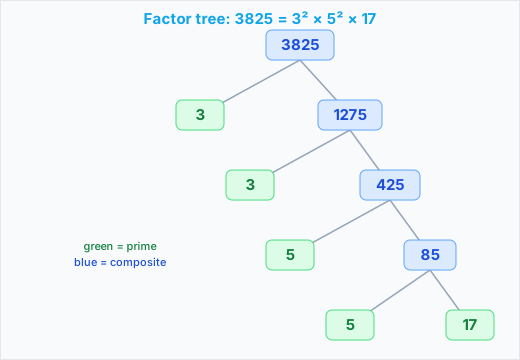
We usually write the primes in increasing order. If a prime repeats, we group it as a power. So we write 3825 = 3² × 5² × 17 (here 3² means 3 × 3, and 5² means 5 × 5).
The theorem really has two parts. The first part says a prime factorisation exists — that some set of primes works. This is easy to believe. A factor tree always comes to an end, because each split makes the numbers smaller, and you keep going until only primes are left. The second part says this set of primes is unique — there is only one such set. This second part is the deep and powerful one. It is exactly the part we will use below to prove the next theorem and to prove that roots like √2 are irrational.
So why must the recipe be unique? You should not just take this on trust. Here is the idea of the proof. It rests on one key fact about primes: if a prime divides a product of numbers, it must divide at least one of those numbers. (For example, 7 divides 7 × 4 = 28, and sure enough 7 divides one of the factors, namely 7 itself. A non-prime like 6 does not behave this way: 6 divides 4 × 9 = 36, yet 6 divides neither 4 nor 9.)
Now suppose, just to test it, that some number N had two different prime recipes. Write them side by side: N = p₁ × p₂ × p₃ × … and also N = q₁ × q₂ × q₃ × … Take the first prime on the left, p₁. It divides N, so it divides the whole right-hand product q₁ × q₂ × q₃ × … By the key fact, p₁ must divide one of the q’s. But each q is itself a prime, and a prime is divided only by 1 and by itself. So p₁ cannot just divide a q — it must equal one of them. Now cancel that matching prime from both sides. You are left with a shorter version of the same situation, and you can repeat the very same step again and again. Every prime on the left pairs off with an equal prime on the right, until nothing is left over. The two “different” recipes were never different at all — they were the same list, just written in a different order. That is exactly what uniqueness means.
Figure 1.2 below follows this cancelling, one prime at a time, until the two recipes collapse into one:

(The single key fact — a prime dividing a product divides one of the factors — is the one part we take as given here; everything else above is a real proof. The full justification of that key fact is just beyond Class 10.)
Let us put the factor-tree idea to work on a real number and break it all the way down to primes:
Express 156 as a product of its prime factors.
- 156 is even, so it divides by 2: 156 = 2 × 78.
- 78 is even too, so divide by 2 again: 78 = 2 × 39. So far we have 156 = 2 × 2 × 39.
- Now split 39: 39 = 3 × 13. Both 3 and 13 are prime, so we stop here.
- Put all the primes together: 156 = 2² × 3 × 13.
Reading off the HCF and LCM
Once you have written two numbers in prime-power form, finding their HCF and LCM needs no guessing.
The HCF (highest common factor) is the biggest number that divides both numbers. The LCM (lowest common multiple) is the smallest number that both numbers divide into. Here are the two rules:
- HCF = multiply the smallest power of each prime that appears in both numbers (the part they share).
- LCM = multiply the greatest power of every prime that appears in either number (everything put together).
These rules use the words “factor” and “multiple” a lot, so make sure the two are clear in your head first:
Why these rules? Think of a number as a bag of prime “bricks”
Imagine each number’s primes as bricks in a bag. 12 = 2 × 2 × 3 is a bag holding the bricks 2, 2, 3. And 18 = 2 × 3 × 3 is a bag holding 2, 3, 3. Two simple facts about these bricks explain both rules at once.
- A factor of a number can only be built from bricks that the number actually has. And it can never use more copies of a brick than the number has. So a common factor of two numbers can use only bricks found in both bags. And for each prime, it can use no more copies than the smaller bag holds. The biggest factor you can build this way is the HCF. It is the overlap of the two bags: each shared prime, taken to its smallest power.
- A multiple of a number must contain all of that number’s bricks. (You cannot be a multiple of 12 unless you carry two 2’s and a 3 inside you.) So a common multiple must contain every brick of both bags. But you do not double up shared bricks. If one number needs one 2 and the other needs two 2’s, then two 2’s already cover both. So for each prime, you just take the bigger count. The smallest multiple you can build this way is the LCM. It is all the bricks together: each prime, taken to its greatest power.
Figure 1.3 below is a Venn diagram showing both bags at once, so you can actually see the overlap and the leftovers:

This picture also explains the shortcut coming up next. Look at the whole diagram: the overlap (the HCF) plus the two outer parts together use every brick of 12 and every brick of 18 exactly once. That is exactly why HCF × LCM = the product of the two numbers.
To see the “smallest versus greatest” idea clearly, let us zoom in on just one prime. Suppose the prime 2 appears three times in a number a, and five times in a number b. Figure 1.4 below shows this side by side.

- To divide both numbers, your stack of 2’s must fit inside each number. So it can be at most the smaller stack, which is 2³ here. A stack of 2⁴ would not fit inside a, because a only has three 2’s. This is why the HCF takes the smallest power.
- To be a multiple of both numbers, your stack of 2’s must cover each number. So it must be at least the larger stack, which is 2⁵ here. A stack of 2⁴ is not tall enough to contain b, because b needs five 2’s. This is why the LCM takes the greatest power.
Now just do this one prime at a time, across all the primes. Put the results together, and you have built the HCF and the LCM.
Here are the two rules side by side, so you never mix them up:
| HCF (common factor) | LCM (common multiple) | |
|---|---|---|
| Which primes | only primes in BOTH | every prime in EITHER |
| Which power | the smallest | the greatest |
| Size | ≤ both numbers | ≥ both numbers |
| Think of it as | the largest tile that fits both | when two cycles next align |
Let us run both rules on a pair of actual numbers and see them in action:
Find the HCF and LCM of 96 and 404.
- First, factorise each number into primes: 96 = 2⁵ × 3, and 404 = 2² × 101.
- For the HCF, look for primes in both. The only prime in both is 2. Its smallest power is 2² (since 96 has 2⁵ and 404 has 2², we take the smaller). So HCF = 2² = 4.
- For the LCM, take every prime at its greatest power: that is 2⁵, 3 and 101. So LCM = 2⁵ × 3 × 101 = 32 × 303 = 9696.
- So HCF(96, 404) = 4 and LCM(96, 404) = 9696.
For two numbers there is a lovely shortcut. The bricks you put in the HCF, plus the bricks you put in the LCM, together use up every prime exactly once. So:
HCF(a, b) × LCM(a, b) = a × b
Here is exactly why this works, prime by prime. Pick any prime, and suppose number a has it x times and number b has it y times. The HCF takes the smaller of x and y. The LCM takes the larger of x and y. Now think about how many copies the HCF and LCM use together: the smaller count plus the larger count. But “the smaller plus the larger” is just the two counts added up — you have only swapped their order. In short, smaller + larger = x + y. So for this prime, the HCF and LCM together carry exactly x + y copies — the very same total that a and b carried between them. This is true for every prime. Multiply everything back together, and HCF × LCM rebuilds each prime to its full a-plus-b total. That is precisely a × b.
Figure 1.5 below makes the “smaller + larger = both added” step plain to see:

This is handy in two ways. If you already know the HCF, you can find the LCM at once. And you can use it to check your work. Look at the example above: 4 × 9696 = 38784, and 96 × 404 = 38784 too. ✓
Here is the shortcut at its most useful — finding an LCM when you are handed the HCF for free:
Given that HCF(306, 657) = 9, find LCM(306, 657).
- For two numbers, HCF × LCM = product. Rearranging, LCM = (306 × 657) / HCF.
- First find the product: 306 × 657 = 201042. Now divide by the HCF, which is 9: LCM = 201042 / 9.
- 201042 / 9 = 22338, so LCM(306, 657) = 22338.
Warning: the HCF × LCM = product rule works for two numbers only. For three numbers, HCF(a, b, c) × LCM(a, b, c) is usually not equal to a × b × c. So do not use this rule with three or more numbers.
Using uniqueness to settle a question
A number has only one prime recipe. Because of this, you can completely rule out certain possibilities. Here is a useful fact: a number ends in the digit 0 only if it divides by 10. And 10 = 2 × 5. So a number ends in 0 only if both 2 and 5 appear in its prime factorisation.
Let us use that to settle a question you might think needs checking forever — every power of 6:
Is there any natural number n for which 6ⁿ ends in the digit 0?
- To end in 0, the number must divide by 10. Since 10 = 2 × 5, the number must have the prime 5 in its factorisation.
- Now factorise 6ⁿ. Since 6 = 2 × 3, we get 6ⁿ = (2 × 3)ⁿ = 2ⁿ × 3ⁿ. The only primes here are 2 and 3. There is no 5.
- The Fundamental Theorem says this prime recipe is the only one 6ⁿ can have. So 6ⁿ has no other prime factors, and 5 can never sneak in.
- Since 5 never appears, 6ⁿ can never end in the digit 0, for any natural number n.
Why some numbers can’t be written as fractions
A rational number is a number you can write as p/q, where p and q are integers (whole numbers, positive or negative) and q is not 0. For example, 3/4, 7, and −2/5 are all rational. An irrational number is one you cannot write this way, no matter how hard you try.
That definition leans on the word “integer”, so let us be sure what that means:
The star example of an irrational number is √2, so it helps to recall exactly what that √ sign is asking for:
We are about to draw √2 as the diagonal of a square, and that uses one rule from an earlier class:
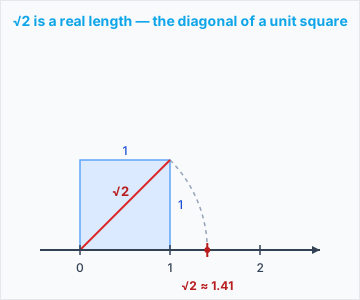
Irrational numbers are not strange or “unreal”. They are real points sitting on the number line, just like any other. Take √2 as an example. It is simply the length of the diagonal of a square with sides 1 × 1. By Pythagoras’ theorem, the diagonal² = 1² + 1² = 2, so the diagonal is √2. If you swing that diagonal down onto the number line with a compass, it lands at a fixed point somewhere between 1 and 2. Figure 1.6 below shows this construction.
To prove a number is irrational, we use proof by contradiction. We assume the opposite — that the number is rational. Then we follow that assumption until it forces something impossible. Since the assumption led to nonsense, the assumption was wrong, and the number must be irrational.
But first we need one small fact. Since it is a theorem, we will prove it too. The proof uses the uniqueness part of the Fundamental Theorem of Arithmetic.
Theorem. If a prime p divides a², then p also divides a (where a is a positive integer).
Here is the short proof, and it rests entirely on the uniqueness of prime factorisation:
Show that whenever a prime p divides a², it must also divide a.
- Write a as a product of its primes: a = p₁ × p₂ × … × pₙ. These are the prime building blocks of a. (Some of them may repeat — that is fine.)
- Now square a: a² = (p₁ × p₂ × … × pₙ)² = p₁² × p₂² × … × pₙ². Notice that squaring did not bring in any new primes. So the primes inside a² are exactly p₁, p₂, …, pₙ — the same primes as a.
- We are told that the prime p divides a². By the uniqueness of prime factorisation, the only primes inside a² are p₁, …, pₙ. So p has to be one of these.
- But p₁, …, pₙ are exactly the primes of a. So p is a prime of a, which means p divides a. ∎ (This small theorem is the engine that powers every “root is irrational” proof.)
Now we have everything we need. Watch how assuming √2 is a fraction tangles itself into a contradiction:
Prove that √2 cannot be written as a fraction.
- Assume the opposite of what we want. Suppose √2 is rational. Then we can write √2 = a/b, where a and b are integers, b ≠ 0, and the fraction is already in its simplest form. “Simplest form” means a and b have no common factor left to cancel.
- Multiply both sides by b: b√2 = a. Now square both sides: 2b² = a². This tells us a² is divisible by 2. By the fact we just proved, if 2 divides a², then 2 divides a. So we can write a = 2c for some integer c.
- Put a = 2c back in: 2b² = (2c)² = 4c². Divide both sides by 2: b² = 2c². This tells us b² is divisible by 2. Again, by the same fact, 2 divides b.
- Now we have a problem. We just showed 2 divides a and 2 divides b. So a and b share the common factor 2. But step 1 said they had no common factor! This is a contradiction. The only thing we assumed was that √2 is rational, so that assumption must be wrong. Therefore √2 is irrational.
The exact same argument works for other primes. Just put 3 in place of 2, or 5 in place of 2, and you prove √3, √5, and so on are irrational. And once you know √3 is irrational, you can prove that combinations like 5 − √3 or 3√2 are irrational too. The trick is the same: assume the combination is rational, then rearrange until a number you already know is irrational is forced to equal a fraction. That is impossible, so the assumption was wrong.
Prove that 5 − √3 is irrational, given that √3 is irrational.
Assume the opposite. Suppose 5 − √3 is rational. Then we can write 5 − √3 = a/b, with a and b integers and b ≠ 0.
Now rearrange to get √3 by itself: √3 = 5 − a/b. Putting the right side over one denominator, √3 = (5b − a)/b.
Look at the right side. It is made only of integers, using subtraction and division. So it is a rational number. That would make √3 rational. But we are told √3 is irrational. This is a contradiction.
So our assumption was wrong, and 5 − √3 is irrational.
Common Mistakes
The number 1 is a prime number, because its factors are 1 and itself.
Primes are often described as 'divisible only by 1 and themselves'. The number 1 seems to fit that phrase, since it is divisible by 1.
A prime must have exactly TWO different factors. But 1 has only one factor (itself), so it is neither prime nor composite. There is a good reason for this rule: if 1 were a prime, factorisation would no longer be unique. You could keep sticking extra 1s on, like 12 = 2 × 2 × 3 × 1 × 1, and break the whole theorem.
For the LCM you take the smallest powers, and for the HCF you take the greatest powers.
Both rules talk about 'powers of primes'. Since they are mirror images of each other, it is easy to swap the two words by mistake.
It is the other way round. The HCF takes the SMALLEST power of each shared prime, because a common factor cannot be bigger than what both numbers have. The LCM takes the GREATEST power of every prime, because a common multiple must contain all of each number.
The rule HCF × LCM = product of the numbers works for any set of numbers.
It is a clean, easy-to-remember rule, and it really does work for two numbers. So it feels natural to use it for three numbers as well.
It works for TWO numbers only. For three numbers, HCF(a,b,c) × LCM(a,b,c) is usually not equal to a × b × c. Check it with 6, 72, 120: here HCF = 6 and LCM = 360, so HCF × LCM = 6 × 360 = 2160. But 6 × 72 × 120 = 51840, which is much bigger. So the rule fails.
To prove √2 is irrational, you just type it into a calculator (√2 = 1.41421356…) and notice the decimal never repeats.
A decimal that never repeats really is irrational, and the calculator's screen looks like it goes on forever.
A calculator only shows a few digits — a finite chunk. You can never actually SEE that the decimal goes on forever without repeating. So a calculator can never prove it. Irrationality must be proved by contradiction: assume √2 = a/b in simplest form, then show a and b must share a factor, which is a contradiction.
Quick Check
What does the Fundamental Theorem of Arithmetic guarantee about a composite number?
If 90 = 2 × 3² × 5 and 24 = 2³ × 3, what is HCF(90, 24)?
For two numbers, HCF = 9 and LCM = 90. What is the product of the two numbers?
Why is 7 × 11 × 13 + 13 a composite number?
Practice Problems
Easy
Express 5005 as a product of its prime factors.
5005 ends in 5, so it divides by 5: 5005 = 5 × 1001.
Now split 1001: 1001 = 7 × 143. Then split 143: 143 = 11 × 13.
Putting it all together, 5005 = 5 × 7 × 11 × 13. All four are prime, so we stop.
Find the HCF and LCM of 26 and 91, and verify HCF × LCM = product.
First factorise: 26 = 2 × 13 and 91 = 7 × 13.
For the HCF, find the shared primes. The only shared prime is 13, so HCF = 13.
For the LCM, take every prime at its greatest power: 2 × 7 × 13 = 182.
Now check the rule: HCF × LCM = 13 × 182 = 2366. And 26 × 91 = 2366. They match. ✓
Medium
There is a circular track. Sonia takes 18 minutes for one round and Ravi takes 12 minutes. They start together from the same point. After how many minutes do they next meet at the starting point?
They both reach the start only at times that fit a whole number of laps for each of them. The first such time is the LCM of their lap times, 18 and 12.
First factorise: 18 = 2 × 3² and 12 = 2² × 3.
For the LCM, take the greatest power of each prime: 2² × 3² = 4 × 9 = 36 minutes.
Let us check. After 36 minutes, Sonia has done 36/18 = 2 full laps, and Ravi has done 36/12 = 3 full laps. Both are back at the start together.
Explain why 7 × 6 × 5 × 4 × 3 × 2 × 1 + 5 is a composite number.
Both parts of the sum have 5 in them. The first part, 7 × 6 × 5 × 4 × 3 × 2 × 1, has a 5 inside it. And the second part is 5.
So take out the common 5: 7 × 6 × 5 × 4 × 3 × 2 × 1 + 5 = 5 × (7 × 6 × 4 × 3 × 2 × 1 + 1) = 5 × (1008 + 1) = 5 × 1009.
Now it is written as a product of two numbers, both bigger than 1. So it is composite.
Challenge
Prove that 3 + 2√5 is irrational, given that √5 is irrational.
Assume the opposite. Suppose 3 + 2√5 is rational. Then we can write 3 + 2√5 = a/b, with a and b integers and b ≠ 0.
Now get √5 by itself. First, 2√5 = a/b − 3 = (a − 3b)/b. Then divide by 2: √5 = (a − 3b)/(2b).
Look at the right side. It is made only of integers, using subtraction and division. So it is a rational number. That would make √5 rational. But we are told √5 is irrational. This is a contradiction.
So the assumption fails, and 3 + 2√5 is irrational.
Summary
You should now be able to explain:
- A prime has exactly two factors. The number 1 is neither prime nor composite.
- The Fundamental Theorem of Arithmetic: every composite number is a product of primes, and that product is unique apart from the order.
- To find the HCF, multiply the smallest power of each prime that both numbers share. To find the LCM, multiply the greatest power of every prime in either number.
- For two numbers, HCF × LCM = product of the numbers. This does not work for three or more numbers.
- Because each number has only one prime recipe, you can rule things out. For example, 6ⁿ can never end in 0, because 5 is never one of its primes.
- A number is irrational if it cannot be written as p/q. We prove √2, √3 and √5 are irrational by contradiction, using the fact “if a prime divides a², it also divides a”.
What’s Next
Next, in Polynomials, we move from numbers to expressions — things like x² − 5x + 6. You will see that polynomials have “building blocks” too. These are their zeroes: the values of x that make the polynomial equal to 0. There is also a neat link between these zeroes and the numbers in front of x (the coefficients). It has the same kind of structure you just met here with primes.
Frequently Asked Questions
What is the Fundamental Theorem of Arithmetic in simple words?
It says that every whole number greater than 1 can be written as a product of prime numbers in exactly one way (ignoring the order in which you write the primes). For example, 60 = 2 × 2 × 3 × 5, and there is no other set of primes that multiplies to give 60. This unique prime factorisation is the reason it works to find HCF and LCM through primes.
How do you find HCF and LCM using prime factorisation?
First write each number as a product of its prime factors. For the HCF, multiply the common prime factors, taking the smallest power of each that appears in every number. For the LCM, multiply all the prime factors that appear, taking the highest power of each. For example, 12 = 2² × 3 and 18 = 2 × 3²: the HCF is 2 × 3 = 6 and the LCM is 2² × 3² = 36.
Is HCF × LCM always equal to the product of the two numbers?
Yes, but only for two numbers: HCF(a, b) × LCM(a, b) = a × b. This is a handy shortcut — if you know any three of these values you can find the fourth. For example, HCF(12, 18) × LCM(12, 18) = 6 × 36 = 216, and 12 × 18 = 216 too. Important: this rule does not extend to three or more numbers.
How do you prove that √2 is irrational?
You use proof by contradiction. Assume √2 is rational, so √2 = p/q where p and q are integers with no common factor. Squaring gives 2q² = p², so p² is even, which means p is even. Write p = 2m, then 2q² = 4m², so q² = 2m², meaning q is also even. But if both p and q are even they share the factor 2 — contradicting the assumption that p/q was in lowest terms. So √2 cannot be rational, and is therefore irrational.
What is the difference between rational and irrational numbers?
A rational number can be written as a fraction p/q of two integers (with q not zero); its decimal form either ends or repeats a pattern forever, like 0.5 or 0.333... An irrational number cannot be written as such a fraction; its decimal form goes on forever without ever repeating, like √2 = 1.41421356... or π. Together, the rational and irrational numbers make up all the real numbers.