Arithmetic Progressions
Why This Matters
Look around and you’ll see lists of numbers that grow by the same fixed step each time. Here are three.
- Reena starts a job at ₹8000 a month. She gets a ₹500 raise every year. So her salary goes 8000, 8500, 9000, … (add 500 each year).
- The rungs of a ladder get shorter by 2 cm as you go up: 45, 43, 41, 39, … (subtract 2 each step).
- Shakila puts ₹100 in a money box on her daughter’s first birthday. Each year she adds ₹50 more than the year before: 100, 150, 200, 250, … (add 50 each year).
Of course, you could just keep adding the fixed amount again and again. But what if someone asks: what is the salary in the 25th year? Or how much money is in the box on the 21st birthday? Now you’d have to add 24 or 21 times by hand. That is slow, and it’s easy to make a mistake.
This chapter gives you two shortcuts. The first is a formula for the nth term. It lets you jump straight to any term in the list without writing out all the earlier ones. The second is a formula for the sum of the first n terms. It lets you add up a whole list in a single line. And you won’t just memorise them. You’ll see exactly why each one works — including the clever trick a 10-year-old boy named Gauss used to add 1 + 2 + ⋯ + 100 in just a few seconds.
The Big Idea
An arithmetic progression (AP) is a list of numbers where each term is the one before it plus a fixed number d. That fixed number d is called the common difference. You only need to know two things to build the whole list: the first term a and the step d. Then the list is a, a + d, a + 2d, a + 3d, … . Once you know a and d, you can find any term directly using aₙ = a + (n − 1)d. And you can add up the first n terms in one shot using Sₙ = n/2 [2a + (n − 1)d]. If you happen to know the last term l, the same sum can also be written as n/2 (a + l).
Let’s Break It Down
What an AP is, and how to spot one
Before we name the pattern, let’s nail down two words we’ll use again and again — “sequence” and “term”.
A list of numbers is an arithmetic progression if you get each term by adding the same fixed number to the one before it. The first term has nothing before it, so it just starts the list. That fixed number is the common difference. We write it as d. The value of d can be positive, negative, or zero. If d is positive, the list grows (like 2, 5, 8, …). If d is negative, the list shrinks (like 9, 7, 5, …). If d is zero, every term is the same (like 4, 4, 4, …).
We give the terms names: a₁, a₂, a₃, …, aₙ. So the AP is a₁, a₂, a₃, …, aₙ. Since each term is the one before it plus d, the gap between any two terms in a row is always d:
a₂ − a₁ = a₃ − a₂ = ⋯ = aₙ − aₙ₋₁ = d
So here is how to test a list. Take each term and subtract the term just before it. If you get the same answer every time, it’s an AP — and that answer is d. One thing to be careful about. Always do (later term) − (earlier term), in that order. We write this as aₖ₊₁ − aₖ. Do this even when the later term is smaller. In that case d simply comes out negative, which is fine. Figure 5.1 below shows this stepping idea on a number line.
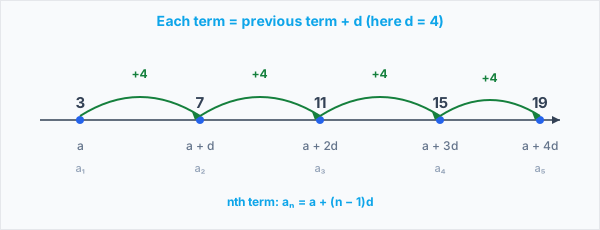
If you know a and d, the AP is fully decided. You can write out the whole list. The form a, a + d, a + 2d, a + 3d, … is called the general form of an AP. An AP that stops at a last term (like 45, 43, …, 31) is called finite. An AP that keeps going forever (like 1, 2, 3, …) is called infinite.
Let’s put the test to work on three lists — and where they pass, pin down a, d and the next two terms.
For each list, say whether it is an AP. If it is, give a, d and the next two terms: (i) 4, 10, 16, 22, … (ii) 1, −1, −3, −5, … (iii) −2, 2, −2, 2, …
- (i) Subtract each term from the next: 10 − 4 = 6, 16 − 10 = 6, 22 − 16 = 6. The answer is 6 every time, so it’s an AP. So a = 4 and d = 6. To get the next two terms, keep adding 6: 22 + 6 = 28, then 28 + 6 = 34.
- (ii) Subtract each term from the next: −1 − 1 = −2, then −3 − (−1) = −2, then −5 − (−3) = −2. The answer is −2 every time, so it’s an AP. So a = 1 and d = −2. Keep adding −2: −5 + (−2) = −7, then −7 + (−2) = −9.
- (iii) Subtract each term from the next: 2 − (−2) = 4, but the next one is −2 − 2 = −4. The answers are different (4 and −4), so this is not an AP. Final answers: (i) AP, a = 4, d = 6, next 28 and 34; (ii) AP, a = 1, d = −2, next −7 and −9; (iii) not an AP.
Here’s a famous pattern that fools many people. Try the subtraction test on it before you read the answer.
Is 1, 1, 2, 3, 5, 8, … (the Fibonacci list) an arithmetic progression?
Deriving the nth term: aₙ = a + (n − 1)d
Say we want Reena’s salary in the 25th year, but we don’t want to write out all 25 terms. Let’s watch how the list is built. We start at the first term a, and we add d at each step:
- a₁ = a (the 1st term — we have added d zero times)
- a₂ = a + d = a + (2 − 1)d (added d once)
- a₃ = a₂ + d = a + 2d = a + (3 − 1)d (added d twice)
- a₄ = a₃ + d = a + 3d = a + (4 − 1)d (added d three times)
Now look at the pattern. To reach the 2nd term we added d once. To reach the 3rd term we added d twice. To reach the 4th term we added d three times. Each time, the number of additions is one less than the term number. So to reach the nth term, you start at a and add d a total of (n − 1) times. Why one fewer than n? Because the first term needed no addition at all — it’s just a. This gives us:
aₙ = a + (n − 1)d
This is called the nth term (or general term) of the AP. If the AP has a last term, we often call it l. So for the final term, l = a + (n − 1)d.
If the “(n − 1)” still feels strange, the climbing-the-ladder picture in Figure 5.2 below makes it click.

Let’s take the formula for a spin: jump straight to the 10th term without writing out the first nine.
Find the 10th term of the AP 2, 7, 12, …
- First find a and d. The first term is a = 2. The common difference is d = 7 − 2 = 5. We want the 10th term, so n = 10.
- Put these into aₙ = a + (n − 1)d: a₁₀ = 2 + (10 − 1) × 5 = 2 + 9 × 5 = 2 + 45.
- So the 10th term is 47.
Often we flip the question around: instead of finding a term, we’re told the value and must find n — which means solving an equation. Here’s a quick refresher on that.
Now let’s use that equation-solving to answer the reverse question: given a value, which position does it sit at — and does the list ever hit exactly 0?
Which term of the AP 21, 18, 15, … is −81? Is any term equal to 0?
- First find a and d. Here a = 21 and d = 18 − 21 = −3. We want to find the term number n where the term equals −81.
- Put the values into aₙ = a + (n − 1)d and set it equal to −81: −81 = 21 + (n − 1)(−3). Open the bracket: −81 = 21 − 3(n − 1), which gives −81 = 24 − 3n.
- Move 24 to the left: −81 − 24 = −3n, so −105 = −3n. Divide by −3: n = 35. So the 35th term is −81.
- Now check if any term equals 0. Set aₙ = 0: 21 + (n − 1)(−3) = 0. Move 21 over: 3(n − 1) = 21, so n − 1 = 7, which gives n = 8. Yes — the 8th term is 0.
Sometimes you are not given a and d directly. Instead you are given two terms of the AP. In that case, write each term using the formula. This gives you two equations with two unknowns (a and d). Then solve them together as a pair, just like you did in Chapter 3.
Let’s see that play out: from just the 3rd and 7th terms, we can rebuild the entire AP.
The 3rd term of an AP is 5 and the 7th term is 9. Find the AP.
- Write both terms using aₙ = a + (n − 1)d. The 3rd term: a₃ = a + 2d = 5 … (1). The 7th term: a₇ = a + 6d = 9 … (2).
- Subtract equation (1) from equation (2). The a cancels out: (a + 6d) − (a + 2d) = 9 − 5, which gives 4d = 4, so d = 1.
- Now put d = 1 back into equation (1): a + 2(1) = 5, so a = 3.
- So a = 3 and d = 1. Adding 1 each time, the AP is 3, 4, 5, 6, 7, …
You can also use the formula to check if a given number is in an AP at all. Just assume it is the nth term and solve for n. If n comes out as a positive whole number, the number is a term. But if n is a fraction or not a whole number, then the number is not a term of that AP.
Check whether 301 is a term of 5, 11, 17, 23, …
- This is an AP with a = 5 and d = 6. Suppose 301 is the nth term. Then 301 = 5 + (n − 1) × 6.
- Open the bracket: 301 = 5 + 6n − 6, so 301 = 6n − 1. Add 1 to both sides: 6n = 302, so n = 302/6 = 151/3.
- But n must be a positive whole number, and 151/3 is not a whole number. So 301 is not a term of this AP.
Deriving the sum: Sₙ = n/2 [2a + (n − 1)d] = n/2 (a + l)
Now comes the big reward: adding the first n terms without going through them one by one. Let’s call this sum Sₙ (or just S). Writing each term in its full form:
S = a + (a + d) + (a + 2d) + ⋯ + [a + (n − 1)d] … (1)
Here is the clever trick young Gauss used to add 1 + 2 + ⋯ + 100. Write the same sum a second time, but backwards. Start from the last term and end with a:
S = [a + (n − 1)d] + [a + (n − 2)d] + ⋯ + (a + d) + a … (2)
Now add line (1) and line (2) together, one column at a time (a column means the two terms sitting in the same spot, one from each line). Watch what happens. As you move right along line (1), each term goes up by d. But along line (2), each term goes down by d. So in every column, whatever extra d is added on top is taken away on the bottom. This means every column adds up to the same total: 2a + (n − 1)d.
Let’s check this. First column: a + [a + (n − 1)d] = 2a + (n − 1)d. Second column: (a + d) + [a + (n − 2)d] = 2a + (n − 1)d (the +d and the −d cancel). It’s the same total every time.
There are n terms, so there are n columns. Each column gives the same total. So when we add line (1) and line (2), we get:
2S = n × [2a + (n − 1)d]
(It’s 2S because we added the sum S to itself.) Now divide both sides by 2:
S = n/2 [2a + (n − 1)d]
That is the sum of the first n terms. Here’s one more nice form. Notice that 2a + (n − 1)d can be split as a + [a + (n − 1)d]. The part a + (n − 1)d is just the nth term. So 2a + (n − 1)d = a + (nth term). This lets us write S = n/2 [a + aₙ]. When the AP has a last term l (so the nth term aₙ is l), this becomes the neat form:
S = n/2 (a + l)
So which form do you use? Use n/2 (a + l) when you know the first term and the last term (but not d). Use n/2 [2a + (n − 1)d] when you know a, d and n. Figure 5.3 below lays out Gauss’s whole trick in three rows.
![The reverse-and-add proof. The sum S is written forwards as a, a+d, ..., l, then again backwards as l, l−d, ..., a. Each column adds to a+l, and with n columns this gives 2S = n(a+l), so S = n/2 (a+l) = n/2 [2a + (n−1)d].](/images/diagrams/ap-reverse-and-add.svg)
Time to cash in the formula — adding 22 terms in a single line instead of adding them one by one.
Find the sum of the first 22 terms of the AP 8, 3, −2, …
- Find a, d and n. Here a = 8, d = 3 − 8 = −5, and we want n = 22 terms.
- We know a, d and n, so use Sₙ = n/2 [2a + (n − 1)d]: S₂₂ = 22/2 × [2(8) + (22 − 1)(−5)] = 11 × [16 + 21(−5)].
- Work out the bracket: 21 × (−5) = −105, so 16 + (−105) = −89. Then S₂₂ = 11 × (−89) = −979.
Remember the boy from the start of the chapter? Let’s use the formula to crack the exact sum that made Gauss famous.
Find the sum of the first n positive integers 1 + 2 + 3 + ⋯ + n.
- The list 1, 2, 3, …, n is an AP. The first term is a = 1, the common difference is d = 1, and the last term is l = n.
- We know the first and last terms, so the (a + l) form is easiest: Sₙ = n/2 (a + l) = n/2 (1 + n).
- So 1 + 2 + ⋯ + n = n(n + 1)/2. (Try n = 100: 100 × 101 ÷ 2 = 5050 — exactly the answer Gauss got.)
We can also run the sum formula backwards: instead of finding the sum, fix the target sum and hunt for how many terms it takes. This one has a surprise ending.
How many terms of the AP 24, 21, 18, … must be taken so that their sum is 78?
- Find a and d. Here a = 24 and d = 21 − 24 = −3. We are told the sum Sₙ = 78, and we want to find n. Use Sₙ = n/2 [2a + (n − 1)d]: 78 = n/2 [2(24) + (n − 1)(−3)] = n/2 [48 + (n − 1)(−3)].
- Simplify the bracket: 48 − 3(n − 1) = 48 − 3n + 3 = 51 − 3n. So 78 = n/2 (51 − 3n). Multiply both sides by 2: 156 = n(51 − 3n) = 51n − 3n².
- Bring everything to one side: 3n² − 51n + 156 = 0. Divide the whole equation by 3: n² − 17n + 52 = 0. Factorise: (n − 4)(n − 13) = 0.
- So n = 4 or n = 13. Both answers are valid. How can two different answers both work? The terms from the 5th to the 13th add up to 0 — some are positive and some are negative, and they cancel out. So the first 4 terms and the first 13 terms both add to 78. Answer: 4 or 13 terms.
Two answers from one question feels odd, so let’s actually look at the terms. This AP is 24, 21, 18, … , and because d is negative the terms slide down past 0 into negative numbers. Figure 5.4 below draws all 13 terms as bars and shows exactly why both answers are right.

There is also a useful link between the sum and the terms: aₙ = Sₙ − Sₙ₋₁. In words, the nth term equals the sum of the first n terms minus the sum of the first (n − 1) terms. This makes sense: if you take the first n terms and remove the first (n − 1) of them, only the nth term is left over. Figure 5.5 below makes this “remove all but the last” idea easy to see.

This trick is handy when you are given a formula for the sum and asked to find the terms.
Putting it together: word problems
Most “real life” AP problems come down to three steps. First, spot the AP hiding in the question. Second, write down a and d (or a and l). Third, pick the right formula and use it.
A TV maker produced 600 sets in the 3rd year and 700 in the 7th year, with production rising by a fixed number each year. Find (i) the 1st-year production, (ii) the 10th-year production, (iii) the total over the first 7 years.
- Production goes up by a fixed amount each year, so it forms an AP. We are told the 3rd year is 600 and the 7th year is 700. Write these as: a₃ = a + 2d = 600 … (1) and a₇ = a + 6d = 700 … (2).
- Subtract (1) from (2). The a cancels: 4d = 100, so d = 25. Put d = 25 into (1): a + 2(25) = 600, so a + 50 = 600, giving a = 550. So (i) the 1st year is 550 sets.
- (ii) For the 10th year, use a₁₀ = a + 9d = 550 + 9(25) = 550 + 225 = 775 sets.
- (iii) For the total of the first 7 years, use the sum formula: S₇ = 7/2 [2(550) + (7 − 1)(25)] = 7/2 [1100 + 150] = 7/2 × 1250 = 4375 sets.
Common Mistakes
The nth term is a + nd — you add d once for every term.
It feels natural that 'n terms' means 'add the step n times'. And a + nd looks simpler than a + (n − 1)d.
The correct formula is a + (n − 1)d. The FIRST term needs no addition — it is just a. So to reach the nth term you add d only (n − 1) times. Quick test: take a = 2, d = 5. The 1st term must be 2. The correct formula gives a + (1 − 1)d = 2 ✓. The wrong one gives a + 1×d = 7 ✗.
Common difference = (first term) − (second term), so for 6, 3, 0, … take d = 6 − 3 = 3.
Subtracting the smaller number from the bigger one keeps d positive, which feels neater.
Always do d = (later term) − (earlier term), that is aₖ₊₁ − aₖ. For 6, 3, 0, … that means d = 3 − 6 = −3, a NEGATIVE common difference. The list is going down, so d should be negative. Doing the subtraction the other way would describe a different list that goes up.
If solving aₙ = (some value) gives n = 151/3 or n = 7.5, just round it to the nearest whole number.
A number that is close to a whole number looks like it 'almost' fits. So rounding feels harmless.
n is the position of a term in the list, so it must be a POSITIVE WHOLE NUMBER. If n comes out as a fraction, it means the value is simply NOT a term of the AP. There is nothing to round. Just say it is not a term.
To add the first n terms, you can use Sₙ = n/2 (a + l) even when you don't know the last term l.
The (a + l) form is shorter and faster, so it is tempting to use it all the time.
Use n/2 (a + l) only when you know l, the last term. If you only know a, d and n, use Sₙ = n/2 [2a + (n − 1)d] instead. Or first find l = a + (n − 1)d, and then use the (a + l) form.
Quick Check
For the AP 21, 18, 15, …, what is the common difference d?
An AP has first term a = 7 and common difference d = 3. What is its 8th term?
Which formula gives the sum of the first n terms of an AP when you know a, d and n?
Using the reverse-and-add trick, each of the n columns of (S written forwards) + (S written backwards) adds up to:
Practice Problems
Easy
Find the common difference and the next two terms of the AP −1.2, −3.2, −5.2, −7.2, …
Subtract each term from the next: d = −3.2 − (−1.2) = −2. Check again: −5.2 − (−3.2) = −2. Same answer, so it’s an AP with d = −2.
To get the next terms, keep adding −2. Next term: −7.2 + (−2) = −9.2. After that: −9.2 + (−2) = −11.2.
So the next two terms are −9.2 and −11.2.
Which term of the AP 3, 8, 13, 18, … is 78?
First find a and d: a = 3 and d = 8 − 3 = 5. Suppose 78 is the nth term.
Use aₙ = a + (n − 1)d: 78 = 3 + (n − 1)×5. Subtract 3: 75 = 5(n − 1). Divide by 5: n − 1 = 15, so n = 16.
So 78 is the 16th term.
Medium
How many two-digit numbers are divisible by 3?
The two-digit multiples of 3 are 12, 15, 18, …, 99. These form an AP with a = 12, d = 3, and last term l = 99. The number of terms n tells us how many such numbers there are.
Use l = a + (n − 1)d: 99 = 12 + (n − 1)×3. Subtract 12: 87 = 3(n − 1). Divide by 3: n − 1 = 29, so n = 30.
So there are 30 two-digit numbers divisible by 3.
The 17th term of an AP exceeds its 10th term by 7. Find the common difference.
Write the two terms: a₁₇ = a + 16d and a₁₀ = a + 9d. “Exceeds by 7” means the 17th term is 7 more than the 10th, so a₁₇ − a₁₀ = 7.
(a + 16d) − (a + 9d) = 7. The a cancels: 7d = 7, so d = 1.
(Notice that a dropped out. The gap between two terms depends only on d and how many steps apart they are. Here that is 16 − 9 = 7 steps of d.)
A sum of ₹1000 is invested at 8% simple interest per year. Do the yearly interest amounts form an AP? Find the interest at the end of 30 years.
Simple interest for T years is P × R × T ÷ 100. Here P = 1000 and R = 8. Find the interest for each year:
- Year 1: 1000 × 8 × 1 ÷ 100 = 80
- Year 2: 1000 × 8 × 2 ÷ 100 = 160
- Year 3: 240, and so on.
The amounts 80, 160, 240, … go up by 80 each year, so they form an AP with a = 80 and d = 80.
The interest at the end of 30 years is the 30th term: a₃₀ = a + 29d = 80 + 29 × 80 = 80 × 30 = ₹2400.
Challenge
In a flower bed there are 23 rose plants in the first row, 21 in the second, 19 in the third, and so on, down to 5 in the last row. How many rows are there?
The counts 23, 21, 19, …, 5 form an AP with a = 23, d = 21 − 23 = −2, and last term l = 5. The number of rows is the number of terms n.
Say there are n rows. Then the last term is the nth term, so aₙ = 5: 5 = 23 + (n − 1)(−2).
Subtract 23: 5 − 23 = −2(n − 1), so −18 = −2(n − 1). Divide by −2: n − 1 = 9, so n = 10.
So there are 10 rows in the flower bed.
If the sum of the first 14 terms of an AP is 1050 and its first term is 10, find the 20th term.
We are given S₁₄ = 1050, n = 14, and a = 10. We need d. Use Sₙ = n/2 [2a + (n − 1)d]:
1050 = 14/2 [2(10) + (14 − 1)d] = 7 [20 + 13d] = 140 + 91d.
Subtract 140: 91d = 1050 − 140 = 910. Divide by 91: d = 10.
Now find the 20th term: a₂₀ = a + 19d = 10 + 19 × 10 = 10 + 190 = 200.
The sum of the first n terms of an AP is given by Sₙ = 4n − n². Find the first term, the second term, and the nth term.
The sum of the first 1 term is just the first term. So put n = 1: S₁ = 4(1) − 1² = 3. So a = 3.
Now the sum of the first 2 terms: S₂ = 4(2) − 2² = 8 − 4 = 4. The second term is the first two terms minus the first term: S₂ − S₁ = 4 − 3 = 1.
So d = a₂ − a₁ = 1 − 3 = −2.
For the nth term, use the link aₙ = Sₙ − Sₙ₋₁. First work out Sₙ₋₁ by replacing n with (n − 1): Sₙ₋₁ = 4(n − 1) − (n − 1)² = 4n − 4 − (n² − 2n + 1) = −n² + 6n − 5. Now subtract: aₙ = Sₙ − Sₙ₋₁ = (4n − n²) − (−n² + 6n − 5) = 4n − n² + n² − 6n + 5 = 5 − 2n.
(Quick check: a₁ = 5 − 2 = 3 ✓, a₂ = 5 − 4 = 1 ✓.)
Summary
You should now be able to explain:
- An AP is a list where each term is the one before it plus a fixed common difference d. The value of d can be positive, negative or zero. General form: a, a + d, a + 2d, … .
- To test a list, check that aₖ₊₁ − aₖ gives the same answer every time. Always subtract the earlier term from the later one.
- The nth term is aₙ = a + (n − 1)d. Reaching the nth term means adding d a total of (n − 1) times, since the first term needs no addition.
- The sum of the first n terms is Sₙ = n/2 [2a + (n − 1)d] = n/2 (a + l). We proved it by writing the sum, then writing it again backwards, then adding. Every column totals (a + l), and there are n columns, so 2S = n(a + l).
- Use n/2 (a + l) when you know the last term l. Use n/2 [2a + (n − 1)d] when you know a, d and n.
- n must be a positive whole number. If n comes out as a fraction, the value is not a term, or the situation is impossible.
- Two handy links: l = a + (n − 1)d for the last term, and aₙ = Sₙ − Sₙ₋₁.
What’s Next
So far you’ve been working with numbers in a line. Next, in Triangles, we move to shape and proportion. You’ll learn when two triangles have the same shape (we call this “similar”). You’ll see what that forces about the ratios of their sides. And you’ll meet some powerful results, like the Basic Proportionality Theorem and the rules for similarity. The same careful habit you used here — spot the pattern first, then prove it — works just as well in geometry.
Frequently Asked Questions
What is an arithmetic progression and how do you identify one?
An arithmetic progression (AP) is a list of numbers where you always add the same fixed number to get the next term. That fixed number is called the common difference d. To check if a list is an AP, subtract each term from the next — if all the differences are equal, it is an AP.
What is the formula for the nth term of an AP?
The nth term is aₙ = a + (n − 1)d, where a is the first term and d is the common difference. The logic is simple: to reach the nth term you take the first term and add d exactly (n − 1) times. For example, in the AP 2, 5, 8, 11, …, the 10th term is 2 + (10 − 1) × 3 = 2 + 27 = 29.
How is the sum of the first n terms of an AP derived?
Write the sum forwards and also backwards (reversing the order). Add the two versions term by term — each pair adds up to (a + l), where l is the last term. There are n such pairs, giving 2Sₙ = n(a + l), so Sₙ = n/2 (a + l). Replacing l with a + (n − 1)d gives the full formula Sₙ = n/2 [2a + (n − 1)d]. This clever trick is known as Gauss's method.
How do you find the common difference of an AP if you know two terms?
If you know the pth term aₚ and the qth term aₙ, subtract one nth-term formula from the other: aₙ − aₚ = (n − p)d, so d = (aₙ − aₚ) / (n − p). For example, if the 5th term is 17 and the 2nd term is 8, then d = (17 − 8) / (5 − 2) = 9 / 3 = 3.
What is the difference between the nth term formula and the sum formula, and when do you use each?
Use aₙ = a + (n − 1)d when you want one specific term (e.g. the 15th term). Use Sₙ = n/2 [2a + (n − 1)d] when you want the total of many terms added together (e.g. the sum of the first 20 terms). A common mistake is using the sum formula when the question asks for a single term.