Triangles
Why This Matters
How did anyone measure the height of Mount Everest? Nobody climbed it with a tape measure. How do we know the distance to the Moon? Nobody flew there to check. Yet we know both numbers. The trick is called indirect measurement. It means measuring something you can reach, then using maths to find something you can’t reach.
This trick rests on one simple idea. If two figures have the same shape, they behave in a neat, predictable way — even if one is tiny and the other is huge.
Think of a photo of the Taj Mahal. Print it stamp-size, then print the same photo postcard-size. Both are clearly the same shape. Every length just got bigger by the same number of times, and every angle stayed exactly the same. We call this “same shape, different size” relationship similarity. Triangles are where similarity becomes a real tool you can calculate with.
Here is the payoff. Once you can say “this small triangle is the same shape as that huge one,” you can find a length you could never measure. You measure the small triangle, then keep the ratios equal to get the big one. For example, a 6 m pole and its 4 m shadow can tell you the height of a tall tower just from the tower’s shadow. The same idea powers map scales, building plans, and even the proof of the Pythagoras theorem. This chapter builds that tool step by step.
The Big Idea
Two figures are similar if they have the same shape. For polygons, that means two things must be true: matching angles are equal and matching sides are in the same ratio. For triangles, this idea becomes really handy. You don’t have to check all six things (three angles and three side-ratios). The Basic Proportionality Theorem says that a line drawn parallel to one side of a triangle cuts the other two sides in the same ratio. From this one theorem come three easy shortcuts — AA, SSS, SAS. Each shortcut lets you prove two triangles are similar after checking just three facts. And once triangles are similar, you can find lengths you could never measure directly.
Let’s Break It Down
Similar figures and similar triangles
Before we meet “same shape, different size”, let’s warm up with its stricter cousin from Class 9 — “same shape AND same size”.
Remember from Class IX: two figures are congruent if they have the same shape and the same size. Congruent figures are exact copies of each other. Similarity keeps the “same shape” part but lets go of the “same size” part. So similar figures look alike, but one can be bigger than the other.
- All circles are similar. All squares are similar. All equilateral triangles are similar.
- Every congruent pair is similar, but a similar pair need not be congruent.
Figure 6.1 below puts the two side by side so you can see exactly where they differ.

Take two polygons with the same number of sides. (A polygon is just a closed shape made of straight sides, like a triangle, square or pentagon.) For these two polygons to be “the same shape”, two things must both be true:
- Matching angles are equal, and
- Matching sides are in the same ratio.
“Matching” sides means sides that sit in the same position in each shape. The ratio you get is the same for every pair of matching sides. We call that common ratio the scale factor. For example, if every side of the big shape is 3 times the matching side of the small shape, the scale factor is 3.
Since the whole chapter runs on “equal ratios”, here is a quick refresher on what a ratio is and the one move — cross-multiplication — you’ll lean on constantly.
Be careful: for polygons you need both conditions. One alone is not enough. A square and a rhombus have sides in the same ratio (all sides equal in each), but their angles are different — so they are not similar. A square and a rectangle have all angles equal (90° each), but their sides are not in the same ratio — so they are not similar either.
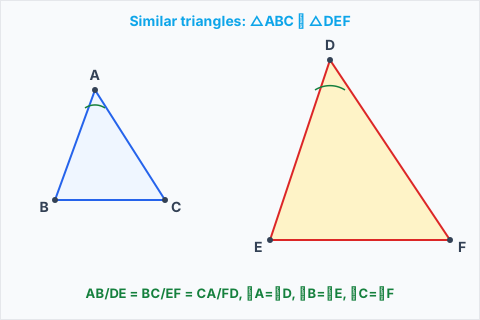
For triangles we write similarity using the symbol ∼. When we write △ABC ∼ △DEF, the order of the letters matters a lot. It tells you which vertex matches which: A↔D, B↔E, C↔F. So this statement means
∠A = ∠D, ∠B = ∠E, ∠C = ∠F and AB/DE = BC/EF = CA/FD.
Figure 6.2 below shows such a pair — a small △ABC and a bigger △DEF of exactly the same shape.
Here’s a quick gut-check to make sure “same shape” hasn’t quietly become “looks a bit alike”.
Are all isosceles triangles similar to one another?
The Basic Proportionality Theorem (Thales’ Theorem)
This theorem is the engine that drives the whole chapter. Almost everything later is built on it.
Theorem 6.1 (BPT). If a line is drawn parallel to one side of a triangle, and it cuts the other two sides at two different points, then it divides those two sides in the same ratio.
Figure 6.3 below shows the set-up: the parallel line DE cutting the two sides of △ABC.
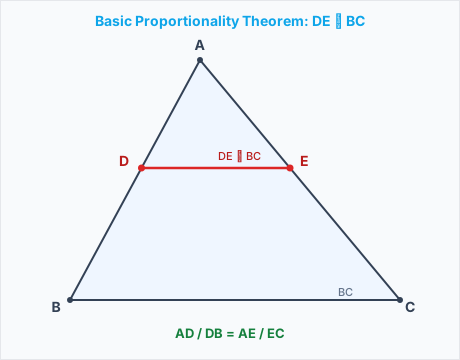
Given: A triangle ABC. A line is drawn parallel to side BC. This line meets side AB at point D and side AC at point E. To prove: AD/DB = AE/EC. In words: the way D splits AB matches the way E splits AC.
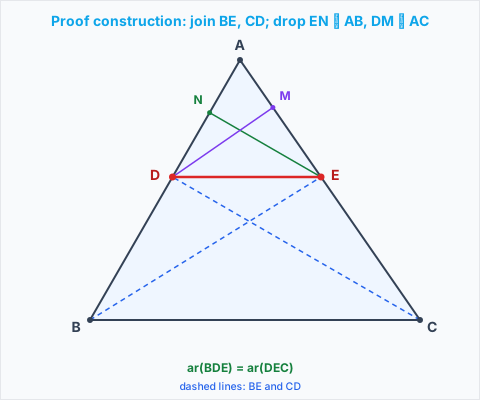
Construction: First we add some helper lines. Join BE and CD (these create two extra small triangles). From point E, draw a line straight down onto AB so it makes a right angle — call it EN ⊥ AB. From point D, draw a line straight onto AC at a right angle — call it DM ⊥ AC. (The symbol ⊥ just means “perpendicular”, that is, meeting at 90°.) These perpendicular lines will act as the heights of our triangles. Figure 6.4 below shows all these construction lines added on top of the original triangle.
The proof leans entirely on triangle areas, so let’s first dust off the area formula and one neat fact about triangles squeezed between parallel lines.
Proof. The whole proof uses one fact you already know: the area of a triangle is ½ × base × height. We write the area of a triangle XYZ as “ar(XYZ)”.
Step 1 — Compare two triangles that share the height EN. Look at triangle ADE. Use AD as its base. Then EN is its height. So ar(ADE) = ½ × AD × EN. Now look at triangle BDE. Use DB as its base. Its height is the same line EN. So ar(BDE) = ½ × DB × EN. Divide one area by the other. The ½ and the EN are the same on top and bottom, so they cancel:
ar(ADE) / ar(BDE) = (½ × AD × EN) / (½ × DB × EN) = AD/DB … (1)
Step 2 — Do the same thing using the other height, DM. Look at triangle ADE again, but now use AE as its base and DM as its height: ar(ADE) = ½ × AE × DM. Look at triangle DEC, using EC as base and the same height DM: ar(DEC) = ½ × EC × DM. Divide again. The ½ and DM cancel:
ar(ADE) / ar(DEC) = AE/EC … (2)
Step 3 — The clever part. Look at the two triangles BDE and DEC. They both sit on the same base DE. And they both lie between the same pair of parallel lines (the line DE and the line BC). There is a rule from earlier: two triangles on the same base and between the same parallels always have equal areas. So
ar(BDE) = ar(DEC) … (3)
Step 4 — Put it all together. Equation (1) is ar(ADE)/ar(BDE) = AD/DB. Equation (2) is ar(ADE)/ar(DEC) = AE/EC. The top of both fractions is the same: ar(ADE). And equation (3) says the bottoms are equal too: ar(BDE) = ar(DEC). So the two fractions on the left must be equal. That makes their right-hand sides equal as well:
AD/DB = AE/EC. ∎
Now let’s put the theorem to work and use it to hunt down a length we aren’t given.
In △ABC, D lies on AB and E on AC with DE ∥ BC. If AD = 1.5 cm, DB = 3 cm and AE = 1 cm, find EC.
- DE is parallel to BC. So the Basic Proportionality Theorem applies, which gives AD/DB = AE/EC.
- Now put in the lengths we know: AD = 1.5, DB = 3, AE = 1. This gives 1.5/3 = 1/EC.
- Cross-multiply (multiply each side’s top by the other side’s bottom): 1.5 × EC = 3 × 1. So EC = 3/1.5.
- Divide: 3 ÷ 1.5 = 2. Therefore EC = 2 cm.
The converse of the BPT
The theorem also works backwards. This backward version is just as useful, because it lets you prove that a line is parallel using only a ratio of lengths.
Theorem 6.2 (Converse of BPT). If a line divides any two sides of a triangle in the same ratio, then that line is parallel to the third side.
Why it holds. We use a method called “proof by contradiction”. We pretend the opposite is true, then show it leads to nonsense.
Suppose in △ABC a line meets AB at D and AC at E, with AD/DB = AE/EC. We want to show DE is parallel to BC. So let us assume the opposite — that DE is not parallel to BC — and see what goes wrong.
If DE is not parallel to BC, then some other line through D must be the parallel one. So draw a different line through D that really is parallel to BC. Let it hit AC at a new point E′. (So E′ is a different point from E.)
Now this new line DE′ is parallel to BC, so we can use the BPT (Theorem 6.1) on it: AD/DB = AE′/E′C.
But we were given AD/DB = AE/EC. The left sides are identical, so the right sides must be equal too: AE/EC = AE′/E′C.
Add 1 to both sides and simplify:
AE/EC + 1 = AE′/E′C + 1 → (AE + EC)/EC = (AE′ + E′C)/E′C → AC/EC = AC/E′C.
(Here AE + EC is just the whole side AC, and AE′ + E′C is also the whole side AC.)
Cancel the AC on top of both sides. We are left with EC = E′C. But E and E′ are both on the same side AC, and they are both the same distance from C. So E and E′ must be the exact same point. That means our “different” line DE′ was really the line DE all along. And DE′ was parallel to BC. So DE ∥ BC. Our assumption that DE was not parallel led to nonsense, so DE must be parallel. ∎
The next example mixes parallel lines with equal angles, so let’s first recall the equal-angle pairs that parallel lines always create.
The example below finishes with one more rule worth knowing why it is true, not just that it is true: in a triangle, the sides facing equal angles are themselves equal. Here is the quick reason.
Here’s the converse in action — a ratio of lengths hands us a parallel line, and that parallel line then reveals two equal sides.
In △PQR, S lies on PQ and T on PR with PS/SQ = PT/TR, and ∠PST = ∠PRQ. Prove that △PQR is isosceles.
- We are told PS/SQ = PT/TR. So the line ST splits the two sides PQ and PR in the same ratio. By the converse of the BPT, that means ST ∥ QR.
- Since ST ∥ QR, the line PQ acts as a transversal cutting them. So ∠PST = ∠PQR (these are corresponding angles). … (i)
- We were also given ∠PST = ∠PRQ. … (ii). Statements (i) and (ii) both equal ∠PST, so ∠PQR = ∠PRQ.
- There is a rule: in a triangle, sides opposite equal angles are equal. The equal angles are ∠PQR and ∠PRQ, so the sides facing them are equal: PR = PQ. A triangle with two equal sides is isosceles. Hence △PQR is isosceles.
Criteria for similarity of triangles
Checking all six conditions (three angles plus three side-ratios) every time would be a lot of work. The good news: for triangles, just three facts are enough to prove similarity. There are three shortcuts, and each one is a proper theorem the chapter proves.
Theorem 6.3 — AAA (which gives AA). If the matching angles of two triangles are all equal, then their matching sides are in the same ratio, and the triangles are similar.
Proof sketch. Let △ABC and △DEF have ∠A = ∠D, ∠B = ∠E, ∠C = ∠F. The plan is to place a copy of the small triangle inside the big one. On side DE, mark a point P so that DP = AB. On side DF, mark a point Q so that DQ = AC. Now join P to Q. Look at △ABC and △DPQ: we made DP = AB and DQ = AC, and the angle between them is ∠D = ∠A. So by the SAS congruence rule, △ABC ≅ △DPQ (they are exact copies). Because they are copies, ∠DPQ = ∠B, and ∠B = ∠E, so ∠DPQ = ∠E. These are corresponding angles for the lines PQ and EF, so PQ ∥ EF. Now apply the BPT inside △DEF: DP/PE = DQ/QF. Adding 1 to each side turns part-ratios into whole-ratios, giving DE/DP = DF/DQ, which means AB/DE = AC/DF. Doing the same with a different pair of sides gives the full chain AB/DE = BC/EF = AC/DF. So all sides are in the same ratio, and the triangles are similar. ∎
That “copy the small triangle into the corner of the big one” step is the heart of the proof, so Figure 6.6 below shows exactly what the construction looks like.

Here is a useful shortcut. The three angles of any triangle add up to 180°. So if two pairs of angles are equal, the third pair is automatically equal too. Why? If the first two pairs match, they take up the same total in both triangles. Whatever is left over to reach 180° must therefore also be the same. So you never need to check the third angle by hand — it comes free. That is why we usually use this rule as AA: if two pairs of angles match, the triangles are similar.
Figure 6.7 below shows this happening with real numbers.

Theorem 6.4 — SSS. If the sides of one triangle are in the same ratio as the sides of another, then their matching angles are equal and the triangles are similar.
Proof sketch. Suppose AB/DE = BC/EF = CA/FD. As before, mark P on DE with DP = AB, and Q on DF with DQ = AC, then join PQ. The given ratios let us show that DP/PE = DQ/QF, so by the converse of the BPT, PQ ∥ EF. From the parallel line we also get DP/DE = DQ/DF = PQ/EF. Comparing this with the given ratios, it works out that PQ = BC. Now △ABC and △DPQ have all three sides equal (AB = DP, AC = DQ, BC = PQ), so △ABC ≅ △DPQ by SSS congruence. Equal copies have equal angles, so ∠A = ∠D, ∠B = ∠E, ∠C = ∠F. The triangles are similar. ∎
Theorem 6.5 — SAS. If one angle of a triangle equals one angle of another, and the two sides that form that angle are in the same ratio, then the triangles are similar.
Proof sketch. Let ∠A = ∠D and AB/DE = AC/DF. Mark P on DE with DP = AB, and Q on DF with DQ = AC, then join PQ. The side ratios make PQ ∥ EF. From this, △ABC ≅ △DPQ by SAS congruence, so ∠B = ∠E and ∠C = ∠F. All angles match, so △ABC ∼ △DEF. ∎
With all three rules proved, here they are lined up together so you can see at a glance exactly what each one asks you to check.
| Criterion | What you must show | In short |
|---|---|---|
| AA (from AAA) | Two pairs of corresponding angles equal | two equal angles ⇒ similar |
| SSS | All three pairs of corresponding sides in the same ratio | AB/DE = BC/EF = CA/FD |
| SAS | One pair of equal angles AND the two sides including it proportional | ∠A = ∠D and AB/DE = AC/DF |
Figure 6.8 below shows what each rule looks like as a picture — watch how the tick marks and angle arcs show you which three facts are being checked.

Let’s try the easiest rule first. When two segments cross between parallel lines, AA spots the similar triangles almost instantly.
Two segments PQ and RS cross at O with PQ ∥ RS. Prove that △POQ ∼ △SOR.
- PQ ∥ RS, and the line PS crosses both of them. So ∠P = ∠S (these are alternate angles between parallel lines). In the same way, the line QR crosses both, so ∠Q = ∠R.
- At the crossing point O, the two segments make an X. So ∠POQ = ∠SOR (vertically opposite angles are equal).
- That gives all three angle pairs equal. But remember, just two equal pairs is already enough for similarity.
- By the AA (AAA) similarity rule, △POQ ∼ △SOR.
This next one flips things around: we prove similarity from the sides using SSS, then read off an angle we were never told.
In △ABC, AB = 3.8, BC = 6, CA = 3√3, and ∠A = 80°, ∠B = 60°. In △PQR, QP = 12, RQ = 7.6, PR = 6√3. Find ∠P.
- To use SSS, divide each side of the first triangle by the matching side of the second. The matching here is A↔R, B↔Q, C↔P. So: AB/RQ = 3.8/7.6 = 1/2, then BC/QP = 6/12 = 1/2, then CA/PR = 3√3/6√3 = 1/2.
- All three ratios came out the same (1/2). So the sides are in the same ratio. By the SSS similarity rule, △ABC ∼ △RQP.
- Similar triangles have equal matching angles. In our matching, C goes with P, so ∠C = ∠P. We don’t know ∠C directly, but the three angles add to 180°: ∠C = 180° − ∠A − ∠B = 180° − 80° − 60° = 40°.
- Since ∠P = ∠C, therefore ∠P = 40°.
Finally, the payoff promised at the very start — using similar triangles to measure something with a tape measure you’d never reach: a moving shadow.
A girl 90 cm tall walks away from a lamp-post 3.6 m high at 1.2 m/s. Find the length of her shadow after 4 seconds.
- Let’s draw the picture. AB is the lamp-post, 3.6 m tall, standing up straight. CD is the girl, 0.9 m tall, also standing up straight. Her shadow lies on the ground; call its length x and call its far end E. The tip of the shadow, the top of her head, and the lamp are in a straight line of light. First find how far she has walked: speed × time = 1.2 × 4 = 4.8 m. So BD = 4.8 m.
- Now compare the big triangle ABE (lamp, ground, light ray) and the small triangle CDE (girl, ground, light ray). Both the lamp and the girl stand straight up, so ∠B = ∠D = 90°. And both triangles share the same angle at E (the tip of the shadow). Two equal angles, so by AA, △ABE ∼ △CDE.
- Because the triangles are similar, their matching sides are in the same ratio: BE/DE = AB/CD. Now BE is the whole base from the lamp to the shadow tip, which is 4.8 + x. DE is the shadow, which is x. So (4.8 + x)/x = 3.6/0.9. And 3.6/0.9 = 4.
- Solve (4.8 + x)/x = 4. Multiply both sides by x: 4.8 + x = 4x. Take x to the right: 4.8 = 3x. Divide: x = 1.6. The shadow is 1.6 m long.
Common Mistakes
The triangles are similar, so I can write the names in any order, like △ABC ∼ △EDF.
Once you've checked the three facts and proved the triangles are similar, the letters feel like simple labels you can shuffle around.
The ORDER of letters tells you which vertex matches which. △ABC ∼ △DEF means A↔D, B↔E, C↔F. If you instead write △ABC ∼ △EDF, you are claiming A↔E and B↔D — a different matching, which is usually wrong. Always write the letters so that equal angles line up in the same position.
For polygons, equal matching angles alone make them similar (or matching sides in the same ratio alone do).
For TRIANGLES, one of these conditions really does force the other (that is the whole point of AA and SSS). So students assume the same shortcut works for every polygon.
That shortcut works only for triangles. For other polygons you need BOTH conditions: equal angles AND sides in the same ratio. Examples: a square and a rhombus have sides in the same ratio but unequal angles — not similar. A square and a rectangle have equal angles but sides not in the same ratio — also not similar.
The BPT gives AD/AB = AE/EC.
The names AD, AB, AE and EC are all sitting in the figure, so any ratio of them looks fine. And AD/DB looks almost the same as AD/AB, so it is easy to mix them up.
The BPT cuts each side into the SAME two pieces and matches them piece-to-piece: AD/DB = AE/EC (top piece over bottom piece, on each side). There is also a correct whole-side version: AD/AB = AE/AC (part over whole, on each side). But never mix them — don't put a PART of one side over the WHOLE of the other.
AAA similarity is just like the congruence rules — three equal angles make the triangles congruent (equal copies).
These criteria look a lot like the congruence rules from Class IX, so 'three angles equal' feels as strong as 'three sides equal'.
Equal angles give the same SHAPE, but not the same SIZE. Same shape is similarity, not congruence. A tiny equilateral triangle and a giant one both have all angles 60°, yet one is clearly much bigger — definitely not equal copies. So AAA means similar. To prove congruence you need at least one matching side to fix the size.
Quick Check
A line DE meets AB at D and AC at E in △ABC and DE ∥ BC. If AD = 4, DB = 6 and AE = 6, what is EC?
In △PQR, points E on PQ and F on PR give PE = 4, EQ = 4.5, PF = 8, FR = 9. Is EF ∥ QR?
Which single extra fact, with ∠A = ∠D already known, lets you conclude △ABC ∼ △DEF by the AA criterion?
△ABC ∼ △DEF with AB/DE = 2/5. If BC = 4 cm, what is EF?
Practice Problems
Easy
In △ABC, DE ∥ BC with D on AB and E on AC. If AD = 2 cm, AB = 6 cm and AE = 3 cm, find AC.
Since DE ∥ BC, we can use the BPT. Here we use the part-over-whole version: AD/AB = AE/AC.
Put in the numbers: 2/6 = 3/AC. Cross-multiply: 2 × AC = 3 × 6 = 18. So AC = 18/2 = 9 cm.
State whether EF ∥ QR in △PQR, given PE = 3.9 cm, EQ = 3 cm, PF = 3.6 cm, FR = 2.4 cm.
Work out the two ratios. PE/EQ = 3.9/3 = 1.3. And PF/FR = 3.6/2.4 = 1.5.
The two ratios are different (1.3 is not 1.5). So the line does NOT split the two sides in the same ratio. The converse of the BPT only gives a parallel line when the ratios are equal. They aren’t, so EF is not parallel to QR.
Medium
ABCD is a trapezium with AB ∥ DC. E lies on AD and F on BC with EF ∥ AB. Show that AE/ED = BF/FC.
Draw the diagonal AC. It crosses the line EF at a point; call it G. This splits the trapezium into two triangles we can work with.
We are given AB ∥ DC, and also EF ∥ AB. Two lines that are both parallel to AB must be parallel to each other, so EF ∥ DC as well.
Now look at triangle ADC. Inside it, EG is part of EF, and EG ∥ DC. By the BPT: AE/ED = AG/GC … (1)
Next look at triangle CAB. Inside it, GF is part of EF, and GF ∥ AB. By the BPT: CG/GA = CF/FB. Flipping both fractions upside down keeps them equal, which gives AG/GC = BF/FC … (2)
Equations (1) and (2) both equal AG/GC, so their other sides are equal: AE/ED = BF/FC.
In △POQ and △SOR, PQ ∥ RS and the segments meet at O. If PQ = 5 cm, RS = 8 cm and OQ = 4 cm, find OR.
Since PQ ∥ RS, the slanting lines that cross them give equal alternate angles: ∠P = ∠S and ∠Q = ∠R. At O the segments form an X, so ∠POQ = ∠SOR (vertically opposite). Two equal angle pairs is plenty, so △POQ ∼ △SOR by AA.
In similar triangles, matching sides are in the same ratio: PQ/SR = OQ/OR.
Put in the numbers: 5/8 = 4/OR. Cross-multiply: 5 × OR = 8 × 4 = 32. So OR = 32/5 = 6.4 cm.
Challenge
D is a point on side BC of △ABC such that ∠ADC = ∠BAC. Show that CA² = CB · CD.
We will compare two triangles inside the figure: △ABC and △DAC.
First angle: ∠ACB and ∠DCA are actually the same angle at C, shared by both triangles. So they are equal.
Second angle: ∠BAC = ∠ADC. This is given in the question.
Two equal angles, so by AA the triangles are similar. Now we must match the vertices carefully. The equal angles tell us A↔D, B↔A, C↔C. So the correct statement is △BAC ∼ △ADC.
In similar triangles, matching sides are in the same ratio. Lining them up by the matching above gives CA/CD = CB/CA.
Cross-multiply: CA × CA = CB × CD. That is CA² = CB · CD.
CM and RN are medians of △ABC and △PQR respectively, and △ABC ∼ △PQR. Prove that CM/RN = AB/PQ.
Since △ABC ∼ △PQR, two things follow. Matching sides are in the same ratio: AB/PQ = BC/QR = CA/RP … (1). And matching angles are equal: ∠A = ∠P, ∠B = ∠Q, ∠C = ∠R … (2).
A median goes from a vertex to the middle of the opposite side. CM is the median to AB, so M is the midpoint of AB, which means AM = ½AB. Likewise RN is the median to PQ, so PN = ½PQ.
From (1) we have AB/PQ = CA/RP. Now AM is half of AB and PN is half of PQ. Halving the top and bottom of a fraction by the same amount does not change it, so AM/PN = AB/PQ. Combining, AM/PN = AC/PR.
Now compare △AMC and △PNR. They share an equal angle: ∠A = ∠P (from (2)). And the two sides forming that angle are in the same ratio: AM/PN = AC/PR. That is exactly the SAS similarity rule, so △AMC ∼ △PNR.
Because these two triangles are similar, their matching sides are in the same ratio, which gives CM/RN = AC/RP. But from (1), AC/RP = AB/PQ.
Therefore CM/RN = AB/PQ. In words: matching medians are in the same ratio as the matching sides.
Summary
You should now be able to explain:
- Similar figures have the same shape but not always the same size. All congruent figures are similar, but similar figures need not be congruent.
- Two polygons with the same number of sides are similar only if both are true: matching angles equal and matching sides in the same ratio. That common ratio is the scale factor.
- Basic Proportionality Theorem (Thales): a line parallel to one side of a triangle splits the other two sides in the same ratio — AD/DB = AE/EC. We proved it using triangles that have equal area because they sit on the same base between the same parallel lines.
- Converse of the BPT: if a line splits two sides of a triangle in the same ratio, then it is parallel to the third side. This is your tool for proving lines are parallel.
- Similarity rules for triangles: AAA/AA (equal angles give sides in the same ratio), SSS (sides in the same ratio give equal angles), SAS (one equal angle sitting between two sides in the same ratio). Each needs only three facts.
- Always write similarity in the correct vertex order: △ABC ∼ △DEF means A↔D, B↔E, C↔F.
- Similar triangles make indirect measurement possible — finding heights, distances and shadow lengths you cannot measure directly.
What’s Next
So far you have studied shapes using lengths, ratios and parallel lines. That is pure geometry, with no grid. Next, in Coordinate Geometry, you will place points on the x–y plane and turn geometry into algebra. You will learn a distance formula to find how far apart two points are. You will also learn a section formula to find the point that splits a line segment in a given ratio. That is the very same “splitting in a ratio” idea you just saw in the BPT — only now you get to work it out with exact coordinates.
Frequently Asked Questions
What is the Basic Proportionality Theorem (Thales theorem) and what does it say?
The Basic Proportionality Theorem says: if a line is drawn parallel to one side of a triangle, it divides the other two sides in the same ratio. For example, if DE is parallel to BC in triangle ABC and D is on AB, E is on AC, then AD/DB = AE/EC. The converse is also true: if a line divides two sides in the same ratio, it must be parallel to the third side.
What is the difference between congruent and similar triangles?
Congruent triangles are identical — same shape AND same size, so all sides and all angles match exactly. Similar triangles have the same shape but can be different sizes — all matching angles are equal and matching sides are in the same ratio. Similarity is the broader idea; congruence is just a special case where the ratio of sides is 1.
What are the criteria for similarity of two triangles?
There are three criteria. AA (or AAA): if two angles of one triangle equal two angles of another, the triangles are similar. SSS: if the three sides of one triangle are proportional to the three sides of another, they are similar. SAS: if one angle of a triangle equals one angle of another and the sides including those angles are in the same ratio, the triangles are similar.
If two triangles are similar, what is the relationship between their areas?
The ratio of the areas of two similar triangles equals the square of the ratio of their corresponding sides. For example, if the sides are in ratio 2 : 3, the areas are in ratio 4 : 9 (which is 2² : 3²). This is because area depends on two dimensions (length × breadth), so scaling every length by k scales the area by k².
How is the Pythagoras theorem proved using similar triangles?
Draw a perpendicular from the right-angle vertex to the hypotenuse of the right triangle. This creates two smaller triangles, both similar to the original and to each other. Using the properties of similar triangles, you can show that the square on the hypotenuse equals the sum of the squares on the other two sides, proving Pythagoras' theorem.