Minerals and Energy Resources
Why This Matters
Look around the room you are sitting in. The steel in a cupboard, the aluminium in a window frame, the copper inside every wire, the cement in the walls, the glass in the windows — every one of them began as a mineral dug out of the earth’s crust. A tiny pin and a towering ship are both made from minerals. Cars, buses, trains and aeroplanes are built from minerals and run on power resources pulled out of the earth. Even the food we eat carries minerals: though they are only about 0.3 per cent of what we take in, without them our body could not use the other 99.7 per cent.
So minerals are not some distant geology-lesson topic — they are the raw material of modern life. But here is the catch that runs through this whole chapter: minerals took millions of years to form, they are spread unevenly across the country, and we are using them up far faster than nature can replace them. The same is true of the energy we burn to run all those machines. This chapter is really about a single big question: where do these resources come from, and how do we make them last?
The Big Idea
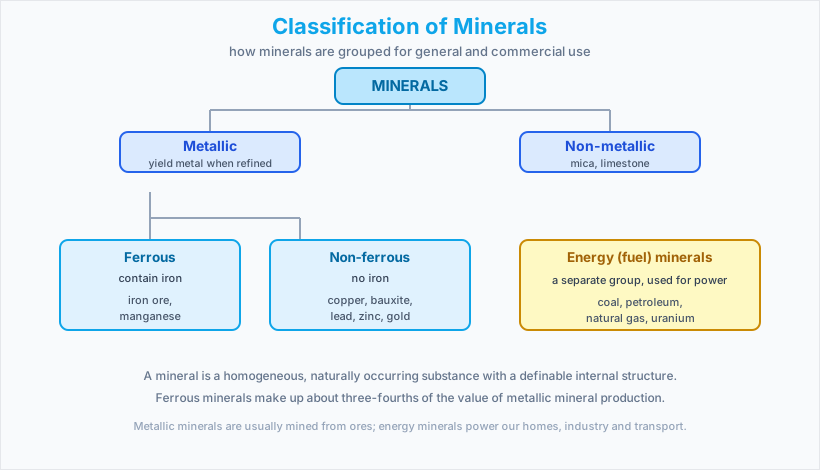
A mineral is a homogeneous, naturally occurring substance with a definable internal structure, usually dug out of the earth as part of an ore (a mineral mixed with other elements). Minerals are grouped into metallic (ferrous — containing iron — and non-ferrous), non-metallic, and energy/fuel minerals. Energy resources are split into conventional sources (firewood, dung cake, coal, petroleum, natural gas, electricity) and non-conventional renewable sources (solar, wind, tidal, geothermal, biogas, nuclear). Because both minerals and fossil fuels are finite and non-renewable, conservation — recycling, using substitutes, and switching to renewables — is the real lesson of the chapter.
Let’s Break It Down
What exactly is a mineral?
Geologists define a mineral as a “homogeneous, naturally occurring substance with a definable internal structure.” Rocks are combinations of minerals: some rocks (like limestone) are a single mineral, but most are several minerals in varying proportions. Over 2000 minerals have been identified, yet only a few are abundant in most rocks.
Why are minerals so varied — from the hardest diamond to the softest talc? Because the particular mineral that forms depends on the physical and chemical conditions present. That gives each mineral its own colour, hardness, crystal form, lustre and density — the very properties geologists use to classify them.
How minerals occur (mode of occurrence)
Minerals are usually found in ores — an accumulation of a mineral mixed with other elements, where the mineral content is concentrated enough to make extraction commercially worthwhile. The type of formation they sit in decides how easily, and how cheaply, they can be mined. There are five main modes:
| Mode | Where / how it forms | Examples |
|---|---|---|
| Veins and lodes | In cracks, crevices, faults or joints of igneous and metamorphic rocks; molten/gaseous minerals forced up, then cool and solidify. Smaller = veins, larger = lodes | tin, copper, zinc, lead |
| Beds and layers | In sedimentary rocks, deposited and concentrated in horizontal strata under heat and pressure; or by evaporation in arid regions | coal, some iron ore; gypsum, potash salt, sodium salt |
| Decomposition of surface rocks | Surface rocks decompose, soluble parts are removed, leaving a residual weathered mass containing ore | bauxite |
| Placer deposits | As alluvial deposits in valley-floor sands and at the base of hills; only minerals NOT corroded by water | gold, silver, tin, platinum |
| Ocean waters | Dissolved in sea water (mostly too diffused to be useful) and in ocean-bed nodules | common salt, magnesium, bromine; manganese nodules |
India is fortunate to have fairly rich and varied minerals, but they are unevenly distributed. Broadly: the peninsular rocks hold most of the coal, metallic minerals, mica and many non-metallic minerals; the sedimentary rocks on the western and eastern flanks of the peninsula (Gujarat, Assam) hold most of the petroleum; Rajasthan has many non-ferrous minerals; and the vast alluvial plains of north India are almost devoid of economic minerals.
Ferrous minerals: iron ore and manganese
Ferrous minerals contain iron and account for about three-fourths of the value of metallic-mineral production, giving a strong base to metallurgical industries. India even exports them after meeting its own needs.
Iron ore is the backbone of industrial development, and India is rich in good-quality ores:
| Type | Iron content | Special quality |
|---|---|---|
| Magnetite | very high, up to 70% | finest iron ore; excellent magnetic qualities, valuable in the electrical industry |
| Haematite | lower, 50–60% | most important industrially by quantity used |
In 2018–19, almost the entire production of iron ore (97%) came from Odisha, Chhattisgarh, Karnataka and Jharkhand. The four major iron ore belts are:
| Belt | States | Key mines / facts |
|---|---|---|
| Odisha–Jharkhand belt | Odisha, Jharkhand | high-grade haematite at Badampahar (Mayurbhanj, Kendujhar); Gua and Noamundi in Singhbhum |
| Durg–Bastar–Chandrapur belt | Chhattisgarh, Maharashtra | very high-grade haematite in the Bailadila range (Bastar) — 14 deposits; exported to Japan and South Korea via Vishakhapatnam port |
| Ballari–Chitradurga–Chikkamagaluru–Tumakuru belt | Karnataka | huge reserves; Kudremukh mines (Western Ghats) are a 100% export unit; ore sent as slurry by pipeline to a port near Mangaluru |
| Maharashtra–Goa belt | Goa, Ratnagiri (Maharashtra) | ores not very high grade but well exploited; exported through Marmagao port |
Manganese is mainly used to make steel and ferro-manganese alloy — about 10 kg of manganese is needed for one tonne of steel. It is also used in bleaching powder, insecticides and paints. (Madhya Pradesh, Maharashtra and Odisha are leading producers.)
Non-ferrous minerals: copper and bauxite
India’s reserves and production of non-ferrous minerals (copper, bauxite, lead, zinc, gold) are not very satisfactory, yet they are vital to metallurgical, engineering and electrical industries.
- Copper — India is critically deficient in it. Being malleable, ductile and a good conductor, copper is used in electrical cables, electronics and the chemical industry. Leading producers: Balaghat mines (Madhya Pradesh), Khetri mines (Rajasthan) and Singhbhum district (Jharkhand).
- Bauxite — the clay-like ore from which alumina and then aluminium is obtained. It forms by the decomposition of aluminium-silicate-rich rocks. Aluminium matters because it combines the strength of iron with extreme lightness, good conductivity and great malleability. Deposits lie in the Amarkantak plateau, Maikal hills and the Bilaspur–Katni plateau; Odisha was the largest producer in 2018–19 (the Panchpatmali deposits in Koraput district).
Non-metallic minerals: mica and limestone
- Mica is made of a series of plates or leaves that split easily into very thin sheets — a thousand thin sheets can stack into a slab only a few centimetres high. It can be clear, black, green, red, yellow or brown. Thanks to its excellent di-electric strength, low power-loss, insulating properties and resistance to high voltage, mica is indispensable to the electric and electronic industries. The leading belt is the Koderma–Gaya–Hazaribagh belt of Jharkhand (northern edge of the Chota Nagpur plateau); other producers are around Ajmer (Rajasthan) and the Nellore belt (Andhra Pradesh).
- Limestone is found in rocks of calcium carbonate (or calcium and magnesium carbonate), in sedimentary rocks of most geological formations. It is the basic raw material for the cement industry and is essential for smelting iron ore in the blast furnace.
A mineral is mainly used in electric and electronic industries because it can be split into very thin sheets and resists high voltage. Which mineral is it, and which category does it belong to?
Hazards of mining and conservation of minerals
Mining has a human and an environmental cost. Dust and noxious fumes leave miners vulnerable to pulmonary (lung) diseases; collapsing roofs, flooding and fires in coal mines are constant threats. Water sources get contaminated, and dumping waste and slurry degrades land and pollutes streams and rivers. Stricter safety rules and environmental laws are needed to stop mining from becoming a “killer industry”.
Why conserve minerals? Workable mineral deposits are an insignificant fraction — about one per cent — of the earth’s crust. They took millions of years to form, but nature replenishes them so slowly that, compared with how fast we use them, the rate is effectively zero. Minerals are therefore finite and non-renewable. As we dig deeper for ore, costs rise and quality falls. Conservation means a planned, sustainable approach: developing technology to use low-grade ores cheaply, recycling metals, using scrap metal, and finding substitutes.
Energy resources: conventional vs non-conventional
Energy is needed for everything — cooking, light, heat, moving vehicles, running machines. It comes from fuel minerals (coal, petroleum, natural gas, uranium) and from electricity. Energy resources are classified into two groups:
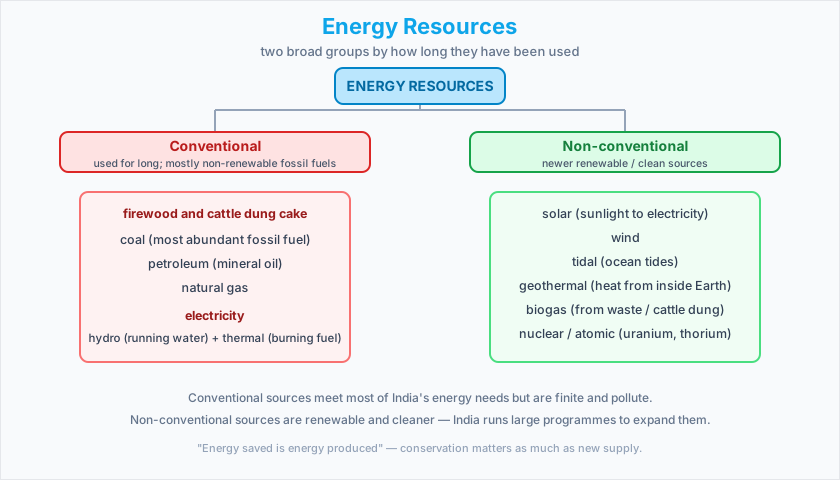
| Conventional | Non-conventional | |
|---|---|---|
| Sources | firewood, cattle dung cake, coal, petroleum, natural gas, electricity (hydro and thermal) | solar, wind, tidal, geothermal, biogas, nuclear/atomic |
| Renewable? | mostly non-renewable fossil fuels (except hydro) | mostly renewable and clean |
| Pollution | burning fossil fuels causes serious environmental problems | much cleaner |
| Status | meet most of India's energy needs today | growing fast; India has the largest renewable-energy programmes |
Conventional sources in detail:
- Coal — India’s most abundantly available fossil fuel, used for power generation, industry and domestic needs. Formed by the compression of plant material over millions of years, so its forms differ by degree of compression: peat (low carbon, high moisture, low heat) → lignite (low-grade brown coal, soft, high moisture; reserves at Neyveli, Tamil Nadu, used for electricity) → bituminous (buried deep, hotter; the most popular commercial coal; metallurgical coal is high-grade bituminous used for smelting iron) → anthracite (highest-quality hard coal). Indian coal occurs in two ages: Gondwana (over 200 million years old — metallurgical coal in the Damodar valley: Jharia, Raniganj, Bokaro; also Godavari, Mahanadi, Son, Wardha valleys) and tertiary (about 55 million years old — Meghalaya, Assam, Arunachal Pradesh, Nagaland). Because coal is bulky and loses weight as it burns to ash, heavy industries and thermal power stations sit on or near the coalfields.
- Petroleum (mineral oil) — the next major source after coal; provides fuel, lubricants and raw material, so refineries are a “nodal industry” for synthetic textile, fertiliser and chemical industries. It is trapped in anticlines and fault traps of tertiary rocks, in porous limestone or sandstone sealed by non-porous layers; gas, being lighter, sits above the oil. Major areas: Mumbai High, Gujarat (Ankleshwar) and Assam (the oldest oil-producing state — Digboi, Naharkatiya, Moran-Hugrijan).
- Natural gas — found with petroleum, released when crude oil surfaces. Used to generate power, for heating, as a chemical/fertiliser raw material, and increasingly as transport fuel (CNG) and cooking fuel (PNG). Major reserves: Mumbai High and west-coast fields, the Cambay basin, and the Krishna–Godavari basin on the east coast. GAIL’s 1700 km Hazira–Vijaipur–Jagdishpur (HVJ) pipeline links these fields with industry.
- Electricity — its per-capita consumption is an index of development. It is generated two ways: hydro (fast-flowing water drives turbines — a renewable resource; e.g. Bhakra Nangal, Damodar Valley Corporation, Kopili Hydel Project) and thermal (burning coal, petroleum or natural gas — uses non-renewable fossil fuels). Once generated, the electricity is exactly the same.
Non-conventional sources in detail:
- Nuclear / atomic — energy from altering the structure of atoms, released as heat to make power. Uses uranium and thorium (found in Jharkhand and the Aravalli ranges of Rajasthan); the Monazite sands of Kerala are rich in thorium.
- Solar — India, a tropical country, has huge potential. Photovoltaic technology converts sunlight directly into electricity; it is spreading in rural and remote areas, cutting dependence on firewood and dung cake.
- Wind — great potential; the largest wind-farm cluster runs in Tamil Nadu from Nagarcoil to Madurai. Nagarcoil and Jaisalmer are well known for wind energy; other farms are in Andhra Pradesh, Karnataka, Gujarat, Kerala, Maharashtra and Lakshadweep.
- Biogas — shrubs, farm waste and animal/human waste are decomposed to yield gas with higher thermal efficiency than kerosene, dung cake or charcoal. Cattle-dung plants are called ‘Gobar gas plants’; they give twin benefits — energy and improved manure.
- Tidal — floodgate dams across inlets trap water at high tide; when the tide falls, the trapped water flows back through a turbine. Ideal sites: Gulf of Khambhat, Gulf of Kuchchh (Gujarat) and the Gangetic delta in the Sunderbans (West Bengal).
- Geothermal — heat from the interior of the Earth. Where the geothermal gradient is high, groundwater turns to steam that drives turbines. Two experimental projects: the Parvati valley near Manikaran (Himachal Pradesh) and the Puga valley, Ladakh.
Conservation of energy resources
Every sector — agriculture, industry, transport, commerce, homes — needs energy, and consumption has been steadily rising. Since India is currently one of the least energy-efficient countries, the way forward is a sustainable path: promoting energy conservation and renewable sources together. As citizens we can use public transport, switch off unused lights, use power-saving devices, and prefer non-conventional sources. After all, “energy saved is energy produced”.
Common Mistakes
Minerals are renewable — the earth will simply make more, so we needn't worry about running out.
The earth is enormous and we have always dug minerals out of it, so it feels like an endless supply that quietly refills itself.
Workable deposits are only about one per cent of the earth's crust and took millions of years to form. Nature replenishes them so slowly that, against our consumption, the rate is effectively zero. Minerals are finite and non-renewable, which is exactly why recycling and substitutes matter.
Ferrous and non-ferrous just mean 'metal' and 'non-metal'.
The words look like a metal/non-metal split, and ferrous minerals are indeed metals, so the pattern seems to continue.
Both ferrous and non-ferrous minerals are METALLIC. The difference is iron: ferrous minerals CONTAIN iron (iron ore, manganese), non-ferrous minerals do NOT (copper, bauxite, lead, zinc, gold). The true non-metallic group is separate — mica and limestone.
All non-conventional energy sources are renewable and clean.
Solar, wind, tidal and biogas really are renewable, so it's easy to assume the whole group is.
Most non-conventional sources are renewable, but nuclear (atomic) energy uses uranium and thorium — finite mineral fuels. It is grouped as non-conventional because it is a newer, alternative source, not because it is renewable.
Hydro and thermal electricity are different kinds of electricity.
They are made in very different ways — one from falling water, one from burning fuel — so the end products feel different too.
Only the METHOD differs: hydro uses fast-flowing water (renewable) and thermal burns coal, oil or gas (non-renewable). Once generated, the electricity is exactly the same.
Quick Check
Which mineral is formed by the decomposition of surface rocks, leaving a residual mass of weathered material?
Koderma in Jharkhand is the leading producer of which mineral?
Minerals deposited and accumulated in horizontal strata are found mainly in which rocks?
The Monazite sands of Kerala are an important source of which mineral?
Practice Problems
Easy
What is a mineral?
A mineral is a homogeneous, naturally occurring substance with a definable internal structure. Minerals are found in many forms in nature — from the hardest diamond to the softest talc — and rocks are combinations of one or more minerals.
Distinguish between ferrous and non-ferrous minerals (in about 30 words).
Ferrous minerals contain iron — for example iron ore and manganese — and form the base of metallurgical industries. Non-ferrous minerals do not contain iron — for example copper, bauxite, lead, zinc and gold. Both are metallic.
Medium
How are minerals formed in igneous and metamorphic rocks?
In igneous and metamorphic rocks, minerals occur in the cracks, crevices, faults or joints of the rock. Minerals in liquid (molten) or gaseous form are forced upward through these cavities towards the earth’s surface; as they rise they cool and solidify. The smaller occurrences are called veins and the larger ones lodes. Major metallic minerals such as tin, copper, zinc and lead are obtained this way.
Why do we need to conserve mineral resources? (about 30 words)
Workable mineral deposits are only about one per cent of the earth’s crust, took millions of years to form, and are finite and non-renewable. We are using them far faster than they replenish, so conservation through planned use, recycling and substitutes is essential.
Challenge
Describe the distribution of coal in India (about 120 words).
Coal is India’s most abundant fossil fuel and occurs in rocks of two geological ages. The older Gondwana coal (over 200 million years old) is metallurgical coal, located chiefly in the Damodar valley of West Bengal and Jharkhand — the important coalfields being Jharia, Raniganj and Bokaro. The Godavari, Mahanadi, Son and Wardha valleys also contain Gondwana coal deposits.
The younger tertiary coal (about 55 million years old) is found in the north-eastern states of Meghalaya, Assam, Arunachal Pradesh and Nagaland.
Because coal is a bulky material that loses weight on use (reduced to ash), it is uneconomical to transport far. Hence heavy industries and thermal power stations are located on or near the coalfields.
Why do you think solar energy has a bright future in India? (about 120 words)
India is a tropical country that receives abundant sunlight through most of the year, giving it enormous potential to tap solar energy. Photovoltaic technology converts sunlight directly into electricity, and solar power is fast becoming popular in rural and remote areas where the electricity grid is weak.
Big solar power plants being set up across the country will reduce rural households’ dependence on firewood and cattle-dung cake. This brings two further gains: it conserves the environment (less deforestation and less burning) and ensures an adequate supply of manure for agriculture, since dung can be returned to the fields instead of being burnt.
Being renewable, clean and non-polluting, and supported by India’s large renewable-energy programmes, solar energy has a genuinely bright future.
Summary
You should now be able to explain:
- A mineral is a homogeneous, naturally occurring substance with a definable internal structure; it is usually mined from an ore (mineral mixed with other elements, concentrated enough to be worth extracting).
- Minerals occur in five modes: veins and lodes (igneous/metamorphic — tin, copper, zinc, lead), beds and layers (sedimentary — coal, some iron ore), decomposition (bauxite), placer deposits (gold, silver, tin, platinum), and ocean waters (salt, magnesium, bromine, manganese nodules).
- Minerals are classified as metallic (ferrous = with iron: iron ore, manganese; non-ferrous = without iron: copper, bauxite, lead, zinc, gold), non-metallic (mica, limestone) and energy/fuel minerals.
- Iron ore types: magnetite (up to 70% iron, magnetic) and haematite (50–60%, most used). The four belts: Odisha–Jharkhand, Durg–Bastar–Chandrapur, Ballari–Chitradurga–Chikkamagaluru–Tumakuru, Maharashtra–Goa.
- Minerals are finite and non-renewable, so we conserve them by using low-grade ores, recycling, using scrap and finding substitutes.
- Energy resources are conventional (firewood, dung cake, coal, petroleum, natural gas, electricity from hydro and thermal) and non-conventional (solar, wind, tidal, geothermal, biogas, nuclear).
- Conservation matters as much as new supply — “energy saved is energy produced.”
What’s Next
You have seen where raw materials and power come from. Next, in Manufacturing Industries, you will follow those minerals and that energy into the factory — how iron ore plus coal becomes steel, how raw cotton becomes cloth, why industries cluster where they do, and how manufacturing both drives the economy and pollutes the air, water and land we depend on.