Agriculture
Why This Matters
Look at your plate. The rice or roti, the dal, the vegetables, the sugar in your tea, the cotton in your shirt — almost all of it began in a field somewhere in India. Agriculture is a primary activity: it produces most of the food we eat and the raw material for industries like cotton textiles, sugar and jute. About two-thirds of India’s population depends on farming for a living.
This chapter is the story of how India farms — and it’s not one story but many. A family in the hills of Assam clears a forest patch, burns it and grows just enough to eat. A farmer in Punjab pumps water from a tubewell, sows high-yielding wheat and sells the whole crop. A tea estate in Darjeeling employs hundreds of workers to pick leaves all year for a factory. Same country, completely different ways of growing.
Understanding agriculture is understanding India itself: why some regions are rich and others poor, why the monsoon makes the whole nation hold its breath, and why a small change in the price of wheat can shake an entire economy. By the end you’ll be able to name the right crop for the right season, soil and region — exactly what exams ask.
The Big Idea
Indian farming ranges from subsistence (grown to feed the farmer’s own family) to commercial (grown to sell), with plantations as a large-scale commercial type. The year is split into three cropping seasons — kharif (monsoon), rabi (winter) and zaid (short summer) — and each major crop has its own demands of temperature, rainfall, soil and region. Because most farmers still depend on the monsoon, the government has pushed technological and institutional reforms — the Green Revolution, minimum support prices, cheap credit and crop insurance — to make farming more secure and productive.
Two questions unlock almost every part of this chapter: “Why is it grown?” (subsistence vs commercial) and “What does the crop need?” (season, temperature, rainfall, soil, region). Keep those two in mind and the long lists of crops and states stop feeling like random facts.
Let’s Break It Down
Types of farming
Farming methods in India have changed over centuries depending on the physical environment (climate, soil), technology available, and socio-cultural practices. We group them by their main purpose.
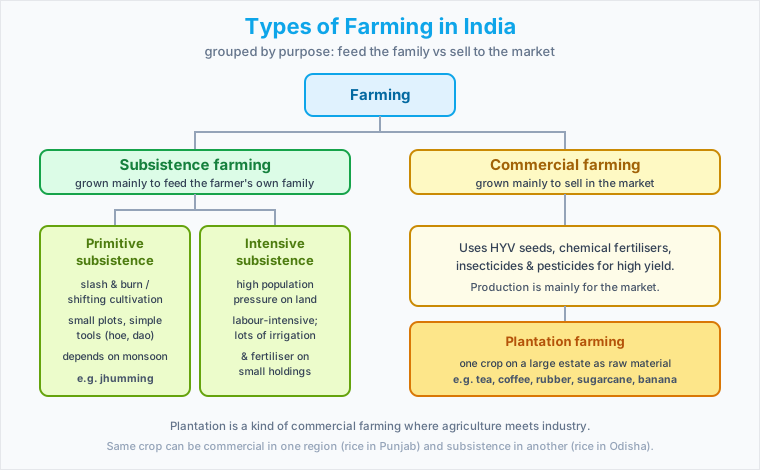
Primitive subsistence farming is still practised in a few pockets. It is slash-and-burn (shifting) agriculture: farmers clear and burn a small patch of land, grow cereals and food crops to feed the family using simple tools (hoe, dao, digging sticks) and family or community labour, and when the soil loses fertility they move to a fresh patch — letting Nature slowly restore the old one. It depends entirely on the monsoon, natural soil fertility and the environment, uses no fertilisers, and so gives low productivity. In India it is called jhumming in the north-eastern states (Assam, Meghalaya, Mizoram, Nagaland), Pamlou in Manipur, Dipa in Bastar (Chhattisgarh), Bewar or Dahiya in Madhya Pradesh, Podu or Penda in Andhra Pradesh, Kumari in the Western Ghats, Khil in the Himalayan belt and Kuruwa in Jharkhand.
Intensive subsistence farming is practised where the population pressure on land is high. It is labour-intensive, using high doses of biochemical inputs and irrigation to squeeze the maximum output from small plots. The right of inheritance keeps dividing land among each generation, so holdings shrink and become uneconomical — yet farmers keep cultivating them because there is no other source of livelihood.
Commercial farming uses higher doses of modern inputs — high-yielding variety (HYV) seeds, chemical fertilisers, insecticides and pesticides — to get high productivity, and the produce is grown mainly to sell. Note that the same crop can be commercial in one region and subsistence in another: rice is a commercial crop in Punjab and Haryana but a subsistence crop in Odisha.
Plantation is a type of commercial farming where a single crop is grown on a large area (estate). It is the meeting point of agriculture and industry: it uses capital-intensive inputs and migrant labour, and all the produce becomes raw material for industry. Important Indian plantation crops are tea, coffee, rubber, sugarcane and banana — for example tea in Assam and North Bengal, coffee in Karnataka. A well-developed transport and communication network linking estates, factories and markets is essential.
Rice is grown in both Punjab and Odisha, yet it is classified differently in each. Why?
The cropping seasons: rabi, kharif and zaid
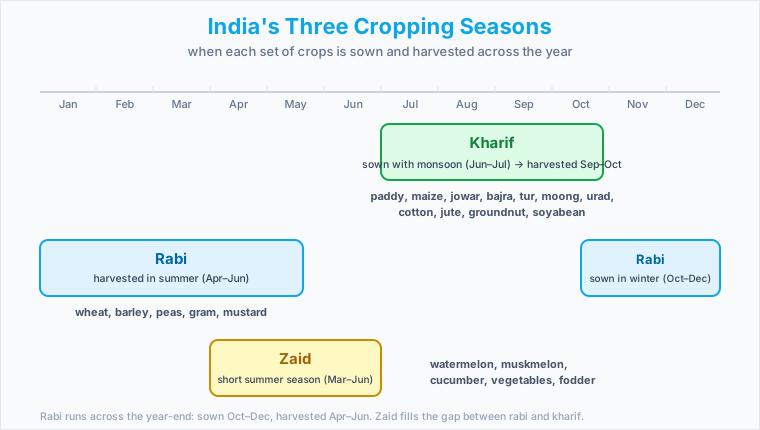
India has three cropping seasons. The trick is to remember each by when it is sown and harvested and a couple of example crops.
| Season | Sown | Harvested | Example crops |
|---|---|---|---|
| Rabi | Winter, Oct–Dec | Summer, Apr–Jun | Wheat, barley, peas, gram, mustard |
| Kharif | Onset of monsoon, Jun–Jul | Sep–Oct | Paddy (rice), maize, jowar, bajra, tur, moong, urad, cotton, jute, groundnut, soyabean |
| Zaid | Short summer season (between rabi and kharif) | Summer | Watermelon, muskmelon, cucumber, vegetables, fodder crops |
Rabi crops are sown in winter and harvested in summer. Winter rainfall from the western temperate cyclones helps them succeed, and the Green Revolution in Punjab, Haryana, western Uttar Pradesh and parts of Rajasthan greatly boosted rabi crops like wheat. Kharif crops are sown with the onset of the monsoon and harvested in September–October. In Assam, West Bengal and Odisha, three crops of paddy — Aus, Aman and Boro — are grown in a year. Zaid is the short summer season between rabi and kharif. (Sugarcane is a special case — it takes almost a year to grow.)
Kharif crops are sown in winter and rabi crops in summer.
The word 'kharif' is unfamiliar, so students guess, and both seasons span several months, which makes them easy to swap.
It is the OTHER way round. KHARIF rides the monsoon — sown around June–July, harvested September–October (paddy, maize, cotton). RABI grows through winter — sown October–December, harvested April–June (wheat, gram, mustard). A memory hook: kharif = rainy/monsoon, rabi = winter.
Major crops — the food grains
Now the crops themselves. For each, the exam wants: type/season, temperature, rainfall, soil and main producing states.
Rice is the staple food of most Indians and India is the second largest producer in the world after China. It is a kharif crop needing high temperature (above 25°C), high humidity and annual rainfall above 100 cm; in drier areas it grows with irrigation. It is grown in the plains and deltas of north and north-eastern India and the coasts — and thanks to canals and tubewells, also in low-rainfall Punjab, Haryana and western UP.
Wheat is the second most important cereal and the main food crop of the north and north-west. This rabi crop needs a cool growing season with bright sunshine at ripening and 50–75 cm of rainfall evenly spread. Its two great zones are the Ganga–Satluj plains in the north-west and the black-soil region of the Deccan. Major states: Punjab, Haryana, Uttar Pradesh, Madhya Pradesh, Bihar and Rajasthan.
Millets — jowar, bajra and ragi — are called coarse grains but have very high nutritional value (ragi is rich in iron, calcium and micronutrients).
| Crop | Season / type | Conditions | Main states |
|---|---|---|---|
| Rice | Kharif; staple food | Temp above 25°C, high humidity, rainfall above 100 cm (irrigation in dry areas) | West Bengal, Assam, coastal Odisha, Andhra Pradesh, Tamil Nadu, Punjab, Haryana |
| Wheat | Rabi; second cereal | Cool season, bright sun at ripening, 50–75 cm rainfall | Punjab, Haryana, UP, MP, Bihar, Rajasthan |
| Jowar | Rain-fed; third food crop by area | Moist areas, hardly needs irrigation | Maharashtra, Karnataka, Andhra Pradesh, MP |
| Bajra | Coarse grain | Sandy soils and shallow black soil | Rajasthan, UP, Maharashtra, Gujarat, Haryana |
| Ragi | Crop of dry regions | Red, black, sandy, loamy soils | Karnataka, Tamil Nadu, Himachal Pradesh, Uttarakhand, Sikkim, Jharkhand |
| Maize | Kharif (rabi in Bihar); food & fodder | Temp 21–27°C, old alluvial soil | Karnataka, MP, UP, Bihar, Andhra Pradesh, Telangana |
| Pulses | Mostly kharif & rabi; protein source | Need less moisture, survive dry conditions | MP, Rajasthan, Maharashtra, UP, Karnataka |
Maize is used as both food and fodder, a kharif crop (also grown in rabi in Bihar) needing 21–27°C and old alluvial soil; HYV seeds, fertilisers and irrigation have raised its output.
Pulses — tur (arhar), urad, moong, masur, peas and gram — make India the world’s largest producer and consumer. They are the main protein source in a vegetarian diet, need less moisture, and (being leguminous) all except arhar restore soil fertility by fixing nitrogen from the air, so they are grown in rotation with other crops.
All pulses help the soil, but rice and wheat also fix nitrogen the same way.
Pulses are famous as 'soil-improving' crops, so it's tempting to assume any nutritious food grain does it.
Only LEGUMINOUS crops fix nitrogen, and that means pulses — and even among them, all EXCEPT arhar (tur) help restore fertility. Cereals like rice and wheat do NOT fix nitrogen; in fact they draw heavily on the soil, which is exactly why pulses are grown in rotation with them.
Cash and other crops
Sugarcane is a tropical and subtropical crop needing a hot, humid climate (21–27°C) and 75–100 cm rainfall (irrigation where rainfall is low). It grows on a variety of soils, needs manual labour from sowing to harvesting, and India is the second largest producer after Brazil. It is the source of sugar, gur (jaggery), khandsari and molasses. Major states: Uttar Pradesh, Maharashtra, Karnataka, Tamil Nadu, Andhra Pradesh, Telangana, Bihar, Punjab and Haryana.
Oilseeds cover about 12% of India’s cropped area; India was the second largest producer of groundnut after China (2020). Main oilseeds: groundnut, mustard, coconut, sesamum (til), soyabean, castor, cotton seeds, linseed and sunflower — most are edible cooking media, some go into soap and cosmetics. Groundnut is a kharif crop (about half of India’s oilseeds); linseed and mustard are rabi; sesamum is kharif in the north and rabi in the south; castor is grown both seasons.
Tea is an example of plantation agriculture, a beverage crop introduced by the British. It needs a tropical/sub-tropical climate, deep, fertile, well-drained soil rich in humus, a warm, moist, frost-free climate all year and frequent evenly-distributed showers. It is labour-intensive (needs abundant, cheap, skilled labour) and processed within the tea garden to keep it fresh. Major states: Assam, the Darjeeling and Jalpaiguri hills of West Bengal, Tamil Nadu and Kerala.
Coffee — India’s Arabica variety (originally from Yemen, first grown on the Baba Budan Hills) is in great demand worldwide. Its cultivation is confined to the Nilgiri hills in Karnataka, Kerala and Tamil Nadu.
Horticulture — India was the second largest producer of fruits and vegetables after China (2020), growing both tropical and temperate fruits: mangoes (Maharashtra, AP, UP, West Bengal), oranges (Nagpur), bananas (Kerala, Tamil Nadu), apples and walnuts (J&K, Himachal Pradesh), and vegetables like pea, cauliflower, onion, tomato and potato.
Rubber is an equatorial crop (also grown in tropical/sub-tropical areas under special conditions) needing a moist, humid climate with rainfall over 200 cm and temperature above 25°C. An important industrial raw material, it is grown mainly in Kerala, Tamil Nadu, Karnataka, the Andaman & Nicobar Islands and the Garo Hills of Meghalaya.
Fibre crops
The four major fibres are cotton, jute, hemp and natural silk. The first three come from the soil; silk comes from the cocoons of silkworms fed on mulberry leaves — rearing silkworms is called sericulture.
Cotton — India is believed to be the original home of the cotton plant, and is the second largest producer after China. The main raw material for the cotton textile industry, it grows well in the drier parts of the black (cotton) soil of the Deccan plateau, needing high temperature, light rainfall or irrigation, 210 frost-free days and bright sunshine. It is a kharif crop taking 6–8 months to mature. Major states: Maharashtra, Gujarat, Madhya Pradesh, Karnataka, Andhra Pradesh, Telangana, Tamil Nadu, Punjab, Haryana and UP.
Jute is the golden fibre. It grows on well-drained fertile soils in flood plains (renewed yearly) and needs high temperature during growth. Major states: West Bengal, Bihar, Assam, Odisha and Meghalaya. It is used for gunny bags, mats, ropes, yarn and carpets.
Jute and cotton grow in the same kind of conditions because they are both fibre crops.
They're listed together as 'fibre crops', so it feels natural to assume they like the same land.
They want OPPOSITE conditions. Cotton needs DRY weather, light rainfall and BLACK soil of the Deccan plateau. Jute needs WET, fertile alluvial FLOOD PLAINS (mainly West Bengal) that are renewed by floods each year, with high temperature. Same category, very different homes.
Technological and institutional reforms
Agriculture employs over 60% of India’s population, yet most farmers still depend on the monsoon and natural fertility — a serious risk for a growing population. So India launched reforms in two directions:
Institutional reforms (especially after Independence): collectivisation, consolidation of holdings, cooperation and abolition of zamindari. Land reform was the main focus of the First Five Year Plan. Later steps included crop insurance (against drought, flood, cyclone, fire, disease), Grameen banks, cooperative societies and banks giving farmers low-interest loans, the Kisan Credit Card (KCC) and the Personal Accident Insurance Scheme (PAIS).
Technological reforms (1960s–70s): the Green Revolution (package technology — HYV seeds, fertilisers, irrigation) and the White Revolution / Operation Flood (milk). These boosted output but concentrated development in a few regions, so in the 1980s–90s a comprehensive land-development programme combined both technical and institutional reforms.
To protect farmers from exploitation by speculators and middlemen, the government announces a minimum support price (MSP) along with remunerative and procurement prices for important crops, and runs special weather bulletins and farm programmes on radio and TV.
What is the purpose of the minimum support price (MSP)?
Bhoodan–Gramdan: Vinoba Bhave, Gandhiji’s spiritual heir, undertook a padyatra spreading the idea of gram swarajya. At Pochampally (Telangana), Shri Ram Chandra Reddy offered 80 acres for 80 landless villagers — this gift of land was called Bhoodan. When some zamindars later offered whole villages, it was called Gramdan. Because it transferred land peacefully, the movement is known as the Bloodless Revolution.
Food security and globalisation
For a country where so many depend on farming, food security means ensuring enough food is produced and made available to all. The reforms above — guaranteed prices, credit, insurance and higher-yielding technology — are all part of keeping the nation fed.
Globalisation is not new to Indian agriculture: under British rule, cotton, spices and indigo were exported, and Indian farmers were often forced into growing cash crops. Today, after the 1990s reforms, Indian farmers face competition from cheaper, often subsidised imports from developed countries, which can pull down the prices they get. To compete, Indian agriculture needs better technology, organic farming and value addition — turning a challenge into an opportunity. India’s spices, tea and coffee remain proud exports known for quality.
Common Mistakes
Primitive subsistence farming gives low yields because the farmers are lazy or unskilled.
The word 'primitive' sounds like a judgement on the farmers, so it's easy to blame the people.
The low productivity comes from the METHOD and inputs, not the farmers. Slash-and-burn uses no fertilisers or modern inputs and relies entirely on natural soil fertility and the monsoon, so the land simply cannot yield more. The farmers work hard; the technique is what limits output.
Plantation farming is a kind of subsistence farming because it's done on land in rural areas.
Both happen on farmland in the countryside, so they blur together if you only picture the location.
Plantation is a type of COMMERCIAL farming. A single crop is grown on a large estate, with capital-intensive inputs and migrant labour, and the ENTIRE produce is sold as raw material to industry — the opposite of subsistence, where you grow food to feed your own family.
The Green Revolution and the White Revolution are the same thing.
Both are 1960s–70s 'revolutions' that modernised farming, so the colours feel interchangeable.
They are different. The GREEN Revolution raised CROP output through package technology (HYV seeds, fertilisers, irrigation). The WHITE Revolution (Operation Flood) was about MILK production. Green = grain, White = milk.
Quick Check
Which set of crops is grown in the rabi season?
A single crop is grown on a large estate using migrant labour, and the whole produce goes to a factory as raw material. This describes:
Which crop grows best in the dry parts of the black (cotton) soil of the Deccan plateau?
Why are pulses often grown in rotation with other crops?
Practice Problems
Easy
Name one important beverage crop and state the geographical conditions required for its growth. (30 words)
Tea is an important beverage crop. It needs a warm, moist, frost-free climate all year, frequent evenly-distributed showers, and deep, fertile, well-drained soil rich in humus in a tropical or sub-tropical region.
Name one staple food crop of India and the regions where it is produced. (30 words)
Rice is a staple food crop. It is grown in the plains and deltas of north and north-eastern India and the coastal regions — chiefly West Bengal, Assam, coastal Odisha, Andhra Pradesh and Tamil Nadu — and, with irrigation, in Punjab, Haryana and western UP.
Medium
Distinguish between primitive subsistence farming and commercial farming.
Primitive subsistence farming is practised on small plots with simple tools (hoe, dao, digging sticks) and family labour. It is slash-and-burn agriculture, depends on the monsoon and natural soil fertility, uses no modern inputs, and the produce is grown only to feed the farmer’s own family, giving low productivity.
Commercial farming uses high doses of modern inputs — HYV seeds, chemical fertilisers, insecticides and pesticides — to achieve high productivity, and the produce is grown mainly to sell in the market. Plantation is a type of commercial farming. (The same crop can be commercial in one region and subsistence in another — e.g. rice in Punjab vs Odisha.)
Enlist the various institutional reform programmes introduced by the government in the interest of farmers. (30 words)
Collectivisation, consolidation of holdings, cooperation and abolition of zamindari; land reform; crop insurance, Grameen banks, cooperative societies for low-interest loans, the Kisan Credit Card (KCC) and the Personal Accident Insurance Scheme (PAIS).
Challenge
Describe the geographical conditions required for the growth of rice. (about 120 words)
Rice is the staple food of most Indians and a kharif crop, so it is sown with the onset of the monsoon and harvested in September–October. It requires a high temperature, above 25°C, throughout its growing period, together with high humidity.
Rice is a water-loving crop and needs abundant water — an annual rainfall of more than 100 cm. In areas where rainfall is lower, it can still be grown with the help of irrigation: the development of a dense network of canals and tubewells has made it possible to grow rice in the comparatively dry areas of Punjab, Haryana, western Uttar Pradesh and parts of Rajasthan.
It grows best in the plains of north and north-eastern India, the coastal areas and the deltaic regions, where fertile alluvial soil and plenty of water are available. India is the second largest producer of rice in the world after China.
Suggest the initiatives taken by the government to ensure the increase in agricultural production. (about 120 words)
The government acted through technological and institutional reforms. On the institutional side it carried out land reform (the main focus of the First Five Year Plan), consolidation of holdings, collectivisation, cooperation and abolition of zamindari, and set up Grameen banks, cooperative societies and banks to give farmers loans at low interest, along with crop insurance against drought, flood, cyclone, fire and disease.
On the technological side it launched the Green Revolution (HYV seeds, fertilisers and irrigation) and the White Revolution (Operation Flood) for milk. It introduced the Kisan Credit Card (KCC) and Personal Accident Insurance Scheme (PAIS), broadcast special weather bulletins and farm programmes on radio and TV, and announced a minimum support price (MSP) and procurement prices to protect farmers from speculators and middlemen.
Summary
- Agriculture is a primary activity that feeds India and supplies industrial raw material; about two-thirds of the population depends on it.
- Primitive subsistence farming = slash-and-burn (jhumming), simple tools, family labour, monsoon-dependent, low yield, grown to feed the family.
- Intensive subsistence farming = high population pressure, labour-intensive, lots of irrigation and fertiliser on small holdings.
- Commercial farming = modern inputs (HYV seeds, fertilisers, pesticides), grown to sell; plantation (tea, coffee, rubber, sugarcane) is a large-scale commercial type linking agriculture and industry.
- Three seasons: rabi (sown winter Oct–Dec, harvested Apr–Jun — wheat, gram, mustard); kharif (sown with monsoon Jun–Jul, harvested Sep–Oct — paddy, maize, cotton, jute); zaid (short summer — watermelon, muskmelon, cucumber).
- Food grains: rice (kharif staple, above 25°C, rainfall above 100 cm), wheat (rabi, cool season, 50–75 cm), millets (jowar, bajra, ragi — nutritious coarse grains), maize, and pulses (protein source; leguminous, fix nitrogen, grown in rotation).
- Other crops: sugarcane (gur, sugar, molasses), oilseeds (groundnut etc.), tea and coffee (plantation beverages), horticulture, rubber (equatorial, over 200 cm rain); fibres — cotton (dry black soil of the Deccan) and jute (the golden fibre, wet flood plains of West Bengal).
- Reforms: Green Revolution and White Revolution (technological); land reform, consolidation, abolition of zamindari, crop insurance, KCC, PAIS and MSP (institutional) — all to raise output and secure farmers’ incomes; globalisation brings both competition from cheap imports and export opportunities for India’s spices, tea and coffee.
What’s Next
You now know what India grows and how. But farms, factories and homes all need power and materials to run — the minerals dug from the earth and the energy that drives the economy. In Chapter 5 — Minerals and Energy Resources, you’ll explore where India’s iron, copper, coal and petroleum come from, how they are conserved, and the shift towards renewable energy. The link is direct: the tractors, tubewells, fertiliser factories and transport that made the farming in this chapter possible all depend on those minerals and energy.