Water Resources
Why This Matters
Three-fourths of the earth is covered in water, and water is a renewable resource — the sun lifts it from the oceans, clouds carry it, rain returns it to land and rivers, and the whole cycle starts again. So here is a puzzle that should bother you: if there is so much water, and it keeps coming back, why do whole regions run dry? Why do experts warn that by 2025 nearly two billion people could be living in absolute water scarcity?
You have seen the images — women in Rajasthan walking miles balancing earthen pots (matkas), a boy in flooded Kolkata scooping drinking water out of the streets, an earthquake survivor carrying water through the snow. The strange truth is that scarcity is often not about how much rain falls. Cities with plenty of water still run short. Rivers fat with monsoon flood the land and then leave it parched by April.
This chapter is about that puzzle — and what India is doing about it: building giant dams, fighting over them, and quietly going back to 2,000-year-old ways of catching the rain. Understanding it changes how you see the tap in your home: water is not endless, and how we manage it decides whether it lasts.
The Big Idea
Water is renewable through the hydrological cycle, yet scarcity is real — caused less by low rainfall and more by over-exploitation, excessive use, unequal access and pollution. To conserve and manage water, India built multi-purpose river projects (dams that do many jobs at once — irrigation, power, water supply, flood control) under integrated water resources management. But large dams brought heavy costs — displacement, ecological damage and protest — pushing many back toward an older, gentler solution: rainwater harvesting, both traditional and modern.
Hold two ideas side by side as you read. One is scale: a single dam can transform four states at once — and uproot thousands of people at once. The other is smallness: a tank under one family’s courtyard, or a bamboo pipe on a hillside, can quietly solve the same problem with none of the damage. The chapter is really an argument between the big and the small.
Let’s Break It Down
How water becomes a renewable resource
Freshwater is the small usable slice of all that water — fed by precipitation, surface run-off and groundwater, all of it constantly renewed and recharged through the hydrological cycle. Because water keeps moving through this cycle — evaporating, forming clouds, falling as rain, flowing and soaking in — it is replenished again and again. That endless circulation is exactly why water counts as a renewable resource.
Water scarcity — and why it is not just about rainfall
It is tempting to picture scarcity only as a desert with no rain. But the availability of water varies over space and time mainly due to seasonal and annual variations in rainfall, while scarcity in most cases is caused by over-exploitation, excessive use and unequal access among different social groups. The main drivers:
- Large and growing population — more people need more water, not just to drink but to grow more food.
- Irrigated agriculture, the largest consumer of water — to raise food-grain output, water resources are over-exploited to expand irrigation for dry-season farming. Farmers’ own wells and tube-wells pump so hard that groundwater levels fall, hurting future water availability and food security.
- Industrialisation and urbanisation — industries are heavy users of water and need power (much of it hydroelectric). Crowded cities and housing colonies sink their own groundwater pumps, draining fragile resources.
- Bad-quality (polluted) water — even where there is enough water, it may be unfit to use, polluted by domestic and industrial waste, chemicals, pesticides and fertilisers. So an area can have ample water and still suffer scarcity.
This is why a city can be water-rich on paper yet still go thirsty. Government responses include Atal Bhujal Yojana (Atal Jal) to improve groundwater management in water-stressed Gram Panchayats across seven states, and the Jal Jeevan Mission (JJM), whose goal is assured piped potable water — about 55 litres per person per day — to every rural household.
Can a region with plenty of water still face water scarcity? Give the reason.
Yes. If the available water is polluted by domestic/industrial waste, chemicals or pesticides, it becomes unfit for use — so the region suffers scarcity despite having water. Scarcity can also come from over-use and unequal access, not only from low rainfall.
Multi-purpose river projects: dams as “temples of modern India”
So how do we conserve and manage water? One ancient answer is the dam — a barrier across flowing water that obstructs, directs or slows the flow, usually creating a reservoir (a stored lake of water) behind it. (Interestingly, the word “dam” often refers to the reservoir, not just the wall. Most dams have a spillway through which water is let out.)
India has built dams in most of its river basins since ancient times — from the flood-water harvesting at Sringaverapura near Allahabad in the 1st century B.C., to the dams of Chandragupta Maurya, to Bhopal Lake (11th century) and the Hauz Khas tank in Delhi (built by Allauddin Khilji). After Independence these became multi-purpose projects: dams built not only to impound water for irrigation but for electricity generation, water supply for homes and industry, flood control, recreation, inland navigation and fish breeding — all integrated together. Jawaharlal Nehru proudly called them the “temples of modern India”, because they would tie farming and village life to industry and city growth.
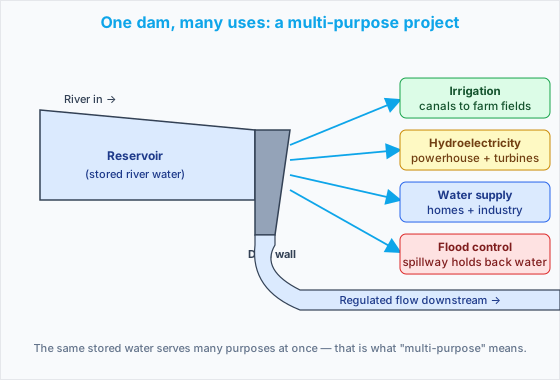
Famous examples to remember:
- Bhakra-Nangal project (Sutlej-Beas basin) — water used for both hydel power and irrigation.
- Hirakud project (Mahanadi basin) — integrates conservation of water with flood control.
- Sardar Sarovar Dam on the Narmada in Gujarat — one of India’s largest projects, spanning four states (Maharashtra, Madhya Pradesh, Gujarat, Rajasthan), meant to bring assured water to drought-prone and desert areas.
Why large dams came under fire
In recent years multi-purpose projects and large dams have come under great scrutiny and opposition. The problems are serious:
- Damaged river ecology — regulating and damming a river spoils its natural flow, causing poor sediment flow and excessive sedimentation at the bottom of the reservoir. This leaves rockier stream beds and poorer habitats for aquatic life, and fragments rivers, making it hard for fish to migrate to spawn.
- Submerged land and decomposing vegetation — reservoirs built on floodplains drown existing vegetation and soil, which then decomposes.
- Displacement and loss of livelihood — large numbers of people, often poor villagers and tribal communities, are forced off their land. The Narmada Bachao Andolan is the best-known movement opposing the building of large dams over the Narmada, on the grounds of such displacement and ecological harm.
- Floods, ironically — dams built to control floods have sometimes triggered them through reservoir sedimentation, and have largely failed to control floods during very heavy rainfall. The devastating floods cause soil erosion, and trapped silt is denied to the floodplains, where it was a natural fertiliser — worsening land degradation.
- Other harms — multi-purpose projects have induced earthquakes, caused water-borne diseases and pests, and led to pollution. Easy irrigation has pushed farmers toward water-intensive commercial crops, with consequences like salinisation of the soil. Sharing dammed water also sparks inter-state disputes, such as the Krishna-Godavari dispute between Maharashtra, Karnataka and Andhra Pradesh over diversion of water at Koyna.
| Benefits (arguments in favour) | Problems (arguments against) |
|---|---|
| Irrigation for dry-season and drought-prone areas | Large-scale displacement and loss of livelihood (e.g. Narmada Bachao Andolan) |
| Hydroelectricity for industry and homes | Disturbed river flow, excessive reservoir sedimentation, rockier beds |
| Water supply for domestic and industrial use | Submerges land and vegetation on floodplains, which decomposes |
| Flood control by regulating river flow | Has sometimes triggered floods; mostly failed in very heavy rain |
| Also aids recreation, navigation, fish breeding | Induced earthquakes, water-borne diseases, soil salinisation, inter-state disputes |
Name the movement associated with opposition to large dams on the Narmada, and one reason for the protest.
The Narmada Bachao Andolan. Reasons include the large-scale displacement of villagers and tribal people whose land is submerged, and the ecological damage caused by the dams.
Rainwater harvesting: going back to catch the rain
Given the drawbacks of and rising resistance to large dams, many saw rainwater harvesting as a viable alternative — socially, economically and environmentally. Ancient India had an extraordinary tradition of it, with techniques matched to local soil and rainfall:
- Guls and kuls — diversion channels in the Western Himalayas that carry stream water to fields.
- Rooftop rainwater harvesting — collecting rain off roofs to store drinking water, especially in Rajasthan.
- Inundation channels — in the floodplains of Bengal, to irrigate fields.
- Khadins (Jaisalmer) and Johads (other parts of Rajasthan) — fields turned into rain-fed storage so water stands and moistens the soil in arid regions.
Tankas of Rajasthan. In semi-arid and arid Rajasthan — Bikaner, Phalodi, Barmer — almost every house traditionally had an underground tank, or tanka, for storing drinking water, built inside the house or courtyard. (One household in Phalodi had a tank 6.1 m deep, 4.27 m long, 2.44 m wide — as big as a room.) The tanka was connected by a pipe to the sloping rooftop; rain ran down the pipe into the tank. The first spell of rain was not collected — it washed the roof and pipes clean — and only later showers were stored. This rainwater, called palar pani, was considered the purest natural water and stayed reliable through the dry summers when other sources failed; some families even built cool underground rooms beside the tanka. Sadly, the practice is now declining in western Rajasthan because the perennial Indira Gandhi Canal brings plenty of water, though some still keep their tankas — they dislike the taste of tap water.
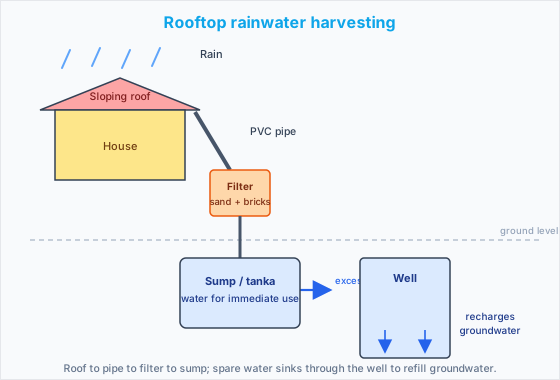
Modern adaptations. Rooftop rainwater harvesting is now being revived across rural and urban India:
- Shillong, Meghalaya — nearly every household harvests rooftop rainwater, meeting 15-25% of its water needs — striking, since nearby Cherrapunji and Mawsynram get the world’s highest rainfall yet Shillong faces acute shortage.
- Gendathur, near Mysuru, Karnataka — a remote village where ~200 households installed rooftop systems and earned the rare distinction of being “rich in rainwater.” With ~1,000 mm annual rain, 80% collection efficiency and about 10 fillings, each house can collect roughly 50,000 litres a year.
- Tamil Nadu — the first Indian state to make rooftop rainwater harvesting compulsory for all houses, with legal penalties for defaulters.
In a modern setup, rooftop rain is collected through a PVC pipe, filtered using sand and bricks, carried by an underground pipe to a sump for immediate use, and the excess is sent to a well to recharge the groundwater for later.
Bamboo drip irrigation of Meghalaya. In Meghalaya, a 200-year-old system taps stream and spring water using bamboo pipes. Water from perennial hilltop springs is diverted downhill by gravity through bamboo channels, split into branches, and routed over hundreds of metres. About 18-20 litres enters the system and is finally delivered as just 20-80 drops per minute right at the roots of the plant — an ingenious, low-tech drip irrigation.
| Method | Where | What it does |
|---|---|---|
| Guls / kuls | Western Himalayas | Diversion channels carrying stream water to fields |
| Khadins / Johads | Jaisalmer / Rajasthan | Fields store rain so water stands and moistens the soil |
| Tankas (rooftop harvesting) | Bikaner, Phalodi, Barmer (Rajasthan) | Underground tanks store rooftop rain as drinking water (palar pani) |
| Modern rooftop harvesting | Shillong, Gendathur, Tamil Nadu | Filtered roof water to a sump; excess recharges groundwater |
| Bamboo drip irrigation | Meghalaya | Bamboo pipes carry spring water by gravity, dripping at plant roots |
Common Mistakes
Water scarcity simply means a region does not get enough rainfall.
The classic picture of scarcity is a dry desert with women carrying pots long distances, so 'no rain = scarcity' feels obviously true.
Rainfall matters, but scarcity in most cases is caused by over-exploitation, excessive use, unequal access and pollution. A region with high rainfall but a huge population, or with plenty of polluted water, can still suffer scarcity.
Because water is renewable through the water cycle, it can never actually run out.
The hydrological cycle really does keep replenishing water, so it sounds safe to assume the supply is endless.
Renewable does not mean unlimited at any place or time. Over-pumping makes groundwater levels fall faster than they recharge, and pollution makes available water unusable. Usable freshwater can absolutely become scarce.
Multi-purpose river projects are an unmixed blessing — there is no real downside to building big dams.
They bring irrigation, electricity, water supply and flood control all at once, so they look like pure progress — the 'temples of modern India'.
They carry heavy costs too: displacement and loss of livelihood (sparking movements like the Narmada Bachao Andolan), disturbed river ecology and sedimentation, submerged land, soil salinisation, induced earthquakes and inter-state disputes. Dams meant to control floods have even triggered them.
In rooftop rainwater harvesting, you should collect the very first rain that falls because it is the cleanest.
The first rain feels purest because it is the 'freshest' water straight from the sky, before anything else.
The first spell of rain is deliberately NOT collected — it is used to wash the dust off the roofs and pipes. Only the rainwater from later showers is stored in the tanka.
Quick Check
Which of these is the MAIN cause of water scarcity in most cases?
Which statement is NOT an argument in favour of multi-purpose river projects?
In the tankas of Rajasthan, the first spell of rain is not collected because it:
Which state was the first in India to make rooftop rainwater harvesting compulsory for all houses?
Practice Problems
Easy
Explain how water becomes a renewable resource. (about 30 words)
Water is renewed and recharged continually through the hydrological cycle — it evaporates, forms clouds, falls as precipitation, and flows as surface run-off and groundwater. This endless circulation replenishes freshwater, making water renewable.
A region has high annual rainfall but its water is highly polluted. Is it suffering from water scarcity? Justify.
Yes, it is suffering from water scarcity. Although the quantity of water is high, the water is of bad quality — polluted by domestic and industrial waste, chemicals and pesticides — making it hazardous and unfit for use. Scarcity is about usable water, not just total water.
Medium
What is water scarcity and what are its main causes? (about 30 words)
Water scarcity is the shortage of usable water relative to demand. Its main causes are over-exploitation and excessive use (especially by irrigated agriculture and industry), a large and growing population, unequal access, falling groundwater, and pollution of available water.
Compare the advantages and disadvantages of multi-purpose river projects. (about 30 words)
Advantages: irrigation, hydroelectricity, domestic and industrial water supply, flood control, recreation, navigation and fish breeding.
Disadvantages: displacement and loss of livelihood, disturbed river ecology and sedimentation, submerged land, soil salinisation, induced earthquakes and inter-state disputes — and dams have sometimes even triggered floods.
Challenge
Discuss how rainwater harvesting in the semi-arid regions of Rajasthan is carried out. (about 120 words)
In the semi-arid and arid regions of Rajasthan — particularly Bikaner, Phalodi and Barmer — almost all houses traditionally had underground tanks (tankas) for storing drinking water. These tankas could be as large as a big room (one in Phalodi was 6.1 m deep, 4.27 m long, 2.44 m wide) and were built inside the main house or the courtyard.
Each tanka was connected by a pipe to the sloping rooftop of the house. Rain falling on the roof travelled down the pipe and was stored in the underground tank. The first spell of rain was not collected, as it washed the roofs and pipes clean; rainwater from the later showers was then stored. This water, called palar pani, was considered the purest natural water and remained a reliable source of drinking water through the dry summers when all other sources dried up. Many families also built cool underground rooms beside the tanka.
Describe how modern adaptations of traditional rainwater harvesting methods are being carried out to conserve and store water. (about 120 words)
Traditional rooftop harvesting is being revived in modern form across rural and urban India. In a typical modern system, rooftop rainwater is collected through a PVC pipe, filtered using sand and bricks, and carried by an underground pipe to a sump for immediate use; the excess water is led to a well that recharges the groundwater for later use.
Examples show its success. In Gendathur (near Mysuru, Karnataka), about 200 households installed rooftop systems and the village became “rich in rainwater,” each house collecting roughly 50,000 litres a year. In Shillong, Meghalaya, nearly every household harvests rooftop rain, meeting 15-25% of its needs, even though nearby Cherrapunji and Mawsynram get the world’s highest rainfall. Tamil Nadu has made rooftop rainwater harvesting compulsory for all houses by law, with penalties for defaulters.
Summary
- Water is renewable through the hydrological cycle (precipitation, surface run-off, groundwater), yet scarcity is real — caused mainly by over-exploitation, excessive use, unequal access and pollution, not just by low rainfall.
- Drivers of scarcity: growing population, water-hungry irrigated agriculture, industrialisation and urbanisation (falling groundwater), and polluted water — so even a water-rich region can be short of usable water.
- Multi-purpose river projects are dams that do many jobs at once — irrigation, hydroelectricity, water supply, flood control, navigation, recreation, fish breeding — under integrated water resources management. Nehru called them the “temples of modern India.” Examples: Bhakra-Nangal, Hirakud, Sardar Sarovar (Narmada).
- Large dams carry heavy costs: displacement and lost livelihoods (the Narmada Bachao Andolan), disturbed river ecology and sedimentation, submerged land, soil salinisation, induced earthquakes, inter-state disputes — and they have sometimes triggered floods instead of controlling them.
- Rainwater harvesting is the gentler alternative — traditional methods like guls/kuls, khadins, johads and the tankas of Rajasthan (storing pure palar pani), and modern revivals (Gendathur, Shillong, Tamil Nadu’s compulsory rule) plus Meghalaya’s bamboo drip irrigation.
What’s Next
You have seen how India manages the water that makes farming possible. Next comes the thing that water is largely used for: Agriculture. The next chapter looks at the crops India grows, the types of farming, the cropping seasons (rabi, kharif, zaid), and the challenges Indian farmers face — turning the water of this chapter into the food on the country’s plate.