Forest and Wildlife Resources
Why This Matters
We share this planet with millions of other living beings — from microbes and bacteria, lichens and banyan trees, to elephants and blue whales. They are not just scenery. The plants, animals and microorganisms around us quietly re-create the very things we cannot live without: the air we breathe, the water we drink, and the soil that grows our food. We humans are only one strand in this giant web of life — and completely dependent on it.
India is one of the richest countries in the world for this variety of life. Look around your own area and you will find plants and animals that grow nowhere else. Yet these diverse flora and fauna are so woven into our daily life that we take them for granted — and lately they are under great stress, mostly because of our own carelessness towards the environment.
This chapter is about that web: how rich it is, what is going wrong with it, and the real, practical ways India is trying to save its forests and wildlife — including the role of ordinary villagers, who often protect a forest better than any government office can.
The Big Idea
Biodiversity is the immense variety of life — wild and cultivated species, all different in form and function but tightly linked through a network of dependencies, with forests as the primary producers the whole system rests on. Species can be sorted by how threatened they are — from normal, through vulnerable, rare and endangered, to extinct (with endemic species found in just one place). When forests and wildlife shrink, we lose our life-support systems, so India conserves them through law (the Wildlife Protection Act, Project Tiger), through classifying and managing forests (reserved, protected, unclassed), and — increasingly — through local communities who guard their own forests.
Let’s Break It Down
Flora, fauna and biodiversity
Flora means all the plant life of an area; fauna means all the animal life. Together, the variety of all living things — wild species, cultivated crops, and the web of relationships between them — is called biodiversity (biological diversity).
The key idea is interdependence. No species lives alone. Plants make food using sunlight and become food for animals; animals spread seeds and return nutrients to the soil; microorganisms break down the dead and recycle everything. Forests sit at the base of this — as primary producers, they feed the entire chain, which is why losing forests damages everything above them.
The categories of existing species
Conservationists sort species by how threatened they are — how close they are to disappearing. This is what tells us which species need urgent protection.
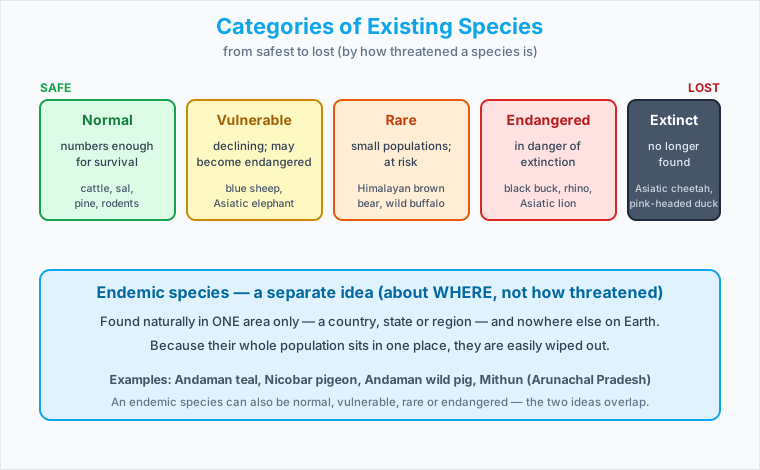
| Category | What it means | Examples |
|---|---|---|
| Normal species | Population is enough for their survival | cattle, sal, pine, rodents |
| Endangered species | In danger of extinction; will not survive if the threats continue | black buck, crocodile, Indian rhino, lion-tailed macaque, sangai (Manipur brow-antlered deer) |
| Vulnerable species | Numbers are declining; likely to slip into the endangered group soon | blue sheep, Asiatic elephant, Gangetic dolphin |
| Rare species | Small populations; could become endangered or vulnerable if disturbed | Himalayan brown bear, wild Asiatic buffalo, desert fox, hornbill |
| Endemic species | Found naturally in ONE area only and nowhere else | Andaman teal, Nicobar pigeon, Andaman wild pig, mithun (Arunachal Pradesh) |
| Extinct species | No longer found at all — in a region, country, or the whole Earth | Asiatic cheetah, pink-headed duck |
The big trap here is mixing up endemic with the others. The first five — normal, vulnerable, rare, endangered, extinct — form a ladder of risk. Endemic is about place: a species found only in one region. An endemic species can also be rare or endangered; the two ideas overlap rather than compete.
The Asiatic cheetah is no longer found in India. Which category does it belong to?
Why forests and wildlife are being depleted
The variety of life in India is shrinking, and the causes are almost all human:
- Loss of habitat — forests cleared for farming, expanding cities, roads, dams, mines and industry. When the home goes, so do the animals.
- Over-use and hunting — poaching for skins, bones, horns and meat, and trade in wildlife, pushed several species to the edge.
- Forest fires and grazing — repeated fires and heavy cattle grazing stop forests from recovering.
- Pollution — chemicals, plastics and effluents poison rivers and soil, harming aquatic and land life.
- Pressure of a growing population — more people means more demand for land, fuelwood and resources, all of it taken from forests.
The pattern to remember: it is not one big cause but many human pressures together, slowly squeezing forests and wildlife out of the space they need.
Conservation — and why we need it
Conservation means protecting and using our forests and wildlife wisely so they survive for the future. Why bother? Because:
- It preserves ecological diversity and our life-support systems — water, air and soil.
- It preserves the genetic diversity of plants and animals, which is essential for the healthy growth and breeding of species. In agriculture we still depend on traditional crop varieties, and fisheries depend on keeping aquatic biodiversity alive.
In the 1960s and 1970s, conservationists demanded a national wildlife protection programme. The result was the Indian Wildlife (Protection) Act, 1972, with provisions for protecting habitats. It published an all-India list of protected species, banned hunting of them, gave legal protection to their habitats, and restricted trade in wildlife.
After this, central and state governments set up national parks and wildlife sanctuaries, and the centre announced special projects for specific gravely threatened animals — the tiger, the one-horned rhinoceros, the Kashmir stag (hangul), three types of crocodile (fresh water crocodile, saltwater crocodile and the gharial), the Asiatic lion, and others. More recently the Indian elephant, black buck (chinkara), the great Indian bustard (godawan) and the snow leopard have been given full or partial legal protection against hunting and trade across India.
Importantly, conservation has widened from a few big animals to biodiversity as a whole. Under the Wildlife Act notifications of 1980 and 1986, several hundred butterflies, moths, beetles and one dragonfly were added to the protected list. In 1991, for the first time, plants were added too — starting with six species.
Project Tiger
The tiger is one of the key species in the faunal web — protect the tiger, and you protect the whole forest it lives in. By 1973 the authorities realised the tiger population had crashed to just 1,827, from an estimated 55,000 at the turn of the century.
The threats were many: poaching for trade, shrinking habitat, the loss of prey species, and a growing human population. The trade in tiger skins and the use of tiger bones in traditional medicines, especially in Asian countries, had pushed tigers to the brink. Because India and Nepal together hold about two-thirds of the world’s surviving tigers, both became prime targets for poachers.
So “Project Tiger” — one of the best-known wildlife campaigns in the world — was launched in 1973. It was seen not just as saving one endangered species, but as a way to preserve large, important natural areas (biotypes) as a whole. Some of India’s tiger reserves include:
| Tiger reserve / park | State |
|---|---|
| Corbett National Park | Uttarakhand |
| Sunderbans National Park | West Bengal |
| Bandhavgarh National Park | Madhya Pradesh |
| Sariska Wildlife Sanctuary | Rajasthan |
| Manas Tiger Reserve | Assam |
| Periyar Tiger Reserve | Kerala |
Types of forests — by who manages them
Even when we want to conserve forests, they are hard to manage and control. In India, most forest and wildlife resources are owned or managed by the government, mainly through the Forest Department. Forests are classified into three categories by how they are managed:
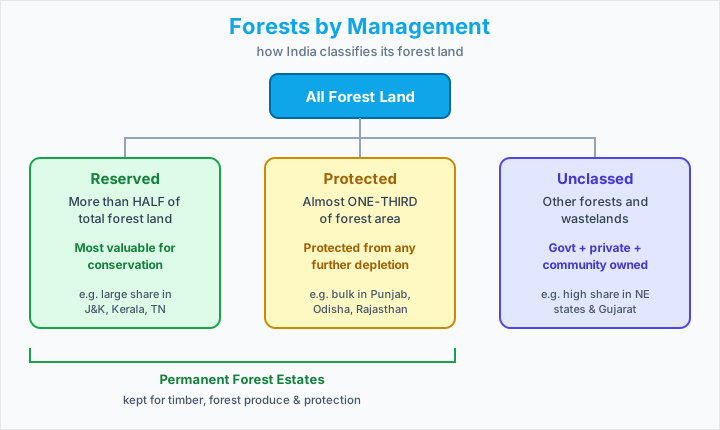
| Type | Share / status | Who owns or manages it |
|---|---|---|
| Reserved forests | More than HALF of total forest land; the MOST valuable for conserving forest and wildlife | Government (Forest Department) |
| Protected forests | Almost ONE-THIRD of forest area; protected from any further depletion | Government (Forest Department) |
| Unclassed forests | Other forests and wastelands | Both government and private individuals and communities |
Reserved and protected forests together are called permanent forest estates — kept mainly for producing timber and other forest produce, and for protection. A few facts worth knowing:
- Madhya Pradesh has the largest area under permanent forests — about 75% of its total forest area.
- Jammu and Kashmir, Andhra Pradesh, Uttarakhand, Kerala, Tamil Nadu, West Bengal and Maharashtra have large shares of reserved forests.
- Bihar, Haryana, Punjab, Himachal Pradesh, Odisha and Rajasthan have most of their forests as protected forests.
- All North-eastern states and parts of Gujarat have a very high share of unclassed forests, managed by local communities.
Community and conservation
Conservation in India is not only a government job. Forests are home to many traditional communities, and in several places local people themselves protect the forest — sometimes alongside officials, sometimes rejecting government involvement entirely — because they understand their own long-term survival depends on it.
- Sariska Tiger Reserve (Rajasthan) — villagers fought against mining by citing the Wildlife Protection Act.
- Alwar district (Rajasthan) — the people of five villages declared 1,200 hectares of forest as the Bhairodev Dakav ‘Sonchuri’, set their own rules banning hunting, and guard the wildlife against outsiders.
- The Chipko movement in the Himalayas not only resisted deforestation in several areas but also showed that community afforestation with indigenous (local) species can be hugely successful.
- Beej Bachao Andolan (in Tehri) and Navdanya — farmers’ and citizens’ groups showing that good, diversified crop production without synthetic chemicals is both possible and profitable.
Joint Forest Management (JFM)
The Joint Forest Management (JFM) programme is a good example of involving local communities in restoring degraded forests. It has existed formally since 1988, when Odisha passed the first JFM resolution. The idea is simple: village institutions are formed to protect mostly degraded forest land managed by the Forest Department, and in return community members get benefits like non-timber forest produce and a share in the timber harvested after successful protection.
Sacred groves
Nature worship is an age-old tribal belief: that all creations of nature must be protected. This belief has preserved patches of virgin forest in their original, untouched form — called sacred groves (“the forests of God and Goddesses”), where any interference is banned.
Certain communities revere particular trees too. The Mundas and Santhals of the Chota Nagpur region worship the mahua and kadamba trees; tribals of Odisha and Bihar worship the tamarind and mango trees at weddings; and for many of us the peepal and banyan are sacred. Sacred qualities are also given to springs, mountain peaks and animals — you will see troops of macaques and langurs cared for around temples, and around Bishnoi villages in Rajasthan, herds of blackbuck (chinkara), nilgai and peacocks live safely as part of the community.
The clear lesson is that local communities everywhere must be involved in managing natural resources, and that we should accept only those developmental activities that are people-centric, environment-friendly and economically rewarding.
Common Mistakes
'Endemic' and 'endangered' mean the same thing.
Both words sound technical and both describe species that need watching, so it is easy to treat them as synonyms.
They answer DIFFERENT questions. 'Endangered' is about RISK — a species in danger of extinction. 'Endemic' is about PLACE — a species found in only one area and nowhere else. An endemic species (like the Nicobar pigeon) may be perfectly safe, or it may also be endangered; the two ideas overlap but are not the same.
Reserved forests are 'reserved' for the public, and protected forests are 'protected' from the public.
The everyday meanings of the words pull you this way — 'reserved' sounds like booked-for-people and 'protected' sounds like fenced-off.
Both are categories of GOVERNMENT MANAGEMENT. Reserved forests are the most valuable for conservation and make up more than half of forest land; protected forests are protected from any further depletion and make up about a third. Neither is about reserving land for public use — together they are the 'permanent forest estates'.
The Wildlife Protection Act was passed in 1973, the same year as Project Tiger.
Project Tiger (1973) is the most famous date in this chapter, so it is tempting to attach the Act to it too.
The Indian Wildlife (Protection) Act was passed in 1972. Project Tiger was launched the next year, in 1973. Plants were first added to the protected list later still, in 1991.
Conservation is purely the government's job, done through laws and parks.
The chapter spends a lot of time on the Wildlife Act, Project Tiger and national parks, so it feels like a top-down government story.
Communities are central. Villagers at Sariska used the law against mining; the people of Alwar created their own sanctuary; the Chipko movement and JFM show local people protecting and restoring forests. Often the most effective conservation is bottom-up.
Quick Check
Which Act, passed in 1972, banned the hunting of listed species and gave legal protection to their habitats?
More than half of India's total forest land falls under which category?
A species found naturally in only one area and nowhere else on Earth is called:
Which of these conservation strategies does NOT directly involve community participation?
Practice Problems
Easy
What is biodiversity? Why is biodiversity important for human lives? (about 30 words)
Biodiversity is the immense variety of all living things — wild and cultivated species — different in form and function but linked through a web of interdependencies.
It is important because it sustains our life-support systems (air, water, soil) and the genetic diversity needed for agriculture, fisheries and the survival of all species, including humans.
Match each forest type to its description: (a) Reserved forests (b) Protected forests (c) Unclassed forests.
- Reserved forests → Forests regarded as the most valuable for conserving forest and wildlife resources (more than half of total forest land).
- Protected forests → Forest lands protected from any further depletion (almost one-third of forest area).
- Unclassed forests → Other forests and wastelands belonging to both government and private individuals and communities.
Medium
How have human activities affected the depletion of flora and fauna? Explain. (about 30 words)
Human activities deplete flora and fauna mainly through habitat loss (forests cleared for farming, cities, dams, mines and industry), poaching and over-hunting, forest fires and over-grazing, pollution, and the pressure of a growing population demanding more land and resources.
What was Project Tiger, why was it needed, and when was it launched?
Project Tiger was a major wildlife conservation campaign launched in 1973 to save the tiger, a key species in the faunal web.
It was needed because the tiger population had crashed to about 1,827 (from an estimated 55,000 at the turn of the century), threatened by poaching for skins and bones, shrinking habitat, loss of prey and a growing human population. India and Nepal hold about two-thirds of the world’s tigers, making them targets for poachers.
The project aimed not only to save an endangered species but also to preserve large natural areas as a whole. Reserves include Corbett (Uttarakhand), Sunderbans (West Bengal), Bandhavgarh (Madhya Pradesh), Sariska (Rajasthan), Manas (Assam) and Periyar (Kerala).
Challenge
Describe how communities have conserved and protected forests and wildlife in India. (about 120 words)
Across India, local communities have protected forests and wildlife, often more effectively than official efforts.
In Sariska Tiger Reserve, Rajasthan, villagers fought against mining by invoking the Wildlife Protection Act. In Alwar district, the people of five villages declared 1,200 hectares of forest the Bhairodev Dakav ‘Sonchuri’, framing their own rules that ban hunting and keep out encroachers.
The Chipko movement in the Himalayas resisted deforestation and proved that afforestation with indigenous species can succeed. Groups like the Beej Bachao Andolan and Navdanya promote diversified, chemical-free farming.
Joint Forest Management (JFM), formalised in 1988 in Odisha, lets village institutions protect degraded forests in return for forest produce. Finally, sacred groves and the worship of trees and animals (as around Bishnoi villages) preserve biodiversity through belief and tradition.
Write a note on good practices towards conserving forest and wildlife. (about 120 words)
Good conservation in India blends law, management and community action.
The Wildlife (Protection) Act, 1972 bans hunting of listed species, protects their habitats and restricts wildlife trade; national parks, wildlife sanctuaries and species projects like Project Tiger (1973) protect threatened animals such as the tiger, one-horned rhino, gharial and Asiatic lion. Conservation has widened from a few large animals to whole biodiversity, with insects added (1980, 1986) and even plants from 1991.
Forests are managed as reserved, protected and unclassed categories. Most importantly, communities must be involved — through Joint Forest Management, sacred groves, and movements like Chipko. The guiding rule: accept only development that is people-centric, environment-friendly and economically rewarding.
Summary
- We share the planet with millions of species; the whole variety of life — wild and cultivated, linked through interdependencies — is biodiversity, with forests as the primary producers the system depends on.
- Flora is plant life, fauna is animal life. India is one of the world’s richest countries in biodiversity.
- Species are grouped by threat level: normal, vulnerable, rare, endangered, extinct. Endemic species (found in one area only) are a separate idea — about place, not risk.
- Flora and fauna are being depleted mainly by human activities: habitat loss, poaching and over-use, fires and grazing, pollution, and population pressure.
- Conservation preserves ecological and genetic diversity and our life-support systems. The Indian Wildlife (Protection) Act, 1972 banned hunting, protected habitats and restricted trade; plants were added to the protected list in 1991.
- Project Tiger (launched 1973) saved the tiger and large natural areas; reserves include Corbett, Sunderbans, Bandhavgarh, Sariska, Manas and Periyar.
- Forests are managed as reserved (most valuable, over half), protected (about a third) and unclassed (government, private and community). Reserved + protected = permanent forest estates.
- Communities are central to conservation: Sariska, the Alwar ‘Sonchuri’, the Chipko movement, Joint Forest Management (1988, Odisha) and sacred groves.
What’s Next
You have seen how forests and wildlife are living resources we must use wisely and protect. Next we turn to a resource that is just as vital and just as stressed — water. In Water Resources, you will learn why a country with heavy monsoon rains can still face water scarcity, how dams and rainwater harvesting work, and how communities once again play a key role in saving a shared resource.