Resources and Development
Why This Matters
Look around the room you are sitting in. The wood in the door, the iron in the window grille, the cotton in your shirt, the plastic of your pen, the water in your glass, the very electricity lighting the page — every single one of these started out as something lying in nature. None of it was useful on its own. A lump of iron ore in the ground does nothing for you; it became a window only because someone had the technology to dig it, melt it and shape it, and a society organised enough to make that worthwhile.
That is the quiet secret of this chapter: a “resource” is not just a thing in nature — it is a thing in nature that we have learned to use. Coal was useless rock until the steam engine made it precious. Uranium was just heavy stone until we understood the atom. So resources are really a story about us — about human skill, need and choices — as much as about the Earth.
And that story has a warning attached. Because we treated nature’s gifts as free and endless, we have used them carelessly — draining them, hoarding them in a few hands, and damaging the planet in the process. Learning to plan and conserve resources, so that there is enough for everyone today and for the generations not yet born, is one of the most important ideas you will ever study. This chapter is where it begins.
The Big Idea
A resource is anything in our environment that can be used to satisfy our needs — but only if it is technologically accessible, economically feasible and culturally acceptable. Resources are not free gifts of nature; human beings turn materials into resources using technology and institutions. We can sort every resource four ways — by origin, exhaustibility, ownership and status of development — and because they are limited and unevenly spread, we must use them through careful planning and conservation so that development today does not rob the future. That last idea is sustainable development.
Let’s Break It Down
What exactly is a resource?
Everything available in our environment that can be used to satisfy our needs is a resource — provided three conditions are met: it must be technologically accessible (we can reach and use it), economically feasible (worth the cost) and culturally acceptable (our society agrees to use it).
The key insight: resources are a function of human activity. Human beings are themselves an essential part of resources, because they transform the raw material in the environment into something usable. The process involves an interactive relationship between three things — nature (the raw material), technology (the means to use it) and institutions (the rules and organisations that make development happen). Humans interact with nature through technology and build institutions to speed up their economic development.
Sea water has always contained gold in tiny traces. Why is that gold not considered a usable resource today?
Classifying resources — four different lenses
Because there are so many kinds of resources, geographers sort them in four ways. The important thing to realise is that these are four separate questions about the same resource — a single resource gets a label under each heading at once.
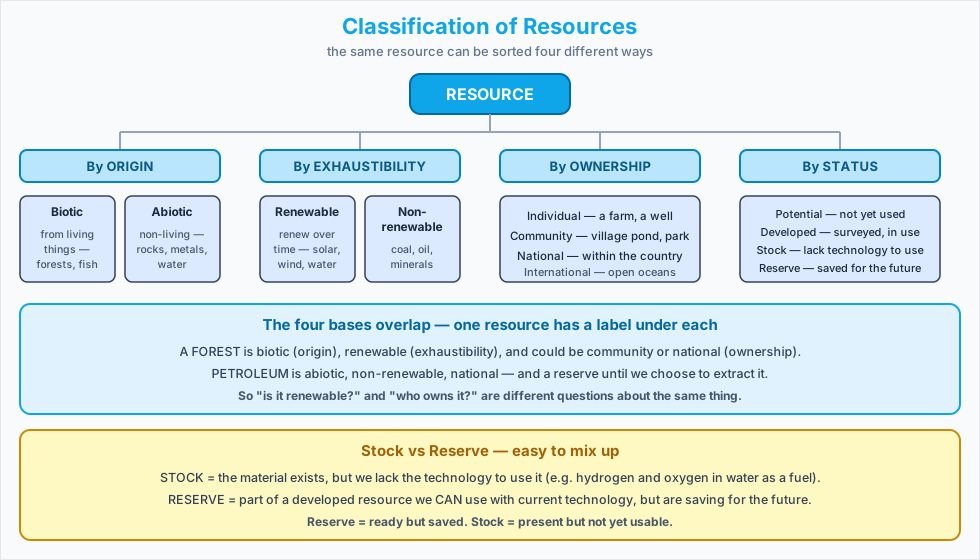
(a) On the basis of origin — whether the resource comes from living or non-living sources.
| Type | What it means | Examples |
|---|---|---|
| Biotic | obtained from the living world (the biosphere) | human beings, flora and fauna, fisheries, livestock |
| Abiotic | made of non-living things | rocks and metals, water, air, minerals |
(b) On the basis of exhaustibility — whether the resource runs out.
| Type | What it means | Examples |
|---|---|---|
| Renewable | can be renewed or reproduced by physical, chemical or mechanical processes — they keep coming back | solar and wind energy, water, forests, wildlife |
| Non-renewable | take millions of years to form; once used up, they are gone for human time scales | minerals, fossil fuels (coal, petroleum) |
(c) On the basis of ownership — who the resource belongs to.
| Type | Who owns it | Examples |
|---|---|---|
| Individual | owned privately by a person | a farmer's land, a house, a private well or plantation |
| Community | accessible to all members of a community | village grazing grounds, public parks, ponds, picnic spots |
| National | belong to the nation; the country has legal powers over them | land, water, minerals, the road and railway, and resources up to 12 nautical miles into the ocean |
| International | regulated by international bodies | the oceanic resources beyond 200 nautical miles of the Exclusive Economic Zone |
(d) On the basis of status of development — how far we have explored and started using the resource.
| Type | What it means | Example |
|---|---|---|
| Potential | exist in a region but are not yet used | solar and wind energy in Rajasthan and Gujarat — plenty there, not fully developed yet |
| Developed | surveyed, their quality and quantity determined, and being used | coalfields and oilfields already in production |
| Stock | the material exists but we lack the technology to use it | the hydrogen and oxygen in water — a huge energy source we can't yet tap as fuel |
| Reserve | part of the developed stock that we CAN use with current technology, but keep for the future | water in dams, forests, a portion of known reserves kept aside |
Development of resources — and why it went wrong
For a long time people believed resources were free gifts of nature, so they used them without restraint. That careless attitude caused three big problems:
- Depletion of resources to satisfy the greed of a few individuals.
- Accumulation of resources in a few hands, which split society into the “haves” and “have-nots” — the rich and the poor.
- Indiscriminate exploitation, which triggered global ecological crises such as global warming, ozone-layer depletion, environmental pollution and land degradation.
If this trend of a few people and countries draining resources continues, the future of the planet is in danger. So an equitable (fair) distribution of resources has become essential for a sustained quality of life and for global peace. This is exactly why resource planning is needed — for the sustainable existence of all forms of life.
Sustainable development and the Rio Earth Summit
Sustainable development means “development should take place without damaging the environment, and development in the present should not compromise with the needs of the future generations.” In short: meet today’s needs without stealing from tomorrow.
In June 1992, more than 100 heads of state met in Rio de Janeiro, Brazil, for the first International Earth Summit. They gathered to tackle urgent problems of environmental protection and socio-economic development at the global level. The leaders signed the Declaration on Global Climatic Change and Biological Diversity. The Rio Convention also endorsed the global Forest Principles and adopted Agenda 21.
Agenda 21 is the declaration signed at the United Nations Conference on Environment and Development (UNCED) at Rio. It aims at achieving global sustainable development — an agenda to fight environmental damage, poverty and disease through global cooperation built on common interests, mutual needs and shared responsibilities. A major objective: every local government should draw up its own local Agenda 21.
In one line, what is the core promise of sustainable development?
Resource planning in India
Planning is the widely accepted strategy for the judicious (wise) use of resources. It matters especially in a country like India, where resources are spread very unevenly:
- Jharkhand, Chhattisgarh and Madhya Pradesh are rich in minerals and coal deposits.
- Arunachal Pradesh has abundant water resources but lacks infrastructure.
- Rajasthan is well endowed with solar and wind energy but short of water.
- The cold desert of Ladakh has a rich cultural heritage but lacks water, infrastructure and some vital minerals.
This unevenness is why India needs balanced resource planning at the national, state, regional and local levels. Resource planning in India is a complex process carried out in three stages:
| Stage | What happens |
|---|---|
| 1. Identification and inventory of resources | surveying, mapping, and qualitative and quantitative estimation and measurement of the resources across the regions of the country |
| 2. Evolving a planning structure | setting up appropriate technology, skill and an institutional set-up to actually implement the resource development plans |
| 3. Matching with national development | aligning the resource development plans with the overall national development plans |
India has worked towards these goals right from the First Five Year Plan launched after Independence.
But here is the catch: availability of resources alone is not enough. Without matching technology and institutions, development can be held back — many resource-rich regions in India remain economically backward, while some resource-poor regions are economically developed. History shows it too: colonisers were drawn to the rich resources of their colonies, but it was their higher technology that let them exploit those resources. So resources contribute to development only when accompanied by appropriate technology and institutional change.
Conservation of resources
Resources are vital for development, but reckless over-use leads to socio-economic and environmental problems — so conservation at every level matters. This was a concern of great thinkers:
- Mahatma Gandhi put it sharply: “There is enough for everybody’s need and not for any body’s greed.” He blamed greedy individuals and exploitative modern technology for global resource depletion, and wanted “production by the masses” instead of mass production.
- At the international level, the Club of Rome advocated resource conservation systematically in 1968.
- In 1974, Schumacher revived Gandhian philosophy in his book Small is Beautiful.
- The Brundtland Commission Report, 1987 made the landmark contribution: it introduced the concept of Sustainable Development, published in the book Our Common Future.
- And then came the Earth Summit at Rio de Janeiro in 1992.
Land resources and land use
We live on land, farm on it, build on it and travel across it — land is a natural resource of the utmost importance, supporting natural vegetation, wildlife, human life, economic activities, transport and communication. But land is an asset of finite (limited) magnitude, so it must be used with careful planning.
India has land under a variety of relief features:
| Relief | Share of area | What it offers |
|---|---|---|
| Plains | about 43% | facilities for agriculture and industry |
| Mountains | about 30% | perennial flow of rivers, tourism, ecological value |
| Plateaus | about 27% | rich reserves of minerals, fossil fuels and forests |
Land is put to several uses: forests; land not available for cultivation (barren and waste land, and land put to non-agricultural uses such as buildings, roads and factories); other uncultivated land such as permanent pastures, miscellaneous tree crops, and culturable waste land (left uncultivated for more than 5 agricultural years); fallow lands (current fallow, left for one year or less; and other fallow, left 1 to 5 years); and the net sown area — the actual extent of land on which crops are sown and harvested.
A useful pair of terms: net sown area is land sown at least once, while gross cropped area is the net sown area plus the area sown more than once in a year.
The pattern of land use depends on physical factors (topography, climate, soil) and human factors (population density, technology, culture and traditions). India’s total geographical area is 3.28 million sq km, but land-use data is available only for about 93% of it — the north-eastern states (except Assam) are not fully reported, and areas of Jammu and Kashmir occupied by Pakistan and China are unsurveyed. The net sown area is over 80% in Punjab and Haryana but less than 10% in Arunachal Pradesh, Mizoram, Manipur and the Andaman & Nicobar Islands. Forest area remains far below the 33% of geographical area desired by the National Forest Policy (1952) for ecological balance.
Land degradation and conservation
Continuous use of land without proper care leads to land degradation — and human activities such as deforestation, overgrazing, mining and quarrying have sped up the damage:
| Cause | States most affected |
|---|---|
| Deforestation due to mining (deep scars, over-burden left behind) | Jharkhand, Chhattisgarh, Madhya Pradesh and Odisha |
| Overgrazing | Gujarat, Rajasthan, Madhya Pradesh and Maharashtra |
| Over-irrigation (water-logging → salinity and alkalinity) | Punjab, Haryana and western Uttar Pradesh |
| Mineral-processing dust (cement, ceramic industries) settling on land | many regions — it blocks water from soaking into the soil |
Industrial effluents dumped as waste have also become a major source of land and water pollution. The conservation measures are practical:
- Afforestation and proper management of grazing.
- In arid areas: planting shelter belts of plants, controlling overgrazing, and stabilising sand dunes by growing thorny bushes.
- In industrial and suburban areas: proper management of waste lands, control of mining activities, and proper treatment and disposal of industrial effluents and wastes before discharge.
Soil — the most important natural resource
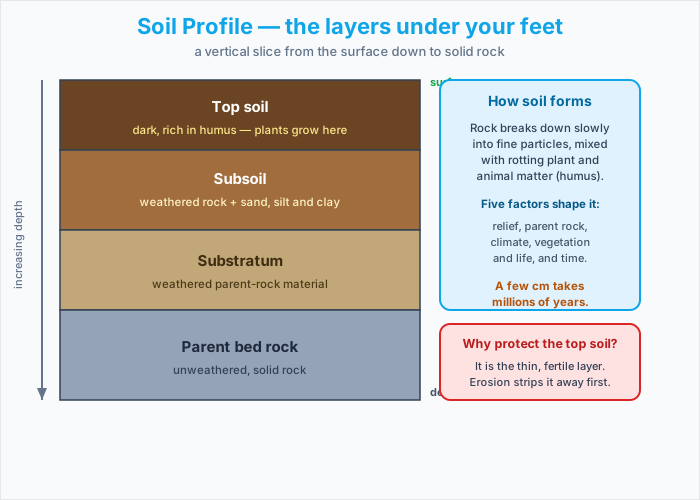
Soil is the medium of plant growth and supports countless living organisms — it is a living system. Yet it takes millions of years to form just a few centimetres of soil. Its formation depends on relief, parent rock (bedrock), climate, vegetation and other life, and time, with natural forces (temperature change, running water, wind, glaciers, and decomposers) breaking rock down and mixing in organic humus.
The major soil types of India
India’s varied relief, climate and vegetation have produced several soil types. This table is the heart of the chapter — learn the where, why and what grows for each.
| Soil | Where found | Key features | Best for |
|---|---|---|---|
| Alluvial | the entire northern plains (deposited by the Indus, Ganga and Brahmaputra); also Rajasthan–Gujarat corridor, and eastern coastal deltas of the Mahanadi, Godavari, Krishna and Kaveri | very fertile; mix of sand, silt and clay; rich in potash, phosphoric acid and lime; old alluvium = Bangar (more kanker nodules), new = Khadar (finer, more fertile) | sugarcane, paddy, wheat and other cereals and pulses; intensively cultivated and densely populated |
| Black (regur) | Deccan trap region — Maharashtra, Saurashtra, Malwa, Madhya Pradesh, Chhattisgarh; along the Godavari and Krishna valleys | made of fine clayey material; holds moisture well; rich in calcium carbonate, magnesium, potash and lime; poor in phosphoric content; develops deep cracks in hot weather | cotton (also called black cotton soil) |
| Red and yellow | low-rainfall eastern and southern Deccan plateau; parts of Odisha, Chhattisgarh, southern middle Ganga plain, Western Ghats piedmont | develops on crystalline igneous rocks; red from iron diffusion; yellow when in a hydrated form | various crops with treatment |
| Laterite | high-rainfall areas with alternate wet and dry seasons — southern states, Western Ghats of Maharashtra, Odisha, parts of West Bengal and the North-East | from heavy leaching; acidic (pH less than 6.0); deficient in plant nutrients; humus-rich under forest, humus-poor under sparse vegetation; prone to erosion | tea and coffee (hilly Karnataka, Kerala, Tamil Nadu); cashew (red laterite in Tamil Nadu, Andhra Pradesh, Kerala) |
| Arid | western Rajasthan and other dry regions | red to brown; sandy and saline; lacks humus and moisture due to dry climate and fast evaporation; a Kankar layer below restricts water infiltration | cultivable after proper irrigation |
| Forest | hilly and mountainous areas with enough rainforest | loamy and silty in valley sides, coarse on upper slopes; acidic with low humus in snow-covered Himalayas; fertile on lower river terraces and alluvial fans | varies with the mountain environment |
Soil erosion and conservation
The denudation (stripping) of the soil cover and its washing or blowing away is called soil erosion. Normally, soil formation and erosion stay in balance — but human activities like deforestation, overgrazing, construction and mining, plus natural forces like wind, glaciers and water, upset that balance.
| Type | How it happens | Result |
|---|---|---|
| Gully erosion | running water cuts deep channels through clayey soil | land becomes unfit for cultivation — called bad land; in the Chambal basin these are ravines |
| Sheet erosion | water flows as a sheet over a large sloping area | the top soil is washed away evenly |
| Wind erosion | wind blows loose soil off flat or sloping land | fertile soil lost to the air |
Defective farming also erodes soil — ploughing up and down a slope makes channels for fast water flow. The conservation methods counter exactly these problems:
| Method | How it works | Where used |
|---|---|---|
| Contour ploughing | ploughing along the contour lines, across the slope, to slow water flowing downhill | sloping farmland |
| Terrace cultivation | cutting steps (terraces) into a slope to restrict erosion | well developed in the western and central Himalayas |
| Strip cropping | leaving strips of grass to grow between crops, breaking the force of the wind | large open fields |
| Shelter belts | planting rows of trees to create a windbreak | stabilising sand dunes and the desert in western India |
Common Mistakes
Everything in nature — sunlight, rivers, minerals — is automatically a resource.
In everyday speech we call anything useful in nature a 'natural resource', so it feels obvious that all of nature counts.
A material becomes a resource ONLY when it is technologically accessible, economically feasible AND culturally acceptable. Gold dissolved in seawater or ice on a distant mountain isn't a resource until we can actually use it usefully and affordably. Resources are a function of human activity, not just nature's stock.
A resource belongs to just one category — it is either biotic or renewable or national, and that's its 'type'.
Textbook lists present the four bases one after another, so it's natural to assume a resource picks one box and stays there.
The four bases are FOUR separate questions answered at the same time. A single forest is biotic (origin), renewable (exhaustibility), AND community or national (ownership) all at once. Every resource gets a label under each heading.
Stock and reserve mean the same thing — resources kept aside for later.
Both words sound like 'something stored up for the future', so they feel interchangeable.
They differ by TECHNOLOGY. A STOCK is material we cannot yet use because we lack the technology (like the hydrogen in water as fuel). A RESERVE is part of a developed resource we CAN use right now but choose to save (like water in a dam). Reserve = ready but saved; stock = present but not yet usable.
Black soil is black because it is rich in humus or rotting organic matter, like dark garden soil.
In gardens, the darkest soil really is the one richest in humus, so the colour-equals-humus rule feels universally true.
Black (regur) soil gets its colour from its parent rock — the lava of the Deccan trap (basalt) — and the climate, not from humus. In fact it is its fine clayey nature and minerals like calcium carbonate that matter; it is its moisture-holding power, not humus, that makes it ideal for cotton.
Quick Check
Which three conditions must be met before something in the environment counts as a 'resource'?
The oceanic resources beyond 200 nautical miles of the Exclusive Economic Zone are an example of which kind of resource by ownership?
In which of these states is black soil predominantly found?
What is the main cause of land degradation in Punjab?
Practice Problems
Easy
Name three states having black soil, and the crop mainly grown in it.
Three states with black soil are Maharashtra, Madhya Pradesh and Chhattisgarh (others include the Saurashtra and Malwa regions of Gujarat and Madhya Pradesh).
The crop mainly grown in black soil is cotton — which is why black soil is also called black cotton soil. Its fine clayey nature and high moisture-holding capacity suit cotton well.
In which states is terrace cultivation practised, and why is it useful?
Terrace cultivation is well developed in the hilly regions of the western and central Himalayas (for example, Uttarakhand).
Steps (terraces) are cut into the slopes so that the land becomes a series of flat platforms instead of a continuous slope. This slows the downhill flow of water and restricts soil erosion, making farming possible on steep ground.
Medium
What type of soil is found in the river deltas of the eastern coast? Give three main features of this type of soil.
The river deltas of the eastern coast — the deltas of the Mahanadi, Godavari, Krishna and Kaveri — have alluvial soil.
Three main features:
- It is very fertile, containing adequate proportions of potash, phosphoric acid and lime, ideal for crops.
- It is a mix of sand, silt and clay, and can be classified by age into old alluvium (Bangar, with more kanker nodules) and new alluvium (Khadar, which is finer and more fertile).
- Because of its high fertility, regions of alluvial soil are intensively cultivated and densely populated; it is ideal for sugarcane, paddy, wheat and other cereals and pulses.
What steps can be taken to control soil erosion in the hilly areas?
In hilly areas, soil erosion can be controlled mainly by changing how water moves down the slopes:
- Contour ploughing — ploughing along the contour lines (across the slope rather than up and down it) decelerates the flow of water down the slope.
- Terrace cultivation — cutting steps or terraces into the slope so that water cannot rush down; this restricts erosion and is well developed in the western and central Himalayas.
- Afforestation and shelter belts — planting trees and rows of trees holds the soil together with roots and breaks the force of wind and water.
- Strip cropping — leaving strips of grass between crops to break the force of the wind.
Challenge
Explain the land-use pattern in India, and why has the land under forest not increased much since 1960-61?
Land-use pattern in India. India’s land (total geographical area 3.28 million sq km) is put to several uses: forests; land not available for cultivation (barren and waste land, and land used for buildings, roads and factories); other uncultivated land (permanent pastures, miscellaneous tree crops, and culturable waste land left uncultivated for more than 5 years); fallow lands (current fallow up to one year, and other fallow for 1 to 5 years); and the net sown area — the land actually sown and harvested. The pattern is shaped by physical factors (topography, climate, soil) and human factors (population density, technology, culture). Net sown area is very high in fertile plains like Punjab and Haryana (over 80%) but very low in hilly or forested states like Arunachal Pradesh, Mizoram, Manipur and the Andaman & Nicobar Islands (less than 10%). Land-use data, however, is available for only about 93% of the total area, since most north-eastern states (except Assam) and the areas of Jammu and Kashmir occupied by Pakistan and China are not fully surveyed.
Why forest land has barely increased. The National Forest Policy (1952) set a target of 33% of geographical area under forest for ecological balance, but the actual forest cover remains far below this and has changed only marginally since 1960-61. This is because the growing population and economic development create constant pressure to convert land to settlements, agriculture, industry, roads and railways, while afforestation is slow and the millions who live on the forest fringes depend on these forests for their livelihood. So even as some forests are planted, others are cleared, and the net forest area stays almost the same.
How have technical and economic development led to more consumption of resources?
Technical and economic development have steadily increased resource consumption in several linked ways:
- Better technology lets us reach more resources. Things that were once useless materials (a ‘stock’) became usable resources once technology caught up — coal for steam engines, petroleum for vehicles, uranium for nuclear energy. The more we can extract and process, the more we use.
- Economic development raises demand. As industries grow and incomes rise, people consume far more goods, energy, water and minerals than a simple subsistence economy ever did. Mass production multiplies the raw materials drawn from the Earth.
- Historically, technology drove exploitation. Colonising countries used their higher technology to exploit the rich resources of their colonies and build their supremacy — showing that resources contribute to development only when paired with technology and institutions.
The result is that resources are now consumed far faster than before, which is why resource planning, conservation and sustainable development have become essential — so that this faster consumption does not deplete resources or compromise the needs of future generations. As Gandhiji warned, there is “enough for everybody’s need and not for any body’s greed.”
Summary
You should now be able to explain:
- A resource is anything in our environment we can use to satisfy our needs, provided it is technologically accessible, economically feasible and culturally acceptable — resources are a function of human activity, not free gifts of nature.
- Resources are classified on four bases: origin (biotic / abiotic), exhaustibility (renewable / non-renewable), ownership (individual / community / national / international), and status of development (potential / developed / stock / reserve) — and one resource gets a label under each.
- Treating resources as free led to depletion, unequal accumulation, and ecological crises; the answer is equitable distribution, resource planning and conservation.
- Sustainable development means developing without harming the environment or compromising future generations; the Rio Earth Summit (1992) adopted Agenda 21 to pursue it globally.
- Resource planning in India has three stages — identification/inventory, building a planning structure, and matching with national development — and works only when resources are paired with technology and institutions.
- Land is a finite resource (plains ~43%, mountains ~30%, plateaus ~27%); it is used for forests, cultivation, pasture and non-agricultural purposes, and is harmed by land degradation from deforestation, overgrazing, over-irrigation and mining.
- India’s major soils are alluvial, black (regur), red and yellow, laterite, arid and forest — each with its own region, features and crops.
- Soil erosion (gully, sheet, wind) is countered by contour ploughing, terrace cultivation, strip cropping and shelter belts.
What’s Next
You now know that resources are limited and must be used wisely. The next chapter, Forest and Wildlife Resources, zooms in on one of the most precious biotic resources — the forests and wildlife of India. You will see why biodiversity is declining, how species are classified by how threatened they are, and what conservation efforts like Project Tiger and community forestry are doing to protect this living heritage for the future.