Manufacturing Industries
Why This Matters
Walk into a Diwali market and it overflows with things — shoes, clothes, utensils, sugar, tea, earthen diyas. Ever wonder how so many of each can exist? The shoes and clothes rolled out of large factory machines; the steel ladle was made in a small workshop; the diya was shaped by a single potter at home. Three very different scales of making — but all of them turn raw stuff into something more useful. That is manufacturing.
This chapter is the story of how India makes things. Paper from wood, sugar from sugarcane, steel from iron ore, aluminium from bauxite, cloth from yarn. It explains why a steel plant sits on a plateau but a jute mill hugs a riverbank, why one cooperative runs a sugar mill while the government runs a steel giant, and why the same factories that power our growth also choke our air and rivers.
It matters because the strength of a country’s economy is measured by how well it manufactures. A nation that only sells raw materials stays poor; one that turns them into valuable finished goods grows rich. India’s future prosperity is being built, quite literally, in its factories.
The Big Idea
Manufacturing means producing goods in large quantities by processing raw materials into more valuable finished products. It is the backbone of economic development — it modernises agriculture, creates jobs outside farming, earns foreign exchange through exports, and reduces regional inequality. Where a factory is built is decided by a tug-of-war between raw material, power, labour, market, transport, capital and water. We sort the thousands of industries using five handy bases — what they are made from, what role they play, how much money is invested, who owns them, and how heavy their goods are.
Keep two threads in mind throughout. First, agriculture and industry move hand in hand, not against each other — agro-industries take crops as raw material and sell back pumps, fertilisers and tools to farmers. Second, every industry has a cost the textbook is honest about: pollution. Growth and the environment have to be balanced — that is sustainable development.
Let’s Break It Down
Why manufacturing is the backbone
Manufacturing belongs to the secondary sector — workers there turn primary materials (from farming, mining, forestry) into finished goods. Steel factories, car plants, breweries, textile mills and bakeries all fall here. The sector is called the backbone of development for clear reasons:
- It modernises agriculture and frees people from depending only on farm income by giving them jobs in the secondary and tertiary sectors.
- It is a precondition for ending unemployment and poverty — the very idea behind India’s public-sector and joint-sector ventures, which were also meant to reduce regional disparities by placing industries in tribal and backward areas.
- Exporting manufactured goods expands trade and commerce and earns much-needed foreign exchange.
- Countries that turn raw materials into a wide variety of higher-value finished goods become prosperous. India’s prosperity lies in increasing and diversifying its manufacturing as fast as possible.
In a globalised world, self-sufficiency alone is not enough — our goods must match international quality to compete in the world market.
Agriculture and industry are rivals competing for the same workers. True or false?
False. They move hand in hand. Agro-industries depend on farms for raw materials and, in turn, sell farmers irrigation pumps, fertilisers, pesticides, PVC pipes, machines and tools — raising farm productivity and making the whole process more efficient.
What decides where a factory is built
A factory does not appear just anywhere. Its location is chosen where production is cheapest and most profitable, weighing several pulls at once:
- Raw material — heavy, bulky, weight-losing materials pull the factory close to their source (a steel plant near coal and ore; a sugar mill near cane, because cut cane loses sucrose with delay and distance).
- Power — to run the machinery (aluminium smelting needs a steady, large electricity supply).
- Labour — cheap and available workers.
- Market — being near where the goods are sold.
- Transport — road, rail, water and port links to move materials in and goods out.
- Capital — money to invest.
- Water — for processing (jute mills need abundant water).
When several of these come together in one place, industries cluster there. That is why the Chhotanagpur plateau has the densest concentration of iron and steel plants — cheap iron ore, high-grade raw materials nearby, cheap labour and a vast home market.
Five ways to classify industries
Because there are thousands of industries, we sort them using a chosen basis. The same industry will land in different categories depending on which basis you use.
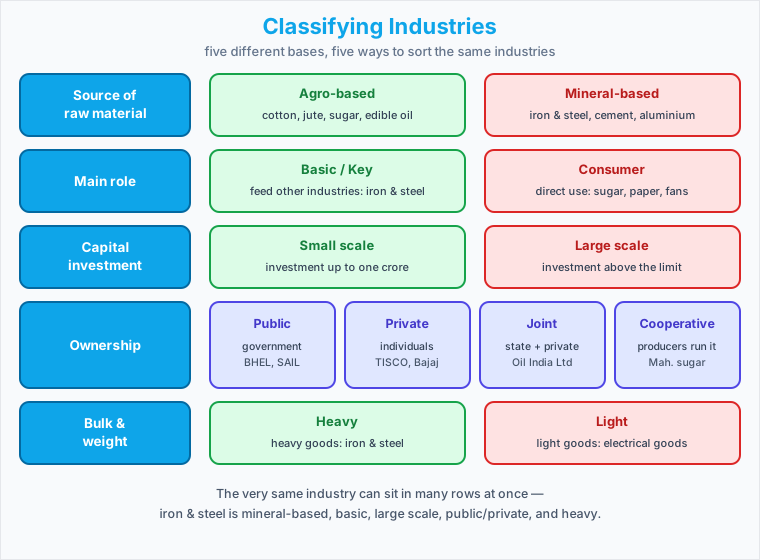
| Basis | Categories | Examples |
|---|---|---|
| Source of raw material | Agro-based / Mineral-based | Agro: cotton, jute, silk, woollen textile, rubber, sugar, tea, coffee, edible oil. Mineral: iron & steel, cement, aluminium, machine tools, petrochemicals. |
| Main role | Basic (key) / Consumer | Basic: iron & steel, copper smelting, aluminium smelting (supply raw materials to other industries). Consumer: sugar, toothpaste, paper, sewing machines, fans (for direct use). |
| Capital investment | Small scale / Large scale | Small scale = investment on assets up to ₹1 crore (the limit has changed over time); above it is large scale. |
| Ownership | Public / Private / Joint / Cooperative | Public: BHEL, SAIL (government). Private: TISCO, Bajaj Auto, Dabur. Joint: Oil India Ltd (state + private). Cooperative: sugar in Maharashtra, coir in Kerala. |
| Bulk & weight | Heavy / Light | Heavy: iron & steel. Light: electrical goods. |
A quick note on the cooperative sector: it is owned and run by the producers or suppliers of raw materials, the workers, or both — they pool resources and share profits or losses proportionately.
Iron and steel is a 'basic' industry. Why that name?
Because it supplies its product — steel — as a raw material to manufacture other goods. Heavy, medium and light industries all depend on it for machinery, so it is foundational, or ‘basic’, to them.
Agro-based industries: textiles & sugar
Agro-based industries run on agricultural raw materials — cotton, jute, silk, woollen textiles, sugar and edible oil.
The textile industry holds a unique position in the Indian economy: it contributes hugely to industrial production, employment and foreign-exchange earnings. It is the only industry in the country that is self-reliant and complete in the value chain — from raw material right up to the highest value-added finished products.
Cotton textiles. In ancient India, cotton cloth was made by hand spinning and handloom weaving. After the 18th century, power-looms arrived. Our traditional industry suffered badly in the colonial period because it could not compete with mill-made cloth from England.
- The first successful textile mill was set up in Mumbai in 1854.
- The two World Wars (fought in Europe, while India was a British colony) created demand for cloth in the U.K. and so boosted India’s cotton textile industry.
Early on, the industry concentrated in the cotton-growing belt of Maharashtra and Gujarat — pulled there by raw cotton, market, transport and port access, labour and a moist climate. It is closely linked to agriculture and supports a long chain of work: cotton-boll pluckers, ginning, spinning, weaving, dyeing, designing, packaging, tailoring and sewing. It also feeds other industries — chemicals and dyes, packaging, engineering.
Today spinning stays centralised in Maharashtra, Gujarat and Tamil Nadu, while weaving is highly decentralised to keep alive traditional skills and designs (cotton, silk, zari, embroidery). India is world-class at spinning but its weaving still supplies low-quality fabric, as it cannot use much of the fine yarn the country produces. Weaving is done by handloom, powerloom and in mills, and handspun khadi gives large-scale cottage employment to weavers at home.
Jute textiles. India is the largest producer of raw jute and jute goods and the second-largest exporter after Bangladesh. Most mills sit in West Bengal, in a narrow belt along the banks of the Hugli river. The first jute mill was set up near Kolkata at Rishra in 1855. After Partition in 1947 the mills stayed in India, but three-fourths of the jute-growing area went to Bangladesh (then East Pakistan). Their location in the Hugli basin is explained by the nearness of jute-growing areas, cheap water transport backed by railways and roadways, abundant water to process raw jute, cheap labour from West Bengal and neighbouring Bihar, Odisha and Uttar Pradesh, and Kolkata as a large urban centre offering banking, insurance and port facilities.
Sugar industry. India is the second-largest producer of sugar in the world but first in gur and khandsari. Its raw material, sugarcane, is bulky and loses sucrose as it is hauled — so mills sit close to cane fields. Mills are found in Uttar Pradesh, Bihar, Maharashtra, Karnataka, Tamil Nadu, Andhra Pradesh, Gujarat, Punjab, Haryana and Madhya Pradesh, with 60% of the mills in Uttar Pradesh and Bihar. The industry is seasonal, which makes it ideally suited to the cooperative sector. In recent years mills have tended to shift to the southern and western states, especially Maharashtra, because the cane there has higher sucrose content, the cooler climate gives a longer crushing season, and cooperatives are more successful in those states.
Mineral-based industries
Industries that use minerals and metals as raw materials are mineral-based.
Iron and steel is the basic industry, because every other industry — heavy, medium or light — depends on it for machinery. Steel is needed for engineering goods, construction, defence, medical and telephonic and scientific equipment, and countless consumer goods. Its production and consumption is regarded as the index of a country’s development. It is a heavy industry: raw materials and finished goods are heavy and bulky, so transport costs are high. Iron ore, coking coal and limestone are needed in the ratio of roughly 4 : 2 : 1, with some manganese to harden the steel. Ideally, steel plants should be located where these materials and an efficient transport network for distribution all meet — which is why the Chhotanagpur plateau has the maximum concentration of iron and steel plants.
Aluminium smelting is India’s second most important metallurgical industry. Aluminium is light, corrosion-resistant, a good conductor of heat, malleable, and becomes strong when alloyed — used for aircraft, utensils and wires, and increasingly as a substitute for steel, copper, zinc and lead. Its raw material is bauxite, a very bulky, dark reddish rock. Smelters are located in Odisha, West Bengal, Kerala, Uttar Pradesh, Chhattisgarh, Maharashtra and Tamil Nadu. The two prime location factors are a regular supply of electricity and an assured source of raw material at minimum cost.
Chemical industries. Fast-growing and diversifying, covering both large and small units, and both inorganic and organic sectors.
- Inorganic chemicals — sulphuric acid (for fertilisers, synthetic fibres, plastics, adhesives, paints, dye-stuffs), nitric acid, alkalies, soda ash (for glass, soaps, detergents, paper) and caustic soda. These are spread widely across the country.
- Organic chemicals — petrochemicals, used to make synthetic fibres, synthetic rubber, plastics, dye-stuffs, drugs and pharmaceuticals. Their plants sit near oil refineries or petrochemical plants.
The chemical industry is its own largest consumer — basic chemicals are processed into other chemicals for industry, agriculture or consumers.
Fertiliser industry. Centred on nitrogenous fertilisers (mainly urea), phosphatic fertilisers, ammonium phosphate (DAP) and complex fertilisers combining nitrogen (N), phosphate (P) and potash (K). The potash is entirely imported — India has no commercially usable potash reserves. After the Green Revolution the industry spread; Gujarat, Tamil Nadu, Uttar Pradesh, Punjab and Kerala make about half the country’s fertiliser.
Cement industry. Cement is essential for construction — houses, factories, bridges, roads, airports, dams. It needs bulky, heavy raw materials like limestone, silica and gypsum, plus coal, electric power and rail transport. The first cement plant was set up in Chennai in 1904, and the industry expanded after Independence. Plants in Gujarat are strategically located for the Gulf-country market.
Automobile industry. Makes trucks, buses, cars, motorcycles, scooters, three-wheelers and multi-utility vehicles for quick transport of goods and passengers. After liberalisation, new contemporary models stimulated demand and the industry grew healthily. It is located around Delhi, Gurugram, Mumbai, Pune, Chennai, Kolkata, Lucknow, Indore, Hyderabad, Jamshedpur and Bengaluru.
Information Technology and Electronics industry. Covers a wide range — transistor sets, televisions, telephones, cellular telecom, telephone exchanges, radars, computers and telecommunication equipment. Bengaluru has emerged as the electronic capital of India; other important centres are Mumbai, Delhi, Hyderabad, Pune, Chennai, Kolkata, Lucknow and Coimbatore, with major concentration at Bengaluru, Noida, Mumbai, Chennai, Hyderabad and Pune. Its biggest impact has been on employment generation, and continuing growth in hardware and software is the key to its success.
Sugar mills and iron & steel plants are both located close to their raw material, yet for slightly different reasons. Explain each.
- Sugarcane is bulky and its sucrose content drops the longer it waits and the farther it travels after cutting. To save sucrose, the mill must be near the fields.
- Iron & steel uses iron ore, coking coal and limestone (roughly 4 : 2 : 1) — all heavy and bulky, so hauling them far is expensive. The finished steel is heavy too.
- So both locate near raw materials to cut cost — but the sugar mill is racing against sucrose loss, while the steel plant is fighting heavy transport costs of bulky inputs. This is exactly why the Chhotanagpur plateau, rich in ore and coal, hosts most steel plants.
Industrial pollution and how it is controlled
Industries drive India’s growth, but they also pollute. There are four types of pollution, and thermal power plants are polluters too.
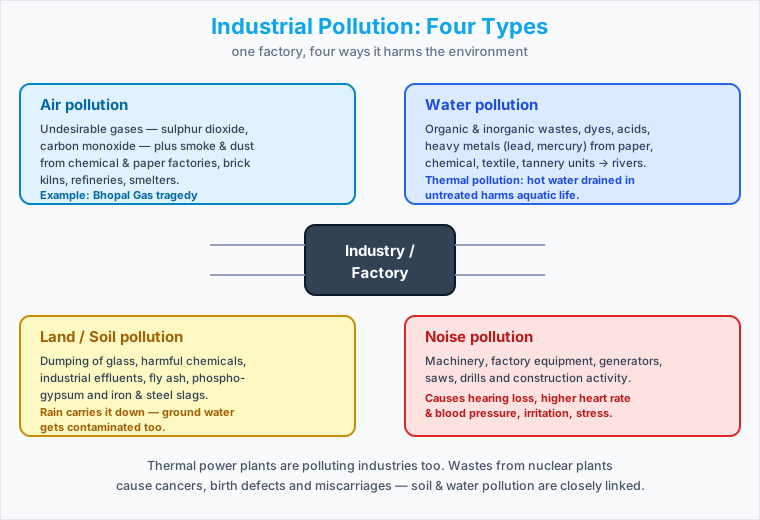
| Type | Caused by | Main effects |
|---|---|---|
| Air | High proportion of undesirable gases (sulphur dioxide, carbon monoxide), smoke and dust from chemical & paper factories, brick kilns, refineries, smelters; toxic gas leaks | Harms human health, animals, plants, buildings and the atmosphere. Example: the Bhopal Gas tragedy. |
| Water | Organic & inorganic wastes and effluents — dyes, detergents, acids, salts, heavy metals like lead & mercury — from paper, pulp, chemical, textile & dyeing, refineries, tanneries, electroplating; solid wastes like fly ash, phospho-gypsum, slags | Pollutes rivers and water bodies. Thermal pollution (hot water drained in before cooling) harms aquatic life. |
| Land / Soil | Dumping of glass, harmful chemicals, industrial effluents, packaging, salts and garbage; rain carries pollutants into the ground | Renders soil useless and contaminates ground water. Nuclear wastes cause cancers, birth defects and miscarriages. |
| Noise | Industrial & construction activity, machinery, factory equipment, generators, saws, pneumatic and electric drills | Irritation, anger, stress, hearing impairment, raised heart rate and blood pressure. |
Controlling the damage. Every litre of waste water our industry discharges pollutes eight times that quantity of freshwater. The fixes:
- Reduce freshwater use by reusing and recycling water in two or more successive stages, and harvest rainwater.
- Treat hot water and effluents before releasing them — in three phases: (a) primary (mechanical: screening, grinding, flocculation, sedimentation), (b) secondary (biological), (c) tertiary (biological, chemical and physical, recycling the wastewater).
- Regulate overdrawing of ground water legally where reserves are threatened.
- Cut air pollution — fit smoke stacks with electrostatic precipitators, fabric filters, scrubbers and inertial separators; use oil or gas instead of coal to reduce smoke.
- Cut noise — fit generators with silencers, redesign machinery for energy efficiency and quiet, use noise-absorbing material, earplugs and earphones.
The challenge of sustainable development is to integrate economic growth with environmental concerns. NTPC, a major power corporation, shows the way: it holds ISO 14001 certification for its Environment Management System and protects natural resources through optimum use of equipment, minimising waste, ash-pond and ash-water recycling, green belts and afforestation, and ecological monitoring at all its power stations.
Common Mistakes
Manufacturing simply means making any product, even one piece by hand.
In everyday talk we call any making of an object 'manufacturing', and a potter shaping a single diya certainly makes something — so 'one item = manufacturing' feels right.
The definition stresses scale and value: manufacturing is the production of goods in LARGE quantities by processing raw materials into MORE VALUABLE finished products. The key ideas are bulk production and value addition, not a single handmade piece.
A factory should always be built right next to its market or wherever land is cheap.
It sounds efficient to be close to buyers, and cheap land obviously cuts cost, so location seems to be about market and land price.
Location is a balance of many factors — raw material, power, labour, market, transport, capital and water. Which one dominates depends on the industry: heavy or weight-losing raw materials (ore, sugarcane) pull the factory to their SOURCE, not to the market.
India does not import any raw material for fertilisers because it is self-sufficient.
India is a big agricultural country with a large fertiliser industry, so it feels obvious that it would make all its own inputs.
India entirely IMPORTS potash (the 'K' in NPK), because it has no commercially usable potash or potassium-compound reserves. The country produces nitrogenous and phosphatic fertilisers, but potash must be brought in.
Thermal pollution means the air getting hotter near a factory.
The word 'thermal' means heat, and factories do feel hot, so 'thermal pollution' sounds like heat in the air.
Thermal pollution is a WATER problem: it happens when hot water from factories and thermal plants is drained into rivers and ponds BEFORE cooling, harming aquatic life. It is listed under water pollution, not air pollution.
Quick Check
Which one of the following industries uses bauxite as a raw material?
Which industry manufactures telephones, computers and similar equipment?
Most jute mills in India are located along the banks of which river?
Why is the sugar industry well suited to the cooperative sector?
Practice Problems
Easy
What is manufacturing? (Answer in not more than 30 words.)
Manufacturing is the production of goods in large quantities by processing raw materials into more valuable finished products — for example, sugar from sugarcane, steel from iron ore, or aluminium from bauxite.
What are basic industries? Give an example.
Basic (or key) industries are those whose products are used as raw materials to manufacture other goods. Other heavy, medium and light industries depend on them.
Example: the iron and steel industry — its steel becomes the machinery and material for almost every other industry.
Medium
Why is the cotton textile industry called self-reliant and complete in its value chain, and name three states where spinning is centralised.
The cotton textile industry is the only industry in the country that is self-reliant and complete in the value chain — it covers everything from the raw material right up to the highest value-added finished products, all within India. It contributes significantly to industrial production, employment generation and foreign-exchange earnings.
Spinning is centralised in Maharashtra, Gujarat and Tamil Nadu, while weaving is highly decentralised to keep alive traditional skills and designs in cotton, silk, zari and embroidery.
Explain why the Chhotanagpur plateau has the maximum concentration of iron and steel industries.
The Chhotanagpur plateau enjoys several relative advantages for this industry:
- Low cost of iron ore in the region.
- High-grade raw materials (coking coal, limestone) available in close proximity, important because iron & steel is a heavy industry and these inputs are bulky.
- Cheap labour.
- Vast growth potential in the home market.
Together these make production cheaper here than elsewhere, so most plants cluster on the plateau.
Challenge
How do industries pollute the environment? Discuss the four types. (Around 120 words.)
Industries are responsible for four types of pollution — air, water, land and noise — and thermal power plants add to it.
Air pollution comes from undesirable gases like sulphur dioxide and carbon monoxide, and smoke and dust from chemical and paper factories, brick kilns, refineries and smelters; toxic gas leaks (such as the Bhopal Gas tragedy) are especially hazardous.
Water pollution is caused by organic and inorganic wastes, dyes, acids, salts and heavy metals like lead and mercury discharged into rivers by paper, chemical, textile, tannery and electroplating units; thermal pollution from hot water harms aquatic life.
Land/soil pollution results from dumping glass, chemicals, effluents, fly ash and slags, which also contaminate ground water.
Noise pollution from machinery, generators and drills causes hearing loss, raised blood pressure and stress.
Discuss the steps to be taken to minimise environmental degradation by industry. (Around 120 words.)
Industrial pollution of freshwater can be reduced by minimising water use — reusing and recycling it in two or more successive stages — and by harvesting rainwater. Hot water and effluents must be treated before release in three phases: primary (mechanical — screening, grinding, flocculation, sedimentation), secondary (biological), and tertiary (biological, chemical and physical, recycling the wastewater). Overdrawing of ground water by industry should be regulated legally.
For air, particulate matter can be cut by fitting smoke stacks with electrostatic precipitators, fabric filters, scrubbers and inertial separators, and smoke reduced by using oil or gas instead of coal. Noise is lowered by fitting generators with silencers, redesigning machinery and using noise-absorbing material and earplugs.
Ultimately, sustainable development means integrating economic growth with environmental concerns.
Summary
You should now be able to explain:
- Manufacturing is producing goods in large quantities by processing raw materials into more valuable finished products; it is the backbone of economic development (modernises agriculture, creates jobs, earns foreign exchange, reduces regional disparity).
- A factory’s location balances raw material, power, labour, market, transport, capital and water — heavy or weight-losing raw materials pull it to their source.
- Industries are classified on five bases: source of raw material (agro/mineral), main role (basic/consumer), capital (small/large scale), ownership (public/private/joint/cooperative), and bulk & weight (heavy/light).
- Agro-based: the textile industry (cotton — first mill Mumbai 1854, spinning in Maharashtra/Gujarat/Tamil Nadu; jute — mostly West Bengal along the Hugli, first mill Rishra 1855) and sugar (seasonal, suited to cooperatives, shifting to Maharashtra for higher sucrose).
- Mineral-based: iron & steel (the basic industry, concentrated on the Chhotanagpur plateau), aluminium smelting (from bauxite, needs power), chemical, fertiliser (potash entirely imported), cement (limestone, silica, gypsum), automobile, and IT & electronics (Bengaluru, the electronic capital).
- Industries cause four types of pollution — air, water, land, noise (plus thermal pollution of water) — controlled by recycling and treating water, fitting precipitators and filters, silencing machinery, and pursuing sustainable development.
What’s Next
Factories make goods, but those goods are worthless if they cannot move — raw materials must reach the plant and finished products must reach the market. In Lifelines of National Economy, you will see how roadways, railways, waterways, airways, pipelines and communication knit the whole country together, and why trade — the exchange of goods within and beyond our borders — is the true lifeline that carries everything this chapter produced to the people who need it.