Lifelines of National Economy
Why This Matters
Look around the room you are sitting in. The phone in your hand, the rice on your plate, the cloth you are wearing, the petrol in the scooter outside — almost none of it was made where you are. It was grown, dug up or manufactured somewhere else and brought to you. Goods and services don’t walk to where they’re needed; somebody has to move them.
That movement is what this chapter is about. A farmer can grow a mountain of onions, but if there’s no road to carry them to the city, they rot in the field. A factory can make the best phones in the world, but without ports and airports it can never sell them abroad. The making of things and the moving of things are two halves of the same story — and a country develops only when both work well.
So transport (roads, rail, pipelines, water, air), communication (post, phone, radio, TV, press, films) and trade (buying and selling, at home and abroad) are not boring background details. They are the lifelines — the arteries through which goods, people, money and information flow. When they’re strong and dense, the whole economy is alive. This is also the last chapter of your geography journey, and it ties everything together: the resources you studied earlier mean little until they can move.
The Big Idea
Things are made in one place but needed in another, so a country’s growth depends not only on producing goods and services but on moving them. Transport carries goods and people over land, water and air; communication carries information without anyone moving; and trade is the exchange of goods between people, states and countries. Transport, communication and trade are complementary — each needs the others — and together they form the lifelines that keep the national economy running.
Let’s Break It Down
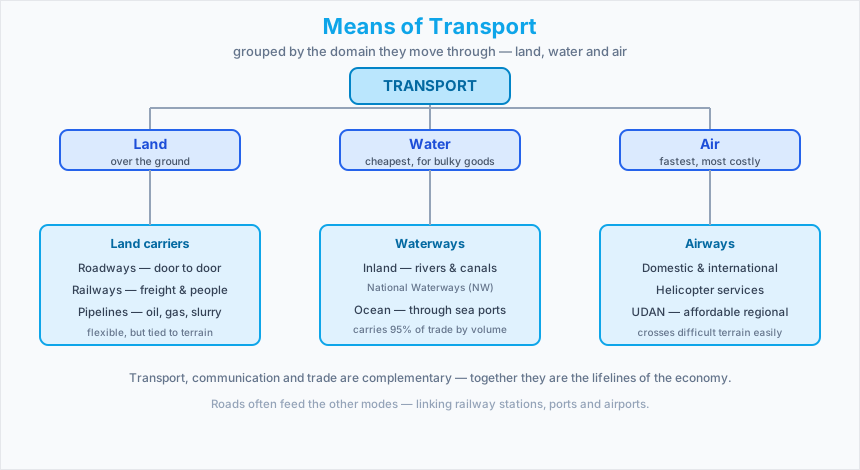
Movement happens over three domains of the earth — land, water and air — and transport is classified the same way. Here is the whole family of transport modes at a glance before we take them one by one.
Roadways
India has the second largest road network in the world, about 62.16 lakh km (2020–21). Interestingly, roads came before railways in India and still hold an edge, because:
- Roads are far cheaper to build than railway lines.
- Roads can climb dissected, undulating land and higher slopes — even mountains like the Himalayas.
- For a few people or small loads over short distances, road transport is economical.
- Roads give door-to-door service, so loading and unloading costs are low.
- Roads act as a feeder to other modes, linking railway stations, ports and airports.
In India, roads are classified into six classes by their capacity and the area they serve. This is the most exam-favourite list in the chapter, so learn it as a ladder from the biggest highways down to village roads, plus the special border roads.
| Class of road | What it connects | Who looks after it / key fact |
|---|---|---|
| Golden Quadrilateral Super Highways | Delhi–Kolkata–Chennai–Mumbai by six-lane super highways, plus North–South corridor (Srinagar to Kanniyakumari) and East–West corridor (Silchar to Porbandar) | Built by the National Highways Authority of India (NHAI) to cut time and distance between mega cities |
| National Highways | Link the extreme parts of the country; the primary road system running North–South and East–West | Maintained by central authorities (NHAI / CPWD) |
| State Highways | Link a state capital with the different district headquarters | Built and maintained by the State Public Works Department |
| District Roads | Connect district headquarters with other places of the district | Maintained by the Zila Parishad |
| Other Roads (rural roads) | Link villages and rural areas with towns | Boosted under the Pradhan Mantri Grameen Sadak Yojana — every village linked to a town by an all-season road |
| Border Roads | Roads in the bordering areas of the country | Built and maintained by the Border Roads Organisation (set up 1960) for strategic northern and north-eastern borders |
Roads are also classified by the material used. Metalled roads (made of cement, concrete or bitumen) are all-weather roads; unmetalled roads go out of use in the rainy season. One more idea: road density is the length of road per 100 sq km of area — it varies a lot across India, being high in plains and low in hilly or thinly populated areas.
Which organisation builds and maintains roads in India's border areas, and in what year was it set up?
Railways
Railways are the principal mode of transport for both freight and passengers in India — more important to the economy than all other means put together. Beyond carrying goods over long distances, railways let people do business, sightseeing and pilgrimage, and have been a great integrating force for over 150 years.
A few facts worth remembering:
- Indian Railways is the largest public sector undertaking in the country.
- The first train ran from Mumbai to Thane in 1853, covering 34 km.
- The network is now reorganised into 17 zones.
- Track runs on multiple gauges over about 67,956 km — Broad Gauge (1.676 m), Metre Gauge (1.000 m) and Narrow Gauge (0.762 m and 0.610 m).
Where the railway network grew was shaped by physiography, economy and administration. The northern plains, with level land, dense population and rich agriculture, were ideal — though the many rivers needed bridges. Tracks were hard to lay in the hilly peninsular region (laid through low hills, gaps and tunnels), the high Himalayas (high relief, sparse population), the sandy plains of western Rajasthan, the swamps of Gujarat and the forested tracts of central and eastern India. The Sahyadri could be crossed only through gaps (Ghats); the recent Konkan Railway along the west coast opened up that region, despite problems like track-sinking and landslides.
Pipelines
Pipelines are a newer arrival on India’s transport map. Once used only to carry water to cities, they now move crude oil, petroleum products and natural gas from oilfields to refineries, fertiliser factories and big thermal power plants. Even solids can travel as slurry. Far inland refineries like Barauni, Mathura and Panipat, and gas-based fertiliser plants, became possible only because of pipelines.
The trade-off is simple: the initial cost of laying a pipeline is high, but running costs are minimal, and it rules out trans-shipment losses or delays (you don’t keep loading and unloading). There are three important pipeline networks:
- From the oilfields of upper Assam to Kanpur (UP), via Guwahati, Barauni and Prayagraj, with branches to Haldia, Rajbandh, Maurigram and Siliguri.
- From Salaya (Gujarat) to Jalandhar (Punjab), via Viramgam, Mathura, Delhi and Sonipat, with branches to Koyali, Chakshu and other places.
- The Hazira–Vijaipur–Jagdishpur (HVJ) gas pipeline (first 1,700 km long), linking Mumbai High and Bassein gas fields with fertiliser, power and industrial complexes in western and northern India. India’s gas-pipeline network has since grown from 1,700 km to about 18,500 km.
Waterways
Waterways are the cheapest means of transport and the most suitable for heavy and bulky goods. They are fuel-efficient and environment-friendly. India has long been a seafaring nation. There are two parts to remember: inland waterways (rivers and canals inside the country) and ocean routes that carry foreign trade through ports.
Inland waterways stretch about 14,500 km. Under the National Waterways Act, 2016, a total of 111 inland waterways were declared National Waterways (this included 5 declared earlier). The key National Waterways to know:
| Waterway | Stretch | Length |
|---|---|---|
| N.W. No. 1 | Ganga river — Prayagraj to Haldia | 1620 km |
| N.W. No. 2 | Brahmaputra river — Sadiya to Dhubri | 891 km |
| N.W. No. 3 | West-Coast Canal in Kerala (Kottapuram–Kollam, Udyogamandal and Champakkara canals) | 205 km |
| N.W. No. 4 | Specified stretches of Godavari and Krishna rivers, with the Kakinada–Puducherry canals | 1078 km |
| N.W. No. 5 | Specified stretches of Brahmani, with Matai river, delta channels of Mahanadi and Brahmani, and East Coast Canal | 588 km |
Other inland waterways with substantial traffic include Mandavi, Zuari and Cumberjua, the Sunderbans, the Barak, and the backwaters of Kerala.
Ocean routes and major sea ports. India’s foreign trade is carried from ports along its coast — 95 per cent of trade volume (68 per cent by value) moves by sea. With a coastline of about 7,517 km (the textbook also cites a longer figure including islands), India has 12 major ports and about 200 notified non-major (minor/intermediate) ports; the major ports handle 95 per cent of foreign trade. Here are the major ports and what makes each special.
| Port | Coast / location | Special feature |
|---|---|---|
| Deendayal (Kandla) | Gujarat (Kuchchh) | First port developed after Independence to ease the load on Mumbai port (after losing Karachi at Partition); a tidal port |
| Mumbai | Maharashtra | Biggest port, with a spacious natural and well-sheltered harbour |
| Jawaharlal Nehru (Nhava Sheva) | Maharashtra | Planned to decongest Mumbai port and act as a hub port for the region |
| Mormugao | Goa | Premier iron-ore exporting port — about 50% of India's iron-ore export |
| New Mangalore | Karnataka | Exports iron-ore concentrates from the Kudremukh mines |
| Cochin | Kerala | Extreme south-western port at the entrance of a lagoon — a natural harbour |
| V.O. Chidambaranar (Tuticorin) | Tamil Nadu | Extreme south-eastern port; natural harbour, rich hinterland, trades with Sri Lanka, Maldives, etc. |
| Chennai | Tamil Nadu | One of the oldest artificial ports; ranks next to Mumbai in trade volume |
| Vishakhapatnam | Andhra Pradesh | Deepest landlocked and well-protected port; originally for iron-ore export |
| Paradwip | Odisha | Specialises in the export of iron ore |
| Shyama Prasad Mookerjee (Kolkata) | West Bengal | Inland riverine port serving the rich Ganga–Brahmaputra hinterland; tidal, needs constant dredging of the Hooghly |
| Haldia | West Bengal | Developed as a subsidiary port to relieve pressure on Kolkata port |
Airways
Air travel is the fastest, most comfortable and most prestigious mode of transport — and the most expensive. Its great advantage is that it can cross difficult terrain with ease: high mountains, dreary deserts, dense forests and long stretches of ocean. Think of the north-eastern states, with big rivers, dissected relief, dense forests, frequent floods and international borders — air travel makes reaching them far easier.
Two schemes to remember:
- Pawanhans Helicopters Ltd. provides helicopter services to ONGC for off-shore operations and to inaccessible, difficult areas like the north-eastern states and the interiors of Jammu & Kashmir, Himachal Pradesh and Uttarakhand.
- UDAN (Ude Desh ka Aam Nagrik) is a first-of-its-kind scheme by the Ministry of Civil Aviation under the Regional Connectivity Scheme, designed to make flying affordable for the common citizen and to connect regional and remote routes.
Communication
Ever since humans appeared, they have communicated — but the pace of change has been rapid in modern times. The beauty of communication is that information travels without the sender or receiver moving. It splits into two kinds.
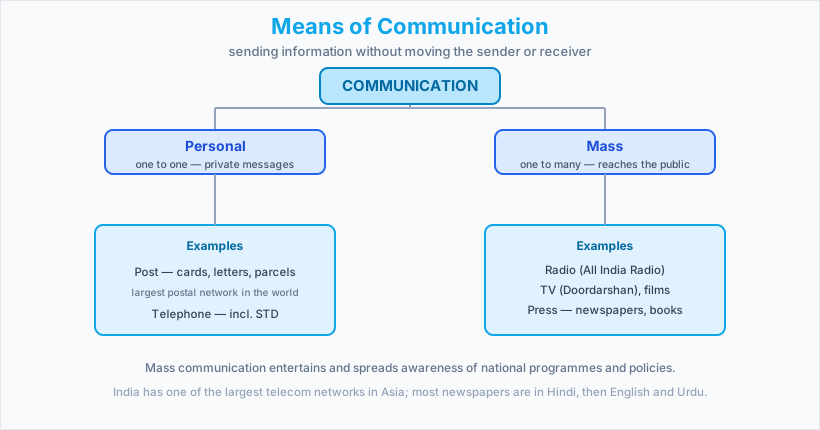
Personal communication is one-to-one — chiefly the post and the telephone. The Indian postal network is the largest in the world: cards and envelopes count as first-class mail (airlifted between stations); book packets, registered newspapers and periodicals are second-class mail (carried by surface — land and water). Six special mail channels speed up delivery in big towns: Rajdhani, Metro, Green, Business, Bulk Mail and Periodical channels. India also has one of the largest telecom networks in Asia; the government has worked to extend 24-hour STD facilities to every village, with a uniform STD rate across India, made possible by linking space technology with communication technology.
Mass communication reaches many people at once — it provides entertainment and spreads awareness of national programmes and policies. It includes:
- Radio — All India Radio (Akashvani) broadcasts in national, regional and local languages.
- Television — Doordarshan, one of the largest terrestrial networks in the world, from entertainment to education to sport.
- Press — India publishes newspapers in about 100 languages and dialects; the most are in Hindi, followed by English and Urdu.
- Films — India is the largest producer of feature films in the world; the Central Board of Film Certification certifies Indian and foreign films.
International Trade and Tourism
Trade is the exchange of goods among people, states and countries; the market is where exchange happens. Trade between two countries is international trade (by sea, air or land). Local trade happens within cities, towns and villages; state-level trade between states. The advancement of a country’s international trade is an index of its economic prosperity — it’s called the economic barometer of a country. Because resources are space-bound, no country can survive without international trade.
The two components of trade are export (selling out) and import (buying in). The balance of trade is the difference between them:
| Situation | What it means | Name |
|---|---|---|
| Value of exports > value of imports | the country earns more than it spends abroad | Favourable balance of trade |
| Value of imports > value of exports | the country spends more than it earns abroad | Unfavourable balance of trade |
India trades with all the major trading blocks and geographical regions of the world.
- Exports include gems and jewellery, chemicals and related products, and agriculture and allied products. India has also become a software giant, earning large foreign exchange through the export of information technology.
- Imports include petroleum crude and products, gems and jewellery, chemicals, base metals, electronic items, machinery, and agriculture and allied products.
Tourism as a trade. Tourism in India has grown remarkably over the past two decades. It is an important invisible trade — it earns foreign exchange, promotes national integration, supports local handicrafts and cultural pursuits, and builds international understanding of our culture and heritage. Schemes like Swadesh Darshan 2.0, the Vibrant Village Programme, PRASHAD (Pilgrimage Rejuvenation and Spiritual Heritage Augmentation Drive) and Paryatan Mitra boost it. Foreign tourists come for heritage, eco, adventure, cultural, medical and business tourism.
Common Mistakes
Railways are the cheapest means of transport in India.
Railways carry huge loads over long distances and feel efficient, so 'big and busy' gets confused with 'cheapest'.
WATERWAYS are the cheapest means of transport — they're fuel-efficient and best for heavy, bulky goods. Railways are the MOST IMPORTANT mode, but not the cheapest.
A favourable balance of trade is when a country imports more than it exports.
The word 'favourable' makes people think of buying lots of nice things from abroad, so importing more sounds like a good thing.
A FAVOURABLE balance of trade is when EXPORTS exceed IMPORTS — the country earns more from abroad than it spends. When imports exceed exports, the balance is UNFAVOURABLE.
The Golden Quadrilateral and the National Highways are the same thing.
Both are big, fast, central highways with similar-sounding names, so they blur together.
They are different classes. The GOLDEN QUADRILATERAL is a specific NHAI project of six-lane super highways joining Delhi–Kolkata–Chennai–Mumbai (plus the North–South and East–West corridors). NATIONAL HIGHWAYS are the broader primary road system linking the extreme parts of the country.
The East–West corridor connects Mumbai and Kolkata.
Mumbai and Kolkata are India's famous east and west port cities, so they sound like the natural ends of an 'East–West' corridor.
The EAST–WEST corridor connects SILCHAR (Assam) and PORBANDAR (Gujarat). The North–South corridor connects Srinagar and Kanniyakumari. (Mumbai and Kolkata are corners of the Golden Quadrilateral, not the corridor.)
Quick Check
Which two extreme locations are connected by the East–West corridor?
Which mode of transport reduces trans-shipment losses and delays?
Which is the deepest landlocked and well-protected port along the east coast?
Which is the most important mode of transportation in India?
Practice Problems
Easy
State any three merits of roadways.
Any three of the following:
- Construction cost of roads is much lower than that of railway lines.
- Roads can cross more dissected and undulating land, and negotiate higher slopes — even mountains like the Himalayas.
- Road transport is economical for carrying a few people or small loads over short distances.
- Roads provide door-to-door service, so loading and unloading costs are low.
- Roads act as a feeder to other modes, linking railway stations, ports and airports.
What is meant by trade? How is international trade different from local trade?
Trade is the exchange of goods among people, states and countries; the place where this exchange takes place is the market.
Local trade is carried on within cities, towns and villages (and state-level trade between states), all inside one country. International trade is trade between two countries, carried on through sea, air or land routes. The advancement of international trade is considered an index of a country’s economic prosperity — its economic barometer.
Medium
What is the significance of border roads?
Border roads are built and maintained by the Border Roads Organisation (BRO), a Government of India undertaking set up in 1960 for roads of strategic importance in the northern and north-eastern border areas.
Their significance:
- They improve accessibility in areas of difficult terrain (high mountains, remote borders) that earlier had no good roads.
- They are of strategic importance for the movement of the armed forces and supplies along sensitive borders.
- They have helped the economic development of these otherwise isolated regions (for example, the BRO built the Atal Tunnel connecting Manali to the Lahaul–Spiti valley all year round).
Where and why is rail transport the most convenient means of transportation?
Rail transport is most convenient in the northern plains of India.
Why: the northern plains have vast level land (easy and cheap to lay track), high population density (plenty of passengers) and rich agricultural resources (plenty of goods to carry). These conditions made the plains the most favourable region for the growth of railways. (The one obstacle was the many rivers, which needed bridges.) In contrast, hilly, sandy, swampy or thickly forested regions are far harder for laying track.
Challenge
Why are the means of transportation and communication called the lifelines of a nation and its economy? Explain in about 120 words.
Goods and services are produced in one place but needed in another, and they cannot move on their own. Transport carries goods and people from supply locations to demand locations over land, water and air, so a country’s pace of development depends on efficient transport just as much as on production. Communication carries information — orders, prices, news, ideas — quickly and without anyone moving, which is what makes trade and business possible across distances. Trade, local to international, exchanges these goods and adds vitality to the economy and amenities to daily life.
These three are complementary: transport needs communication to be organised, and trade needs both. Just as blood vessels keep a body alive by carrying what every part needs, this dense network keeps the economy alive — which is why they are called its lifelines.
Write a note on the changing nature of India's international trade in recent years.
India’s international trade has changed in both composition and scale.
- Composition of exports: India exports gems and jewellery, chemicals and related products, and agriculture and allied products. A major change is that India has become a software giant, earning large foreign exchange through the export of information technology — a sector that barely featured earlier.
- Composition of imports: India imports petroleum crude and products, gems and jewellery, chemicals, base metals, electronic items, machinery, and agriculture and allied products.
- Wider reach: India now has trade relations with all major trading blocks and all geographical regions of the world.
- Tourism as trade: invisible trade like tourism has grown remarkably, earning foreign exchange and supporting handicrafts and culture.
So the trend is towards a larger, more diversified trade with a rising share of services and technology, alongside traditional goods.
Summary
- Goods and services are made in one place but needed in another, so a country develops only when it can both produce and move things. Transport, communication and trade are complementary — together they are the lifelines of the economy.
- Roadways: India has the world’s second largest road network. Six classes — Golden Quadrilateral super highways, National Highways, State Highways, District roads, Other (rural) roads, and Border roads (BRO, 1960). Roads are also metalled (all-weather) or unmetalled; road density is road length per 100 sq km.
- Railways: the principal and most important mode; 17 zones; first train Mumbai–Thane (1853, 34 km); runs on Broad, Metre and Narrow gauges. Easiest in the northern plains; hard in hills, deserts and swamps.
- Pipelines: carry crude oil, petroleum products, gas and slurry; high initial cost but low running cost and no trans-shipment loss. Three networks, including the HVJ gas pipeline.
- Waterways: the cheapest, eco-friendly mode for bulky goods. Inland National Waterways (NW 1–5 and more); ocean trade through 12 major ports carrying 95% of trade by volume.
- Airways: the fastest and costliest mode; vital for difficult terrain like the north-east. Schemes: Pawanhans helicopters and UDAN.
- Communication: personal (post — world’s largest network; telephone/STD) and mass (radio/All India Radio, TV/Doordarshan, press, films — India is the world’s largest feature-film producer).
- International trade: exports minus imports gives the balance of trade — favourable if exports exceed imports, unfavourable if imports exceed exports. Tourism is an important invisible trade.
What’s Next
This is the final chapter of your geography course — so take a moment to see the whole picture you’ve built. You began with the resources and development that a country has, then studied specific resources — forests and wildlife, water, agriculture, minerals and energy, and manufacturing industries. Each chapter answered “what does India have, and how do we use it well?”
This chapter completes the loop. All those resources and products are useless if they sit where they’re made. The lifelines — transport, communication and trade — are what carry them to the people who need them, at home and across the world, turning raw potential into a living economy. Resources → their use → moving goods and ideas → trade: that is the geography of a nation’s economy in one breath.
You now have the full story of how India works as a land and as an economy. Carry one habit forward: every time you see a truck on a highway, a ship at a port, or a phone in someone’s hand, you’ll know it’s a lifeline at work. Well done — you’ve reached the end of the journey.