The Human Eye and the Colourful World
Why This Matters
In the last chapter you learned how a convex lens bends light to make an image. Now meet the most amazing lens you will ever use. It is the one inside your own eye.
Look at a book in your hands. Now look at a hill far away. Your eye changed its focus in less than a second. You did not press any button. No camera can do this so easily.
This same chapter also explains many beautiful things you see in the sky. Why is the sky blue? Why does the sunset look orange and red? Why does a rainbow appear after rain? Why do stars twinkle but planets do not? And why can we see the Sun a couple of minutes before it actually rises? You will understand all of these here.
This chapter is also the reason spectacles exist. Some eyes cannot focus far-away things. Some cannot focus near things. Once you understand why this happens, picking the right lens to fix it is just the lens rules you already know.
The Big Idea
The eye is a convex lens that adjusts itself. It focuses light onto a screen called the retina. When the eye cannot focus properly, a corrective lens (a spectacle lens) fixes it. A concave lens is used for myopia (when you cannot see far things). A convex lens is used for hypermetropia (when you cannot see near things). And the colours of the sky come from light meeting the air around the Earth. Three things happen: dispersion (splitting light into colours), refraction (bending light) and scattering (spreading light in all directions).
There are two main ideas in this chapter. The first idea is about the eye and its problems. This is just lens-and-image thinking. If the image forms on the retina, you see clearly. If it forms in front of or behind the retina, there is a problem to fix. The second idea is about colours in the sky. Every colourful thing you see in the sky is light being bent or spread by air and water drops. It is the same physics of light from before, just happening on a huge scale across the whole sky.
Let’s Break It Down
How the eye sees
Light coming into the eye passes through many parts before it makes an image. Let us look at each part one by one. But first, since the eye works by bending light, let us quickly refresh the lens ideas from the last chapter that everything here builds on.
Figure 10.1 below is a labelled picture of the eye. Follow the light as it enters from the front and travels to the screen at the back, and notice where each part sits.
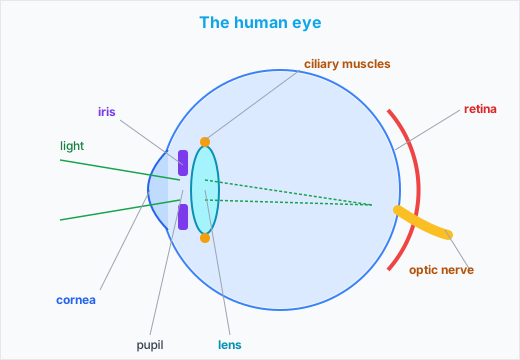
- Cornea — the clear front part of the eye that bulges out a little. Most of the bending of light happens here.
- Iris — the coloured ring you see in someone’s eye (brown, black, and so on). It is a small muscle that controls the size of the pupil.
- Pupil — the black hole in the middle that lets light in. It becomes bigger in dim light to let in more light. It becomes smaller in bright light to let in less light.
- Crystalline lens — a soft, bendy convex lens. It adjusts the focus finely so the image is sharp.
- Retina — a screen at the back of the eye that can sense light. It is full of tiny cells that change light into electrical signals.
- Optic nerve — carries these electrical signals to the brain.
The image that forms on the retina is real and inverted. “Inverted” means it is upside down. So the image inside your eye is actually upside down. Your brain then turns it the right way up for you, so the world looks normal.
Power of accommodation
The eye has a special power called accommodation. Accommodation means the eye can change the focal length of its lens. Because of this, things that are near and things that are far can both look sharp.
To see why changing the focal length matters, recall what focal length and a real image actually mean.
For example, you can read a book and then look out of the window, and both stay in focus. The eye does this by making its lens thicker or thinner.
- When you look at something far away: small muscles called ciliary muscles relax. The lens becomes thin. Its focal length increases.
- When you look at something near: the ciliary muscles tighten (contract). The lens becomes thick. Its focal length decreases.
Why does changing the shape fix the focus? A far object sends in rays that are almost parallel, so they need only a gentle bend — a thin, flat lens is enough. A near object sends in rays that are spreading apart, so they need a much stronger bend to be pulled back together in the same short distance — that is why the lens must become fat and round. A fatter lens bends light more strongly, so the image still lands exactly on the retina. Figure 10.2 below shows the same eye doing both jobs.

But the lens cannot keep getting thicker and thicker. There is a limit. The closest point where the eye can still focus comfortably is called the near point. For a normal young eye, the near point is about 25 cm. (Another name for it is the least distance of distinct vision.) Try it yourself: bring your book closer and closer until the words go blurry. That blurry point is near your near point.
The farthest point the eye can see clearly is called the far point. For a normal eye, the far point is infinity, which just means “very, very far away”. So a normal eye can see clearly from 25 cm all the way out to far-away things.
So what happens if you push past that 25 cm limit? Test the idea on a very close object.
Why can't you read this text clearly if you hold it just 5 cm from your eyes?
To see something that close, the eye lens would have to become thicker than it possibly can. The lens has a limit, so its focal length cannot go below a certain value. 5 cm is much closer than the near point (about 25 cm). So the eye cannot bring the image onto the retina. The words look blurry and your eyes feel tired.
Defects of vision and their correction
Sometimes accommodation does not work properly. Then the image does not form on the retina. It forms in the wrong place, so things look blurry. This is called a defect of vision. There are three common defects. Here they are side by side first — what goes wrong, where the image lands, and which lens fixes it — and then we explain each one.
| Defect | Problem | Image forms | Corrected with |
|---|---|---|---|
| Myopia (near-sighted) | Can't see distant objects | In front of the retina | Concave lens |
| Hypermetropia (far-sighted) | Can't see near objects | Behind the retina | Convex lens |
| Presbyopia (ageing) | Can't see near; weak accommodation | Behind the retina (near objects) | Convex / bi-focal lens |
- Myopia (near-sightedness) means you cannot see far-away things clearly, but near things look fine. This happens when the eyeball is too long, or the lens is too curved. So light from a far object comes to a focus before it reaches the retina. The image forms too early. To fix this, we use a concave (diverging) lens. This lens spreads the rays out a little first. Then they focus a bit later, right on the retina.
Figure 10.3 below shows this clearly: the faulty focus on top, and the same eye fixed by a concave lens below.

- Hypermetropia (far-sightedness) means you cannot see near things clearly, but far things look fine. This happens when the eyeball is too short, or the lens is too weak. So light from a near object would come to a focus behind the retina. The image forms too late. To fix this, we use a convex (converging) lens. This lens adds extra bending power. It pulls the focus forward, right onto the retina.
See it in Figure 10.4 below — the same idea as before, but now the focus is pulled forward instead of pushed back.

- Presbyopia happens as a person grows old. The ciliary muscles become weak and the lens becomes stiff. So accommodation becomes poor and the near point moves further away. This is why many older people hold a newspaper far from their eyes to read it. Some people have both myopia and presbyopia at the same time. They use bi-focal lenses. A bi-focal lens has two parts in one glass: a concave part on top for seeing far, and a convex part at the bottom for reading.
These two names trip up almost everyone, so let us clear up the most common mix-up before moving on.
Myopia means you can only see things far away (you are 'far-sighted').
The word 'myopia' is new and hard to remember. And 'near-sighted' is easy to read wrongly as 'can see things that are near', so students mix up the meaning.
The name tells you what works well, not what is wrong. Myopia = near-sighted: near vision is fine, but far objects look blurry. It is fixed with a concave lens. Hypermetropia = far-sighted: far vision is fine, but near objects look blurry. It is fixed with a convex lens.
Now let us put numbers to it and actually work out the lens power a myopic person needs.
A myopic person's far point is 80 cm. They cannot see anything clearly beyond 80 cm. What lens power will correct their vision?
- First, think about what the lens must do. The person can only focus up to 80 cm. So the lens has to take light from a far object and make it seem to come from 80 cm, where the eye can focus. In other words, the lens must form a virtual image of the far object at 80 cm.
- Now put in the values. The far object is at infinity, so u = −∞. The image is at the far point, on the same side as the object, so v = −80 cm = −0.80 m.
- Use the lens formula: 1/f = 1/v − 1/u = 1/(−0.80) − 1/(−∞) = −1.25 − 0 = −1.25. So f = −0.80 m.
- Find the power. Power P = 1/f = 1/(−0.80) = −1.25 D.
- So we need a concave lens of power −1.25 D. The minus sign tells us the lens is diverging (concave), which is exactly the right kind of lens for myopia.
Refraction and dispersion through a prism
Think about a glass slab. Light bends when it enters and bends back when it leaves. So the ray that comes out is parallel to the ray that went in. A prism is different. A prism is a piece of glass with two faces that are tilted towards each other (it looks like a triangle from the side). Because the faces are tilted, the ray bends the same way at both surfaces. So the ray comes out turned to one side. The angle by which it has turned is called the angle of deviation.
Here is the interesting part. The amount of bending is not the same for every colour. When white light enters a prism, each colour bends by a slightly different amount. Violet bends the most. Red bends the least. Because of this, the white light spreads out into a band of seven colours. The order is VIBGYOR: Violet, Indigo, Blue, Green, Yellow, Orange, Red. This splitting of white light into its colours is called dispersion. The band of colours you get is called a spectrum. (You have already seen this: when sunlight passes through the edge of a glass or a water drop, you see small rainbow colours. That is dispersion.)
Figure 10.5 below shows white light fanning out into all seven colours as it passes through a prism.
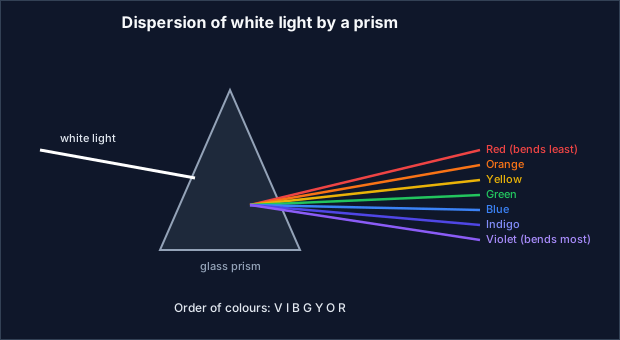
But why does violet bend more than red? It comes straight from the rule you met in Chapter 9: light bends because it changes speed. In empty space all colours travel at the same speed. But inside glass, the colours do not travel at the same speed. Violet is slowed down the most, and red is slowed down the least. And the rule from before says a bigger change of speed means a bigger bend. So violet, being slowed most, turns the most; red, being slowed least, turns the least. Each colour leaves the prism at its own angle, and the white light fans out. Figure 10.6 below draws out that idea.

A scientist named Newton proved that white light is really a mixture of these colours. First he split white light into colours using one prism. Then he placed a second prism the other way round. This second prism joined the colours back together and gave white light again. This showed that the colours were inside the white light all along.
A rainbow is nature’s own prism show. After rain, the air is full of tiny water drops. Each water drop does three things to sunlight: it bends (refracts) the light, then reflects it inside the drop, then bends it again as it comes out. Along the way the light splits into colours. This is why a rainbow always appears in the part of the sky opposite to the Sun. So to see a rainbow, the Sun should be behind you.
Atmospheric refraction
The air around the Earth is not the same everywhere. It has layers. Some layers are denser (thicker) and some are thinner. Each layer bends light by a different amount. As light passes through these layers, it keeps bending a little. This bending of light by the air is called atmospheric refraction. It causes a few interesting effects.
- Twinkling of stars. Starlight passes through the moving air on its way to us. The air keeps changing, so the light keeps bending in slightly different ways. A star is so far away that it looks like a single tiny point of light. So these small changes make its light look like it is flickering: brighter, then fainter, then brighter again. This is twinkling. Planets do not twinkle. A planet is much closer to us, so it looks like a tiny disc, not a point. A disc is like many points together. Some points get brighter while others get fainter, and the changes cancel out. So a planet shines with a steady light.
- Advanced sunrise and delayed sunset. “Advanced” means earlier than expected. Refraction bends the Sun’s light over the horizon. Because of this, we can see the Sun about 2 minutes before it actually rises in the morning. In the same way, we keep seeing it for about 2 minutes after it has actually set in the evening.
The star-versus-planet difference is a favourite exam question, so make sure you can explain it in your own words.
Why does a star twinkle but a planet shine steadily?
A star is so far away that it looks like a single point of light. The bending of light by the moving air keeps changing how bright that point looks and where it seems to be. So the star twinkles. A planet is much closer, so it looks like a tiny disc, which is like many points joined together. The flickers of all those points cancel each other out, so the planet shines with a steady light.
Scattering — why the sky is blue and sunsets are red
When light hits very tiny particles, like the molecules of air, it gets scattered. Scattering means the light is thrown off in all directions, not just straight ahead. How much a colour scatters depends on the colour. Blue light scatters much more than red light. (This is because blue light has a shorter wavelength than red light.) So the air spreads blue light around the most.
But why does a shorter wavelength scatter more? Think about how tiny an air molecule is. Light travels as waves. Blue light has short, tightly packed waves. Red light has long, stretched-out waves. A particle as tiny as an air molecule is just the right size to grab a short blue wave and fling it off sideways in all directions. But a long red wave is far too big for such a tiny particle to catch hold of, so it mostly slides past and keeps going straight. That is why the air throws blue light all over the place but lets most red light pass through. Figure 10.7 below shows the difference.

- Blue sky: As sunlight passes through the air, the air scatters its blue part all over the sky. So blue light comes to your eyes from every direction, and the whole sky looks blue. If there were no air, there would be no scattering, so the sky would look black. This is exactly why astronauts in space see a dark sky even during the day.
- Red sunrise and sunset: When the Sun is near the horizon, its light has to travel through much more air to reach you. Along this long path, almost all the blue light gets scattered away. So mostly red and orange light is left to reach your eyes. That is why the sky looks red and orange at sunrise and sunset.
- Danger and stop signals are red because red light scatters the least. So it can travel the farthest through fog and smoke without being lost. This makes red easy to see even from far away.
Figure 10.8 below puts both cases together: the blue midday sky on one side and the red sunset on the other, with the path length making all the difference.

One popular explanation for the blue sky sounds reasonable but is actually wrong — let us deal with it.
The sky is blue because it reflects the blue colour of the sea.
The sea and the sky are both blue, and they seem to meet at the horizon. So it looks like the sky is just copying the colour of the sea.
It is not a reflection. The sky is blue even over a dry desert, far away from any sea. The real reason is scattering. Air molecules scatter the blue part of sunlight in all directions much more than red. So blue light reaches your eyes from every part of the sky.
Common Mistakes
Two ideas in this chapter catch students out again and again — which lens fixes which defect, and which colour scatters the most. Get these two right and you have the chapter.
A convex lens is used to correct myopia because convex lenses are 'stronger'.
Convex lenses are the ones used in magnifying glasses, so they feel 'stronger'. And a stronger lens seems like it should fix weak eyesight.
What matters is the direction in which the lens bends light, not how strong it is. In myopia, light focuses too early, in front of the retina. So we need a concave lens, which spreads the light out and pushes the focus back onto the retina. In hypermetropia, light would focus too late, behind the retina. So we need a convex lens, which pulls the focus forward onto the retina.
Red light scatters the most, which is why sunsets are red.
You actually see red at sunset. So it feels natural to think that red is the colour being scattered towards you.
It is the opposite. Blue scatters the most (that is why the sky is blue), and red scatters the least. Sunsets look red because the light travels a long way through the air, and almost all the blue gets scattered away. Only the red, which scatters the least, is left to reach your eyes. This is also why red is used for danger and stop lights.
Quick Check
In which part of the eye is the image of an object formed?
The lens of the eye focuses light to form a real, upside-down image on the retina. The retina is the light-sensing screen at the back of the eye. It then sends signals to the brain.
A student sitting in the last row cannot read the blackboard clearly. What is the likely defect and its correction?
Not being able to see far-away things, like the blackboard from the last row, is myopia (near-sightedness). It is corrected with a concave (diverging) lens.
Why does the sky appear dark to an astronaut instead of blue?
The sky looks blue because air molecules scatter sunlight. Very high up, in space, there is almost no air to scatter the light. So the sky looks dark there.
Practice Problems
A person needs a lens of power −5.5 D for distant vision and +1.5 D for near vision. Find the focal length of each lens.
We know that P = 1/f. So focal length f = 1/P, with f in metres.
Distant vision: f = 1/(−5.5) = −0.18 m = −18.2 cm. This is a concave lens, used for myopia (seeing far).
Near vision: f = 1/(+1.5) = +0.67 m = +66.7 cm. This is a convex lens, used for the reading part (hypermetropia or presbyopia).
So this person needs two different lenses: one concave (diverging) and one convex (converging). That is exactly why such a person uses bi-focal spectacles, which have both lenses in one glass.
The far point of a myopic person is 80 cm in front of the eye. Find the nature and power of the lens needed to correct it.
To correct myopia, the lens must take a far object (at infinity) and form its image at the person’s far point. Then the eye can focus on it.
Signs: The object is at infinity, so u = −∞. The image is at the far point, on the same side, so v = −80 cm = −0.80 m.
Lens formula: 1/f = 1/v − 1/u = 1/(−0.80) − 1/(−∞) = −1.25 − 0 = −1.25 m⁻¹. So f = −0.80 m.
Power: P = 1/f = −1.25 D.
The minus sign tells us it is a concave (diverging) lens of power −1.25 D. This is the correct lens for myopia.
The near point of a hypermetropic eye is 1 m. What is the power of the lens needed so the person can read at the normal near point of 25 cm?
This person cannot focus on anything closer than 1 m, but they want to read at 25 cm. So the lens must take an object at 25 cm and form a virtual image at the person’s near point, 1 m, where their eye can focus.
Signs: The object is at the normal reading distance, so u = −25 cm = −0.25 m. The image is at the person’s near point, on the same side, so v = −1 m = −1.0 m.
Lens formula: 1/f = 1/v − 1/u = 1/(−1.0) − 1/(−0.25) = −1 + 4 = +3 m⁻¹. So f = +1/3 m ≈ +0.33 m.
Power: P = 1/f = +3.0 D.
So we need a convex (converging) lens of power +3.0 D. This is the correct lens for hypermetropia. The plus sign confirms it is a converging lens, which gives the extra focusing power that the weak eye is missing.
Summary
- The eye focuses light using the cornea and a bendy lens. It forms a real, upside-down image on the retina. The optic nerve carries the signal to the brain.
- Accommodation is the eye’s power to change its focal length. For a normal eye, the near point is about 25 cm and the far point is infinity (very far away).
- Myopia (image forms before the retina) is fixed with a concave lens. Hypermetropia (image forms behind the retina) is fixed with a convex lens. Presbyopia (caused by old age) is fixed with a convex or bi-focal lens.
- A prism bends light and disperses white light into the spectrum VIBGYOR. Violet bends the most and red the least. A rainbow is dispersion plus reflection inside raindrops.
- Atmospheric refraction (bending of light by the air) causes the twinkling of stars (planets do not twinkle) and early sunrise and late sunset.
- Scattering of light makes the sky blue (blue scatters the most) and the sunset red (blue is scattered away, so red is left). With no air, the sky is dark.
What’s Next
You have now finished all the topics about light: how light bends, how it focuses, how it splits into colours, and how it scatters. The next chapters move to something completely different. It is a force that quietly powers almost everything around you: electricity. In Chapter 11: Electricity, you will learn what electric current really is, how voltage pushes it along, and how resistance slows it down. You will also learn Ohm’s law. This simple rule lets you find the current, the voltage, and the heat and power in any circuit, from a small torch bulb to the wiring in your home.
Frequently Asked Questions
Why do stars twinkle but planets do not?
Stars are so far away that they look like tiny points of light. The moving air layers in our atmosphere keep bending that tiny point slightly in different directions, making it flicker — we call this twinkling. Planets are much closer, so they appear as small discs rather than points. Light from many parts of the disc averages out the bending, so the overall brightness stays steady.
What is the difference between myopia and hypermetropia and how are they corrected?
In myopia (short-sightedness) the eyeball is too long, so the image of a far object forms in front of the retina instead of on it — the person sees nearby things clearly but distant things look blurry. A concave (diverging) lens spreads the rays a little before they enter the eye, pushing the image back onto the retina. In hypermetropia (long-sightedness) the eyeball is too short and the image of a near object would form behind the retina — a convex (converging) lens is used to converge the rays slightly before they enter the eye.
Why does white light split into colours when it passes through a glass prism?
White light is actually a mixture of seven colours — violet, indigo, blue, green, yellow, orange, and red. When light enters the glass prism it slows down and bends (refracts). Each colour bends by a slightly different amount: violet bends the most and red bends the least. This spreading out of colours is called dispersion, and the band of colours you see is called the spectrum.
Why is the sky blue and why does the sunset look red or orange?
Sunlight contains all colours. As it passes through the atmosphere, air molecules scatter shorter wavelengths (blue and violet) much more strongly than longer wavelengths (red and orange). Blue light gets scattered all over the sky, so the sky looks blue to us. At sunset the sunlight has to travel through a much longer path of air to reach our eyes, so almost all the blue has already been scattered away, and only the longer red and orange wavelengths are left — that is why sunsets look red and orange.
What is the power of accommodation of the eye and what is the near point?
The eye's lens can change its thickness (and therefore its focal length) using the ciliary muscles — this ability to focus at different distances is called the power of accommodation. The near point is the closest distance at which a normal eye can see clearly without strain, which is about 25 cm for a healthy young adult. Objects closer than the near point cannot be focused even when the lens is at its most curved.
How does a rainbow form after rain?
After rain, millions of tiny water droplets stay suspended in the air. When sunlight enters a droplet it slows down and refracts, then reflects off the back inner surface of the droplet, and refracts again as it exits. Because different colours refract by different amounts (dispersion), the droplet separates white sunlight into a band of colours. Millions of droplets at slightly different angles together produce the full arc of the rainbow in the sky.