Metals and Non-metals
Why This Matters
Look around you right now. Metals are doing quiet work everywhere. There is steel in the building. There is copper in the electric wires. There is aluminium in the cooking pan. There is gold in a wedding ring. There is bronze in a temple bell.
We picked each metal for a reason. Copper carries electric current well. Aluminium spreads heat well. Gold stays shiny and never goes dull. Steel is strong and can hold heavy weight.
But here is a puzzle. A gold ornament made 2,000 years ago still shines today. An iron gate left out in the monsoon rain gets covered in flaky brown rust in just a few months. Why the difference?
Here is another puzzle. Sodium is so eager to react that we keep it under kerosene oil. If we leave it out in the air, it can catch fire. But platinum just sits in the ground as shiny lumps and nothing happens to it. Why are some metals so eager to react, while others stay so calm? And why are there only a few non-metals, and why do they behave in almost the opposite way?
This chapter answers all of this using one simple idea: the reactivity series. The reactivity series is just a list of metals, arranged in order of how eager they are to react. This one list will explain so much — why iron rusts, how we get metals out of rock, and why your stainless-steel spoon does not dissolve in curd.
The Big Idea
Metals and non-metals are opposites in one important way. They behave differently with electrons.
First, a quick word. An ion is an atom that has lost or gained one or more electrons, so it now carries an electric charge. For example, when a sodium atom loses one electron, it becomes a sodium ion written as Na⁺ (it has a positive charge).
Metals lose electrons to form positive ions (called cations). Non-metals gain electrons to form negative ions (called anions). How easily a metal gives up its electrons is called its reactivity.
To follow why an atom loses or gains electrons, let us quickly refresh where those electrons sit inside an atom.
But why does an atom bother to lose or gain electrons at all? The answer is one neat rule about full outer shells.
Why do atoms do this? Atoms are most stable when their outermost shell is full, like the noble gases (helium, neon, argon). A sodium atom has the electron arrangement (2, 8, 1). It has just one electron in its outer shell. The easiest way for it to get a full outer shell is to lose that one electron. So it becomes Na⁺. A chlorine atom has the arrangement (2, 8, 7). It needs just one more electron to fill its outer shell. So it gains one and becomes Cl⁻.
So when a metal meets a non-metal, the metal hands its electron to the non-metal. Now one ion is positive and the other is negative. Opposite charges attract, so the two ions stick together. This is how they form an ionic compound, like common salt (NaCl).
Now, if we arrange all the metals in order of how easily they lose electrons, we get the reactivity series. This single list quietly explains almost the whole chapter. It tells us which metals burn or fizz, which metal can push out which other metal from a solution, how we take each metal out of its rock, and which metals get spoiled by rust. Learn this list well, and the rest becomes easy.
Let’s Break It Down
Physical properties: how to spot a metal
Most metals share a common set of physical properties:
- Lustre — they have a shiny surface when freshly cut or polished. (“Lustre” just means shine.)
- Malleable — they can be hammered into thin sheets without breaking. Gold and silver are the most malleable.
- Ductile — they can be pulled out into thin wires. Gold is the most ductile. You can pull 1 gram of gold into a wire 2 km long!
- Good conductors of heat and electricity. This means heat and electric current pass through them easily. Silver and copper are the best of all.
- Sonorous — they make a ringing sound when you strike them. This is why bells are made of metal.
- They are hard, have high melting points (you need a lot of heat to melt them), and are solid at room temperature.
Non-metals are mostly the opposite. They are dull (not shiny), brittle (they break instead of bending), poor conductors, and they can be solids, liquids or gases.
But why do metals share this odd combination — carrying current and bending into sheets and wires without snapping? One single picture of what a metal looks like inside explains all of it at once.
Inside a metal, the atoms do not keep all their outer electrons. Each metal atom lets its loose outer electrons go free. So the metal becomes a neat grid of positive metal ions sitting in a shared pool of free electrons — a “sea” of electrons that can drift anywhere through the whole piece. Figure 3.1 below shows this, and shows what happens when you hammer the metal.

This one picture explains every property at once:
- Good conductor of electricity: to carry current you just need charges that can move. The free electrons are already loose, so when you connect a battery they all drift the same way and current flows easily.
- Good conductor of heat: heat is just jiggling. The fast-moving free electrons bump along the jiggle from the hot end to the cold end very quickly.
- Malleable and ductile: when you hammer or pull a metal, the layers of ions slide over each other. But the electron sea is everywhere, so it keeps gluing the ions together even after they have moved. The metal changes shape instead of cracking. (A non-metal has no such sea — its atoms are locked by fixed bonds, so pushing them just snaps the bonds and it shatters. That is why non-metals are brittle.)
- Lustre: the free electrons sit right at the surface and bounce light straight back, so the metal shines.
But nature has many exceptions. So do not judge a substance by its physical properties alone:
- Mercury is a metal, but it is a liquid at room temperature.
- Sodium and potassium are metals, but they are so soft that you can cut them with a knife. Gallium and caesium are so soft they melt in the heat of your palm.
- Iodine is a non-metal, but it is shiny (lustrous).
- Carbon can exist in different forms (these forms are called allotropes). One form is diamond, the hardest natural substance on Earth. Another form is graphite (the “lead” in your pencil). Graphite is a non-metal, but it conducts electricity.
Here is the full side-by-side, so you can compare metals and non-metals property by property at a glance.
| Property | Metals | Non-metals |
|---|---|---|
| Lustre | Shiny | Usually dull (except iodine) |
| Malleable / ductile | Yes | No — brittle |
| Conduct heat & electricity | Good | Poor (except graphite) |
| Sound when struck | Sonorous | Not sonorous |
| State at room temp | Solid (except mercury) | Solid, liquid or gas |
Quick test of those exceptions and “best/worst” metals — see if you can name each one.
Name a metal that is liquid at room temperature, one you can cut with a knife, the best conductor of heat, and a poor conductor of heat.
- Liquid metal: mercury.
- Cut with a knife: sodium (or potassium).
- Best conductor of heat: silver.
- Poor conductor of heat: lead (or mercury).
Chemical properties of metals
Physical properties have too many exceptions. So we sort metals in a more reliable way: by how they react with other things.
With oxygen → metal oxides (mostly basic)
Almost every metal joins with oxygen to form a metal oxide:
Metal + Oxygen → Metal oxide
2Cu + O₂ → 2CuO (black)
4Al + 3O₂ → 2Al₂O₃
Most metal oxides are basic. (Remember from Chapter 2: a base reacts with an acid to give salt and water.) But a few metal oxides, like Al₂O₃ and ZnO, react with both acids and bases. We call these amphoteric oxides (“amphoteric” means it can act in two ways). For example, aluminium oxide reacts with both:
Al₂O₃ + 6HCl → 2AlCl₃ + 3H₂O
Al₂O₃ + 2NaOH → 2NaAlO₂ + H₂O (sodium aluminate)
A few oxides, like Na₂O and K₂O, even dissolve in water to give a strong base called an alkali (Na₂O + H₂O → 2NaOH).
Metals differ a lot in how strongly they react with oxygen:
- Sodium and potassium react so violently that they catch fire in air. This is why we store them under kerosene oil.
- Magnesium, aluminium and zinc form a thin protective oxide layer on their surface. This layer is like a shield. It stops the metal underneath from reacting further. This is why aluminium pans do not get spoiled easily. In fact, a process called anodising is used to make this protective layer thicker on purpose.
- Copper does not burn, but it slowly gets a black coat of copper oxide.
- Silver and gold do not react with oxygen at all, even when heated.
With water → hydroxide/oxide + hydrogen (only some metals)
Only some metals react with water, and they need different “strengths” of water:
2Na + 2H₂O → 2NaOH + H₂ + heat (so violent that the H₂ catches fire)
Ca + 2H₂O → Ca(OH)₂ + H₂ (calcium floats — H₂ bubbles cling to it)
- Potassium and sodium react violently with cold water. Calcium reacts with cold water too, but a little less violently.
- Magnesium reacts only with hot water, not cold water.
- Aluminium, zinc and iron react only with steam (very hot water vapour). For example: 3Fe + 4H₂O → Fe₃O₄ + 4H₂.
- Lead, copper, silver and gold do not react with water at all.
So you can see a pattern: the more reactive the metal, the milder the water it needs to react with.
With dilute acids → salt + hydrogen
When a metal reacts with a dilute acid, it gives a salt and hydrogen gas:
Metal + dilute acid → Salt + Hydrogen
Mg + 2HCl → MgCl₂ + H₂
The reaction is fastest for the most reactive metal. The order of speed is Mg > Al > Zn > Fe. Copper does not react with dilute HCl at all, because copper is not reactive enough.
One acid is different: dilute nitric acid (HNO₃). Nitric acid is an oxidising agent. (An oxidising agent grabs the hydrogen.) So instead of giving hydrogen gas, it usually gives nitrogen oxide gases.
With salt solutions → displacement
A more reactive metal can push out a less reactive metal from its salt solution. This pushing out is called a displacement reaction:
Metal A + salt of B → salt of A + Metal B
Fe + CuSO₄ → FeSO₄ + Cu (iron is more reactive than copper, so iron pushes copper out)
You can actually watch this happen with a single iron nail and some blue solution. Figure 3.2 below shows the nail before and after.

But why should one metal be able to “push out” another at all? It comes straight back to electrons. Remember, a metal reacts by losing electrons, and being “more reactive” simply means letting go of electrons more easily. In a salt solution the less reactive metal is already sitting there as a positive ion (it has given its electrons away). Now drop in a metal that gives up electrons even more eagerly. It hands its electrons over to that waiting ion. So the eager metal turns into an ion and dissolves, while the old ion grabs the electrons, turns back into solid metal, and drops out. Figure 3.3 below traces those electrons for iron and copper.

These displacement experiments are the cleanest way to arrange metals in order of reactivity. If metal A pushes out metal B, then A is more reactive than B.
The reactivity series — the master list
When we put all these experiments together, the metals line up in one order, from most reactive at the top to least reactive at the bottom:
K > Na > Ca > Mg > Al > Zn > Fe > Pb > (H) > Cu > Hg > Ag > Au
(Here the ”>” sign means “more reactive than”. So potassium (K) is the most reactive, and gold (Au) is the least reactive. Hydrogen (H) is not a metal, but we put it in the list as a marker, as you will see below.)
Figure 3.4 below stacks the series top to bottom and also colour-codes how each band of metals is pulled out of its ore — worth a good look.
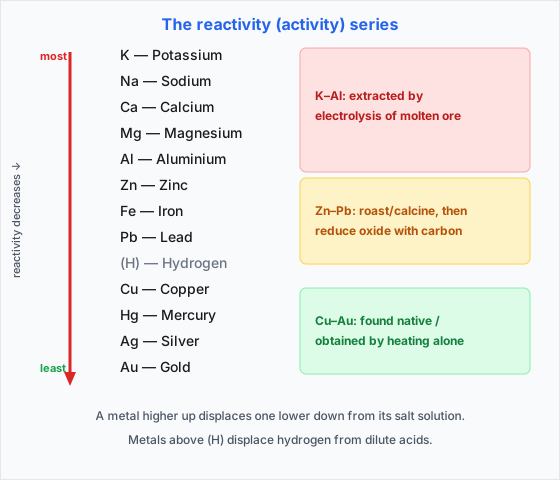
A metal’s place in this list tells you how it will behave. Any metal above hydrogen can push hydrogen out of a dilute acid (so it gives H₂ gas). And any metal can push out the metals that sit below it from their salt solutions.
Let us use exactly that idea to crack a classic exam puzzle: ranking unknown metals from their displacement results.
Four metals A, B, C, D give these results: A displaces Cu but not Fe; B displaces Fe (and Cu); C displaces only Ag; D displaces nothing. Rank them and predict what B does in copper sulphate.
-
D does not push out any metal. So D is the least reactive. It sits below even copper and silver.
-
C pushes out only silver. Silver is the least reactive of the metals named. So C is just above silver, but it is below copper.
-
A pushes out copper but not iron. So A is more reactive than copper, but less reactive than iron. A sits below iron and above copper.
-
B pushes out iron (and also copper). So B is more reactive than iron. B is above iron, which makes it the most reactive metal here.
-
So the order from most to least reactive is B > A > C > D. B is more reactive than copper. So if we add B to copper sulphate solution, B pushes copper out — the blue colour fades and solid copper settles down.
How metals and non-metals actually bond: ionic compounds
Why do metals form positive ions? Because they get a full, stable outer shell by losing electrons. Non-metals get a full outer shell by gaining electrons. So when sodium meets chlorine, the sodium simply hands its electron over to the chlorine:
Na → Na⁺ + e⁻ | Cl + e⁻ → Cl⁻ ⟹ Na⁺ and Cl⁻ attract each other → NaCl
(Here “e⁻” stands for one electron. Sodium gives away one electron and becomes Na⁺. Chlorine takes that electron and becomes Cl⁻.)
Figure 3.5 below shows that electron handover, so you can see exactly which electron moves.
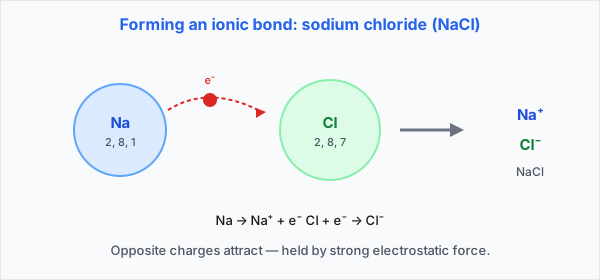
Compounds that form by this transfer of electrons from a metal to a non-metal are called ionic compounds (another name for them is electrovalent compounds). These compounds share a clear set of properties:
| Property | What it looks like | Why |
|---|---|---|
| Physical state | Hard, brittle solids | Strong attraction between + and − ions |
| Melting/boiling points | High | Lots of energy needed to break ionic bonds |
| Solubility | Soluble in water; not in petrol/kerosene | Water pulls the ions apart |
| Conducting electricity | Conduct when molten or dissolved, not as solid | Ions can move only when free |
The last row in that table trips up a lot of students, so let us check it right away.
Why do ionic compounds conduct electricity when molten or dissolved, but not in the solid state?
Ionic compounds always contain ions. But to carry current, the ions need to be able to move. In the solid, strong forces hold the ions in a fixed pattern (a lattice), so they cannot move. Melting the compound, or dissolving it in water, breaks those forces. Now the ions are free to move, so they carry the current.
Where metals come from, and how we extract them (metallurgy)
Metals are found in the earth’s crust mixed inside rocks. These natural compounds of metals in rocks are called minerals. When a mineral has enough metal in it to take out and make a profit, we call it an ore. So an ore is simply a rock that is worth mining for its metal.
An ore also comes mixed with sand, soil and other useless rock. This unwanted stuff is called gangue. So the first step is always to remove the gangue and make the ore cleaner. This step is called enrichment.
After that, how we get the pure metal out depends entirely on its reactivity:
-
Low reactivity metals (Cu, Ag, Au, Hg): These are so unreactive that they are often found as the pure metal itself in nature (this is called “native”). Or, we just heat their ore to get the metal out. For example, mercury comes from an ore called cinnabar: first 2HgS + 3O₂ → 2HgO + 2SO₂, and then on more heating 2HgO → 2Hg + O₂.
-
Medium reactivity metals (Zn, Fe, Pb, Cu): Here we work in two steps. First we turn the ore into a metal oxide. If the ore is a sulphide, we heat it strongly in plenty of air — this is called roasting. If the ore is a carbonate, we heat it with little air — this is called calcination. Once we have the oxide, we remove the oxygen from it by heating it with carbon. (Taking oxygen away is called reduction.)
ZnO + C → Zn + CO
A very reactive metal can also do this job of removing oxygen. In the thermit reaction, aluminium pulls the oxygen away from iron oxide: Fe₂O₃ + 2Al → 2Fe + Al₂O₃ + heat. This reaction gives out so much heat that the iron comes out melted (molten). This hot, molten iron is used to weld (join) broken railway tracks.
-
High reactivity metals (K, Na, Ca, Mg, Al): These metals hold on to oxygen so tightly that even carbon cannot pull it away. So we use electrolysis instead. Electrolysis means passing electricity through the molten (melted) ore to split it into its parts. For example, when we pass electricity through molten common salt (NaCl), sodium metal collects at one electrode (the cathode) and chlorine gas at the other (the anode).
The metal we get this way is still not fully pure. We call it crude metal. We usually clean it by electrolytic refining. In this method, we use a slab of the impure metal as one electrode (the anode) and a thin sheet of pure metal as the other electrode (the cathode), dipped in a salt solution. When electricity is passed, pure metal slowly builds up on the cathode, while the impurities drop to the bottom as a sludge called anode mud.
Figure 3.6 below is a flowchart that ties the whole story together — from raw ore all the way to a refined metal, with the reactivity-based fork in the middle.

If you remember just one table from this section, make it this one — it maps each reactivity band to its extraction method.
| Reactivity | Metals | How it's extracted |
|---|---|---|
| High | K, Na, Ca, Mg, Al | Electrolysis of molten ore |
| Medium | Zn, Fe, Pb, Cu | Roast/calcine to oxide, then reduce with carbon |
| Low | Cu, Hg, Ag, Au | Found native / reduced by heating alone |
Corrosion and alloys
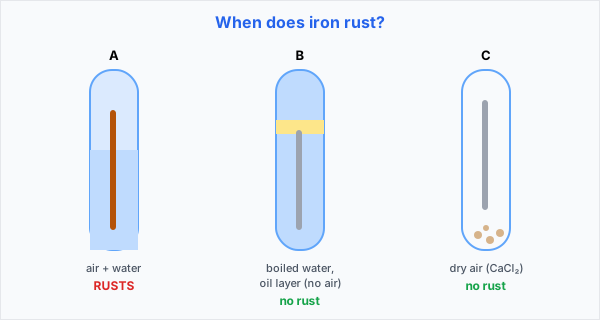
When a metal is slowly eaten away by the air and moisture around it, we call this corrosion. Different metals corrode in different ways. Iron rusts — it gets a reddish-brown coat in moist air (air that has water in it). Silver slowly turns black. Copper slowly grows a green coat. A famous experiment shows that iron needs both air and water together to rust. With only one of them, it does not rust, as Figure 3.7 below sets out:
We can protect metals from rusting in several ways. We can paint them. We can oil or grease them. We can use galvanising, which means coating the iron with a layer of zinc. Galvanising is clever: even if the zinc coat gets scratched and the iron shows through, the iron still does not rust. This is because zinc is more reactive than iron, so the zinc corrodes first and protects the iron. We can also chrome-plate the metal, or mix it into an alloy.
An alloy is a mixture of a metal with one or more other metals, or with a non-metal, made on purpose to improve its properties. (“Homogeneous” means it is mixed evenly all through.) Here are common examples:
- Steel = iron + a little carbon. This makes it hard and strong. Stainless steel = iron + nickel + chromium. This one does not rust.
- Brass = copper + zinc. Bronze = copper + tin. Solder = lead + tin. Solder melts at a low temperature, so it is used to join electrical wires.
- An alloy that contains mercury is called an amalgam.
One useful point: an alloy usually conducts electricity less well than the pure metal, and it melts at a lower temperature than the pure metal.
But here is the question that puzzles most students: if you mix two soft metals, why does the result come out harder than either one? Pure iron is actually quite soft, yet steel (iron plus a little carbon) is famously hard. The reason links right back to the sliding layers we saw earlier. In a pure metal all the atoms are the same size, so they sit in tidy rows and the layers slide over each other easily — that is what makes a pure metal soft and easy to bend. When you mix in atoms of a different size, those odd-sized atoms wedge into the rows and jam them. Now the layers can no longer slide past each other smoothly. Figure 3.8 below shows the neat rows of a pure metal next to the jammed rows of an alloy.

Common Mistakes
These are the slip-ups that cost the most marks in this chapter. Read each one and make sure you are on the “right” side.
Metals gain electrons in reactions, because every atom wants more electrons.
We hear that atoms 'want a full outer shell', and grabbing more electrons feels like the way to get there.
Metals have only a few electrons in their outer shell, so it is easier for them to LOSE those electrons and form positive ions (Na → Na⁺). It is the NON-metals that gain electrons to form negative ions (Cl → Cl⁻). So the metal is the one that gives electrons away.
All metals react with water and acids to give hydrogen.
We learn the rule 'metal + acid → salt + hydrogen', so it feels like it must be true for every metal.
Only metals ABOVE hydrogen in the reactivity series do this. Copper, silver and gold are below hydrogen, so they cannot push hydrogen out of dilute acids. Also, many metals do not react with cold water at all.
Highly reactive metals like sodium and aluminium are extracted by reducing their oxides with carbon, like iron.
Reducing the oxide with carbon is the most famous method, so it feels like it should work for every metal.
Metals high in the series (K, Na, Ca, Mg, Al) hold on to oxygen too tightly. Carbon cannot pull the oxygen away from them. So they are taken out by ELECTROLYSIS of the molten ore instead. Carbon reduction works only for the medium metals (like Zn and Fe).
Ionic compounds conduct electricity in the solid state.
They are made of charged ions, so it seems like they should conduct electricity at any time.
To carry current, the ions must be free to MOVE. In a solid, the ions are locked tightly in a fixed pattern (a lattice), so they cannot move and it does not conduct. Only when the compound is melted or dissolved in water can the ions move freely and carry current.
Nitric acid + metal gives hydrogen gas, like other acids.
Every other dilute acid gives H₂ with a metal, so it feels like nitric acid should too.
Dilute nitric acid (HNO₃) is a strong oxidising agent. This means it grabs any hydrogen that forms and turns it into water, while it itself becomes a nitrogen oxide gas. So metals with nitric acid usually do NOT give hydrogen gas. (There are a couple of exceptions, like very dilute HNO₃ with magnesium or manganese.)
Quick Check
Which pair will give a displacement reaction?
A displacement reaction happens only when the metal we add is more reactive than the metal in the salt. Copper is above silver in the series, so copper pushes silver out of silver nitrate (AgNO₃). In the other options, the added metal is less reactive (copper is below sodium; aluminium is below magnesium; silver is below iron), so nothing happens.
Food cans are coated with tin and not zinc because:
Zinc is more reactive than tin. If we coated the can with zinc, the zinc could react with the acidic food and spoil it. So we use tin, which is less reactive and safe, on the inside of food cans.
What are amphoteric oxides?
Amphoteric oxides can act in two ways. They react with acids, and they also react with bases, to form salt and water. Aluminium oxide (Al₂O₃) and zinc oxide (ZnO) are the two classic examples.
Practice Problems
Try each before tapping “Show Solution.” These are written by Curriv and are completely free.
Easy
Name two metals that displace hydrogen from dilute acids, and two that do not.
Displace hydrogen (above H in the series): magnesium, zinc (also Al, Fe).
Do not (below H): copper, silver (also gold).
Why is sodium stored immersed in kerosene oil?
Sodium is extremely reactive. It reacts strongly with the oxygen and the moisture (water) in the air, and it can even catch fire. Keeping it under kerosene oil cuts off the air and water from it. So the reaction cannot happen, and this prevents accidental fires.
Medium
Write the balanced equation for iron reacting with dilute sulphuric acid, and name the gas produced and how to test it.
Metal + dilute acid → salt + hydrogen:
Fe + H₂SO₄ → FeSO₄ + H₂ ✓
The gas is hydrogen. To test it, bring a burning matchstick or splint near the gas. The hydrogen burns with a ‘pop’ sound.
Galvanising coats iron with zinc. Why does it protect the iron even if the zinc layer gets scratched?
Because zinc is more reactive than iron. Suppose the zinc layer gets a scratch and the iron underneath is exposed. Even then, the zinc reacts first, before the iron, because it gives up its electrons more easily. So the zinc keeps getting used up and protecting the iron. (This is called sacrificial protection — the zinc sacrifices itself to save the iron.) The iron starts to rust only after all the zinc is finished.
Challenge
A fake goldsmith dipped a lady's gold bangles in a solution; they sparkled but lost weight. What was the solution, and why?
The solution was aqua regia. This is a mixture of concentrated hydrochloric acid and nitric acid, taken in a 3:1 ratio. It is one of the very few liquids that can dissolve gold. When the bangles were dipped in it, a thin outer layer of gold dissolved. This made the bangles look clean and sparkling. But real gold metal had been removed, so the bangles lost weight. The dissolved gold stayed behind in the goldsmith’s solution, which he could collect later.
Why is copper used for hot-water tanks but not steel (an alloy of iron)?
Because iron (and steel) reacts with hot water and steam. It forms iron oxide and hydrogen. So over time the tank would corrode and become weak. Copper does not react with cold or hot water (it is below hydrogen in the reactivity series), so it stays safe and strong. Copper is also a good conductor of heat, which is just what you want in a hot-water tank.
Summary
You should now be able to explain each of these in your own words:
- Metals are shiny (lustrous), malleable, ductile, sonorous and good conductors, and they are solid (except mercury). Non-metals are mostly the opposite. But there are exceptions: graphite conducts electricity, and iodine is shiny.
- Metals lose electrons to form positive ions. Non-metals gain electrons to form negative ions. The best way to sort metals is by how they react chemically.
- Metals react to different degrees with oxygen (giving oxides, mostly basic; some are amphoteric, like Al₂O₃ and ZnO), with water and dilute acids (giving salt and H₂), and with salt solutions (giving displacement).
- The reactivity series (K > Na > … > Cu > Hg > Ag > Au) tells us which metal displaces which, which metals can free hydrogen from acids, and how each metal is taken out of its ore.
- A metal and a non-metal join by transfer of electrons to form ionic (electrovalent) compounds. These are hard, have high melting points, dissolve in water, and conduct electricity only when melted or dissolved.
- Metallurgy is the journey from ore to pure metal: ore → remove gangue (enrichment) → take out the metal based on its reactivity (electrolysis for the most reactive metals; roasting or calcination plus carbon reduction for the medium ones; simple heating for the least reactive) → refining (usually electrolytic).
- Corrosion wears metals away. (Iron rusts only when both air and water are present.) We fight it by painting, oiling, galvanising and alloying. An alloy (steel, stainless steel, brass, bronze, solder, amalgam) is made to improve a metal’s properties.
What’s Next
You have now met the two big families of elements, metals and non-metals, and seen the ionic bonds they make together. But one non-metal breaks all these rules: carbon. Carbon does not give away or grab electrons. Instead, it shares them. This one simple trick lets carbon build millions of different compounds, from the gas in a stove to the proteins in your body. In Chapter 4: Carbon and its Compounds, you will learn about this sharing of electrons (called covalent bonding) and the amazing chemistry that makes carbon the element of life.
Frequently Asked Questions
Why is sodium kept under kerosene oil and not just left in a jar?
Sodium is extremely reactive — it reacts vigorously (sometimes violently) with both oxygen in the air and with moisture. Kerosene oil does not react with sodium and keeps both air and water away from its surface. Leaving sodium exposed to air or water can cause it to catch fire or even explode.
What is the reactivity series and how do you use it to predict reactions?
The reactivity series is a list of metals arranged from most reactive (potassium, sodium) at the top to least reactive (gold, platinum) at the bottom. A metal higher in the series can displace a metal lower in the series from its salt solution. For example, zinc can displace copper from copper sulphate solution, but copper cannot displace zinc.
Why does iron rust but gold never rusts even after thousands of years?
Iron is fairly high in the reactivity series, so it readily reacts with oxygen and moisture in the air to form iron oxide (rust, Fe₂O₃). Gold is at the very bottom of the reactivity series — it is so unreactive that it simply does not combine with oxygen or moisture under normal conditions. This is why gold ornaments from ancient times still look shiny.
How are metals extracted from their ores and what is meant by refining?
Metals low in reactivity (like copper, gold) occur as free elements or are reduced simply by heating. Metals in the middle (like zinc, iron) are extracted by reducing their oxides with carbon (coke) in a high-temperature furnace. Metals high in reactivity (like sodium, aluminium) must be extracted by electrolysis. Refining is the final step that removes remaining impurities — the impure metal is used as an anode in an electrolytic cell and pure metal deposits on the cathode.
What is an alloy and why are alloys often more useful than pure metals?
An alloy is a mixture of a metal with one or more other metals or non-metals. Pure metals are often too soft, too reactive, or too corrosive for practical use. Mixing them changes their properties: for example, iron mixed with carbon and other metals gives steel, which is much harder and stronger than pure iron. Brass (copper + zinc) is harder than copper and does not corrode as quickly. Alloys also allow properties to be tuned for specific jobs.