Acids, Bases and Salts
Why This Matters
Think about a few things you have felt at home. You eat one samosa too many and your stomach starts burning. People call this “acidity.” You mix a spoon of baking soda in water, drink it, and the burning eases. You bite a lemon and your face scrunches up because it is so sour. You touch a piece of soap and it feels slippery, and if you taste a tiny bit by mistake, it is bitter. A drop of curry falls on your white shirt. The moment soap touches it, the stain turns reddish-brown. After a good rinse, it goes back to yellow.
All of these are the same simple story. Two opposite kinds of substances are fighting each other. We call them acids and bases. An acid is a substance that tastes sour, like lemon juice or vinegar. A base is a substance that tastes bitter and feels slippery, like soap. Acids cause the sourness and the sting. Bases cause the bitter taste and the slippery feel. Baking soda calms your acidity because a base can cancel out an acid.
This chapter gives you the rules of that fight. You will learn how to tell acids and bases apart. You will see how they react with metals and with each other. You will find the one simple idea that makes an acid acidic. You will meet the pH number, which tells you how strong an acid or base is. And you will learn about the everyday salts that come from these reactions, like table salt, baking soda, washing soda and Plaster of Paris. This is the chemistry of your kitchen, your stomach and your toothpaste.
The Big Idea
The whole chapter sits on one simple pair of ideas. An ion is just an atom or group of atoms that has a tiny electric charge, either plus or minus. Here are the two ions to remember:
But first, if the words “atom”, “molecule” and “ion” feel a bit blurry, here is a quick refresher on how they differ.
When you dissolve an acid in water, it gives out hydrogen ions, H⁺. (We write H⁺(aq) to show it is in water. In water it is really carried as H₃O⁺, but think of it as H⁺ for now.) When you dissolve a base in water, it gives out hydroxide ions, OH⁻. When an H⁺ ion meets an OH⁻ ion, they join and make water. So an acid and a base cancel each other. We say they neutralise each other.
Notice how that idea keeps saying “dissolve in water”. If you have ever wondered what actually happens when something dissolves — and what that little “(aq)” means — here is the quick version.
That is the whole secret. The sour taste, the litmus colour change, the fizzing with metals, the relief you feel after an antacid — every one of these comes back to H⁺ and OH⁻ ions. Two big results follow from this, and they run through the rest of the chapter:
- An acid means H⁺ and a base means OH⁻. So when you mix them, the same thing always happens at heart: H⁺ + OH⁻ → H₂O. The other leftover ions pair up to form a salt. So acid + base → salt + water. We call this a neutralisation.
- The whole thing depends on how much H⁺ (or OH⁻) is floating in the water. So we can give it a number. That number is the pH scale, which runs from 0 to 14.
Keep this one line in your pocket: “acid = H⁺, base = OH⁻”. Everything else in this chapter is just the details.
Let’s Break It Down
Telling acids and bases apart: indicators
You must never taste or touch a lab chemical to find out what it is. It could be dangerous. So instead we use indicators. An indicator is a substance that shows you whether something is an acid or a base by changing its colour (or sometimes its smell). For example, litmus paper turns one colour in an acid and another colour in a base, so it acts like a signal.
- Litmus is a natural purple dye that comes from a plant-like thing called lichen. In an acid, blue litmus turns red. In a base, red litmus turns blue.
- Phenolphthalein is colourless in an acid, and turns pink in a base.
- Methyl orange is red in an acid, and turns yellow in a base.
- Olfactory indicators are substances whose smell changes. (“Olfactory” just means “to do with smell.”) Onion and vanilla are examples. They have a strong smell in an acid, but the smell goes away in a base. These are handy for students who cannot see the colour change.
- Some natural things also work as indicators. Turmeric is one (this is the curry-stain trick — it turns reddish-brown when basic soap touches it). Red cabbage juice and the coloured petals of some flowers (Hydrangea, Petunia, Geranium) work too.
That is a lot of indicators to keep track of. Here they are side by side, so you can see at a glance what each one does in an acid and in a base.
| Indicator | In acid | In base |
|---|---|---|
| Blue litmus | Turns red | Stays blue |
| Red litmus | Stays red | Turns blue |
| Phenolphthalein | Colourless | Pink |
| Methyl orange | Red | Yellow |
| Turmeric | Stays yellow | Reddish-brown |
But a fair question is hiding here. How does litmus “know” it is sitting in an acid? It is not magic, and the paper is not testing anything. Here is the real reason, from the ground up.
An indicator like litmus is itself a special dye molecule. The trick is that this molecule can take two different shapes. And here is the key fact: the two shapes do not reflect the same colour of light. One shape bounces back red light, so it looks red. The other shape bounces back blue light, so it looks blue. (A molecule’s colour comes from which colours of light it reflects.)
So what flips the molecule from one shape to the other? The H⁺ and OH⁻ ions. In an acid there are lots of H⁺ ions floating around. These H⁺ ions stick onto the dye molecule and lock it into the “red” shape. In a base there are lots of OH⁻ ions instead. The OH⁻ ions pull those H⁺ ions back off the molecule, and now it springs into the “blue” shape. So the colour change is really just the molecule changing shape, and the H⁺ or OH⁻ ions are what decide the shape. Same dye, two shapes, two colours.
Figure 2.1 below shows the same dye molecule in its two shapes — and what the ions are doing to flip it.

Now put that to work. Here is a classic puzzle: can you sort three unknown liquids using just one strip of red litmus? Think it through before you open the answer.
You have three test tubes — distilled water, an acid, and a base — and ONLY red litmus paper. How do you identify all three?
First, dip red litmus paper into each tube. In one tube, the paper turns blue. That tube is the base, because only a base turns red litmus blue. In the other two tubes, the red litmus stays red, so you cannot tell them apart yet. Now you have a strip that has turned blue. Use this blue strip: dip it into the two leftover tubes. In one of them it turns back to red. That tube is the acid, because an acid turns blue litmus red. The last tube does not change the colour at all, so it is the distilled water, which is neutral (neither acid nor base).
How acids and bases react
Acids with metals → salt + hydrogen
Drop a piece of zinc metal into dilute sulphuric acid. You will see bubbles streaming off the metal. A gas is being made. To find out which gas it is, catch the gas and bring a burning splint (a thin lit stick) near it. The gas burns with a sharp “pop” sound. This pop sound is the standard test for hydrogen gas.
Acid + Metal → Salt + Hydrogen gas
Zn(s) + H₂SO₄(aq) → ZnSO₄(aq) + H₂(g)
Figure 2.2 below shows what that looks like in the test tube — the bubbles, and the splint giving the tell-tale “pop”.
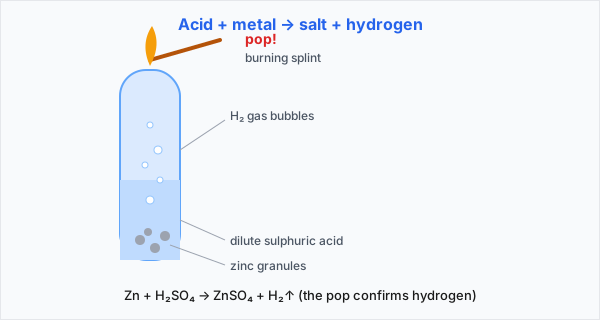
What is happening here? The metal pushes the hydrogen out of the acid and takes its place. We say the metal displaces the hydrogen from the acid. (You saw this kind of displacement reaction in Chapter 1.)
But “pushes out” is a bit vague. Why does the metal hand over its spot, and why does hydrogen come out as a gas? The honest answer is about electrons, and it is worth slowing down for.
A metal atom holds its outer electrons quite loosely. It is actually happy to give them away and become a positive metal ion. So when the metal touches the acid, the metal atom lets go of its electrons and turns into a metal ion (like Zn²⁺), which dissolves into the solution. Meanwhile, remember what the acid is full of: H⁺ ions. An H⁺ ion is just a hydrogen atom that is short of one electron — that is exactly why it carries a plus charge. So the H⁺ ions are desperate for an electron. They grab the electrons the metal just gave away. Once an H⁺ ion gets its electron back, it becomes a normal, neutral hydrogen atom (H). Two of these hydrogen atoms then pair up to make one H₂ molecule, and that is the gas you see bubbling off. So the “pop” gas is really H⁺ ions that have collected the metal’s spare electrons.
Figure 2.3 below lets you follow the electrons — from the metal, across to the waiting H⁺ ions, and out as H₂ gas.

Bases with metals → salt + hydrogen (only some metals)
A few metals can also push out hydrogen from a base, not just from an acid. For example, hot sodium hydroxide reacts with zinc:
2NaOH(aq) + Zn(s) → Na₂ZnO₂(s) + H₂(g) (sodium zincate)
Here the negative part of the salt (called zincate) is made of the metal zinc together with oxygen. This does not happen with every metal. Only a few special metals like zinc and aluminium behave this way.
Acids with metal carbonates / hydrogencarbonates → salt + CO₂ + water
A carbonate is a substance that contains the carbonate group (CO₃). Add dilute HCl to sodium carbonate (or to baking soda) and the mixture fizzes. The gas coming out is carbon dioxide (CO₂). How do we know it is carbon dioxide? We pass the gas through lime water (a clear liquid). The lime water turns milky, because a white solid called calcium carbonate forms in it. A solid that forms inside a liquid like this is called a precipitate. This milky change is the test for carbon dioxide.
Na₂CO₃(s) + 2HCl(aq) → 2NaCl(aq) + H₂O(l) + CO₂(g)
NaHCO₃(s) + HCl(aq) → NaCl(aq) + H₂O(l) + CO₂(g)
Ca(OH)₂(aq) + CO₂(g) → CaCO₃(s)↓ + H₂O(l) (lime water turns milky)
Metal carbonate / hydrogencarbonate + Acid → Salt + Carbon dioxide + Water
Acids with bases → salt + water (neutralisation)
Take some NaOH (a base) and add one drop of phenolphthalein. The solution turns pink, because phenolphthalein is pink in a base. Now add HCl (an acid) drop by drop. The pink colour slowly fades and disappears. This happens because the acid is cancelling the base, so the solution is no longer basic. If you now add NaOH again, the pink colour comes back. So the acid and the base really do cancel each other out:
NaOH(aq) + HCl(aq) → NaCl(aq) + H₂O(l)
Base + Acid → Salt + Water (a neutralisation reaction)
Figure 2.4 below shows the actual swap going on behind that equation — where the H⁺ and OH⁻ go, and where the salt comes from.

Metal oxides + acid, and non-metal oxides + base
An oxide is simply a compound of an element with oxygen. Take copper oxide, which is a black powder. Put it in dilute HCl and it dissolves, giving a blue-green solution of copper chloride:
CuO(s) + 2HCl(aq) → CuCl₂(aq) + H₂O(l)
Look at what happened. The metal oxide reacted with an acid and gave salt and water. That is exactly what a base does. So a metal oxide behaves like a base. We say metal oxides are basic. The opposite is also true. A non-metal oxide like CO₂ reacts with a base (lime water) and also gives salt and water. So a non-metal oxide behaves like an acid. We say non-metal oxides are acidic.
Exam questions love to hide a substance behind its clues and ask you to name it. Let’s crack one such “mystery compound” using the reactions you just learned.
A metal compound A reacts with dilute HCl to give fizzing; the gas puts out a burning candle, and one product is calcium chloride (CaCl₂). Identify A and write the balanced equation.
-
The gas puts out a burning candle and fizzes out of an acid. The only gas that does both is carbon dioxide. Carbon dioxide comes from a carbonate (or a hydrogencarbonate). So A must be a carbonate.
-
One of the products is CaCl₂, and “Ca” stands for calcium. So the metal in A is calcium. A carbonate that contains calcium is calcium carbonate, CaCO₃. So A = CaCO₃.
-
Now write the reaction: CaCO₃ + HCl → CaCl₂ + H₂O + CO₂.
-
Check the balancing. On the right there are 2 chlorine atoms (in CaCl₂), but on the left there is only 1 (in HCl). So put a 2 in front of HCl to make the chlorine equal. The balanced equation is CaCO₃(s) + 2HCl(aq) → CaCl₂(aq) + H₂O(l) + CO₂(g). ✓
What makes an acid an acid? (It’s the H⁺ ion)
Every acid behaves in the same way. For example, they all fizz and give off hydrogen when they meet a metal. When many different acids all act the same way, it tells us they must have one thing in common. That common thing is the hydrogen ion, H⁺.
Here is the proof. Pass electricity through dilute HCl with a bulb in the circuit, and the bulb glows. So the acid lets electricity pass through, that is, it conducts. Now try the same thing with a glucose solution or an alcohol solution. Both of these contain hydrogen too. But the bulb does not glow, and these solutions are not acidic. So just having hydrogen is not enough. An acid is acidic because it gives out its hydrogen as H⁺ ions, and these moving ions are what carry the electric current.
Here is the important part. H⁺ ions only appear when water is present. Dry HCl gas does not turn dry litmus red. Only HCl that is dissolved in water does. This is because water pulls the H⁺ off the HCl:
HCl + H₂O → H₃O⁺ + Cl⁻
An H⁺ ion cannot float around on its own in water. It grabs onto a water molecule and forms what we call the hydronium ion (H₃O⁺). So you will see it written as H⁺(aq) or as H₃O⁺ — both mean the same thing. In the same way, a base that dissolves in water gives out OH⁻ ions:
NaOH(s) →[water] Na⁺(aq) + OH⁻(aq)
A base that dissolves in water has a special name. It is called an alkali (for example NaOH and KOH). But be careful: not every base is an alkali. Many bases do not dissolve in water, so they are bases but not alkalis.
Figure 2.5 below sums up the whole “ions need water” idea — what an acid and a base each release once they hit water.

Quick test of that “no water, no acid” idea — try to explain this one in your own words first.
Why does dry HCl gas not turn dry blue litmus red, but HCl solution does?
A substance is acidic because of its H⁺ ions. But HCl only gives out H⁺ ions when water is present (HCl + H₂O → H₃O⁺ + Cl⁻). With dry gas and dry paper, there is no water around. So no H⁺ ions can form, and with no H⁺ ions there is no acidity and no colour change.
Since acids and water are clearly on your mind, here is a safety rule you must never get wrong when mixing the two.
⚠️ Always add acid to water, never water to acid. When you mix a strong acid (or base) with water, a lot of heat is given out. A reaction that gives out heat like this is called exothermic. If you add the acid slowly into water, the heat spreads out into the large amount of water and stays safe. But if you add water into the acid, the mixture can suddenly spit out, and the heat can even crack the glass.
Measuring strength: the pH scale
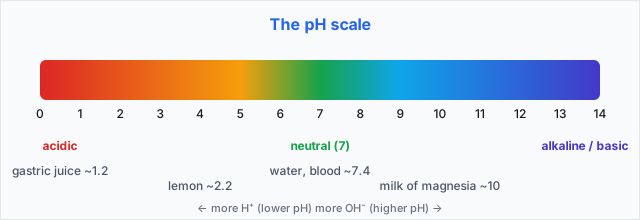
We can give “how acidic something is” an actual number. To do this we use a universal indicator. This is a mix of several dyes, and it shows a different colour depending on how much hydrogen ion (H⁺) is in the solution. Each colour matches a number on the pH scale, which runs from 0 to 14. So pH is just a number that tells you how acidic or how basic a solution is. Here is how to read it:
- pH 7 means neutral, that is, neither acidic nor basic. Pure water has pH 7.
- pH below 7 means the solution is acidic. The lower the pH, the more H⁺ ions there are, and the stronger the acid.
- pH above 7 means the solution is basic (also called alkaline). The higher the pH, the more OH⁻ ions there are.
Figure 2.6 below lays the whole scale out as a coloured strip, with everyday liquids marked on it — so you can see where lemon, water and milk of magnesia actually sit.
There is one more idea to get clear: strong acid vs weak acid. Suppose you take the same amount of two acids in the same amount of water. A strong acid like HCl gives out a lot of H⁺ ions. A weak acid like acetic acid (CH₃COOH, the acid in vinegar) gives out far fewer H⁺ ions, even at the same concentration. More H⁺ means a lower pH, and we call that a “stronger” acid. The same idea works for bases, but with OH⁻ ions instead of H⁺.
One more thing about that 0-to-14 scale is worth explaining, because it surprises most students. The steps are not equal. Going from pH 5 to pH 4 is a much bigger change than it looks.
Here is why. The pH number is really just a short way of counting how many H⁺ ions are crowded into the water. But the count grows very fast. Every time the pH drops by one number, the number of H⁺ ions goes up ten times. So a pH 4 solution has 10 times more H⁺ than pH 5, and 100 times more than pH 6, and a thousand times more than pH 7. We use this “step of ten” trick so that a gigantic range of H⁺ amounts fits onto one neat little scale from 0 to 14. If we tried to write the raw H⁺ counts, the numbers would be huge and clumsy. The pH number squeezes them down to something easy to read. (And the scale stops around 0 and 14 simply because that covers everything from the strongest common acid to the strongest common base — beyond that, ordinary water solutions just do not go.)
So when you see pH 4 next to pH 6, do not think “just 2 apart.” Think “100 times more H⁺.” Figure 2.7 below shows those jars filling up tenfold at every step.

Before moving on, here is everything about acids and bases lined up against each other in one quick-revision table.
| Property | Acids | Bases |
|---|---|---|
| Taste (never test by tasting!) | Sour | Bitter |
| Litmus | Blue → red | Red → blue |
| Ion in water | H⁺ (H₃O⁺) | OH⁻ |
| pH | Less than 7 | More than 7 |
| With metals | Give H₂ gas | Some give H₂ gas |
Why pH matters in everyday life
- Your body only works inside a narrow pH range (about 7.0 to 7.8). If the pH goes outside this, you fall sick. Acid rain is rain whose pH is below 5.6. When acid rain flows into a river, it lowers the river’s pH, and this harms the fish and other water life.
- Digestion: your stomach makes an acid (HCl) to help digest food. If it makes too much, you feel acidity. To fix this you take an antacid. An antacid is a mild base, like milk of magnesia, Mg(OH)₂. It neutralises the extra acid and the burning eases.
- Tooth decay: bacteria in your mouth turn leftover sugar into acid. If the pH in your mouth drops below 5.5, this acid starts to eat away the hard outer layer of your teeth (the enamel). Brushing with toothpaste, which is basic, cancels this acid and protects your teeth.
- Stings: when a bee stings you, it injects an acid into your skin, which is why it burns. Rubbing baking soda (a base) on it gives relief. A stinging nettle plant also injects an acid (methanoic acid).
- Soil: plants grow best when the soil pH is in a certain range. If the soil is too acidic, farmers add bases to it to fix it, such as quick lime (CaO), slaked lime (Ca(OH)₂) or chalk (CaCO₃).
Let’s check the one thing students mix up most about pH — that “bigger number” does not mean “more acidic”.
Solution A has pH 6 and solution B has pH 8. Which is correct?
pH 6 is below 7, so A is acidic. It is only weakly acidic because 6 is close to 7. pH 8 is above 7, so B is weakly basic. Remember, lower pH means more H⁺ ions. Since A has the lower pH, A has more H⁺ ions than B.
More about salts
So what exactly is a salt? Take an acid and replace its H⁺ with a metal ion (or an ammonium ion). What you get is a salt. In short, a salt is the substance left behind after neutralisation (along with water). Salts come in families that share a common ion. For example, NaCl, Na₂SO₄ and NaNO₃ all contain sodium, so they are in the sodium family. NaCl, KCl and CaCl₂ all contain chloride, so they are in the chloride family.
The pH of a salt is not always 7. It depends on which acid and which base the salt came from:
| Made from | Nature of salt | pH | Example |
|---|---|---|---|
| Strong acid + strong base | Neutral | 7 | NaCl |
| Strong acid + weak base | Acidic | Less than 7 | NH₄Cl |
| Weak acid + strong base | Basic | More than 7 | Na₂CO₃ |
Common salt — the parent of many chemicals
Common salt is sodium chloride (NaCl). We get it from seawater and from rock-salt buried in the ground. It is not just for eating. It is the starting material that we use to make a whole family of useful chemicals.
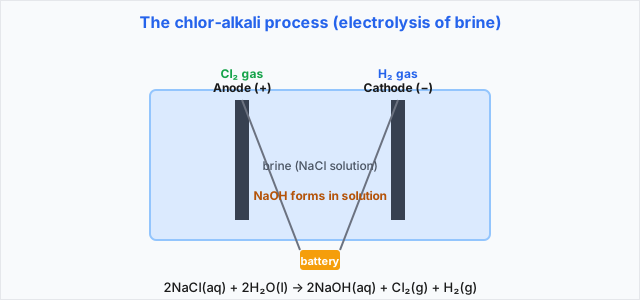
Chlor-alkali process — this means passing electricity through brine. Brine is just a solution of common salt (NaCl) in water:
2NaCl(aq) + 2H₂O(l) → 2NaOH(aq) + Cl₂(g) + H₂(g)
This one reaction gives three useful products. Cl₂ (chlorine) is used to clean water, to make PVC plastic and to make bleaching powder. H₂ (hydrogen) is used as a fuel and to make ammonia. NaOH (sodium hydroxide) is used to make soaps and paper.
Figure 2.8 below shows how one tank of salty water gives all three products at once — and which one comes off at each electrode.
Bleaching powder, CaOCl₂ — we make it by passing chlorine gas over dry slaked lime. It is used to bleach (whiten) cloth and paper, to clean things, and to kill germs in drinking water:
Ca(OH)₂ + Cl₂ → CaOCl₂ + H₂O
Baking soda, NaHCO₃ (also called sodium hydrogencarbonate) — this is a mild basic salt. It is gentle and does not burn the skin. When you heat it, it gives off CO₂ gas, and that is the gas that makes cakes rise:
2NaHCO₃ →[heat] Na₂CO₃ + H₂O + CO₂
Baking soda is used in baking powder (mixed with a mild edible acid), in antacids to fight stomach acidity, and in soda-acid fire extinguishers.
Washing soda, Na₂CO₃·10H₂O — we make it by first heating baking soda to get sodium carbonate, and then letting that crystallise with water. It is used in the glass, soap and paper industries. It is also used to remove the permanent hardness of water (hard water is water that does not lather well with soap).
Are “dry” salt crystals really dry? — Water of crystallisation
Take some blue copper sulphate crystals and heat them. They turn white, and you will see drops of water appear on the sides of the tube. Where did this water come from? It was hidden inside the crystals all along. Now add water to the white powder and the blue colour comes back. So those “dry” looking crystals were actually holding water. We call this hidden water the water of crystallisation. It is a fixed number of water molecules locked inside each formula unit of the crystal. For example, copper sulphate is written CuSO₄·5H₂O, where the 5 means 5 water molecules. This is also why washing soda is written Na₂CO₃·10H₂O (10 water molecules).
Plaster of Paris (PoP), CaSO₄·½H₂O — we make it by gently heating a mineral called gypsum (CaSO₄·2H₂O) to about 373 K. When you mix Plaster of Paris with water, it sets back into hard gypsum again. This is why doctors use it to hold a broken bone in place while it heals, and it is also used to make smooth surfaces and statues. Because it sets hard with water, it must always be kept dry:
CaSO₄·½H₂O + 1½H₂O → CaSO₄·2H₂O (PoP + water → gypsum, sets hard)
(The “½” in the formula looks strange. It simply means that two formula units of CaSO₄ share one water molecule between them.)
That “sets hard with water” habit explains a very common exam question — see if you can spot the right reason.
Why must Plaster of Paris be kept in a moisture-proof container?
Plaster of Paris (CaSO₄·½H₂O) reacts with water and turns into solid gypsum (CaSO₄·2H₂O). Even the small amount of moisture in the air is enough to slowly set it into a hard, useless lump. So it must be kept sealed and dry.
Common Mistakes
A higher pH number means more acidic / a stronger acid.
A bigger number feels like 'more of something', so people read pH 10 as more acidic than pH 4.
It is actually the opposite. A pH below 7 is acidic, and a LOWER pH means more H⁺ ions and a stronger acid. A pH above 7 is basic. So pH 4 is acidic, and pH 10 is basic, not acidic.
Any compound that contains hydrogen is an acid.
Acids contain hydrogen, but so do glucose (C₆H₁₂O₆) and alcohol. So it looks like they should be acids too.
It is not enough just to contain hydrogen. An acid must release that hydrogen as H⁺ ions in water. Glucose and alcohol have hydrogen but do not release H⁺ ions. That is why their solutions do not conduct electricity and are not acidic.
When diluting, you can add water to a concentrated acid.
Diluting just means 'mix with water', so it seems the order should not matter.
Always add ACID TO WATER, slowly, while stirring. This mixing gives out a lot of heat (it is exothermic). If you add water to the acid instead, the mixture can spit out dangerously and the heat can crack the container.
Strong acid and weak acid just mean concentrated and dilute.
The word 'strong' sounds like 'there is a lot of it'.
Strong and weak tell you how fully the acid releases its H⁺ ions, not how much acid there is. At the same concentration, HCl (strong) gives far more H⁺ than acetic acid (weak). Concentrated and dilute are a separate idea, about how much acid is mixed in the water.
All bases are alkalis.
People often use the two words to mean the same thing.
An alkali is a base that DISSOLVES in water (like NaOH and KOH). Many bases do not dissolve in water at all. So those are bases, but they are not alkalis.
Quick Check
An acid reacts with a metal. Which gas is released, and how do you test it?
When an acid reacts with a metal, you get salt and hydrogen gas. To test it, bring a burning splint near the gas. It burns with a clear pop sound. (Carbon dioxide is the gas you get from a carbonate instead, and it turns lime water milky.)
A solution turns red litmus blue. Its pH is most likely:
Only a base can turn red litmus blue. So the solution is basic, which means its pH must be above 7. Out of the four choices, only 10 is above 7.
Equal lengths of magnesium ribbon are added to HCl (tube A) and acetic acid (tube B), same concentration. Where does it fizz more vigorously?
At the same concentration, HCl (a strong acid) gives out more H⁺ ions than acetic acid (a weak acid). More H⁺ ions make the reaction go faster, so tube A fizzes more strongly.
Practice Problems
Try each one yourself before you tap “Show Solution.” These are written by Curriv and are completely free.
Easy
Write the balanced equation for dilute hydrochloric acid reacting with magnesium ribbon.
An acid reacting with a metal gives salt and hydrogen:
Mg + 2HCl → MgCl₂ + H₂ ✓
Check the count on both sides: Mg is 1 on each side, H is 2 on each side, and Cl is 2 on each side. So it is balanced. The bubbles you see are hydrogen gas.
Which medicine treats indigestion: antibiotic, analgesic, antacid or antiseptic? Why?
An antacid. Indigestion happens because there is too much acid (HCl) in the stomach. An antacid is a mild base (for example milk of magnesia). It neutralises (cancels) the extra acid, and that relieves the pain.
Medium
Five solutions A, B, C, D, E have pH 4, 1, 11, 7, 9. Which is neutral, strongly acidic, strongly alkaline, weakly acidic, weakly alkaline? Arrange in increasing order of H⁺ concentration.
- Neutral: D (pH 7)
- Strongly acidic: B (pH 1)
- Strongly alkaline: C (pH 11)
- Weakly acidic: A (pH 4)
- Weakly alkaline: E (pH 9)
The H⁺ concentration is highest when the pH is lowest. So when H⁺ goes up, pH goes down. To list them from least H⁺ to most H⁺, we list them from highest pH to lowest pH:
C (11) < E (9) < D (7) < A (4) < B (1)
Fresh milk has pH 6. (a) How does its pH change as it turns to curd? (b) A milkman adds a little baking soda to fresh milk — why, and why does the milk then take longer to set as curd?
(a) When milk turns into curd, it makes lactic acid. This acid adds more H⁺ ions to the milk. More H⁺ means lower pH, so the pH drops below 6 (the milk becomes more acidic).
(b) Baking soda is a mild base. When the milkman adds it, it pushes the milk from pH 6 up to slightly alkaline (above 7). But curd only forms when the milk turns acidic. Since the milk now starts off alkaline, it takes a longer time for enough acid to build up and pull it back down. So the curd sets slowly. (The baking soda also keeps the milk fresh for longer.)
Challenge
Why does distilled water not conduct electricity, while rain water does?
For electricity to pass through a liquid, the liquid needs ions (charged particles) to carry the current. Distilled water is very pure. It has almost no ions in it, so it cannot conduct electricity.
Rain water is different. As it falls, it dissolves gases from the air, especially CO₂ (and pollution gases like SO₂ and NO₂). These gases form small amounts of acids in the water (such as carbonic acid). The acids release H⁺ ions and other ions into the rain water. Now there are ions to carry the current, so rain water does conduct electricity.
What is a neutralisation reaction? Give two examples, and explain why heating baking soda makes it useful in cooking.
A neutralisation reaction is a reaction between an acid and a base that gives a salt and water. (The H⁺ from the acid joins the OH⁻ from the base to make water.) Two examples:
- NaOH + HCl → NaCl + H₂O
- Ca(OH)₂ + 2HCl → CaCl₂ + 2H₂O
Baking soda in cooking: when you heat baking soda, it breaks down and gives off carbon dioxide gas:
2NaHCO₃ →[heat] Na₂CO₃ + H₂O + CO₂
This carbon dioxide gets trapped inside the batter as tiny bubbles. The bubbles make the batter (bread, cake, pakoras) rise and turn soft and spongy.
Summary
You should now be able to explain each of these in your own words:
- Indicators (litmus, phenolphthalein, methyl orange, turmeric, olfactory) tell acids from bases by a colour or smell change.
- A solution is acidic because of H⁺(aq) ions, and basic because of OH⁻(aq) ions. These ions only form in water, which is why dry HCl gas is not acidic.
- Reaction patterns: acid + metal → salt + H₂; **carbonate/hydrogencarbonate
- acid → salt + CO₂ + water**; metal oxide + acid and non-metal oxide + base → salt + water; acid + base → salt + water (neutralisation).
- Metal oxides are basic, non-metal oxides are acidic. Acidic/basic solutions conduct electricity (they carry ions).
- The pH scale (0 to 14) measures how much H⁺ is present: 7 is neutral, below 7 is acidic, above 7 is basic. A lower pH means more H⁺ and a stronger acid. Remember, strong/weak is not the same as concentrated/dilute.
- pH rules everyday life: digestion & antacids, tooth decay (below 5.5), acid rain, soil treatment, stings.
- Salts come from neutralisation; their pH depends on the parent acid/base. Common salt yields NaOH, Cl₂, H₂ (chlor-alkali), bleaching powder, baking soda and washing soda.
- Water of crystallisation (e.g. CuSO₄·5H₂O); Plaster of Paris (CaSO₄·½H₂O) sets to gypsum and must be kept dry.
- Mixing concentrated acids/bases with water is strongly exothermic — add acid to water, never the reverse.
What’s Next
You have just seen that metals usually make basic oxides, while non-metals make acidic ones. This is a clue that metals and non-metals are really quite different from each other. In Chapter 3: Metals and Non-metals, you will study these two families closely. You will learn why metals shine, carry electricity and bend, while non-metals do not. You will see how we rank metals by how reactive they are, how we get metals out of their ores (the rocks they are found in), and why iron rusts but gold does not.
Frequently Asked Questions
What is the difference between a strong acid and a weak acid?
A strong acid (like hydrochloric acid, HCl, or sulphuric acid, H₂SO₄) breaks apart almost completely in water, releasing a very large number of H⁺ ions. A weak acid (like acetic acid in vinegar, or carbonic acid in soda) only partly breaks apart, so it releases fewer H⁺ ions. Stronger does not mean more concentrated — it means more completely ionised.
Why does a solution of baking soda relieve acidity in the stomach?
The stomach is acidic because it contains hydrochloric acid (HCl). Baking soda is sodium hydrogen carbonate (NaHCO₃), which is a base. When you drink baking soda solution, the base neutralises the excess acid in a neutralisation reaction, producing water and salt and releasing CO₂ gas — which is why you might burp.
What does the pH scale tell us and why does pH 7 mean neutral?
The pH scale runs from 0 to 14 and measures how acidic or basic a solution is. pH below 7 means acidic (more H⁺ ions), pH above 7 means basic (more OH⁻ ions), and pH exactly 7 means neutral — the H⁺ and OH⁻ concentrations are equal, as in pure water. Each step on the scale is a tenfold change, so pH 5 is ten times more acidic than pH 6.
How is common salt (NaCl) made and why is it important beyond cooking?
Common salt (sodium chloride, NaCl) is made by the neutralisation of sodium hydroxide (NaOH) with hydrochloric acid (HCl). Beyond cooking, it is the raw material for a huge family of industrial chemicals — chlorine gas, sodium hydroxide (caustic soda), baking soda, and washing soda are all manufactured from it.
What is water of crystallisation and why does plaster of paris set hard?
Water of crystallisation is water molecules that are chemically locked inside the crystal structure of a salt, not just surface moisture. Plaster of Paris (CaSO₄·½H₂O) has lost most of its water by heating gypsum. When you mix it with water, it reabsorbs the water molecules and recrystallises back into gypsum (CaSO₄·2H₂O), which is hard — that is why plaster sets.