Chemical Reactions and Equations
Why This Matters
Leave a glass of milk out on a summer afternoon. By evening, it turns sour. Leave an iron tawa in a damp corner of the kitchen. A week later, it has a reddish-brown coat on it. Eat a piece of bread. Within a few hours, your body turns it into the energy that lets you read this sentence.
All three of these are really the same thing happening. In each one, a substance quietly turned into a new substance. The milk changed into something different. The iron’s surface became something that is no longer iron. The bread became glucose, and then carbon dioxide, water and energy.
This “turning into something new” is what scientists call a chemical reaction.
Once you can spot reactions, name them, and write them down correctly, the rest of chemistry becomes much easier. This chapter teaches you how to do exactly that. You will learn how to see when a reaction has happened, how to write it as a balanced equation, and how to sort every reaction into a few simple groups. After this one chapter, chemistry will stop looking like magic and start looking like something you can read and understand.
The Big Idea
The whole chapter rests on a few words from Class 9 — atom, element, molecule and compound. Let us warm them up before we go further:
Here is the one big idea that the whole chapter is built on:
In a chemical reaction, atoms are never created and never destroyed. They are only rearranged into new groups.
Think of atoms like a fixed set of LEGO bricks. A reaction takes apart some shapes and builds new ones. But you always end with the exact same bricks you started with. Not one brick more, not one brick less.
This idea has a name. It is the Law of Conservation of Mass, which you met in Class 9. It says that mass cannot be created or destroyed in a chemical reaction. (“Conservation” just means nothing is lost.)
But why is this true? Why can a reaction never make an atom appear out of nowhere, or make one vanish? Figure 1.1 answers that by following the very same atoms through a reaction, so you can count them before and after:

Here is the reason, step by step. An atom is a real, solid object — the tiniest building block of matter. A chemical reaction does just one thing: it breaks the joins (bonds) between atoms and makes new joins. That is all. It cannot crush an atom into nothing, and it cannot build a fresh atom from nothing. (Making or destroying an atom would need a nuclear reaction, which is a completely different thing — not ordinary chemistry.)
So think of it like rearranging the same handful of LEGO bricks into a new model. You take the model apart and build something else, but you still hold every brick you started with. Because the same atoms come out the other end, the number of each kind of atom on the left must equal the number on the right. This is exactly why every correct equation has to be balanced — balancing is just us making the equation honest about the atoms that were there all along.
Two important things follow from this idea, and both matter for the rest of the chapter:
- New substances form during a reaction. So reactions show visible signs — a colour change, a gas bubbling out, a change in temperature, a new smell, or a solid appearing.
- Atoms are never lost. So every correct chemical equation must be balanced. “Balanced” means the same number of atoms of each element on both sides of the arrow.
Keep these two ideas in mind. Everything else in this chapter builds on them.
Let’s Break It Down
How do we even know a reaction happened?
You cannot see atoms rearranging. They are far too small. So how do you know a reaction took place, and not just something simple like water drying up? You look for clues.
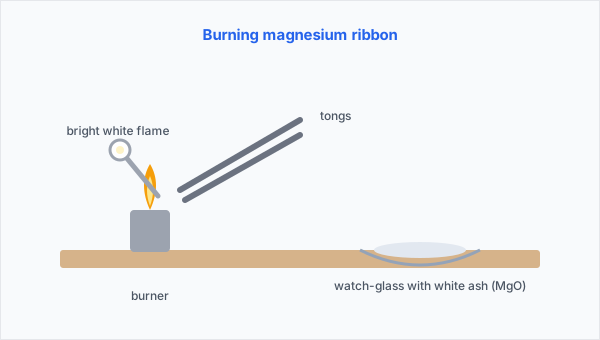
Here are three examples. When you burn magnesium ribbon in air, it gives a very bright white flame and leaves behind a white powder (this powder is magnesium oxide). When you drop zinc granules (small pieces of zinc) into dilute hydrochloric acid or sulphuric acid, bubbles of gas rise up and the test tube feels warm. When you mix lead nitrate solution with potassium iodide solution, a bright yellow solid suddenly forms out of two clear liquids.
Figure 1.2 shows what that burning magnesium ribbon actually looks like:
So a chemical reaction has probably taken place if you notice any of these signs:
- a change in state (a new substance appears as a solid, liquid or gas)
- a change in colour
- a gas being given off (bubbling or fizzing)
- a change in temperature (the container becomes warmer or cooler)
- a precipitate forming (a solid that does not dissolve), or a new smell
Try spotting the signs yourself in this everyday kitchen example:
You add vinegar to baking soda and it fizzes vigorously and the bowl feels slightly cooler. Has a chemical reaction occurred? Which signs tell you so?
Yes. Two signs point to a reaction: evolution of a gas (the fizzing is carbon dioxide) and a change in temperature (it feels cooler, so this one absorbs heat). New substances have clearly formed.
Writing a chemical reaction: from a sentence to a symbol
Writing a reaction as a full sentence takes a lot of words. For example: “When magnesium ribbon is burnt in oxygen, it changes into magnesium oxide.” That is a long sentence. Scientists make it shorter in two steps.
Step 1 — the word-equation. Write the names of the substances. Put the starting substances on the left and the new substances on the right. Draw an arrow in between to show the direction:
Magnesium + Oxygen → Magnesium oxide
The starting substances that get used up (here, magnesium and oxygen) are called the reactants. The new substance that is formed (here, magnesium oxide) is called the product. The ”+” sign means “reacts with” on the left side, and “and” on the right side. The arrow ”→” means “gives” or “produces”.
Step 2 — the chemical equation. Now replace the names with chemical formulae (short symbols for each substance). Before we do, here is a quick reminder of how those symbols and formulae work, from Class 9:
Mg + O₂ → MgO
This is much shorter and more useful. But it has a hidden problem. Let us count the oxygen atoms. On the left there are two oxygen atoms (in O₂). On the right there is only one oxygen atom (in MgO). So one oxygen atom seems to have vanished. But the Law of Conservation of Mass says atoms can never just disappear. An equation like this — correct formulae, but an unequal number of atoms on the two sides — is called a skeletal chemical equation. We must balance it before it is correct.
Balancing equations, step by step
To balance an equation, we add coefficients. A coefficient is a big number written in front of a formula. For example, the 2 in “2H₂O” is a coefficient. We choose these numbers so that each element has the same number of atoms on both sides. Here is the golden rule:
You are allowed to change the coefficients (the big numbers in front). You must never change the subscripts (the small numbers inside a formula). Changing a subscript would turn the substance into a completely different substance.
(A “subscript” is the small lowered number inside a formula, like the 2 in H₂O. It tells you how many atoms of that element are in one unit of the substance.)
Figure 1.3 shows balancing as a weighing scale — watch how only the front numbers change:

The usual method is called hit-and-trial. You balance one element at a time, use the smallest whole numbers you can, and then check at the end. Let us work through the classic example together.
Balance the equation: Fe + H₂O → Fe₃O₄ + H₂
-
First, count the atoms on each side. Left side: Fe = 1, H = 2, O = 1. Right side: Fe = 3, H = 2, O = 4. So iron and oxygen are not balanced yet. Only hydrogen is equal so far.
-
Start with the most complicated formula. That is Fe₃O₄, because it has the most atoms in it. Inside it, pick the element that is most out of balance. That is oxygen: there are 4 on the right side but only 1 on the left side.
-
Balance oxygen. To get 4 oxygen atoms on the left, put a 4 in front of H₂O. Each H₂O has 1 oxygen, and 4 × 1 = 4 oxygen. Now we have: Fe + 4H₂O → Fe₃O₄ + H₂.
-
Balance hydrogen. The left side now has 4 H₂O, which is 4 × 2 = 8 hydrogen atoms. So the right side also needs 8 hydrogen. Put a 4 in front of H₂, since 4 × 2 = 8. Now: Fe + 4H₂O → Fe₃O₄ + 4H₂.
-
Balance iron. The right side has 3 iron atoms (in Fe₃O₄). The left side has only 1. So put a 3 in front of Fe on the left: 3Fe + 4H₂O → Fe₃O₄ + 4H₂.
-
Finally, check every element. Fe: 3 = 3 ✓ H: 8 = 8 ✓ O: 4 = 4 ✓. All balanced! The final answer is 3Fe + 4H₂O → Fe₃O₄ + 4H₂.
Once the equation is balanced, we can add even more information. We write the physical state of each substance in brackets after it: (s) for solid, (l) for liquid, (g) for gas, and (aq) for aqueous, which means “dissolved in water”. We also write any special conditions — like heat, light, a catalyst or pressure — above or below the arrow.
3Fe(s) + 4H₂O(g) → Fe₃O₄(s) + 4H₂(g)
Here, the (g) written after water tells us the water is being used as steam (water in gas form). Now the equation tells the full story: what reacts, what forms, in what state, and in what amounts.
Here is a trap that catches a lot of students — see if you can explain why it is wrong:
Why is it wrong to balance Mg + O₂ → MgO by rewriting it as Mg + O₂ → MgO₂?
Because MgO₂ is not the same substance as MgO. When you change the subscript, you invent a brand new compound (and MgO₂ does not even exist here). You must balance only by adding coefficients in front. The correct answer is 2Mg + O₂ → 2MgO.
Make sure the coefficient-vs-subscript difference is really clear in your head:
In the balanced equation 2H₂ + O₂ → 2H₂O, what do the '2' in front of H₂ and the small '2' inside H₂O represent, respectively?
The big number in front (2H₂) is a coefficient — it counts whole molecules and is what we adjust to balance. The small number inside (H₂O) is a subscript — it’s part of the substance’s identity and must never be changed to balance an equation.
The five families of chemical reactions
During a reaction, atoms never turn into other kinds of atoms. They just move around and form new groups. The way they regroup lets us sort almost every reaction into five families (groups). Figure 1.4 sums up the main four at a glance before we take them one by one:

1. Combination reactions — two become one
When two or more substances join together to make a single product, it is called a combination reaction. For example, when quicklime (calcium oxide) is added to water, it forms slaked lime. The mixture hisses and gives out a lot of heat:
CaO(s) + H₂O(l) → Ca(OH)₂(aq) + heat
Two more examples are the burning of coal (C + O₂ → CO₂) and the making of water (2H₂ + O₂ → 2H₂O). Notice the pattern in all of them: many reactants come in, but only one product comes out.
The slaking of lime gives out heat. Reactions that give out heat are called exothermic reactions. (An easy way to remember: “exo” sounds like “exit”, and heat exits the reaction.) Burning natural gas, respiration inside our body cells, and even vegetables rotting into compost are all exothermic:
CH₄(g) + 2O₂(g) → CO₂(g) + 2H₂O(g) (burning natural gas — exothermic)
C₆H₁₂O₆(aq) + 6O₂(aq) → 6CO₂(aq) + 6H₂O(l) + energy (respiration)
2. Decomposition reactions — one becomes many
A decomposition reaction is the exact opposite of a combination reaction. Here, a single substance breaks down into two or more simpler substances. This always needs some energy to make it happen. The kind of energy used gives the reaction a special name:
- Thermal decomposition — broken apart by heat (“thermal” means heat).
Heating limestone gives quicklime. Heating ferrous sulphate or lead nitrate
gives off coloured fumes (smoke-like gases):
CaCO₃(s) →[heat] CaO(s) + CO₂(g)
2Pb(NO₃)₂(s) →[heat] 2PbO(s) + 4NO₂(g) + O₂(g) (brown fumes of NO₂)
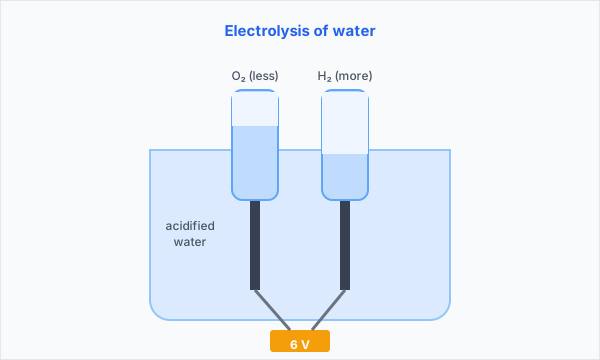
- Electrolytic decomposition — broken apart by electricity. When you pass
electric current through acidified water (water with a little acid added), it
splits into hydrogen and oxygen:
2H₂O(l) →[electricity] 2H₂(g) + O₂(g)
- Photolytic decomposition — broken apart by light (“photo” means light).
White silver chloride turns grey when left in sunlight. This was once used in
black-and-white photography:
2AgCl(s) →[sunlight] 2Ag(s) + Cl₂(g)
Figure 1.5 shows how the electrolysis one is actually set up, with the two gases collecting in separate tubes:
Decomposition reactions take in (absorb) energy, so they are called endothermic reactions. (“Endo” means inside — energy goes in.) This is a neat pair to remember: combination reactions often give heat out (exothermic), while decomposition reactions take energy in (endothermic).
But why does one reaction pour out heat while another keeps drinking it in? Where does that heat even come from, or go to? The answer is hidden in the bonds between atoms, and Figure 1.6 shows it as a simple money budget:

Here is the idea in plain words. Every bond between two atoms is like a tiny stretched spring storing energy. To break a bond, you have to spend energy (you pull the spring apart). To make a new bond, energy is given back (the spring snaps shut and releases it).
A reaction does both: first it breaks the old bonds in the reactants, then it builds new bonds in the products. So it is just a budget. Add up what you spend breaking, and what you earn building.
- If the new bonds give back more energy than the old bonds cost to break, the extra energy has nowhere to stay — it escapes, usually as heat. The reaction feels warm. That is exothermic (like burning, or slaking lime).
- If breaking the old bonds costs more than the new bonds give back, the reaction is short of energy. It can only keep going if you keep feeding heat in. That is endothermic (like heating limestone — it stops the instant you stop heating).
This also clears up a confusing point. Burning needs a match to start, yet it is exothermic. The match only pays the small upfront cost of breaking the first few bonds. Once the reaction gets going, it earns back far more than that, so the flame keeps itself alive. An endothermic reaction is different — it runs at a loss the whole time, so it needs heat fed in non-stop.
This table puts combination and decomposition side by side so the contrast is easy to revise:
| Feature | Combination | Decomposition |
|---|---|---|
| What happens | Two or more → one product | One reactant → two or more products |
| Energy | Usually releases energy (often exothermic) | Needs energy: heat, light or electricity (endothermic) |
| Example | CaO + H₂O → Ca(OH)₂ | CaCO₃ → CaO + CO₂ |
Now test both ideas together — family and energy — on one reaction:
Heating calcium carbonate gives calcium oxide and carbon dioxide. Is this exothermic or endothermic, and which family does it belong to?
It is a decomposition reaction (one substance → two), and it is endothermic because it only happens when you keep supplying heat.
3. Displacement reactions — the stronger metal pushes out the weaker
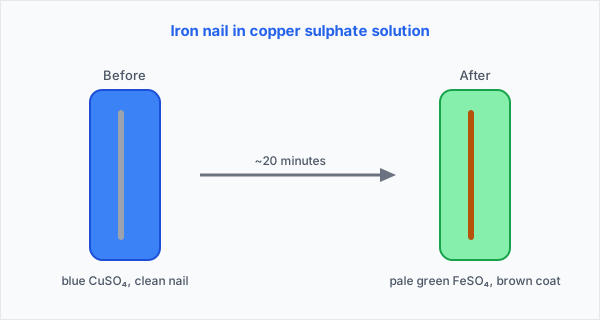
In a displacement reaction, a more reactive element pushes a less reactive element out of its compound and takes its place. (“More reactive” just means it reacts more easily.) For example, dip an iron nail into blue copper sulphate solution. After some time, the blue colour fades to pale green and the nail turns brownish. This happens because iron is more reactive than copper, so iron pushes the copper out:
Fe(s) + CuSO₄(aq) → FeSO₄(aq) + Cu(s)
You can actually watch this colour change happen, as Figure 1.7 shows:
Zinc and lead can do the same thing to copper, because both of them are more reactive than copper:
Zn(s) + CuSO₄(aq) → ZnSO₄(aq) + Cu(s)
4. Double displacement reactions — partners swap
In a double displacement reaction, two compounds in solution swap their ions with each other. (Ions are charged parts of a compound; you can think of them here as the two “partners” inside each compound.) For example, mix sodium sulphate solution with barium chloride solution. A white solid that does not dissolve drops to the bottom:
Na₂SO₄(aq) + BaCl₂(aq) → BaSO₄(s) + 2NaCl(aq)
Here, barium and sodium have swapped partners. That solid which does not dissolve (BaSO₄) is called a precipitate. So any reaction that forms a precipitate is also called a precipitation reaction.
These two “displacement” reactions sound alike but work differently — here they are side by side:
| Feature | Displacement | Double displacement |
|---|---|---|
| What swaps | One element replaces another | Two compounds exchange ions (partners swap) |
| Reactants | An element + a compound | Two compounds (usually in solution) |
| Example | Fe + CuSO₄ → FeSO₄ + Cu | Na₂SO₄ + BaCl₂ → BaSO₄↓ + 2NaCl |
5. Oxidation and reduction — the gain and loss game
Heat some copper powder in air, and its surface turns black. The copper has gained oxygen to become copper oxide:
2Cu + O₂ →[heat] 2CuO
Now pass hydrogen gas over that hot black copper oxide. It turns brown again. This time the copper oxide loses its oxygen and goes back to being copper:
CuO + H₂ →[heat] Cu + H₂O
Here are the two key definitions. Notice that each one has two parts:
- Oxidation = gaining oxygen or losing hydrogen.
- Reduction = losing oxygen or gaining hydrogen.
Look again at that second reaction. CuO loses oxygen, so CuO is reduced. At the same time, H₂ gains oxygen, so H₂ is oxidised. One cannot happen without the other. When one substance is oxidised, another is always reduced in the same reaction. Because of this, such reactions are called oxidation–reduction reactions, or redox reactions for short (“red” from reduction + “ox” from oxidation).
But why must they always come as a pair? Why can a substance never just lose oxygen on its own? Figure 1.8 shows the reason by tracking the single oxygen atom as it moves:

The reason is simple once you see it. When CuO is reduced, it loses an oxygen atom. But that oxygen atom does not disappear — by the very rule we just learnt, atoms are never destroyed. So it has to go somewhere. In this reaction it lands on the hydrogen, turning it into water. The hydrogen has now gained oxygen, so the hydrogen is oxidised.
See what happened? The same oxygen atom leaving one substance and joining another is one single event, looked at from two sides. The substance that drops the oxygen is reduced. The substance that catches it is oxidised. You cannot have one without the other, for the same reason you cannot pass a ball to a friend without someone catching it. That is why we give the pair one combined name — redox.
Figure 1.9 lays out both halves once more and names them:

If you ever mix them up, this small table is all you really need to memorise:
| Process | Oxygen | Hydrogen |
|---|---|---|
| Oxidation | Gains oxygen | Loses hydrogen |
| Reduction | Loses oxygen | Gains hydrogen |
Now spot the reduced substance in a reaction that has no hydrogen at all:
In the reaction ZnO + C → Zn + CO, which substance is reduced?
ZnO loses oxygen to become Zn, so ZnO is reduced. Carbon gains oxygen to become CO, so carbon is oxidised. Every redox reaction has one of each.
Oxidation in everyday life: corrosion and rancidity
Redox reactions are not just something you see in a lab. Two slow redox reactions cause huge problems in real life.
Corrosion is the slow eating-away of a metal. It happens when the metal is attacked by moisture (water in the air), air, and other chemicals around it. The rusting of iron (its reddish-brown coat), the black layer that forms on silver, and the green film on copper are all examples of corrosion. Over time, corrosion slowly weakens car bodies, bridges, railings and ships. This is why we paint, grease, or galvanise iron to protect it. (Galvanising means coating iron with a layer of zinc.) These coatings keep oxygen and water away from the metal.
Rancidity is what happens when the fats and oils in food get oxidised. The food then develops a bad smell and a bad taste — you may have noticed this in old biscuits or fried snacks. To slow this down, food makers add antioxidants (chemicals that stop oxidation), seal food in airtight packets, keep it in the fridge, and fill packets with nitrogen gas. Nitrogen does not react easily, so it keeps oxygen away from the food. (That little “puff” of gas you hear when you open a chips packet is this nitrogen escaping.)
Common Mistakes
To balance an equation, you can change the small subscript numbers inside a formula.
It feels efficient — just bump H₂O up to H₂O₂ and the oxygen balances instantly.
Changing a subscript changes the substance itself (H₂O is water; H₂O₂ is hydrogen peroxide!). You balance ONLY by changing the big coefficients in front of formulae.
A coefficient only multiplies the first atom in a formula.
When you write 4H₂O, it's tempting to think only the hydrogen got multiplied.
A coefficient multiplies EVERY atom in that formula. 4H₂O means 4×2 = 8 hydrogen atoms AND 4×1 = 4 oxygen atoms.
Displacement and double displacement are basically the same thing.
Both have the word 'displacement' and both involve swapping.
In displacement, a single element pushes out another (Fe + CuSO₄ → FeSO₄ + Cu). In double displacement, two compounds swap their ions (Na₂SO₄ + BaCl₂ → BaSO₄ + 2NaCl). Count the elements vs compounds among the reactants.
Oxidation only means gaining oxygen, and reduction only means losing it.
That's how the words are first introduced, so it sticks.
Oxidation is the gain of oxygen OR the loss of hydrogen; reduction is the loss of oxygen OR the gain of hydrogen. Watching only oxygen makes you miss half of all redox reactions.
If a reaction needs heat to start, it must be endothermic.
You're supplying heat, so surely it's absorbing energy?
Many exothermic reactions (like burning) need just a small spark to START. After that, they give out far more heat than the spark put in. 'Endothermic' means the reaction keeps taking in energy the whole time. A good example is the decomposition of CaCO₃, which stops the moment you stop heating it.
Quick Check
Two clear solutions are mixed and a yellow solid immediately settles at the bottom. Which type of reaction is this?
Two compounds in solution exchanged ions to form an insoluble solid (a precipitate). That’s a double displacement reaction — and because a precipitate formed, also a precipitation reaction. (This is exactly what happens with lead nitrate + potassium iodide → yellow PbI₂.)
Which equation is correctly balanced?
In 2H₂ + O₂ → 2H₂O, hydrogen is 4 = 4 and oxygen is 2 = 2. The third option cheats by changing a subscript, and the fourth has 4 oxygen on the left but only 2 on the right.
Silver chloride is kept in sunlight and turns grey. What kind of decomposition is this?
Light supplies the energy, so it’s photolytic decomposition: 2AgCl →[sunlight] 2Ag + Cl₂. This light-sensitivity is what made silver salts useful in old photographic film.
Practice Problems
Try each problem on your own before you tap “Show Solution”. The effort you put in is what helps you learn. These problems are written by Curriv and are completely free.
Easy
Balance: Na + O₂ → Na₂O
Balance oxygen first. There are 2 oxygen on the left, so we need 2 Na₂O on the right (giving 2 oxygen):
Na + O₂ → 2Na₂O
Now the right has 4 sodium atoms, so put 4 in front of Na on the left:
4Na + O₂ → 2Na₂O ✓ (Na: 4 = 4, O: 2 = 2)
Name the type of reaction: CaO + H₂O → Ca(OH)₂
Two reactants join to make one product, so this is a combination reaction. (It also releases heat, making it exothermic.)
Medium
Translate into a balanced equation: 'Aluminium reacts with copper chloride to give aluminium chloride and copper.'
Word-equation: Aluminium + Copper chloride → Aluminium chloride + Copper
Skeletal: Al + CuCl₂ → AlCl₃ + Cu
Balance chlorine: the lowest common multiple of 2 (in CuCl₂) and 3 (in AlCl₃) is 6. So use 3 CuCl₂ and 2 AlCl₃:
Al + 3CuCl₂ → 2AlCl₃ + Cu
Now balance Al (2 on the right) and Cu (3 on the right):
2Al + 3CuCl₂ → 2AlCl₃ + 3Cu ✓
This is a displacement reaction — aluminium displaces copper.
When dilute hydrochloric acid is added to iron filings, which gas is produced — hydrogen or chlorine? Write the balanced equation.
Hydrogen gas is produced (not chlorine). A more reactive metal displaces hydrogen from an acid:
Fe + 2HCl → FeCl₂ + H₂ ✓
The bubbles you see are hydrogen, and the iron salt formed is iron(II) chloride.
Challenge
In the reaction Fe₂O₃ + 2Al → Al₂O₃ + 2Fe, identify what is oxidised, what is reduced, and the type of reaction.
Look at the oxygen:
- Fe₂O₃ loses oxygen to become Fe → iron oxide is reduced.
- Al gains oxygen to become Al₂O₃ → aluminium is oxidised.
So it is a redox reaction (one thing is oxidised and the other is reduced). It is also a displacement reaction, because the more reactive aluminium pushes iron out of its oxide. (This is the famous thermite reaction. It is used to weld railway tracks together, because it gives out so much heat that the iron formed comes out molten, that is, melted.)
Summary
After this chapter, you should be able to explain each of these in your own words:
- A chemical reaction makes new substances by rearranging atoms; atoms are conserved, so mass is conserved (Law of Conservation of Mass).
- You can tell a reaction happened by signs like a change in state, colour, temperature, the evolution of a gas, or the formation of a precipitate.
- A reaction can be written as a word-equation, then a chemical equation, which must be balanced by adjusting coefficients (never subscripts).
- Physical states (s, l, g, aq) and conditions (heat, light, catalyst) make an equation more informative.
- The five families: combination (many → one), decomposition (one → many, by heat/light/electricity), displacement (a more reactive element pushes out a less reactive one), double displacement (compounds swap ions, often making a precipitate), and oxidation–reduction (redox).
- Exothermic reactions release heat; endothermic reactions absorb it.
- Oxidation = gain of oxygen / loss of hydrogen; reduction = loss of oxygen / gain of hydrogen — and they always happen together.
- Slow redox in daily life shows up as corrosion (e.g. rusting) and rancidity (spoiling of fats and oils), which we fight with paint, antioxidants, airtight packing and nitrogen flushing.
What’s Next
You now know that substances react, and how to write those reactions down. A huge part of everyday chemistry comes down to one special tug-of-war between two opposite kinds of substances. This is true for many things you see daily, from the sour taste of a lemon to the relief you feel after taking an antacid tablet. In Chapter 2: Acids, Bases and Salts, you will meet these two opposites. You will learn why some things taste sour while others taste bitter and feel slippery. And you will see the same reaction types from this chapter — especially neutralisation, which is a kind of double displacement — happening in your kitchen and even in your stomach.
Frequently Asked Questions
How do you know a chemical reaction has taken place?
Look for one or more of these signs: a change in colour, a gas being produced (bubbles or a smell), formation of a solid precipitate, a change in temperature, or a change in state. These signs tell you that new substances have formed — not just a physical mix.
Why do we need to balance a chemical equation?
Atoms cannot be created or destroyed in a chemical reaction — this is the Law of Conservation of Mass. So the number of each type of atom on the left side (reactants) must equal the number on the right side (products). Balancing makes the equation obey this law by adjusting the coefficients in front of each formula.
What is the difference between combination, decomposition and displacement reactions?
In a combination reaction, two or more substances join to form one new substance (A + B → AB). In a decomposition reaction, one substance breaks apart into two or more simpler substances (AB → A + B). In a displacement reaction, a more reactive element pushes a less reactive element out of its compound (A + BC → AC + B).
What is a redox reaction and how do you identify oxidation and reduction?
A redox reaction is one where oxidation and reduction happen at the same time. Oxidation means gaining oxygen or losing hydrogen (or more broadly, losing electrons). Reduction means losing oxygen or gaining hydrogen (gaining electrons). The substance that gets oxidised is the reducing agent, and the one that gets reduced is the oxidising agent.
Why does the colour of copper sulphate solution change when iron is dipped in it?
Iron is more reactive than copper, so iron displaces copper from copper sulphate solution. Iron goes into solution as iron sulphate (which is pale green), and copper metal is deposited on the iron nail. The blue colour of copper sulphate fades and the nail gets a reddish copper coating — a classic displacement reaction.