Carbon and its Compounds
Why This Matters
Look at the things around you. The food you ate. The clothes you wear. This page. The medicine in the cabinet. The petrol in a scooter. The plastic of your pen. And you — every cell of your body. One element is hiding inside all of them: carbon.
Here is the surprising part. Carbon is actually quite rare. It makes up only about 0.02% of the earth’s crust and 0.03% of the air. But chemists have found millions of carbon compounds. That is more than all the compounds of every other element put together. How can one rare element make so many different things, from a hard diamond to the DNA inside you?
The secret is in how carbon joins with other atoms. In Chapter 3, metals gave away electrons and non-metals took them. Carbon does neither. Carbon shares its electrons. This sharing habit, together with carbon’s ability to join with itself again and again, is why carbon is the element of life. It is also why carbon is found in almost everything useful around you. This chapter teaches you the basic rules of that chemistry.
The Big Idea
Carbon shares electrons instead of giving or taking them. This kind of bond is called a covalent bond. Carbon has 4 electrons in its outer shell (we say it is tetravalent), and it can join to other carbon atoms in very long chains (this is called catenation). Because of these two things, carbon can build a huge number of stable molecules.
Before we go further, here is a quick refresher on shells and why atoms bond at all — the idea everything below rests on.
Carbon has 4 electrons in its outermost shell. An atom is stable when its outer shell is full (8 electrons, called an octet). So carbon could try to gain 4 electrons. But its small nucleus cannot hold 4 extra electrons easily. Or carbon could try to lose 4 electrons. But removing 4 electrons needs a huge amount of energy. So carbon chooses a third option: it shares all four electrons. By sharing, it forms four covalent bonds.
Why are gaining and losing so much harder than sharing? It comes down to carbon’s tiny size. An atom’s nucleus is positive, and that positive charge is what holds electrons in place. Carbon’s nucleus is small and not very strongly charged. To gain 4 extra electrons, that small nucleus would have to hold 8 electrons in its outer shell — 10 electrons in all, pulled by just 6 protons. That is far more than its weak pull can manage, and the crowded extra electrons would also push each other away. To lose 4 electrons, you would have to drag all four away against the nucleus that is still pulling them back, which takes an enormous amount of energy. Sharing dodges both problems: each shared pair belongs to carbon and to its partner at the same time, so carbon reaches a full shell of 8 without ever holding or losing a single whole electron. Figure 4.1 below lines up the three choices side by side so you can see why only sharing works.

To see why sharing is so different from what metals and non-metals do, compare the two ways atoms can join up.
A covalent bond is simply a pair of electrons shared between two atoms. When atoms share electrons, no charged particles (ions) are formed. This is why carbon compounds have low melting and boiling points. It is also why they do not conduct electricity (unlike the ionic compounds you saw in Chapter 3, which do conduct when melted or dissolved).
But why does “no ions” lead to a low melting point? Think about what melting actually does. Melting is just pulling the particles of a solid far enough apart that they can flow. In a covalent compound the atoms are joined into separate, complete molecules (like one whole CH₄ unit). The bond inside each molecule is strong — but to melt, you do not have to break those inside bonds at all. You only have to loosen the forces between one whole molecule and the next, and those between-molecule forces are very weak. Weak forces give way to a little heat, so the compound melts at a low temperature.
And why no conduction? Electric current needs charged particles that are free to move and carry charge. An ionic compound, once melted or dissolved, sets its ions loose to do exactly that. A covalent compound has no ions at all and no loose electrons — every electron is locked into a shared pair. With no free charge carriers, current has nothing to ride on, so it cannot flow. Figure 4.2 below puts an ionic solid next to a covalent one so you can see both differences at once.

Two special properties make carbon able to form so many compounds:
- Catenation — this means carbon’s ability to join with other carbon atoms. The bond between two carbon atoms is very strong. So carbon links to itself in long straight chains, in branched chains, and even in rings.
- Tetravalency — this means carbon has four bonds to give. So besides other carbon atoms, it can also join with hydrogen (H), oxygen (O), nitrogen (N), sulphur (S), chlorine (Cl) and more. This builds endless families of compounds, each with its own properties.
If you remember just one line — “carbon shares four bonds and links to itself” — the whole chapter will make sense.
Figure 4.3 below shows the three shapes catenation produces — a straight chain, a branched chain and a ring.

Let’s Break It Down
Covalent bonds: sharing to fill the shell
An atom is stable when its outer shell is full. Atoms can fill their shells by sharing electrons. Here are a few examples.
But first, how do we know that carbon makes four bonds, hydrogen one and oxygen two? That number has a name — valency.
Each hydrogen atom needs one more electron to be full. So two hydrogen atoms share one pair of electrons. One shared pair is called a single bond, and we write it as H–H.
Each oxygen atom needs two more electrons. So two oxygen atoms share two pairs. Two shared pairs make a double bond, written as O=O.
Each nitrogen atom needs three more electrons. So two nitrogen atoms share three pairs. Three shared pairs make a triple bond, written as N≡N.
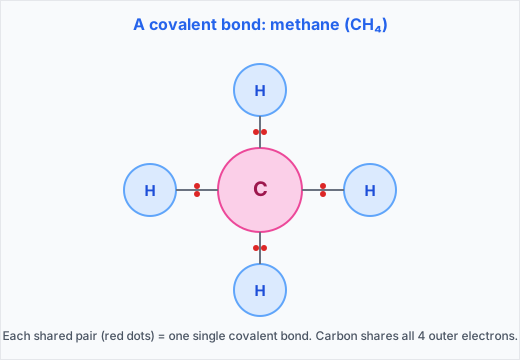
Carbon needs four more electrons. So carbon shares its four electrons with four hydrogen atoms. This makes methane, CH₄ — one carbon joined to four hydrogens by four single bonds. Figure 4.4 below shows this sharing.
Pure carbon itself can exist in different forms. These different forms of the same element are called allotropes. The form depends on how the carbon atoms are joined:
- Diamond — here each carbon is joined to 4 other carbons in a strong 3-D network. This makes diamond the hardest natural substance.
- Graphite (the “lead” in your pencil) — here each carbon is joined to only 3 others, forming flat sheets that can slide over each other. So graphite is soft and slippery. It is also one of the few non-metals that conduct electricity.
- Fullerenes — for example C-60, where 60 carbon atoms join in a shape like a football.
Why carbon makes millions of compounds
A saturated compound has only single bonds between its carbon atoms (for example ethane, C₂H₆). “Saturated” means the carbons are holding as many hydrogen atoms as they possibly can. These compounds are fairly unreactive.
An unsaturated compound has at least one double or triple bond between carbon atoms (for example ethene, C₂H₄, with a double bond; or ethyne, C₂H₂, with a triple bond). These compounds are more reactive.
The carbon atoms can be arranged in different shapes too: in a straight chain, in a branched chain, or joined end-to-end in a ring (like cyclohexane or benzene).
Sometimes two compounds have the same molecular formula but a different arrangement of atoms. Such compounds are called structural isomers. For example, butane (C₄H₁₀) can be built as a straight chain of 4 carbons, or as a shorter chain with one carbon branching off the side. Both are C₄H₁₀, but they are different compounds. Figure 4.5 below shows both arrangements.

Compounds made of only carbon and hydrogen are called hydrocarbons. They come in three main families:
| Family | Bonds | General formula | Example |
|---|---|---|---|
| Alkanes | All single (saturated) | CₙH₂ₙ₊₂ | Methane CH₄ |
| Alkenes | ≥1 double bond | CₙH₂ₙ | Ethene C₂H₄ |
| Alkynes | ≥1 triple bond | CₙH₂ₙ₋₂ | Ethyne C₂H₂ |
Functional groups and homologous series
Take a hydrocarbon and remove one hydrogen atom. In its place, attach a different atom or a small group of atoms. This new atom or group is called a functional group. (A single atom that is not carbon or hydrogen — like O, N or Cl — is called a heteroatom.) The functional group decides how the compound behaves in reactions. The length of the carbon chain does not change this — the functional group is what matters. For example, the –OH group makes a compound an alcohol, whether the chain is short or long.
Here are some common functional groups:
| Class | Functional group | Name suffix/prefix |
|---|---|---|
| Halo (chloro/bromo) | –Cl, –Br | prefix chloro-/bromo- |
| Alcohol | –OH | suffix -ol |
| Aldehyde | –CHO | suffix -al |
| Ketone | –CO– | suffix -one |
| Carboxylic acid | –COOH | suffix -oic acid |
A homologous series is a family of compounds with the same functional group. Each member is bigger than the one before it by one –CH₂– unit (which adds about 14 u to the mass). For example, the alcohols go CH₃OH, C₂H₅OH, C₃H₇OH, and so on — each one has one more –CH₂– than the last. All members of a series react in the same way, because they all carry the same functional group (here, –OH). Only their physical properties — like melting point and boiling point — change slowly as the chain gets longer.
Naming compounds (nomenclature): Naming a carbon compound has two simple steps.
- Count the carbon atoms in the chain and use the matching word: 1 → meth, 2 → eth, 3 → prop, 4 → but, 5 → pent, 6 → hex.
- Add an ending (or a beginning) for the functional group.
A double bond gets the ending -ene, and a triple bond gets the ending -yne. If the ending starts with a vowel, drop the ‘e’ at the end of the first part. For example, propane → propan + one → propanone.
We have covered a lot — let us pause and check the one idea this whole section was built on.
What are the two properties of carbon that lead to the huge number of carbon compounds?
The two properties are catenation and tetravalency. Catenation is carbon’s ability to join with other carbon atoms, making long chains, branches and rings. Tetravalency means carbon has four electrons to share, so it can bond with four other atoms (carbon, H, O, N, S, Cl and more). Together, these two let carbon build a huge variety of stable compounds.
Now try counting bonds yourself in a slightly bigger molecule than methane.
Ethane (C₂H₆) has how many covalent bonds?
Ethane looks like H₃C–CH₃. Let us count the bonds. Each carbon holds 3 hydrogens, so that is 6 C–H bonds in total. Then there is 1 C–C bond joining the two carbons. So 6 + 1 = 7 covalent bonds.
Chemical reactions of carbon compounds
- Combustion (burning): Carbon compounds burn in oxygen and give carbon dioxide, water, and a lot of heat and light. For example: CH₄ + 2O₂ → CO₂ + 2H₂O. Saturated hydrocarbons burn with a clean blue flame. But unsaturated ones — or any fuel that does not get enough air — burn with a sooty yellow flame. This is why a stove with blocked air holes makes the bottom of the vessel black.
Why does the colour of the flame change? The whole story is about whether every carbon atom in the fuel gets enough oxygen to burn fully. Burning a carbon compound fully means turning each carbon all the way into carbon dioxide (CO₂). That happens only when there is plenty of oxygen for the number of carbons in the molecule. Then the flame is a clean blue. Now look at the two cases that go wrong. An unsaturated fuel is richer in carbon for its size (more carbons, relatively less hydrogen), so it needs even more oxygen — and often does not get it. And any fuel starved of air (blocked stove holes) is short of oxygen too. In both cases some carbon does not burn fully. The leftover bits of carbon stay as tiny hot soot particles. These glowing-hot specks light up yellow (the same way a hot iron rod glows), and the unburnt soot settles as the black layer on the pot. So: enough oxygen per carbon → blue; not enough → glowing soot → sooty yellow. Figure 4.6 below shows both flames side by side.

The fuel’s other reactions follow.
- Oxidation: Adding oxygen to a substance is called oxidation. Alcohols can be changed into carboxylic acids this way. The chemical that supplies the oxygen is called an oxidising agent — for example alkaline KMnO₄ or acidified K₂Cr₂O₇. So ethanol can be oxidised into ethanoic acid.
- Addition: An unsaturated hydrocarbon can take in hydrogen and become saturated. This needs a catalyst (a helper) like nickel (Ni) or palladium (Pd). This reaction is called hydrogenation. It is used to turn liquid vegetable oils into solid fats, like vanaspati ghee. (Note: unsaturated oils are healthier for the body than saturated animal fats.)
- Substitution: Saturated hydrocarbons are usually unreactive. But in sunlight, chlorine can replace their hydrogen atoms one at a time. “Substitution” just means one atom takes the place of another: CH₄ + Cl₂ →[sunlight] CH₃Cl + HCl.
Two important compounds: ethanol and ethanoic acid
Ethanol (C₂H₅OH) — this is the common “alcohol”. It is a liquid and a good solvent, so it is used in cough syrups and medicines (tinctures). It is also the active part of alcoholic drinks. Ethanol reacts with sodium metal and gives off hydrogen gas (H₂). If you heat it with concentrated sulphuric acid (H₂SO₄), it loses water and turns into ethene. (Warning: methanol, a similar-looking alcohol, is a poison. Even a small amount can cause blindness or death.)
Ethanoic acid (CH₃COOH) — this is also called “acetic acid”. It is a weak acid from the carboxylic acid family. A 5–8% solution of it in water is the vinegar used in cooking. The pure acid freezes in cold winter weather, so it is called “glacial” acetic acid. Ethanoic acid takes part in these reactions:
- It reacts with a base to give a salt and water. This is called neutralisation.
- It reacts with carbonates and hydrogencarbonates to give a salt, carbon dioxide and water.
- It reacts with ethanol (with a little acid as catalyst) to make a sweet-smelling compound called an ester. This reaction is called esterification. Esters are used in perfumes and food flavours.
Soaps and detergents — the chemistry of cleaning
A soap molecule is the sodium or potassium salt of a long-chain carboxylic acid. The clever thing is that it has two different ends.
- One end is a charged head that loves water. We call it hydrophilic (“hydro” means water, “philic” means loving).
- The other end is a long carbon tail that hates water. We call it hydrophobic (“phobic” means fearing).
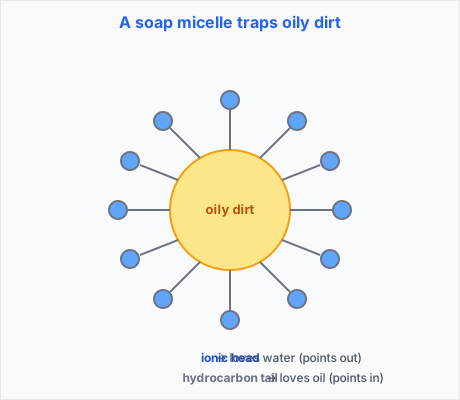
Most dirt on clothes is oily, and oil does not mix with water. So when you wash, the water-hating tails dig into the oil, while the water-loving heads stay facing the water outside. Many soap molecules do this together and form a tiny ball around the oil drop. This ball is called a micelle. The micelle traps the oily dirt inside and floats it away in the water. Figure 4.7 below shows a single micelle.
Some water is called hard water. This is water that has a lot of calcium and magnesium ions (Ca²⁺ and Mg²⁺) in it. In hard water, soap does not make good lather. Instead it forms a sticky, insoluble white mess called scum. Detergents are made from salts of sulphonic acids. They do not form scum, so they clean well even in hard water. This is why detergents are used in shampoos and washing powders.
Here is a kitchen clue that ties straight back to combustion — see if you can read what the black layer is telling you.
While cooking, the bottom of the vessel turns black. This means:
The black layer is soot, which is just carbon. It forms when the fuel does not get enough air to burn fully. This is called incomplete combustion. When the air holes are blocked, the flame turns sooty and some fuel is wasted.
Common Mistakes
Carbon forms ions (C⁴⁺ or C⁴⁻), just like metals and non-metals do.
Chapter 3 taught that atoms gain or lose electrons, so it feels like carbon should too.
Carbon SHARES its four electrons. These shared pairs are covalent bonds. Gaining or losing four electrons would need far too much energy, so carbon does not form ions. Because no ions form, carbon compounds do not conduct electricity.
If two compounds have the same formula, they must be the same compound.
Same formula sounds like the same thing.
They can be structural ISOMERS. This means they have the same molecular formula but their atoms are joined in a different order. For example, straight butane and branched butane are both C₄H₁₀, yet they have different properties.
A homologous series is grouped together because the members have similar physical properties.
The members do look quite alike.
What stays the same is the FUNCTIONAL GROUP, so the chemical properties match. Each member differs from the next by one –CH₂– unit. The physical properties (like melting and boiling point) actually change slowly as you go down the series.
Saturated just means 'full of hydrogen' and unsaturated means 'not full', and both kinds react the same way.
The words sound like they are only about being full or empty.
Saturated means only single bonds between carbons. These are unreactive and burn with a clean flame. Unsaturated means there is a double or triple bond. These are more reactive, burn with a sooty flame, and take part in addition reactions like hydrogenation.
Quick Check
Which of these undergoes addition reactions?
Only unsaturated hydrocarbons take part in addition reactions, because they have a double or triple bond that can take in more atoms. Ethyne (C₂H₂) has a triple bond, so it can. The other three are saturated alkanes with only single bonds, so they cannot.
Butanone is a four-carbon compound with which functional group?
The ending -one tells us the compound is a ketone (which has the –CO– group). So “butan-one” means a 4-carbon chain (“butan-”) that carries a ketone group.
Practice Problems
These are written by Curriv and are completely free. Try before revealing.
Easy
Name these: (i) CH₃–CH₂–Br (ii) a 3-carbon chain ending in –COOH.
(i) Bromoethane (2-carbon chain “eth-” + bromo group).
(ii) Propanoic acid (3 carbons “propan-” + carboxylic acid “-oic acid”).
Give a test to tell a saturated hydrocarbon from an unsaturated one.
The simplest test is to burn them. A saturated hydrocarbon burns with a clean blue flame. An unsaturated one burns with a yellow, sooty flame.
There is also a chemical test: an unsaturated compound makes the brown colour of bromine water disappear (because of an addition reaction), but a saturated compound does not.
Medium
Why is the conversion of ethanol to ethanoic acid called an oxidation reaction?
Because oxygen is added to the ethanol. An oxidising agent, like alkaline KMnO₄, supplies this oxygen. The oxygen changes the –CH₂OH part of ethanol into the –COOH part of the acid:
CH₃CH₂OH →[alkaline KMnO₄ + heat] CH₃COOH
Adding oxygen (or removing hydrogen) is called oxidation. So the chemical that does this is called an oxidising agent.
How can you distinguish ethanol from ethanoic acid by a simple chemical test?
Add a pinch of sodium hydrogencarbonate (baking soda) to each one:
- Ethanoic acid is an acid. So it fizzes and gives off CO₂ gas (this gas turns lime water milky).
- Ethanol is neutral. So there is no fizzing.
(You can also use litmus paper: ethanoic acid turns blue litmus red, but ethanol does not change it.)
Challenge
Why does soap form a scum in hard water, and how do detergents solve this?
Hard water has calcium and magnesium ions (Ca²⁺ and Mg²⁺) in it. Soap is a sodium or potassium salt of a carboxylic acid. When soap meets these ions, they react and form a solid that does not dissolve. This solid is the scum. Because of this, the soap lathers poorly and a lot of it is wasted.
Detergents are sodium salts of sulphonic acids. Their charged ends do not form a solid with Ca²⁺ and Mg²⁺ ions. So detergents stay dissolved and clean properly, even in hard water.
A mixture of oxygen and ethyne is used for welding, but not a mixture of ethyne and air. Why?
When ethyne burns in pure oxygen, it burns completely. This gives a very hot, clean flame — hot enough to melt and join metals. But air is only about 21% oxygen. So when ethyne burns in air, it does not get enough oxygen and burns only partly. This gives a sooty flame that is not hot enough for welding. That is why welders use the oxygen + ethyne (oxy-acetylene) flame, not ethyne + air.
Summary
- Carbon makes covalent bonds by sharing pairs of electrons. These can be single, double or triple. Because of this, carbon compounds have low melting and boiling points, and they do not conduct electricity.
- Carbon can make so many compounds because of two things: catenation (carbon joins to itself in chains, branches and rings) and tetravalency (carbon has 4 bonds to give). Its allotropes are diamond, graphite and fullerenes.
- Saturated compounds (alkanes) have only single bonds. Unsaturated compounds (alkenes and alkynes) have double or triple bonds and are more reactive. Structural isomers have the same formula but a different structure.
- A functional group (like –OH, –CHO, –CO–, –COOH, –Cl, –Br) decides how a compound reacts. A homologous series is a family with the same functional group, where each member differs by one –CH₂– unit.
- The main reactions are: combustion (clean blue flame for saturated, sooty flame when air is short), oxidation (alcohol → acid), addition/hydrogenation (unsaturated → saturated), and substitution (with Cl₂ in sunlight).
- Ethanol is a solvent that reacts with sodium and turns into ethene when heated with acid. Ethanoic acid is vinegar; it does neutralisation, reacts with carbonates to give CO₂, and forms esters.
- Soaps and detergents clean by making micelles — the water-hating tail goes into the oil and the water-loving head faces the water. Soap forms scum in hard water, but detergents do not.
What’s Next
You have now learned the chemistry of carbon, the element of life. Next, Curriv moves from chemistry to biology — how living things actually work. In Chapter 5: Life Processes, you will see what happens to the carbon compounds you just studied, like food, glucose and fats. You will learn how the body takes them in, breaks them down, and uses them. This covers the four basic jobs every living body must do to stay alive: nutrition, respiration, transport and excretion.
Frequently Asked Questions
Why does carbon form so many more compounds than any other element?
Two special properties make carbon unique. First, catenation — carbon atoms can bond with other carbon atoms to form very long chains, branches, and rings. Second, tetravalency — each carbon atom has 4 bonding 'hands', so it can link to many other atoms at once. These two features together let carbon build millions of different stable molecules, far more than any other element.
What is the difference between saturated and unsaturated hydrocarbons?
Saturated hydrocarbons (alkanes, like methane and ethane) have only single bonds between carbon atoms — they are 'full' or saturated with hydrogen. Unsaturated hydrocarbons have one or more double bonds (alkenes) or triple bonds (alkynes) between carbons, meaning they hold fewer hydrogen atoms than possible. Unsaturated compounds are more reactive because the extra bonds can open up to add new atoms.
What is a homologous series and why is it useful?
A homologous series is a family of compounds where each member differs from the next by just one CH₂ group. For example, methane (CH₄), ethane (C₂H₆), propane (C₃H₈) are all alkanes. Because they share the same general formula and functional group, all members of a series show similar chemical properties, and physical properties (like boiling point) change in a smooth, predictable pattern up the series.
Why does soap clean oily dirt but plain water cannot?
Oil and water do not mix because oil molecules are non-polar and water molecules are polar. Soap molecules are special: one end (the 'tail') is hydrophobic and dissolves into oil, while the other end (the 'head') is hydrophilic and dissolves in water. Soap molecules surround oil droplets to form structures called micelles — the tails grip the oil and the heads face outward into water — so the oily dirt can be rinsed away with water.
What happens when ethanol is oxidised and what is the product?
When ethanol (C₂H₅OH, 'alcohol') is oxidised — for example by an oxidising agent like alkaline potassium permanganate — it is converted to ethanoic acid (CH₃COOH, 'acetic acid'). Ethanoic acid is what gives vinegar its sharp sour smell and taste. This is an example of a chemical oxidation reaction where an alcohol is converted to a carboxylic acid.