How do Organisms Reproduce?
Why This Matters
Here is a puzzle. Think about the life processes you have learnt so far. Nutrition, respiration, excretion — each one keeps a single living thing alive. But reproduction is different. An animal or plant can live its whole life and never have any babies. And making babies takes a lot of energy too. So why does almost every living thing do it?
The answer is simple. Life is not just about one individual staying alive. It is about the species — the whole group of that kind of living thing — continuing on. (A species means all the organisms of one type, like all tigers, or all mango trees.)
There is one more thing, and it is important. When a living thing makes copies of itself, the copies are almost the same as the parent. But they are never exactly the same. These small differences are called variations. Variations are what let life survive when the world changes.
Here is an example. Imagine a pond full of bacteria. The water slowly heats up. Most of the bacteria die in the heat. But a few of them, by chance, are a little better at handling heat. Those few survive and keep the species going. If every bacterium had been exactly the same, all of them would have died. So no variation means no survival.
But why does being all the same doom them, while being slightly different saves the group? Because the world keeps changing, and no single feature is the “best” one for ever. If every member is identical, then one bad change — too hot, a new disease, no food — hits all of them the same way, and the whole species can be wiped out at once. When the members vary, the change still kills many of them, but a few happen to have the right feature to get through. Those few survive and rebuild the species. In short, variation means the species never bets everything on one type. Figure 7.1 below compares two ponds and shows exactly this difference:

So reproduction does two jobs at once. It makes copies, so the species continues. And it makes slightly different copies, so the species can survive changes. This chapter starts with one tiny cell splitting in two, and ends with the human reproductive system. Along the way you will see why “sexual reproduction” exists at all: it is nature’s way of mixing variation.
The Big Idea
Reproduction copies the DNA blueprint so a species continues. The copying is never perfect. The small variations this creates are what let a species survive in a changing world. Asexual reproduction (one parent) makes near-identical copies. Sexual reproduction (two parents) mixes DNA and makes much more variation.
Before we go further, a quick reminder of the basics this chapter is built on — what a cell is, and how one cell turns into two.
Deep down, reproduction is really just DNA copying. DNA is found in the nucleus of the cell. Think of DNA as an instruction manual. It tells the cell how to build proteins, and proteins build the body. So the basic event is this: the cell copies its DNA, builds the parts it needs, and then splits into two.
But no copy is ever perfect. So every new generation carries a few small changes. This is not a mistake or a problem. These changes are exactly what evolution works with (you will study evolution in the next chapter). Sexual reproduction takes this even further. It combines the variations of two different parents, making brand-new mixes every single time.
Keep this one idea in your mind: reproduction tries to copy carefully, yet still vary a little. Once you hold on to that, every method in this chapter will make sense.
We keep leaning on the word “DNA”. Before it does any more heavy lifting, here is a plain look at what DNA, chromosomes and genes actually are.
Let’s Break It Down
Asexual reproduction: one parent
When new living things come from just one parent, we call it asexual reproduction. “Asexual” simply means no partner is needed — a single parent does it all by itself. For example, a yeast cell can grow a baby yeast on its own body. Asexual reproduction is fast, and the offspring (the babies) are almost exactly the same as the parent.
Different kinds of bodies use different methods. Here they are together:
| Method | What happens | Examples |
|---|---|---|
| Binary fission | Cell splits into two | Amoeba, Leishmania, bacteria |
| Multiple fission | Cell splits into many at once | Plasmodium (malaria parasite) |
| Budding | A small bud grows on the body, then detaches | Hydra, yeast |
| Fragmentation | Body breaks into pieces, each grows whole | Spirogyra |
| Regeneration | A cut-off piece regrows a whole body | Planaria, Hydra |
| Spore formation | Sporangia release thick-walled spores | Rhizopus (bread mould) |
| Vegetative propagation | New plant from root/stem/leaf | Potato, Bryophyllum, sugarcane, rose |
Words can only do so much here — it helps to actually see these methods side by side. Figure 7.2 below shows all six methods in action, one per panel.

Let us quickly go through each one in plain words:
- Fission means a cell splits to make new cells. In binary fission, one cell splits neatly into two (like Amoeba). In multiple fission, one cell splits into many at the same time (like the malaria parasite).
- Budding means a small lump, called a bud, grows out of the parent’s body. The bud slowly becomes a new individual and then breaks off. You can see this in Hydra and in yeast.
- Fragmentation means the body breaks into pieces, and each piece grows into a whole new body. Spirogyra (a green pond alga) does this.
- Regeneration means a cut-off piece grows back into a complete organism. If you cut a Planaria worm into pieces, each piece can grow into a full worm.
- Spore formation means the parent makes tiny spores. A spore is like a seed with a thick wall around it. When it lands in a good spot, it grows into a new organism. Bread mould (Rhizopus) — the fuzzy stuff on old bread — does this.
- Vegetative propagation means a new plant grows from a part of the old plant — its root, stem or leaf — instead of from a seed. A potato can sprout new shoots, and each can become a new plant.
Now two points that students often get confused about:
- Regeneration is NOT the same as reproduction. Yes, a piece of Planaria can grow into a full worm. But Planaria does not normally chop itself up to make babies. Regeneration is really repair — the body fixing itself — pushed to an extreme. Budding, on the other hand, is a real way of making babies.
- Vegetative propagation is very useful in farming. These plants grow faster than plants grown from seed. Also, some plants (like banana and jasmine) cannot make seeds at all, so this is the only way to grow more of them. And every new plant is exactly like the parent. (In a lab, scientists do something similar called tissue culture — they grow many healthy, disease-free plants from a tiny piece of plant tissue.)
Why sexual reproduction exists
Asexual reproduction is quick and easy, so why do many living things use two parents instead? The answer is one word: variation.
DNA copying is very accurate. So on its own, it makes variation very slowly. But here is the clever part. Each individual already carries its own set of small, harmless variations built up over time. Now combine the DNA of two different individuals. You get a completely new mix. This gives much more variety, and much faster.
But this creates a problem. Suppose each child simply added up the DNA of both parents. Then the amount of DNA would double in every generation. That cannot keep happening. The solution is a special kind of cell division called meiosis. Meiosis makes special reproductive cells called germ cells, or gametes. Each gamete has only half the usual number of chromosomes. (Chromosomes are the thread-like structures that carry the DNA.) So when a male gamete joins a female gamete, the half from each side adds up to the full number again. Problem solved.
The two gametes are not the same. One is large and full of stored food — this is the female gamete (the egg). The other is small and can move on its own — this is the male gamete (the sperm).
But what does “mixing two parents’ DNA” actually do, and why can’t one parent copying itself ever match it? Here is the heart of it. Each gene comes in slightly different versions. (Think of the gene for, say, height — one version makes you a little taller, another a little shorter.) One parent carries only its own versions of each gene. So when it copies itself, every child reads the same versions again — the same set, over and over. There is nothing to shuffle, so the children are near-identical copies. Now bring in two parents. They carry different versions. Each child takes one version of each gene from each parent — so each child ends up with a fresh combination that neither parent had. Mix three genes from two parents and you already get many possible children. Mix thousands, and almost every child is one-of-a-kind. Figure 7.3 below lines the two cases up side by side:

Before moving on, let us pin down the big “why” behind all of this — the reason two parents beat one.
Why does sexual reproduction produce more variation than asexual reproduction?
In asexual reproduction, the babies come from just one parent. So they are almost exact copies of it. The only variation comes from rare mistakes during DNA copying, which do not happen often. In sexual reproduction, DNA from two different parents is mixed together. Each parent already carries its own set of small variations. Mixing them makes brand-new combinations every time. This is why sexual reproduction creates much more variation, and creates it much faster.
Sexual reproduction in flowering plants
In flowering plants, the flower is where reproduction happens. The flower holds both the male part and the female part. Figure 7.4 below labels all of them on a cut-open flower.
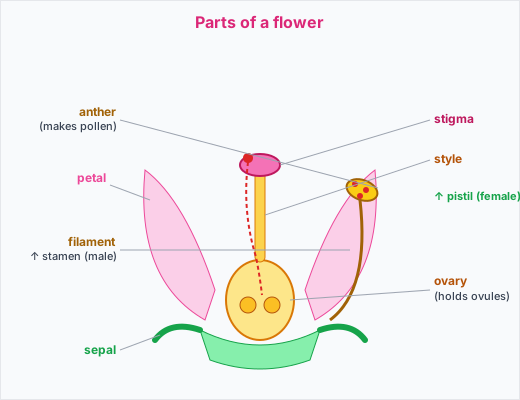
- The stamen is the male part. It is made of the anther and the filament (the stalk that holds the anther up). The anther makes the yellow pollen grains. Pollen grains carry the male gametes.
- The pistil is the female part. It is made of the stigma (the sticky top), the style (the tube below it), and the ovary (the rounded base). The ovary holds tiny ovules, and each ovule has an egg cell inside it.
Now here is how a new plant is made, step by step:
- Pollination is the moving of pollen from the anther to the stigma. The pollen is carried by wind, water, or animals like bees. If the pollen lands on the same flower, it is called self-pollination. If it lands on a different flower, it is called cross-pollination.
- Once pollen reaches the stigma, a thin pollen tube grows from it. This tube goes down through the style and reaches an ovule in the ovary.
- Fertilisation is the joining of the male gamete with the egg cell. The pollen tube delivers the male gamete to the egg, and the two fuse to form a zygote (the first cell of the new plant).
- After this, the zygote grows into an embryo (a baby plant). The ovule becomes a seed with a tough coat around it. The whole ovary becomes a fruit. Later, when conditions are right, the seed germinates — it sprouts and grows into a new plant.
Be careful: pollination and fertilisation are not the same thing. Pollination is only the moving of pollen to the stigma. Fertilisation is the actual joining of the gametes, which happens later. Pollination comes first and makes fertilisation possible. Figure 7.5 below walks through the whole sequence step by step.

Before we move on to humans, a quick check back on the asexual methods — can you remember which organism uses budding?
Asexual reproduction takes place through budding in:
Yeast makes new cells by budding, where a small bud grows out and breaks off (Hydra does this too). Amoeba and Leishmania use binary fission. Plasmodium uses multiple fission.
Reproduction in human beings
Humans reproduce sexually, with a mother and a father. The body becomes ready for this at a stage called puberty. At puberty, the reproductive parts grow up and start working. This happens only after the body has mostly finished growing — the body grows up first, and then becomes ready to reproduce. At puberty, you see signs like new body hair. In girls, the breasts develop and menstruation begins. In boys, facial hair appears and the voice becomes deeper.
Male reproductive system. The testes are the organs that make sperms (the male gametes). The testes hang in a bag of skin called the scrotum, which is outside the main body. Why outside? Because making sperm needs a temperature slightly lower than the rest of the body, and the outside is a bit cooler. The sperms travel through a tube called the vas deferens. Along the way, two glands — the seminal vesicles and the prostate gland — add a fluid. This fluid feeds the sperm and helps them swim. The sperm then leave through the urethra. The same urethra carries urine too, but at different times, not together. A single sperm is mostly genetic material with a long tail that helps it swim.
Female reproductive system. The ovaries are the organs that make eggs (the female gametes). A baby girl is born with thousands of eggs that are not yet ready. After puberty, about one egg becomes ready each month. The ready egg travels down a tube called the oviduct, also called the fallopian tube. Fertilisation happens here, inside the oviduct. The egg then moves on to the uterus (the womb). The uterus opens through a narrow neck called the cervix into the vagina.
What happens if the egg is fertilised? The zygote starts dividing and becomes an embryo. This embryo settles into the soft lining of the uterus and slowly grows into a baby (called a foetus). The growing baby needs food and oxygen, which it gets from the mother’s blood through a special organ called the placenta. The placenta is a disc-shaped organ. It has finger-like villi and blood spaces that give it a very large surface area, so a lot of exchange can happen. Food and oxygen pass from the mother to the baby, and the baby’s waste passes back to the mother. This growth takes about nine months. At the end, the muscles of the uterus squeeze strongly, and the baby is born.
But why does the placenta bother to grow those finger-like villi at all — why not just a smooth, flat join? Because food and oxygen can only cross where the mother’s blood and the baby’s blood actually touch. The bigger that touching surface, the more can pass across each minute. A flat join would have only a small contact surface, so very little could cross — not enough for a growing baby. Folding that same boundary into many finger-like villi packs a far longer contact surface into the same small space. It is the same trick as folding a long towel to fit a small shelf: the towel is just as long, but it now fits in a tiny space. So the villi let a lot of food and oxygen cross without the placenta needing to be huge. Figure 7.6 below compares a flat join with a folded one, side by side.

What happens if the egg is NOT fertilised? Each month, the lining of the uterus becomes thick and full of blood, getting ready in case a baby needs to settle there. If no fertilisation happens, this lining is not needed. So it breaks down and slowly leaves the body through the vagina as blood and mucus. This is called menstruation, and it happens about once a month.
One spot in this whole journey is easy to mix up — the exact place where the egg and sperm actually meet. Test yourself.
Where does fertilisation normally take place in a human female?
The ovary releases the egg. The egg then travels into the oviduct (fallopian tube). This is where the sperm meet it, so fertilisation happens in the oviduct. After that, the fertilised egg moves into the uterus to grow.
Reproductive health
During the sexual act, two bodies come into close contact. Because of this, some infections can pass from one person to another. These are called sexually transmitted infections. Some are caused by bacteria (like gonorrhoea and syphilis) and some by viruses (like warts and HIV-AIDS). A condom is helpful here. It prevents both these infections and pregnancy.
Contraception means stopping an unwanted pregnancy. There are a few ways to do this:
- Barrier methods — things like condoms physically block the sperm, so it cannot reach the egg.
- Hormonal methods — pills that change the body’s hormone balance so that no egg is released. These can have some side-effects.
- Devices — a small device like the copper-T or loop is placed inside the uterus.
- Surgical methods — a doctor blocks the vas deferens in a man, or the fallopian tube in a woman, so the gametes cannot meet.
The textbook also points out a serious social problem. Some families choose to abort a baby just because it is a girl. This is called sex-selective abortion. Over time, it has made the child sex ratio unequal — fewer girls than boys. Finding out the sex of a baby before birth is illegal in India for this reason. A healthy society needs a balanced number of boys and girls.
Common Mistakes
Regeneration is a form of reproduction — Planaria reproduces by being cut up.
A cut piece does grow into a whole organism, so it looks like reproduction.
Regeneration is just the ability to REGROW from a piece. But organisms don't go around getting cut up to make babies. It's really repair, taken to an extreme — NOT a normal way of reproducing. Budding (in Hydra) IS a real way of reproducing.
Pollination and fertilisation are the same thing.
Both happen in the flower, one after the other.
Pollination is only the MOVING of pollen from the anther to the stigma. Fertilisation is the later JOINING of the male gamete with the egg inside the ovule. Pollination happens first and makes fertilisation possible.
Offspring of asexual reproduction show lots of variation.
All reproduction is assumed to produce variety.
Asexual offspring are almost IDENTICAL to their one parent. Only rare copying mistakes make them slightly different. It is SEXUAL reproduction — which mixes the DNA of two parents — that creates lots of variation.
The testes are inside the abdomen like the ovaries.
It seems the body would protect them inside.
The testes sit OUTSIDE the body, in the scrotum. This is because making sperm needs a temperature slightly LOWER than the normal body temperature, and the outside is a little cooler.
Quick Check
The anther of a flower contains:
The anther is the top of the stamen, which is the male part. It makes the pollen grains. Ovules are something different — they sit inside the ovary, which is the female part.
If a woman is using a copper-T, will it protect her from sexually transmitted diseases?
A copper-T sits inside the uterus and only stops pregnancy. It does not stop body fluids from being exchanged between two people. So it gives no protection against STDs. Only a barrier like a condom can help prevent these infections.
Practice Problems
These are written by Curriv and are completely free. Try before revealing.
Easy
How is binary fission different from multiple fission?
- In binary fission, one cell splits into two new cells (for example, Amoeba). “Binary” means two.
- In multiple fission, one cell splits into many new cells all at once (for example, Plasmodium, the parasite that causes malaria).
Name the male and female reproductive parts of a flower.
- The male part is the stamen. It has the anther (which makes pollen) and the filament (the stalk that holds it up).
- The female part is the pistil. It has the stigma (sticky top), the style (the tube), and the ovary (which holds the ovules, and each ovule has an egg cell inside).
Medium
Why is variation beneficial to a species but not necessarily to the individual?
A single variation may not help the individual that has it. It might even harm that individual a little. But think about the whole species. If there are many different variations spread across the group, then when the surroundings suddenly change (for example, a change in temperature, water, or a new disease), at least some of those individuals will have the right features to survive and have babies. So variation keeps the species alive, even if one particular variation does not help the individual carrying it.
How does the embryo get nourishment inside the mother's body?
It gets nourishment through a special organ called the placenta. The placenta is a disc that sits in the wall of the uterus. On the embryo’s side it has finger-like villi, and on the mother’s side there are blood spaces. Together these give a large surface area for exchange. Glucose (food) and oxygen pass from the mother’s blood into the embryo. The embryo’s waste passes back into the mother’s blood, and her body removes it.
Challenge
What are the advantages of sexual reproduction over asexual reproduction?
- More variation: it mixes the DNA of two parents, so it makes new genetic combinations every time. This gives far more variety than asexual reproduction.
- Better survival of the species: this variation is the raw material that lets a species adapt to changing surroundings, and it drives evolution.
(The downside is that it is slower and needs two parents. But for the species, the long-term benefit of all that variation is worth it.)
Why must germ cells (gametes) have only half the number of chromosomes, and how is this achieved?
Imagine each gamete had the full number of chromosomes. Then when two gametes joined, the chromosome number would double in every generation. This would mess up the way the DNA controls the cell, generation after generation.
To stop this from happening, gametes are made by a special cell division called meiosis. Meiosis gives each gamete only half the chromosomes. So when a male gamete and a female gamete join at fertilisation, the two halves add up and the full number is restored in the zygote. This way, the chromosome number stays the same in every generation.
Summary
- Reproduction is not needed to keep one individual alive, but it keeps the whole species going. At its heart it is DNA copying. Since copying is never perfect, it creates variation, which is the raw material for evolution.
- Asexual reproduction uses one parent, and the offspring are almost identical to it. The methods are: binary and multiple fission, budding (Hydra, yeast), fragmentation (Spirogyra), regeneration (Planaria — but this is not true reproduction), spore formation (Rhizopus), and vegetative propagation (potato, Bryophyllum), plus tissue culture in a lab.
- Sexual reproduction uses two parents and makes much more variation by mixing DNA. Meiosis halves the chromosomes in the gametes, so the total number stays the same across generations.
- In flowers: first pollination (pollen moves from anther to stigma), then a pollen tube grows down, then fertilisation (male gamete joins the egg). After that, zygote → embryo → seed, and the ovary → fruit.
- In humans: the testes make sperm (held in the scrotum) and the ovaries make eggs. Fertilisation happens in the oviduct. The embryo grows in the uterus and is fed through the placenta for about 9 months. If there is no fertilisation, the uterus lining sheds as menstruation.
- Reproductive health: condoms prevent both STDs and pregnancy. Other contraceptives are hormonal pills, the copper-T, and surgery. A balanced sex ratio is important, and finding out a baby’s sex before birth is illegal.
What’s Next
Reproduction passes a DNA blueprint, with small variations, from parents to their children. But how exactly are features passed on? Why does a feature sometimes appear in the grandchildren but not in the parents? You will find the answers in Chapter 8: Heredity. There you will learn about Mendel’s experiments with pea plants, about dominant and recessive features, and about how the sex of a baby is decided. In short, you will learn the rules behind why you look like your family, and how variation gets passed down.
Frequently Asked Questions
Why is variation important in reproduction?
Variation means offspring are slightly different from one another and from their parents. This matters for species survival: if all individuals are identical, a single disease, change in temperature, or food shortage could kill every one of them at once. When individuals vary, a few by chance happen to have the feature that lets them survive the change, so the species continues. In short, variation is the species' insurance against an unpredictable world.
What is the difference between asexual and sexual reproduction?
In asexual reproduction, a single parent produces offspring on its own — the offspring are genetically identical clones of the parent. Examples include binary fission in Amoeba and budding in Hydra. In sexual reproduction, two parents contribute genetic material (one sperm, one egg), and the offspring has a mix of both parents' traits. Sexual reproduction is slower and more energy-costly, but it generates far more variation, which helps species adapt.
How does pollination differ from fertilisation in flowering plants?
Pollination is the transfer of pollen grains from the anther (male part) to the stigma (female part) of a flower — it can happen by wind, water, or insects. Fertilisation happens after pollination: a pollen tube grows from the pollen grain down into the ovule, and the male nucleus fuses with the female egg nucleus there. So pollination is the delivery of pollen to the right place, and fertilisation is the actual joining of two nuclei that follows.
What is the function of the placenta during pregnancy?
The placenta is a special organ that forms in the uterus where the mother's blood supply comes very close to the embryo's blood supply, without the two actually mixing. Through this interface, the mother's blood delivers oxygen and nutrients to the growing embryo, and the embryo's blood passes its carbon dioxide and other waste back to the mother for disposal. The placenta is the embryo's complete life-support system while it develops inside the uterus.
Why does menstruation happen every month?
Each month, the lining of the uterus thickens with extra blood vessels and tissue in preparation for a possible fertilised egg to implant and grow. If fertilisation does not happen, the egg breaks down and the thickened lining is no longer needed. The body then sheds this lining along with some blood — that is menstruation. It lasts about 2–8 days, and the cycle then restarts, preparing for the next possible pregnancy.