Heredity
Why This Matters
Maybe you have your mother’s eyes. Maybe you have your father’s nose. Maybe you are tall like your grandfather. A child always looks like its parents in some ways. A human baby has two arms, two eyes, and the same basic body as its parents. But the child never looks exactly like its mother or father. So how does this happen? How do features pass from parents to children? And why is the child still a little different from both parents?
This is the big question of heredity. Heredity means the passing of features from parents to children. These features are called traits. A trait is just one feature, like eye colour or height. For example, “tall” is a trait, and “having dimples” is a trait too.
Heredity is not random or messy. It follows clear, simple rules. A monk named Gregor Mendel found these rules more than a hundred years ago. He grew pea plants and patiently counted them. He did all this even before anyone knew about DNA.
These rules explain many things. They explain why a trait can disappear in the children and then come back in the grandchildren. They explain why two brown-eyed parents can have a blue-eyed child. And here is the most important one: they explain why the father, not the mother, decides whether a baby is a boy or a girl. By the end of this chapter, you will be able to predict the result of a cross using a simple grid called a Punnett square.
The Big Idea
Every trait is controlled by two copies of a gene. A child gets one copy from the mother and one copy from the father. The two copies may be the same, or they may be different. When they are different, only one copy shows up in the body. The one that shows up is the dominant trait. The one that stays hidden is the recessive trait. The hidden trait is not lost. It can show up again in a later generation.
Before we go further, let’s quickly settle what “genes” and “DNA” actually are, so the rest of the chapter makes sense.
Let’s go through this step by step. A child gets genetic material from both parents in roughly equal amounts. (Genetic material is the chemical instructions that build the body.) So for every trait, a child carries two versions. One version comes from the mother. One version comes from the father.
Now suppose the two versions disagree. Say one version is “tall” and the other is “short”. In that case, only one of them shows up in the body. But the other version is still there, hidden inside. And both versions can be passed on to the next child. This is why a hidden trait can come back many generations later.
This one idea is the key to the whole chapter: two copies per trait, only one shows up, but both are passed on.
Let’s Break It Down
Variation accumulates over generations
The word variation means the small differences between living things of the same kind. No two children are exactly alike. That is variation.
Here is how variation builds up. Every time an organism reproduces, the offspring (the children) get the basic body plan from the parents. But they also get tiny new differences. These differences come from small mistakes that happen while DNA is being copied. Now these offspring grow up and reproduce too. Their children carry the old differences and some fresh new ones. So little by little, generation after generation, the differences add up. This is what we mean by variation accumulating.
How much variation builds up depends on how an organism reproduces. So let’s quickly recall the two ways living things make offspring.
The amount of variation depends on the type of reproduction. In asexual reproduction, one parent makes copies of itself. For example, one bacterium splits into two, then four. Here the differences are very small, because they come only from copying mistakes. In sexual reproduction, two parents mix their DNA. This mixing creates much more variation. That is why a field of sugarcane (which is often grown asexually) looks very even, with every plant alike. But a class of 40 students looks very different from one another.
Not all variations are equally useful. Some help the organism survive better. For example, a bacterium that can handle heat will do better during a heat wave. The environment slowly keeps the useful variations and removes the rest. This idea is the starting point of evolution, which is the change in living things over a very long time. The next chapter looks at evolution in detail.
Here’s a quick test of that idea — if a new variation spreads slowly, what does a common trait tell you about its age?
In an asexually reproducing species, trait A is found in 10% of the population and trait B in 60%. Which trait probably arose earlier?
Trait B. In asexual reproduction, a new variation spreads slowly. It can only spread by being passed down through many generations of dividing cells. Trait B is found in 60% of the population. So it has had a lot of time to spread to many individuals. This means it most likely appeared earlier. Trait A is found in only 10%. So it is probably newer. It has not had enough time to spread to many individuals yet.
Mendel and the pea plants
Mendel chose garden pea plants for his experiments. He chose them for a good reason. Their traits came in two clear types, with nothing in between. The seeds were either round or wrinkled. The plants were either tall or short. The flowers were either violet or white. There were no medium or in-between forms. This made the results easy to see.
A “cross” just means breeding two plants together to get offspring. Mendel crossed plants that had opposite traits. Most importantly, he counted the offspring in every generation. This careful counting is what helped him find the hidden pattern.
He began with a simple cross. He took a pure tall plant and crossed it with a pure short plant. (“Pure tall” means a tall plant whose parents and ancestors were all tall. We write it as TT. “Pure short” is written as tt.) The offspring of this first cross are called the F1 generation. F1 just means “first filial generation”, that is, the first set of children.
- F1 result: every single plant was tall. Not medium height. All of them were tall. So the short trait seemed to disappear completely.
Next, Mendel let the F1 tall plants self-pollinate. (Self-pollinate means a plant fertilises itself to make seeds.) The offspring of the F1 plants are called the F2 generation, the second set of children.
- F2 result: about three out of every four were tall, and one out of four was short. The short trait had come back!
Figure 8.1 below traces this whole journey at a glance — the pure parents, the all-tall F1, and the 3:1 split in F2.
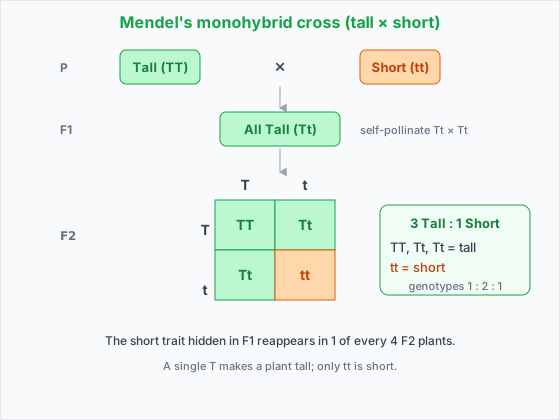
This result told Mendel two important things.
First, the short trait was never really lost. It was only hidden in the F1 plants. Then it came back in the F2 plants.
Second, each plant must carry two factors for each trait. (Today we call these factors genes. A gene is the unit that carries the instructions for a trait.) The tall version is written “T”. The short version is written “t”. The tall version T is dominant. This means even a single T is enough to make a plant tall. The short version t is recessive. This means a plant must have two t’s together (tt) to actually be short.
So now we can explain the F2 plants. A plant can be TT, Tt, or tt. Both TT and Tt look tall, because each has at least one T. Only tt looks short. The three types appear in a 1 : 2 : 1 ratio (TT : Tt : tt). Since both TT and Tt are tall, this looks like 3 tall : 1 short.
This is exactly where students trip up — they think the short trait vanished and then reappeared from nowhere.
The short trait was lost in the F1 generation and a new short trait randomly appeared in F2.
The short trait disappears completely in the F1 plants. Every F1 plant looks tall. So it really does look as if 'short' was lost, and then came back from nowhere in F2.
Nothing was lost. The 'short' factor (t) was hidden inside every F1 plant. Every F1 plant is actually Tt. It carries both factors but only shows the dominant T. Later, when two Tt plants cross, some F2 offspring get tt. In those plants, the recessive short trait shows up again.
Two useful words will help here. The genotype is the actual pair of letters a plant carries, like TT, Tt, or tt. The phenotype is how the plant actually looks, like “tall” or “short”. For example, both TT and Tt have different genotypes but the same phenotype, because both look tall.
There is still a quiet puzzle here. Why does the short trait vanish for a whole generation and then walk right back in? Let’s trace the single short factor — the little t — step by step, and watch where it hides. The short grandparent (tt) hands one t to every F1 plant. But every F1 plant also gets a T from the tall grandparent, so it becomes Tt — tall on the outside, with the t riding along quietly inside. The t is not gone. It is just outvoted by the dominant T. Then, when two Tt plants cross, one unlucky-or-lucky offspring in four happens to collect a t from each parent. With two t’s and no T to hide behind, that plant is short again. The trait “skipped” F1 only because a single T was always there to mask it.
Figure 8.2 below follows that hidden t on its journey — down from the short grandparent, through the all-tall F1, and back into the open in F2.

To see why a trait always comes in a pair of copies, we need one more idea — the special cells that carry just one copy each.
Now let’s put a Punnett square to work and prove the 3:1 ratio for ourselves, step by step.
- List the gametes. (Gametes are the sex cells, like the egg and the pollen.) Each Tt parent makes two kinds of gamete: one with T and one with t.
- Make a 2×2 Punnett square. Write one parent’s gametes across the top. Write the other parent’s gametes down the side. Then fill each box by combining the letter from its row and its column.
- Now read the four boxes: TT, Tt, Tt, tt. That gives a 1 : 2 : 1 ratio.
- Group them by how they look. TT, Tt, and Tt are all tall, because each one has at least one T. Only tt is short.
- So 3 out of 4 are tall, and 1 out of 4 is short. This is exactly the 3:1 ratio Mendel counted. The Punnett square turns a confusing result into simple counting.
Both F1 parents are Tt. Each parent passes only one of its two factors to each offspring. It can pass either T or t, and both have an equal chance. Let’s find every possible result.
| T | t | |
|---|---|---|
| T | TT | Tt |
| t | Tt | tt |
This same logic answers a puzzle from the start of the chapter: how can two brown-eyed parents have a blue-eyed child, when neither parent is blue-eyed? It looks impossible — a trait appearing out of nowhere. But it isn’t. Brown eye colour (B) is dominant, and blue (b) is recessive. A person can look brown-eyed and still be Bb — brown on the outside, carrying one hidden b. Someone who looks like the dominant trait but secretly carries the recessive one is called a carrier. If both parents are Bb carriers, then each can pass down either a B or a b. Run the same Punnett square and one child in four collects a b from each parent. That child is bb — and bb is blue-eyed. No new trait appeared. The blue b was hiding inside both parents the whole time, waiting for two copies to meet.
Figure 8.3 below shows exactly that cross — two brown-eyed Bb carriers, and the one bb child in four who ends up blue-eyed.

Two traits at once — independent inheritance
So far we looked at one trait at a time. What happens if we follow two traits together? Mendel tried this too. He crossed a plant that had round, yellow seeds (RRYY) with a plant that had wrinkled, green seeds (rryy). The F1 plants all had round, yellow seeds. So round (R) is dominant over wrinkled, and yellow (Y) is dominant over green.
Then the F2 generation gave a surprise. As expected, some seeds were round-yellow and some were wrinkled-green, like the grandparents. But there were also new combinations. Some seeds were round-green, and some were wrinkled-yellow. Neither grandparent had these combinations. This showed something important. The seed-shape trait and the seed-colour trait are passed on independently. “Independently” means one trait does not depend on the other. They mix freely. The four types appeared in a ratio close to 9 : 3 : 3 : 1.
Figure 8.4 below shows where that ratio comes from. Each parent now makes four kinds of gamete, so the grid has sixteen boxes — count them and the 9:3:3:1 pattern falls right out.

Here is the lesson. Traits do not travel together in fixed bundles. During sexual reproduction, genes get mixed up and rearranged. This is why offspring can show fresh new combinations that their parents never had. This is yet another source of variation.
Try using that idea yourself — if two traits mix freely, how many different-looking offspring should a two-trait cross produce?
A tall plant with round seeds (TtRr) is crossed. Roughly how many different-looking types of offspring can appear, and why?
Four types can appear: tall-round, tall-wrinkled, short-round, and short-wrinkled. This is because height and seed shape are inherited independently. The two traits mix freely. So you can get a tall plant with wrinkled seeds, or a short plant with round seeds. You are not stuck with only the two combinations the parents had.
Genes, proteins and chromosomes
How does a gene actually control a trait? Let’s see. A gene is a small section of DNA. It carries the instructions to make one protein. (Proteins are the building and working molecules of the body.) Many proteins are enzymes. An enzyme is a protein that speeds up a chemical reaction in the body.
Let’s use plant height as an example. A plant grows because of a hormone. (A hormone is a chemical messenger.) An enzyme is needed to make this growth hormone. Now think about the gene that builds this enzyme. If the gene builds a strong, efficient enzyme, then lots of hormone is made, and the plant grows tall. But if the gene has a small change and builds a weaker enzyme, then less hormone is made, and the plant stays short. So this is how it all connects: genes control proteins, and proteins build the traits.
Now, we said each parent gives an equal share to the child. So each cell must carry two copies of every gene, one copy from each parent. Where do these copies sit? They sit on long threads of DNA called chromosomes. In every body cell, the chromosomes come in pairs. One chromosome of each pair comes from the mother, and the other comes from the father.
But the sex cells are different. Each germ cell (the egg or the sperm) carries only one chromosome from each pair, not the full pair. So when an egg and a sperm join during fertilisation, the pairs are made complete again. And here is the clever part: for each pair, either chromosome can come from either parent. So the genes get mixed independently. This is the machinery that produces Mendel’s results.
Figure 8.5 below ties it all together — where a gene sits, how chromosome pairs split into germ cells, and how fertilisation restores the pair.

How sex is determined in humans
Now we come to the famous part. Humans have 23 pairs of chromosomes. In 22 of these pairs, the two chromosomes match each other well. But the last pair is special. These are called the sex chromosomes, because they decide whether a person is male or female.
- Females are XX. They have two matching X chromosomes.
- Males are XY. They have one X chromosome and one shorter Y chromosome.
Now let’s follow the logic carefully. Remember, a germ cell gets only one chromosome from each pair. A mother is XX. So every egg she makes can only carry an X. A father is XY. So half of his sperm carry an X, and the other half carry a Y. Now look at what happens when an egg meets a sperm:
- Egg (X) + sperm carrying X → child is XX → girl
- Egg (X) + sperm carrying Y → child is XY → boy
Figure 8.6 below lays out both possible crosses side by side, so you can see at a glance why the chance of a boy or a girl is 50:50.
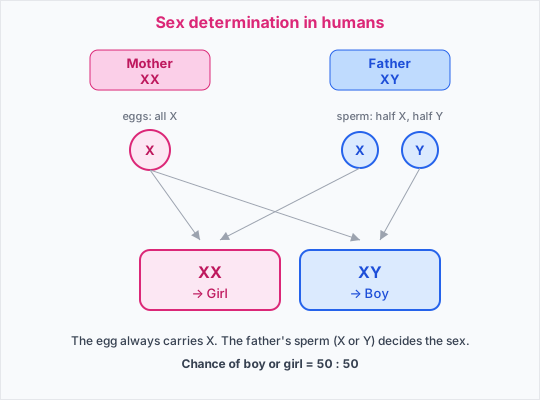
So every child always gets an X from the mother. There is no other option for her. It is the father’s chromosome, X or Y, that decides the baby’s sex. And it is a 50:50 chance each time, just like a coin toss.
The mother is responsible for whether a baby is a boy or a girl.
The mother carries the baby and gives birth to it. So it feels natural to assume she also decides whether it is a boy or a girl. Sadly, the blame is often unfairly put on her.
The mother is XX, so she can only ever give an X. It is the father (XY) who gives either an X (which makes a girl) or a Y (which makes a boy). So it is the father's sperm that decides the sex of the child, with a 50:50 chance.
Common Mistakes
'Dominant' means the trait is stronger, healthier, or more common in the population.
In everyday life, 'dominant' means stronger or more powerful. So it is natural to think the science word means the same thing.
In genetics, 'dominant' only tells us which version shows up when both versions are present. (The recessive one stays hidden unless it is paired with another recessive copy.) It says nothing about being stronger or healthier. It also says nothing about how common the trait is. A dominant trait can be rare, and a recessive trait can be very common. How common a trait is depends on the population, not on dominance.
A tall plant must be TT.
We expect each look to match one exact genotype. So 'tall' feels like it must mean the two matching letters, TT.
A plant needs only one T to look tall. So a tall plant could be TT, or it could be Tt. You cannot tell which one just by looking at it. Only a short plant is certain about its genotype: it must be tt.
Quick Check
In Mendel's cross of pure tall (TT) × pure short (tt), what did the entire F1 generation look like?
Every F1 plant is Tt. T (tall) is dominant, so all of them look tall. The short trait is not lost. It is only hidden. It comes back later, in the F2 generation.
Two parents who both have free earlobes have a child with attached earlobes (the recessive trait). What does this tell you about the parents?
The child has the recessive trait, so the child must have two recessive copies. That means the child got one recessive factor from each parent. So both parents must carry a hidden recessive factor. They are called carriers. They show the dominant trait, but they secretly carry the recessive one.
Who determines the sex of a child in humans, and why?
The mother (XX) always gives an X. The father (XY) gives either an X (which makes a girl) or a Y (which makes a boy). So it is the father’s chromosome that decides the sex.
Practice Problems
A Mendelian cross bred tall pea plants with violet flowers and short pea plants with white flowers. All the progeny had violet flowers, but almost half were short. Write the genetic make-up (genotype) of the tall, violet parent.
Let’s look at each trait one at a time.
Flower colour: all the offspring were violet. So violet is dominant. Also, the violet parent gave only violet offspring. So it must carry two violet copies. We write this as WW.
Height: almost half the offspring were short. Short is recessive, so a short plant must be tt. This means each short offspring got a “t” from each parent, including the tall parent. So the tall parent must carry one T and one t. We write this as Tt. (If the tall parent were TT, no offspring could be short.)
So the tall, violet parent is TtWW. (This is option (c) in the NCERT exercise.)
A man with blood group A marries a woman with blood group O, and their daughter has blood group O. From this single family, can you decide whether blood group A or O is dominant? Explain.
No, this one family is not enough to decide.
The daughter is group O. So she carries two O factors, one from each parent. She got one O from her mother (who is group O). So she must have got her other O from her father. This means the father shows group A, but he also secretly carries an O factor.
So this tells us the father is a carrier. But it does not tell us which trait is dominant. To know that, we would need to look at many families, not just one. A single cross cannot prove dominance. You need to count results across a large population, just as Mendel did.
(In fact, A is dominant over O. But this one family alone does not prove it.)
A study found that children with light-coloured eyes usually have parents with light-coloured eyes. Can we conclude from this whether the light-eye trait is dominant or recessive? Why or why not?
No, we cannot decide dominance from this observation alone.
Light-eyed children tend to have light-eyed parents. This only shows one thing: the trait is inherited. In other words, it runs in families. But it does not tell us whether light is dominant or recessive.
Let’s think about why. Suppose light eye colour is recessive. Then a light-eyed child must carry two recessive copies, one from each parent. If both parents are also light-eyed, this fits the pattern perfectly. But here is the catch: the very same family pattern could also happen if light were dominant. So the pattern fits both cases.
To really decide, you would need to follow crosses across several generations and count the ratios of the different offspring types. For example, you could look at the children of parents who have opposite eye colours and see which version stays hidden. In short, a family pattern shows that a trait is inherited. It does not show which trait is dominant.
Summary
- Heredity is the passing of traits from parents to children. It follows clear rules. Mendel found these rules using pea plants, by counting the offspring.
- Each trait is controlled by two copies of a gene, one from each parent. When the two copies are different, the dominant version shows up and the recessive one stays hidden. The hidden one is not lost.
- Crossing pure tall (TT) with pure short (tt) gives an all-tall F1 (Tt). Letting the F1 self-pollinate gives an F2 in a 3 : 1 ratio (tall : short). The genotypes are 1 TT : 2 Tt : 1 tt. A Punnett square helps you predict this.
- Two traits are inherited independently (about 9 : 3 : 3 : 1). This makes new combinations in F2, which is a major source of variation.
- Genes are sections of DNA that carry instructions to make proteins. They sit on chromosomes, which come in pairs. Germ cells carry one chromosome from each pair, and the pair is made complete again at fertilisation.
- In humans, females are XX and males are XY. The child always gets an X from the mother. The father’s sperm (X or Y) decides the sex, with a 50:50 chance.
What’s Next
You have now seen how variations are created and passed on. These variations are the raw material of life. Next, the syllabus moves into physics. In Chapter 9: Light — Reflection and Refraction, you will learn how mirrors and lenses bend light to form images. You will see why a spoon in a glass of water looks bent. And you will learn the formulas that let you predict exactly where an image will appear. The careful, step-by-step thinking you used for Punnett squares is the same kind of thinking you will use for ray diagrams.
Frequently Asked Questions
What did Mendel discover from his pea plant experiments?
Mendel found that traits are inherited in predictable patterns governed by two copies of an 'instruction' (what we now call a gene), one from each parent. He showed that when a tall plant and a short plant are crossed, all the offspring in the first generation (F1) are tall — but the 'short' instruction is not lost. When F1 plants breed with each other, the short trait reappears in the second generation (F2) in a 3:1 ratio (3 tall : 1 short). This proved that traits are inherited as separate, discrete units.
What is the difference between dominant and recessive traits?
Every organism carries two copies of the gene for each trait. A dominant trait is one that shows up in the body even if only one copy of that version is present — it 'dominates' the other copy. A recessive trait only shows up when both copies are the recessive version; if even one dominant copy is present, the recessive trait stays hidden. For example, in pea plants, the gene for tall (T) is dominant over the gene for short (t): a plant that is Tt looks tall, not short.
How do you use a Punnett square to predict the outcome of a cross?
A Punnett square is a simple grid. Write one parent's possible gametes (reproductive cells, each carrying one gene copy) across the top, and the other parent's possible gametes down the side. Then fill each box by combining the letter from the top with the letter from the side. Each box shows one possible offspring genotype, and all boxes are equally likely. Count how many boxes show each result to get the ratio — for example, a Tt × Tt cross gives one TT box, two Tt boxes, and one tt box, a 3:1 ratio of tall to short.
Why is it the father who determines whether a baby is a boy or a girl?
Human sex is determined by two chromosomes: X and Y. Females have two X chromosomes (XX) and males have one X and one Y (XY). A mother can only pass on an X chromosome in her egg. A father can pass on either an X (from his X chromosome) or a Y (from his Y chromosome) in his sperm. If a Y-carrying sperm fertilises the egg, the baby is XY (boy); if an X-carrying sperm fertilises the egg, the baby is XX (girl). Because the father's sperm determines which sex chromosome reaches the egg, it is the father's contribution that decides the sex of the child.
Why can two brown-eyed parents have a blue-eyed child?
Eye colour (like many traits) can be dominant or recessive. Brown-eye colour (B) is dominant over blue (b). If both parents are 'Bb' — they carry one copy of brown and one of blue — they each appear brown-eyed because B dominates. But when they have children, there is a 1-in-4 chance that a child inherits 'bb' from both parents, which means only recessive blue-eye instructions, so that child has blue eyes. The recessive blue-eye trait was 'hiding' in the parents; it could only show up when both parents happened to pass on their recessive copy.