Our Environment
Why This Matters
Look around you. Grass, insects, a tiger, the soil, the air, the sunlight. They all depend on each other. The grass needs sunlight. The insect eats the grass. The tiger eats animals that eat the grass. If you remove one of them, the others are affected too. All of these living and non-living things together are called the environment. And you are a part of it.
This chapter connects to things you see in the news. Pesticides are sprayed on a field. So why do they end up inside the fish you eat? Years ago there was a worldwide worry about a “hole in the ozone layer”. Why? A plastic wrapper stays in the ground for hundreds of years, but a banana peel rots away in a few weeks. Why the difference? These may look like separate stories. But they all come from the same two ideas: how energy and food move through nature, and what goes wrong when humans disturb that flow.
This is not just for the exam. Once you understand it, you think twice before throwing a wrapper on the ground. Because now you know exactly where it goes and how long it stays.
The Big Idea
An ecosystem means living things and their non-living surroundings working together as one system. The living things are called biotic. The non-living things are called abiotic. Energy moves through this system in one direction. It comes from the Sun, goes to plants (producers), then to animals (consumers). At each step, about 90% of the energy is lost, and only about 10% moves on. But food materials (nutrients) are different. They are recycled again and again by decomposers. When humans disturb this system — by spraying pesticides, releasing CFCs, or dumping plastic and other non-biodegradable waste — the whole system suffers.
There are two flows here. Keep them separate in your mind. First, energy flows in and is lost. It goes one way only: Sun → plants → animals → and finally escapes as heat. It never comes back. Second, nutrients go round and round in a cycle: soil → plants → animals → decomposers → back to soil. Almost everything in this chapter is built on these two ideas.
Let’s Break It Down
What is an ecosystem?
An ecosystem is all the living things in one area, together with the non-living things around them. They all interact with each other and work as one unit. (An organism just means any living thing — a plant, an animal, a tiny germ.)
The parts of an ecosystem are of two types:
- Biotic components — the living parts. For example, plants, animals, and tiny living things like bacteria.
- Abiotic components — the non-living, physical parts. For example, temperature, rainfall, wind, soil, and minerals.
A garden, a forest, a pond, and a lake are all ecosystems. Some ecosystems are natural, like a forest or a pond. They run on their own, without any human help. Others are artificial, like a garden, a crop field, or an aquarium. These are made and looked after by humans.
Inside an ecosystem, living things have three main jobs, based on how they get their food:
- Producers — green plants and some bacteria. They make their own food from sunlight, through a process called photosynthesis. They are the starting point of all food, so they sit at the base of everything.
But how exactly does a plant turn sunlight into food? Here is a quick reminder from Life Processes before we go on.
- Consumers — living things that cannot make their own food, so they eat producers or other consumers. There are different kinds. Herbivores eat only plants (like a cow or deer). Carnivores eat only meat (like a lion). Omnivores eat both plants and meat (like humans). Parasites live on or inside another living thing and take food from it (like a tapeworm).
- Decomposers — bacteria and fungi. When a plant or animal dies, decomposers break down its dead body and waste into simple substances. These simple substances go back into the soil, and plants use them again. So decomposers act like nature’s cleaners and recyclers.
Food chains, food webs and trophic levels
A food chain is a line of living things, where each one eats the one before it. For example: grass → deer → tiger. The grass is eaten by the deer, and the deer is eaten by the tiger. Each feeding step in this line is called a trophic level — it is simply the position of an organism in the food chain, based on what it eats.
Stacked up, these levels form a pyramid — wide at the bottom, narrow at the top. Figure 13.1 below shows why, and names each level.
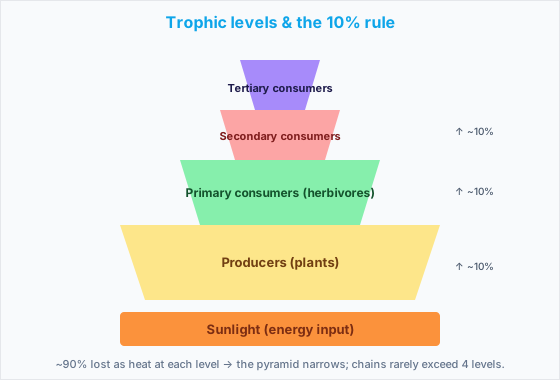
- 1st level — Producers (the green plants). Sunlight falls on their leaves. They catch only about 1% of that sunlight and turn it into food energy.
- 2nd level — Primary consumers. These are the plant-eaters (herbivores).
- 3rd level — Secondary consumers. These are small meat-eaters that eat the herbivores.
- 4th level — Tertiary consumers. These are large meat-eaters that eat the smaller meat-eaters.
Now here is the most important rule of this chapter, called the 10% rule. When one trophic level is eaten by the next, only about 10% of its energy is passed on. The other 90% is lost. It is used up as heat, and in digesting food, moving about, and other life activities. So very little energy is left at each step. Because of this, a food chain almost never has more than three or four steps. There simply isn’t enough energy left to support a fifth level.
But why exactly 10%? Where does the missing 90% actually go? It does not vanish — it slips away in four ordinary ways. Think of a deer that eats 100 units of energy from grass. A big chunk is lost as body heat: the deer’s body stays warm, and that warmth keeps glowing away into the cool air. Another chunk is burned just to stay alive — walking, breathing, digesting, and pumping blood all cost energy. A third chunk simply passes out as dung and waste, because the deer cannot digest every part of the grass. After all that leaks away, only about 10 units are left stored inside the deer’s body as new flesh. And new flesh is the only part a tiger can eat. So when the tiger eats the deer, it can collect at most those 10 units. That is the whole reason only about 10% moves up. The next animal can never eat the heat that has already escaped, or the energy already burned, or the dung.
Figure 13.2 below follows those 100 units and shows each leak, so you can see the 10% appear on its own.

This also explains why chains stay short. Start the chain with 10,000 units and you reach 10 units by the fourth level. A fifth level would have only about 1 unit to share — far too little to feed a whole population of animals.
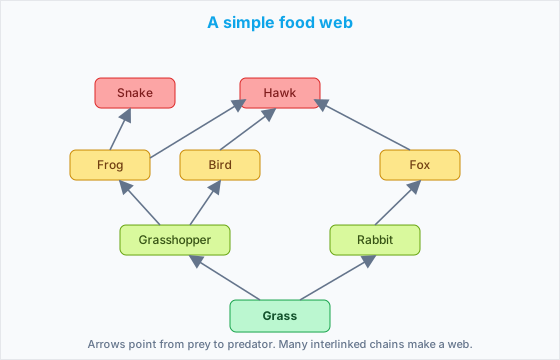
In real life, things are not so neat. One animal is usually eaten by several different animals, and it also eats several different things. So these straight food chains cross and join with each other. Many food chains linked together like this form a food web. Figure 13.3 below shows one.
Let’s put the 10% rule to work and watch how fast the energy shrinks across just a few steps.
Producers in a field capture 10,000 units of energy. Using the 10% rule, how much reaches a tertiary consumer (4th trophic level)?
- Remember the rule: each step passes on only 10% (one-tenth) of its energy to the next step.
- Producers to primary consumer: 10% of 10,000 = 1,000 units. Primary to secondary consumer: 10% of 1,000 = 100 units.
- Secondary to tertiary consumer: 10% of 100 = 10 units. So the energy fell from 10,000 all the way down to 10 in just three jumps. This is why top meat-eaters are so few in number, and why food chains stay short.
Energy flow is one-way
The flow of energy has two main features:
- It is one-way (the science word is unidirectional). Energy goes from the Sun to producers to consumers, and it never comes back. Once energy leaves a level, it is gone from that level forever.
- It gets smaller at every level, because about 90% is lost at each step. This is the exact reason the energy pyramid gets narrower as you go up, and why food chains are short.
Biological magnification
Here is a worrying part of the story. Farmers spray pesticides and other chemicals on their crops to kill pests. These chemicals wash into the soil and water. Plants take them in, and so the chemicals enter the food chain. The problem is that many of these chemicals do not break down. They stay inside the body of any animal that eats them.
Now think about what happens up the food chain. A small fish eats many tiny plants, so it collects all their chemicals. A big fish eats many small fish, so it collects even more. So the chemical builds up more and more at each higher trophic level. And humans sit at the top of most food chains. This means the largest amount of chemical ends up in our bodies. This step-by-step build-up of chemicals up the food chain is called biological magnification (also written as biomagnification). It is the reason why grains, vegetables, fruit, and even meat often carry small amounts of pesticide, and why simply washing them does not remove it all.
You can actually see this build-up in Figure 13.4 below — watch the toxin dots grow more crowded at each step up the chain.

Ozone layer and its depletion
Ozone (O₃) is a gas. Its molecule is made of three oxygen atoms joined together. (Normal oxygen, the kind we breathe, is O₂, with only two atoms.) Down here near the ground, ozone is harmful to breathe. But high up in the atmosphere, ozone does a very important job. It acts like a shield. It stops most of the Sun’s harmful ultraviolet (UV) rays from reaching Earth. These UV rays can cause skin cancer and other damage to living things.
How does this ozone form high up? UV light hits a normal oxygen molecule (O₂) and splits it into two separate oxygen atoms. Each free oxygen atom then joins another O₂ molecule to make ozone (O₃):
O₂ → (UV) → O + O, then O + O₂ → O₃
In the 1980s, scientists found that the amount of ozone was dropping fast. The cause was a group of man-made chemicals called chlorofluorocarbons (CFCs). CFCs were used in refrigerators and fire extinguishers.
But here is the puzzle that worried scientists most: only a tiny amount of CFC was floating up there, so how could it destroy so much ozone? The answer is that one CFC does not just break one ozone molecule and stop. It sets off a chain reaction that repeats again and again. Here is how. High up, sunlight (UV) hits a CFC and knocks loose a single chlorine atom (Cl). This free chlorine then smashes into an ozone molecule (O₃), steals one of its oxygen atoms, and leaves behind ordinary oxygen (O₂). The ozone is now destroyed. The chlorine is now stuck to that oxygen as ClO. So far that is one ozone gone. But then the ClO bumps into a loose oxygen atom, hands over its oxygen — and the chlorine atom is set completely free again, exactly as it started. Now it is ready to attack the next ozone. And the next. And the next. Because the chlorine keeps coming back unharmed, a single chlorine atom can go on to destroy thousands of ozone molecules before it finally settles. That is why such a small amount of CFC did such huge damage.
Follow the chlorine atom in Figure 13.5 below — notice how the dashed loop sends it back to attack ozone over and over.

To stop the damage, the countries of the world came together. In 1987 the United Nations made an agreement called the Montreal Protocol. It aimed to slowly stop the making of CFCs. Today, fridges must be made without CFCs everywhere in the world.
Biodegradable and non-biodegradable waste
To understand this, you need one idea: enzymes are specific. An enzyme is a chemical inside living things that breaks down substances. But each enzyme can break down only one particular kind of substance, not just anything. This is why we cannot digest coal, and why bacteria cannot break down many man-made materials — there is no enzyme that fits them.
This gives us two kinds of waste:
- Biodegradable substances can be broken down by living things (bacteria and other decomposers). For example: vegetable peels, paper, leftover food, leather, and wood. (“Bio” means life, so biodegradable means “broken down by living things”.)
- Non-biodegradable substances cannot be broken down by living things. For example: plastics, glass, and metals. They stay in the environment for a very long time and can harm ecosystems.
Figure 13.6 below puts the two side by side, so you can see how differently they end up — one recycled in weeks, the other lingering for centuries.

Now try sorting a real bin. Watch how one simple question tells you which pile each item belongs in.
Sort this waste into biodegradable and non-biodegradable: banana peel, plastic bottle, newspaper, broken glass, leftover rice.
- For each item, ask one simple question: can bacteria and fungi break this down?
- Biodegradable (yes, decomposers can break them down): banana peel, newspaper, leftover rice.
- Non-biodegradable (no, they stay for a long time): plastic bottle, broken glass. These need recycling or careful disposal. Just burying them does not help — it only hides them for hundreds of years.
Common Mistakes
A few ideas in this chapter trip up almost everyone. Here are the four that catch students most often, starting with the easiest mix-up of all.
Energy goes round and round in an ecosystem, the same way nutrients do.
Energy and nutrients are both taught as things that 'flow through the food chain', so it feels natural to think they behave the same way.
They are different. ENERGY flows one way only and is slowly lost as heat (Sun → producers → consumers). It does not come back. But MATTER and nutrients go round and round in a cycle, because decomposers recycle them back to the soil.
Ozone is always harmful, so losing the ozone layer is a good thing.
Students usually hear the word 'ozone' as a harmful gas in city smog and pollution. So they think ozone is bad everywhere, including the ozone layer.
Whether ozone is good or bad depends on where it is. High up in the atmosphere it shields us from harmful UV rays. So losing that layer is dangerous — more UV reaches Earth and causes skin cancer and other harm. Only ozone near the ground is a pollutant.
Biological magnification means the chemical gets weaker (more diluted) as it moves up the food chain.
It feels like a small amount of chemical spread across a big food chain would get shared out and become weaker. Also, the word 'magnification' does not clearly tell you it means 'getting more concentrated'.
The truth is the opposite. Chemicals that do not break down BUILD UP and become STRONGER (more concentrated) at each higher trophic level. So the top consumers, like humans, get the most.
Anything that looks natural, like a kulhad (clay cup) or paper cup, must be good for the environment.
Earthy, natural-looking things feel harmless just by their looks. So people think 'looks natural' means 'good for the planet'.
Judge a thing by its full effect, not by how it looks. For example, making clay kulhads in huge numbers destroys fertile topsoil. The best choice is usually to reduce and reuse, rather than use any throwaway item, even one that looks natural.
Quick Check
Before moving to practice, test yourself on the four big ideas — energy, decomposers, the ozone layer, and waste.
In a food chain, roughly what fraction of energy is passed from one trophic level to the next?
What is the role of decomposers in an ecosystem?
Why is the depletion of the ozone layer a serious concern?
Which group contains only biodegradable items?
Now put two ideas together in your own words. Try to explain this one fully before reading the answer.
Humans sit at the top of most food chains. Use the idea of biological magnification to explain why this is risky when crops are sprayed with non-degradable pesticides.
These pesticides do not break down. So once an organism takes them in, they stay inside its body and do not leave. As you move up the food chain, each level eats many organisms from the level below. This means the chemical builds up and becomes more concentrated at every step. This is biological magnification. Humans are at the top of the food chain, so we get the highest amount of these chemicals. They build up in us through everything we eat — grains, vegetables, fruit, and meat. This is why the pesticide left in our food is a real health worry, and why you cannot simply wash it off.
Practice Problems
Try each question on your own first, then tap to check your working. They run from easy to challenge.
What are trophic levels? Give an example of a food chain and name the trophic levels in it.
A trophic level is each feeding step in a food chain. It is the position of an organism in the chain, based on what it eats. Example food chain: grass → grasshopper → frog → snake.
- Grass = producer (1st trophic level)
- Grasshopper = primary consumer / herbivore (2nd)
- Frog = secondary consumer (3rd)
- Snake = tertiary consumer (4th)
Give two ways in which non-biodegradable substances affect the environment.
Any two of these: (1) They stay for a very long time. They pile up as litter and fill landfills. (2) They can harm or kill living things — for example, animals choking on plastic, or chemicals entering the food chain. (3) These chemicals go through biological magnification, becoming more concentrated up the food chain. (4) They can pollute soil and water, making soil less fertile and harming animals that live in water.
What will happen if we kill all the organisms in one trophic level?
The whole ecosystem gets disturbed, because all the levels depend on each other.
- If you remove the producers (plants), every level above them has no food, so they all starve. The whole chain collapses.
- If you remove the herbivores, two things happen. The plants (their food) grow out of control. And the meat-eaters above them lose their prey, so they starve.
- If you remove the top meat-eaters, the herbivores below them grow in number without check, and eat up too many plants. So removing any one level upsets the balance. The levels below it tend to grow in huge numbers, and the levels above it tend to starve.
Producers in an ecosystem trap 20,000 J of energy. How much energy is available to a secondary consumer? (Use the 10% rule.)
Apply the 10% rule at each step, starting from the producers.
- Producers → primary consumer: 10% of 20,000 = 2,000 J.
- Primary consumer → secondary consumer: 10% of 2,000 = 200 J. So the secondary consumer gets only 200 J out of the 20,000 J the producers started with.
Why is damage to the ozone layer a cause for concern, and what step has been taken to limit it?
Why it is a concern: The ozone layer high in the atmosphere soaks up the Sun’s harmful ultraviolet (UV) rays. These UV rays cause skin cancer, eye problems (cataracts), and damage to crops and sea life. If the ozone layer becomes thin, more UV reaches Earth’s surface and harms living things. Step taken: Scientists found that CFCs were the main cause. In 1987 the United Nations reached an agreement called the Montreal Protocol. It aimed to slow down and stop the making of CFCs. Today, fridges must be made without CFCs all over the world.
If all the waste we generated were biodegradable, would there be no impact on the environment? Explain.
No, there would still be an impact. Here is why:
- Biodegradable waste still takes time to break down. In huge amounts, it piles up, gives off bad smells, and becomes a breeding place for flies, mosquitoes and germs that cause disease.
- Breaking down waste uses up oxygen. In ponds and rivers, this can leave too little oxygen for fish and other water animals, and they can die.
- Rotting waste gives off gases like methane (a gas that adds to global warming), and it can pollute the water under the ground. So even biodegradable waste needs to be managed properly, for example by composting. “Biodegradable” does not mean “harmless.”
Summary
- An ecosystem = biotic (living) parts + abiotic (non-living) parts, all working together as one. It can be natural (forest, pond) or artificial (garden, aquarium).
- Living things have three jobs: producers make their own food, consumers eat others, and decomposers break down dead matter and return it to the soil.
- A food chain is a line of feeding steps (each step is a trophic level). Many food chains joined together form a food web.
- Energy flows one way and keeps getting smaller. Only about 10% passes to the next level (the 10% rule), so chains are limited to 3 or 4 steps. Matter, though, is recycled by decomposers.
- Biological magnification: chemicals that do not break down (like pesticides) become more concentrated up the food chain. Humans, at the top, get the most.
- The ozone layer shields Earth from UV rays. CFCs made it thin. This led to the 1987 UN agreement to stop making CFCs.
- Waste is either biodegradable (broken down by decomposers) or non-biodegradable (stays for a long time and harms the environment). Both need to be managed responsibly.
What’s Next
This is the end of your Class 10 Science journey. You started with the chemistry of carbon and reactions. Then you learned about life processes and how living things reproduce and pass on features. After that came light, electricity, and magnetism. And now you have reached the whole living planet that you are part of.
See how this last chapter ties everything together. Photosynthesis, which you learned in Life Processes, is what builds the producers. Energy, from the Electricity chapter, flows and slowly turns into heat. And chemistry explains why CFCs and plastics behave the way they do. So science is not a set of separate boxes. It is one connected way of understanding the world. Keep asking why, keep noticing how things link up, and you will keep learning long after the syllabus is over.
Frequently Asked Questions
What is the 10 percent rule in a food chain?
The 10 percent rule says that when energy moves from one trophic level to the next, only about 10% of the energy gets passed on — the remaining 90% is lost mainly as heat during the organism's life activities (movement, body maintenance, etc.). For example, if grass stores 1000 J of energy, a deer eating that grass can use only about 100 J, and a tiger eating the deer can use only about 10 J. This is why food chains rarely have more than four steps — almost all the original energy is gone by then.
What is biological magnification and why are pesticides more harmful to animals at the top of a food chain?
Biological magnification means that certain chemicals (like pesticides) build up in larger and larger concentrations as they move up the food chain. A pesticide sprayed on a field is present in tiny amounts in each plant. Herbivores eat many plants, so the pesticide accumulates in their bodies. Carnivores eat many herbivores, concentrating the chemical further. By the time the pesticide reaches a top predator (or a human eating fish), its concentration can be thousands of times higher than in the original environment — high enough to cause serious harm.
How does the ozone layer protect us and why is its depletion dangerous?
The ozone layer is a region high in the atmosphere (the stratosphere) where ozone molecules (O₃) absorb most of the Sun's harmful ultraviolet (UV) radiation before it reaches the Earth's surface. UV radiation damages DNA in living cells, so it causes skin cancer, eye damage, and harms other organisms too. When ozone is depleted — mainly by chemicals called CFCs (chlorofluorocarbons) from old refrigerators and spray cans — more UV reaches Earth's surface, increasing the risk of these harms.
What is the difference between biodegradable and non-biodegradable waste?
Biodegradable waste is broken down by decomposers (bacteria and fungi) into simple, harmless substances that go back into the soil. Examples: food scraps, paper, plant matter, and animal waste. Non-biodegradable waste cannot be broken down by natural decomposers — it stays in the environment for decades or centuries. Examples: plastics, glass, metals, and many synthetic chemicals. Non-biodegradable waste is harmful because it piles up, pollutes soil and water, and can concentrate in food chains through biological magnification.
Why are decomposers essential to an ecosystem?
Decomposers (bacteria and fungi) break down the dead bodies and waste of plants and animals into simple chemical substances. These substances return to the soil and air, where plants can absorb them again as nutrients. Without decomposers, dead material would pile up endlessly and the nutrients locked inside dead organisms would never be recycled — the soil would become depleted and plants could no longer grow. Decomposers are the recyclers that keep the nutrient cycle running.