The Parliamentary System: Legislature and Executive
Why This Matters
Who makes the rules for our whole country?
Think about your school. Someone decides the rules. Someone makes sure the rules are followed. And someone settles fights when there is a problem. A whole country needs the same three jobs, but much, much bigger.
India is a huge country. Over a billion people live here. Roads, schools, hospitals, taxes, the army — all of it needs rules. And someone must run all of it every single day.
So who decides our laws? Who runs the country? And how do we stop any one person from grabbing all the power? These are big questions. Our Constitution (the big book of rules for India) answers them.
The answer is the parliamentary system. It is the way India shares power so that no single person becomes a king. Power is split up. Leaders are chosen by us. And leaders must answer to us.
In this chapter, you will meet the Parliament — the place where our laws are born. You will see how a simple idea travels a long road to become a law. And you will learn the difference between the people who make laws and the people who run the country. By the end, you will understand how India governs itself.
The Big Idea
India’s government does not put all power in one pair of hands. Instead, it splits the work three ways. The legislature (the Parliament) makes the laws. The executive (the President, the Prime Minister and the Council of Ministers) runs the country and puts those laws into action. The judiciary (the courts) checks that everyone follows the Constitution. The Parliament itself has two houses — the Lok Sabha (chosen directly by the people) and the Rajya Sabha (chosen by the states). This sharing and checking is what keeps India a democracy: power flows from the people, and leaders must always answer back to the people.
Let’s Break It Down
What is the Parliament?
Let us start with a simple idea. In a democracy, the people are the boss. But over a billion people cannot all sit in one room and make laws together. That is impossible.
So we do the next best thing. We choose representatives. A representative is a person we pick to speak and act for us. We vote for them. The ones who win go to a big meeting place in Delhi to make laws on our behalf.
That big law-making body is called the Parliament. It is the supreme law-making body of India. “Supreme” means the highest — no other body in the country can make laws above it.
Here is the chain of trust. The people vote. The winners become Members of Parliament (we call them MPs). The group with the most MPs forms the government. So the government is really running with the people’s permission. That permission is the whole point.
Before we go further, let us refresh one idea you met earlier.
One more important word. Every adult Indian citizen gets to vote, no matter how rich or poor, man or woman, of any religion or background. This right is called Universal Adult Franchise (“franchise” is an old word for the right to vote). It means every adult counts the same — one person, one vote. This is what makes the choosing fair.
The two houses: Lok Sabha and Rajya Sabha
Now here is something interesting. The Parliament is not one room. It has two houses (a “house” here means a chamber, a hall where members sit and debate). A two-house system has a special name: bicameral. Break the word up — “bi” means two, and “cameral” means chamber. So bicameral simply means “two chambers”.
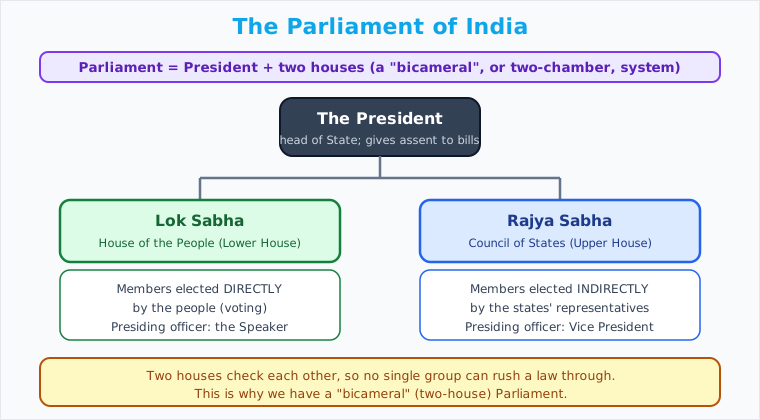
The Parliament is made of the President plus these two houses. Figure 6.1 below shows this whole structure. Take a look first, and then we will go through each part.
Let us meet the two houses.
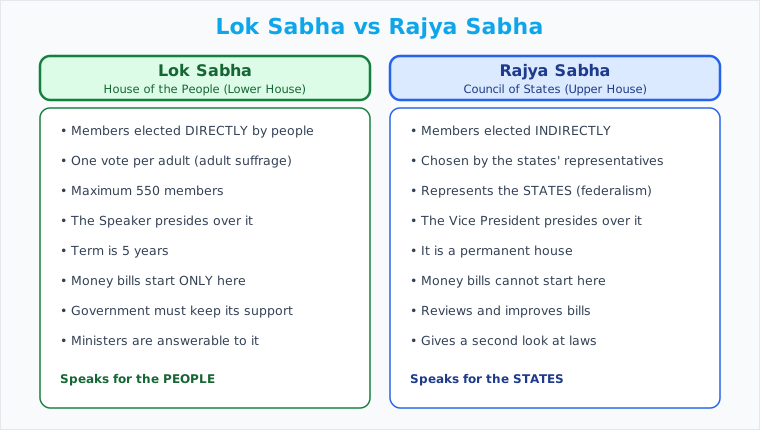
The Lok Sabha is the House of the People. It is also called the Lower House. Its members are chosen by you and me — by direct voting. Every adult votes, and the winners become MPs of the Lok Sabha. The Constitution allows it a maximum of 550 members. Because it comes straight from the people, the Lok Sabha is the voice of the people.
The Rajya Sabha is the Council of States. It is also called the Upper House. Its members are not chosen by direct public voting. Instead, they are chosen indirectly — the elected representatives of each state pick them. So the Rajya Sabha is the voice of the states.
But wait — why do we need a second house at all? Would one house not be simpler?
The Constitution makers thought hard about this. They felt one house, chosen only by direct vote, was not enough for a country as big and varied as India. India is a federal country. That means power is shared between the centre (the union government), the states, and local bodies. This balance keeps the whole country united while letting each state have a say.
So a second house was created on purpose, to give the states a special voice. The Rajya Sabha makes sure the smaller and quieter states are heard, and not just bulldozed by the bigger ones. It also takes a calm “second look” at every law, which catches mistakes. Two houses checking each other is safer than one house deciding alone.
Each house needs someone to run its meetings in an orderly way. We call this person the presiding officer. In the Lok Sabha, the members elect a Speaker. The Speaker conducts the sessions, decides who may speak, keeps discipline, and makes sure the rules are followed. The Rajya Sabha is presided over by the Vice President of India, who acts as its chairperson.
Let us put the two houses side by side so the differences are crystal clear. Figure 6.2 below compares them point by point.
Here is a quick table you can use to revise the two houses together.
| Aspect | Lok Sabha (House of the People) | Rajya Sabha (Council of States) |
|---|---|---|
| How members are chosen | Directly, by the people voting | Indirectly, by the states' representatives |
| Whom it speaks for | The people | The states |
| Presiding officer | The Speaker | The Vice President |
| Maximum members | 550 | Set by the Constitution, smaller, based on state population |
| Money bills | Can start only here | Cannot start here |
The legislature and the executive (and why they are separate)
Now we reach the heart of the chapter. There are two big jobs in running a country.
The first job is to make the laws. The second job is to run the country and put those laws into action. These are different jobs, done by different groups. The Constitution gives them different names.
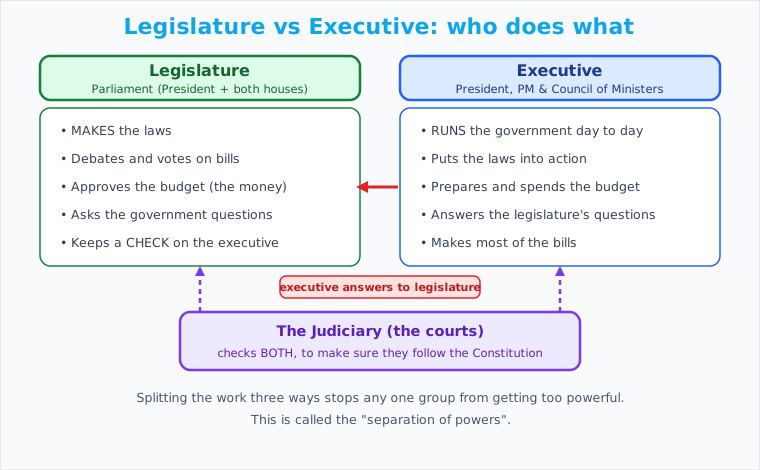
- The legislature is the law-making body. That is the Parliament (the President plus the two houses). “Legislate” means to make laws.
- The executive is the law-running body. That is the President, the Vice President, and the Council of Ministers led by the Prime Minister. “Execute” means to carry out or do.
Think of it like building a house. The legislature is like the people who draw the plan and decide what the house should be. The executive is like the builders who actually build it brick by brick. Planning and building are two different jobs.
But here is the deep question NCERT often skips: why keep them separate at all? Why not let one powerful group both make the laws and run the country?
The answer is about safety. Imagine if the same small group could write any rule it liked and enforce it however it wished, with no one to question them. That group could easily turn into a tyrant. It could make unfair laws and force them on everyone. There would be no check.
So we deliberately split the power. This splitting has a name: separation of powers. When the work is shared, each part can watch the others. The legislature can question the executive. The executive must answer. And as we will see, the courts watch both. No single part can grow too powerful. This is the quiet genius of the system — it protects your rights by making sure power is never all in one place.
Figure 6.3 below lays out exactly who does what, and shows the checks between them.
The President, the Prime Minister, and the Council of Ministers
Let us look more closely at the executive — the group that actually runs the country. It has a clear order.
At the top sits the President. The President is the Head of State — the highest, most respected post in the country. The President appoints the Prime Minister and the other ministers, calls (or “summons”) the Parliament to meet, and gives assent to bills (assent means the final yes that turns a bill into a law).
But here is a point that surprises many students. The President is the nominal head of the executive. “Nominal” means in name. The President holds the top position, but does not run the country day to day. The President mostly acts on the advice of the Council of Ministers. (In some rare crises — for example, when no party wins a clear majority in the Lok Sabha — the President can use their own judgement. But these are special cases.)
So who actually runs the country? The Prime Minister.
The Prime Minister is the de facto head of the executive. “De facto” means in real life, in actual practice. Here is how the Prime Minister is chosen: after an election, the President appoints the leader of the majority party or coalition in the Lok Sabha as Prime Minister. So the Prime Minister is the leader of the team that won the most seats. The PM stays in power only while a majority of Lok Sabha MPs support them.
The Prime Minister’s main jobs include:
- Leading the Council of Ministers (the team of ministers).
- Advising the President.
- Coordinating the work of the different ministries (health, defence, railways, and so on).
- Shaping national policies (the big plans for the country).
The Council of Ministers is the team that helps the PM run the country. Each minister looks after one area, like health or education. Importantly, the ministers are picked from among the MPs of both houses. And they are collectively responsible to the Lok Sabha — meaning they stand or fall together as a team, and they must answer to the elected house.
Behind the ministers stands another quiet group: the civil servants, also called administrators or bureaucrats. These are permanent officials. Ministers come and go with elections, but civil servants stay on. They work under the ministers and make sure government departments run smoothly day after day.
The President is called the 'nominal head' while the Prime Minister is called the 'de facto head' of the executive. What does this difference actually mean in practice?
“Nominal head” means head in name — the President holds the highest position and signs off on things, but does not run the country day to day, and mostly acts on advice. “De facto head” means head in actual practice — the Prime Minister is the one who really runs the government, leads the ministers, and shapes policies. So the President is the top post, but the Prime Minister does the real work of governing.
How a bill becomes a law (the steps)
We keep saying the legislature “makes laws”. But how, exactly? A law is not made in one quick moment. It travels a long, careful road. Let us walk it.
First, two small words. A bill is a draft of a proposed law — like a rough first version, not yet final. An act is a bill that has fully passed and become a real law. So a bill is the seed, and an act is the grown plant. The journey from bill to act is long on purpose, so that bad laws get caught before they are passed.
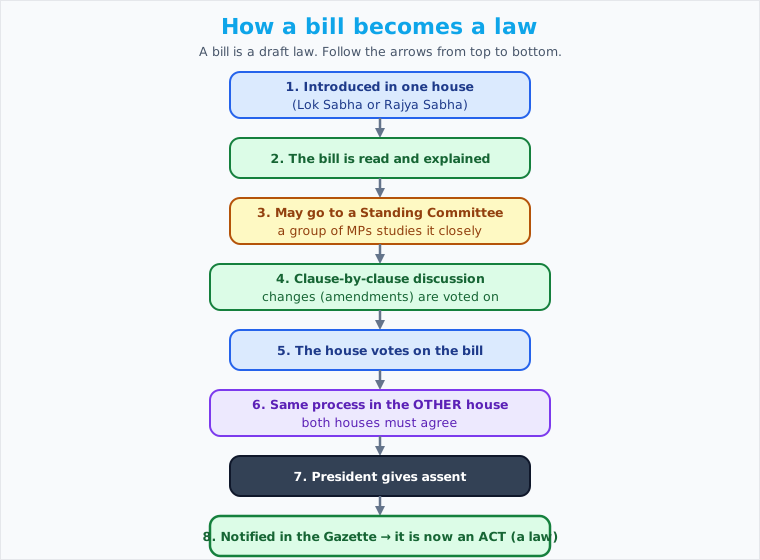
Figure 6.4 below shows the whole journey as a flow, step by step. Follow the arrows from top to bottom.
Let us go through the steps in plain words.
- Introduced in one house. Someone (usually a minister) brings the bill into the Lok Sabha or the Rajya Sabha. This is called “tabling” the bill.
- The bill is read. The contents of the bill are read out so the MPs know what it says. (This habit comes from old times when many members could not read, so a clerk read the bill aloud. Today MPs read it before the debate.)
- It may go to a Standing Committee. A standing committee is a permanent group of MPs that studies the bill carefully and suggests changes. (The members may change over time, but the committee itself stays.) Note: not every bill is sent to a committee.
- Clause-by-clause discussion. A clause is one specific part of the bill. The house goes through the bill part by part, and votes on any changes (amendments).
- The house votes on the whole bill. If most members say yes, it passes in that house.
- The same process is repeated in the other house. The bill now goes to the second house and goes through the same steps there. Both houses must agree.
- The President gives assent. After both houses pass it, the bill goes to the President for the final yes.
- Gazette notification. The new law is announced in the gazette (the official government publication). Now the bill has become an act — a real law.
There is a special rule for one kind of bill. A Money Bill deals with money matters — taxes, government borrowing, and such. A Money Bill can be introduced only in the Lok Sabha, not the Rajya Sabha. Why? Because the Lok Sabha is the house chosen directly by the people, and it is the people’s money the government is spending. So decisions about money begin with the people’s own house.
Let us trace a real example so the steps feel alive. The worked example below follows the famous Right to Education (RTE) Act.
The Right of Children to Free and Compulsory Education Act, 2009 (RTE) gives every child aged 6 to 14 the right to free schooling. Put its journey in order: (a) introduced as a bill in the Rajya Sabha, (b) a committee studied it and suggested changes, (c) passed in the Lok Sabha, (d) the President gave assent and it became an Act.
- Start at the beginning. Every law starts as a bill that is introduced in one house. The RTE was first tabled as a bill in the Rajya Sabha. So (a) comes first.
- Next, the bill is studied closely. A committee studied the RTE bill thoroughly and suggested changes (modifications). So (b) comes second. There was a big debate here about funding — new schools and teachers for millions of children would cost a lot of money.
- After the houses agreed, the bill was passed in the Lok Sabha in August 2009. So (c) comes third. This shows both houses played a part.
- Finally, the bill went to the President. The President gave assent, and the RTE became an Act. So (d) comes last. The full order is (a), (b), (c), (d). Today the RTE has built new schools and given free books and uniforms to children. That is one bill’s long road from idea to law.
Accountability: how the people keep a check
We have said the executive must “answer” to the legislature. This is one of the most important ideas in the whole chapter, so let us slow down and ask why it matters and how it works.
Why does it matter? Because the government spends our money and rules in our name. If no one could question the government, it could do as it pleased. So the Constitution makes the executive accountable — meaning it must explain and justify its actions. This keeps the government honest. Power is borrowed from the people, so it must answer back to the people.
How does it work in practice? Here are the main ways.
- Question Hour. Usually the first hour of a sitting, when MPs can ask ministers direct questions about the government’s policies and actions. The minister must stand up and answer. This is a powerful spotlight.
- Committees. Special committees call ministries in to explain their work. These committees often include MPs from different political parties, so the questioning is not one-sided.
- Collective responsibility. The whole Council of Ministers stands together. If the Lok Sabha loses trust in the government, the government cannot continue.
There is also financial accountability. The Parliament approves and watches the government’s spending through the yearly budget. It checks how much money goes to each ministry. (Remember the hint from the textbook: whose money is the government spending? Ours. So Parliament keeps a close eye on it.)
Here is a moving real example of accountability in action. In 1956, Railway Minister Lal Bahadur Shastri resigned after a train accident. He was not personally blamed for it. But he believed a minister must take moral responsibility for whatever happens in their ministry. Prime Minister Nehru did not want to accept his resignation, but Shastri insisted. That is what accountability looks like when leaders take it seriously.
The judiciary: the third watchman
We have met the legislature and the executive. But there is a third branch we should not forget: the judiciary — the courts.
The judiciary’s job is to interpret and apply the laws, and to settle disputes. But it has one more special power. It is the custodian (guardian) of the Constitution. It checks that both the legislature and the executive stay inside the rules of the Constitution.
So if Parliament passes a law that breaks the Constitution, the courts can step in. And if the executive carries out a law in a way that breaks the Constitution, the courts can step in again. (You saw this guardian role in Figure 6.3 above, with the courts checking both sides.)
Now you can see the full picture. The legislature makes laws. The executive runs the country. The judiciary checks both against the Constitution. This three-way sharing, with each side watching the others, is called checks and balances. It is what makes sure no single organ becomes too powerful — and it is what protects the rights of ordinary citizens like you.
The same system in the states
One last piece. Everything we learned about the union (central) level is mirrored at the state level. Each state has its own legislature and its own executive.
- Just as the union has MPs who make laws in Parliament, each state has MLAs (Members of Legislative Assembly) who make laws for the state.
- The state’s lower house is the Vidhan Sabha (Legislative Assembly), like the Lok Sabha.
- Some states also have an upper house, the Vidhan Parishad (Legislative Council), like the Rajya Sabha. States with two houses are bicameral; states with only the Vidhan Sabha are unicameral (one house).
- The state’s nominal head is the Governor (like the President), and its real, de facto head is the Chief Minister (like the Prime Minister).
Who makes laws on what? The Constitution sorts subjects into lists. The Union List holds subjects only the centre can legislate on (like defence). The State List holds subjects only states handle (like local police). And the Concurrent List holds subjects both can legislate on (like education). If the centre and a state clash on a Concurrent List subject, the centre’s law wins. This neat sharing of subjects is what federalism looks like in action.
Common Mistakes
Here are some slip-ups students make about this topic. Read them once, and you will not be fooled.
The President runs the country and takes all the big day-to-day decisions, like a king.
The President is called the Head of State and holds the highest, most respected post, so it feels natural to assume the top post must also do the most work.
The President is only the nominal head and mostly acts on advice. The real, day-to-day running of the country is done by the Prime Minister and the Council of Ministers. The President's powers are mostly formal, like appointing the PM and giving assent to bills.
The Rajya Sabha members are also elected directly by the public, just like the Lok Sabha members.
Both houses are part of Parliament and both are full of MPs, so it is easy to assume they must be filled in the same way.
Only the Lok Sabha is elected directly by the people voting. The Rajya Sabha is elected indirectly — the elected representatives of each state choose its members. That is exactly why the Rajya Sabha speaks for the states and the Lok Sabha speaks for the people.
A bill becomes a law the moment one house votes yes on it.
A single vote feels like a clear, final decision, so it seems like the job must be finished right after the house says yes.
One house passing a bill is only part of the journey. The bill must also pass the other house, then receive the President's assent, and finally be notified in the gazette. Only after all these steps does the bill become an act, a real law.
Quick Check
Try these quick questions. Each one checks one idea from the chapter.
Which house of Parliament has members elected DIRECTLY by the people through voting?
What is the main job of the executive (the President, PM and Council of Ministers)?
Why is a Money Bill allowed to start ONLY in the Lok Sabha?
Why does India deliberately separate the legislature, the executive and the judiciary?
Practice Problems
Try each one on your own first. Only then tap to see the full answer.
Easy
What is the difference between a 'bill' and an 'act'? Explain in one or two simple sentences.
A bill is a draft of a proposed law. It is a rough first version that still has to be discussed, voted on, and approved.
An act is a bill that has fully passed both houses and received the President’s assent. So an act is a real, working law, while a bill is only a proposal on its way to becoming one.
Name the two houses of the Indian Parliament. For each one, say whether its members are chosen directly or indirectly.
The two houses are:
- The Lok Sabha (House of the People) — its members are chosen directly by the people, through voting.
- The Rajya Sabha (Council of States) — its members are chosen indirectly, by the elected representatives of the states.
So the Lok Sabha speaks for the people, and the Rajya Sabha speaks for the states.
Medium
Write the main steps that show how a bill becomes a law in India, in the correct order.
Here is the journey, step by step:
- The bill is introduced in one house (Lok Sabha or Rajya Sabha).
- The bill is read and explained to the members.
- It may be sent to a standing committee, a group of MPs who study it closely (not every bill is).
- The house has a clause-by-clause discussion, and votes on any changes (amendments).
- The house votes on the whole bill.
- The same process is repeated in the other house — both houses must agree.
- The President gives assent (the final yes).
- The law is notified in the gazette, and the bill becomes an act — a real law.
The President is the Head of State, yet we say the Prime Minister actually runs the country. Explain why both of these statements are true at the same time.
Both are true because the two leaders play different kinds of roles.
The President is the nominal head of the executive. “Nominal” means in name. The President holds the highest, most respected post, appoints the Prime Minister, summons Parliament, and gives assent to bills. But the President mostly acts on the advice of the Council of Ministers, and does not take the day-to-day decisions.
The Prime Minister is the de facto head. “De facto” means in actual practice. The PM leads the Council of Ministers, coordinates the ministries, and shapes the country’s policies. So the PM does the real work of governing.
So there is no contradiction: the President is the top position, while the Prime Minister does the real day-to-day work of running the country.
Challenge
The Constitution makes the executive 'accountable' to the legislature. Explain what this means, why it is important for a democracy, and give two ways in which the legislature actually holds the executive to account.
What it means: “Accountable” means the executive must explain and justify its actions and decisions to the legislature. The government cannot simply do as it pleases — it must answer questions about what it is doing and why.
Why it is important: In a democracy, power comes from the people, and the government spends the people’s money and rules in their name. The ministers are chosen from the elected MPs, so they must answer to those MPs. If the government could act without ever being questioned, it could become unfair or corrupt with no one to stop it. Accountability keeps the government honest and keeps power flowing back to the people.
Two ways the legislature holds the executive to account:
- Question Hour — usually the first hour of a sitting, when MPs can directly ask ministers questions about the government’s policies and actions, and the ministers must answer.
- Committees — special committees call ministries in to explain their work. These often include MPs from different parties, so the questioning is fair and not one-sided.
(A third example is financial accountability: Parliament approves and watches the government’s budget, checking how the people’s money is spent. And under collective responsibility, the whole Council of Ministers must keep the trust of the Lok Sabha to stay in power.)
Summary
Here is everything you can now explain to a friend:
- The Parliament is India’s supreme law-making body. We elect MPs, and the group with the most MPs forms the government, which runs with the people’s consent.
- The Parliament has two houses (a bicameral system): the Lok Sabha (House of the People, elected directly) and the Rajya Sabha (Council of States, elected indirectly to give the states a voice in our federal country).
- The Speaker presides over the Lok Sabha; the Vice President presides over the Rajya Sabha.
- The legislature (Parliament) makes the laws; the executive (President, PM and Council of Ministers) runs the country and carries out the laws. They are kept separate so that no single group becomes too powerful — this is the separation of powers.
- The President is the nominal head, while the Prime Minister is the de facto head who actually runs the government. Ministers are chosen from the MPs and are collectively responsible to the Lok Sabha.
- A bill (a draft law) becomes an act (a real law) by passing both houses, getting the President’s assent, and being notified in the gazette. A Money Bill can start only in the Lok Sabha.
- The executive is accountable to the legislature through Question Hour, committees, and the budget, so the government must always justify its actions.
- The judiciary (the courts) guards the Constitution and checks both the legislature and the executive — together this is checks and balances.
- The states copy this same design, with MLAs, a Vidhan Sabha, a Chief Minister, and a Governor.
What’s Next
Now you understand how India makes its laws and runs the country, and how power is shared so that it can never all sit in one pair of hands. That is the framework of our democracy.
But a country is not only about rules and leaders. It also needs to produce things — food, goods, and services — to feed and clothe and serve all its people. How does that happen? What do we need to make anything at all?
In the next chapter, Chapter 7 — Factors of Production, we will switch from how the country is governed to how it produces. We will meet the basic ingredients — like land, labour and capital — that go into making everything around us. Get ready to see the economy in a whole new way!
Frequently Asked Questions
What is the difference between the Lok Sabha and the Rajya Sabha?
The Lok Sabha is the House of the People. Its members are elected directly by the public through voting. The Rajya Sabha is the Council of States. Its members are elected indirectly by the states' representatives. The Lok Sabha speaks for the people, while the Rajya Sabha speaks for the states. Money bills can start only in the Lok Sabha.
What is the difference between the legislature and the executive in India?
The legislature is the Parliament, and its job is to make the laws and to check the government. The executive is the President, the Prime Minister and the Council of Ministers, and its job is to run the government and put the laws into action. The legislature makes the rules, while the executive carries them out.
How does a bill become a law in India?
A bill is a draft law. It is introduced in one house, read and discussed, often studied by a standing committee, then debated clause by clause and voted on. The same steps are repeated in the other house. After both houses agree, the President gives assent, and the bill is notified in the gazette to become an act, which is a law.
Why is the executive made answerable to the legislature?
Because the government must work with the people's consent. The ministers are chosen from the elected members of Parliament, and they must answer questions in the Lok Sabha, for example during Question Hour. If the elected members lose trust in the government, it cannot continue. This keeps the government honest and under the people's check.
Who is the head of the executive, the President or the Prime Minister?
The President is the head of State and the nominal head of the executive, but the President mostly acts on advice. The Prime Minister is the real, day-to-day head who runs the government. The President appoints the leader of the majority party in the Lok Sabha as the Prime Minister, and the Council of Ministers does the actual work of governing.