Factors of Production
Why This Matters
Look around you right now. Your school bag. Your shoes. Your phone. The chair you are sitting on.
Have you ever stopped to think — how was each of these made?
None of these things just appeared. Every single one of them was produced. Someone took some raw materials, used some tools, did some work, and turned it all into the finished thing in your hand. This whole journey — from raw stuff to a finished product — is called production.
Now here is the interesting part. To produce anything, you always need the same basic ingredients. Not flour and sugar, but a different kind of ingredient. Economists call these ingredients the factors of production.
Think of a small restaurant called Pause Point, run by a woman named Ratna. When she started, she had to find a place, arrange money for rent and equipment, hire staff, buy ingredients, and plan how to make it all work. Each of those things she arranged was a factor of production.
In this chapter, you will learn the four factors that go into making everything — from a loaf of bread to a mobile phone. Once you see them, you will start spotting them in every shop, every farm and every factory around you. That is a powerful way to understand how the whole economy works.
The Big Idea
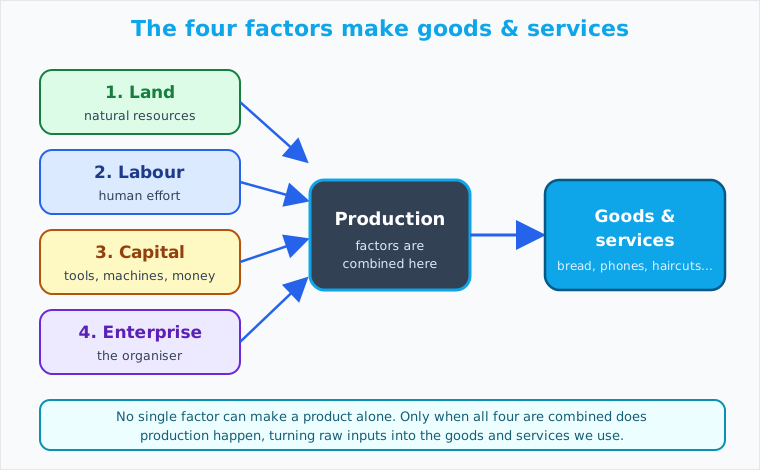
To produce any good or service, a business must bring together four factors of production: land (the gifts of nature, like soil, water and minerals), labour (human effort, both physical and mental), capital (the made things and money used to produce, like tools, machines and savings), and enterprise (the organiser who gathers the other three, takes the risk, and makes the decisions). No single factor can make a product alone. Only when all four are combined does production happen. And each factor earns its own reward in return: land earns rent, labour earns wages, capital earns interest, and enterprise earns profit.
Let’s Break It Down
What does “production” actually mean?
Let us start with the word itself.
Production means making goods or providing services that people want. A good is a thing you can touch — bread, a shirt, a bicycle. A service is useful work done for you — a haircut, a doctor’s check-up, a bus ride.
To make a good or provide a service, a business needs inputs. An input is simply something you put into the process to get the product out. The flour and the oven are inputs that go into making bread.
In economics, these inputs are sorted into four neat groups. These four groups are the factors of production. Figure 7.1 below shows the whole idea at a glance — four factors going in, goods and services coming out.
Now let us meet each of the four factors, one by one.
Factor 1: Land (the gifts of nature)
In everyday talk, “land” means a piece of ground. But in economics, land means much more. It means all the free gifts of nature that we use to produce things.
So “land” includes:
- The soil where crops grow.
- Water from rivers, lakes and the sea.
- Forests, which give us wood.
- Minerals and metals dug from the ground.
- Oil, natural gas, sunlight and air.
All of these come from nature. No human made them. That is the key idea: land is the part of production that nature provides, not people.
A business either owns the land it uses, or it pays rent to use someone else’s land for a period of time. So the reward that land earns is called rent.
Land matters because every product starts with some raw material from nature. The wheat in your bread, the metal in your phone, the cotton in your shirt — all of it began as a gift of the land.
Before we go further, let us refresh one idea from an earlier chapter that this builds on.
Factor 2: Labour (human effort)
The second factor is labour. Labour is the human effort that goes into production — both the effort of the body and the effort of the mind.
Think of the different people who help make things:
- A farmer ploughing a field uses a lot of physical strength.
- A carpenter shaping wood uses strength and skill.
- A teacher or a doctor uses mostly mental effort — knowledge and thinking.
So labour is not just hard physical work. It is any human effort, whether it is lifting bricks or solving a problem in your head. Everyone contributes in their own way.
The reward that labour earns is called wages — the pay a worker gets for the work they do.
Labour and human capital — an important difference
Here is a subtle but important idea. Two workers might both “do labour”, but one may be far better at the job than the other. Why?
The answer is human capital.
Labour is the basic effort of working. But human capital is the quality of that effort — the special knowledge, skills, training and experience a worker brings. A trained chef and an untrained helper both do labour in a kitchen, but the chef has much higher human capital. So the chef can produce better food, faster.
So remember: labour is the effort; human capital is what makes that effort skilled and valuable.
What builds human capital?
Human capital does not appear by magic. A few things build it up:
- Education and training. School gives you knowledge. Training gives you hands-on practice. A civil engineering student learns the ideas in college, then learns the real job by watching construction sites and testing materials.
- Good health. A healthy worker can work harder, think more clearly, and miss fewer days. A healthy child can attend school regularly and learn better. So good health quietly builds human capital too.
- Social and cultural habits. A culture that values hard work and care improves human capital. For example, Japan has an idea called kaizen, which means “continuous improvement” — always getting a little better. This habit helped Japan make very high-quality goods.
Why human capital matters so much for India
Here is a fact that should make you proud. According to the Economic Survey of India 2024, about 65 per cent of Indians are below the age of 35. That is a huge number of young, working-age people.
When a country has many young workers and fewer people depending on them, it can grow fast. Economists call this benefit the demographic dividend — the boost a country gets from having a large young, working population. But there is a “but”. This boost only works if those young people get good education, health and skills. Without that, the chance is wasted.
So building human capital is not just good for one worker. It is one of the biggest ways our whole country can grow richer.
Factor 3: Capital (the made things and money)
The third factor is capital. Be careful here — in economics, “capital” does not just mean money. It means two things together:
- Made things used to produce other things — machines, tools, equipment, vehicles, computers, shops, factories. These are called physical capital.
- Money used to run and grow a business — to buy materials, pay rent and buy machines.
So capital = the human-made resources plus the money used to produce goods and services.
Notice the difference from land. Land is made by nature. Capital is made by humans. A river is land; a water pump is capital. Wood from a forest is land; a saw is capital.
When Ratna started Pause Point, she needed money to take the place on rent, buy furniture and buy kitchen equipment. All of that — the money and the equipment — is capital.
Where do businesses get capital?
A business needs money to start. Where does it come from?
- Personal savings, family and friends are usually the first source. Ratna used her own savings first.
- Bank loans fill the gap. Ratna’s savings were not enough, so she took a loan from a bank. She then paid back the loan a little at a time, plus an extra amount called interest — the charge for borrowing the money.
- The stock market helps big companies. Large companies need huge amounts of money. They raise it by selling small pieces of their company, called shares, to the public. In return, the company shares part of its profit with these owners — that payment is called a dividend.
The reward that capital earns is called interest — the payment made for using borrowed money.
Factor 4: Enterprise (the organiser)
We now have land, labour and capital. But these three do not combine themselves. Someone has to bring them together, take the risk, and make it all work. That someone is the entrepreneur, and what they do is enterprise.
An entrepreneur is a person who starts a business or creates something new to solve a problem. Here is what an entrepreneur does:
- Spots a problem and decides to solve it with a new idea.
- Gathers the other factors — finds the land, hires the labour, arranges the capital.
- Takes risks by putting in their own money and time, with no promise of success.
- Makes the key decisions about how the business runs.
- Benefits society by creating useful products and giving people jobs.
Because the entrepreneur takes the biggest risk — they might lose everything if the business fails — they earn the reward called profit. Profit is whatever money is left over after all the other costs (rent, wages, interest, materials) are paid. If the business does badly, the entrepreneur may even face a loss instead. That risk is exactly why this factor is so special.
A famous Indian example is J.R.D. Tata. He started India’s first airline in 1932 (which became Air India) and grew the Tata Group into steel, cars, power and chemicals. He believed business should help society, not just earn money, and he cared deeply about his workers. In 1992 he received the Bharat Ratna, India’s highest civilian award. He shows what a great entrepreneur can do for a whole nation.
Now that you have met all four factors, let us see the reward each one earns, side by side.
The reward each factor earns
Every factor of production gives something to the business. So every factor gets paid in return. Figure 7.2 below lines up each factor with its special reward.
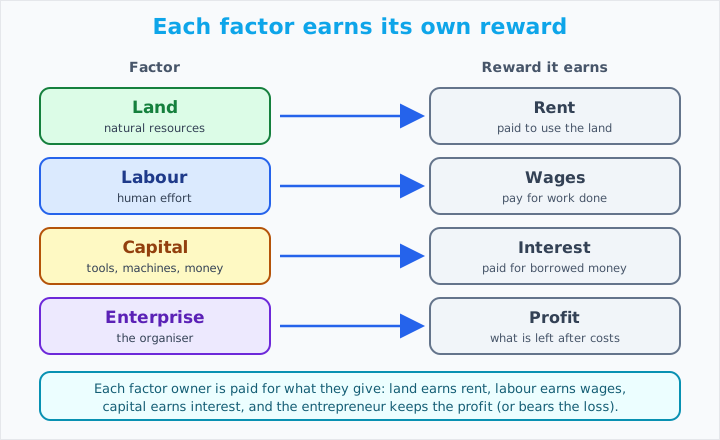
It helps to learn these four reward words as a set: rent, wages, interest, profit. A common way to remember the order is the same order as the factors: land–rent, labour–wages, capital–interest, enterprise–profit.
How the four factors combine
Now for the most important idea in the chapter. The four factors do not work alone. They combine to make a product. And the amount of each factor used depends on the product.
Let us walk through a real example — making a loaf of bread. Figure 7.3 below shows all four factors coming together to make that one loaf.
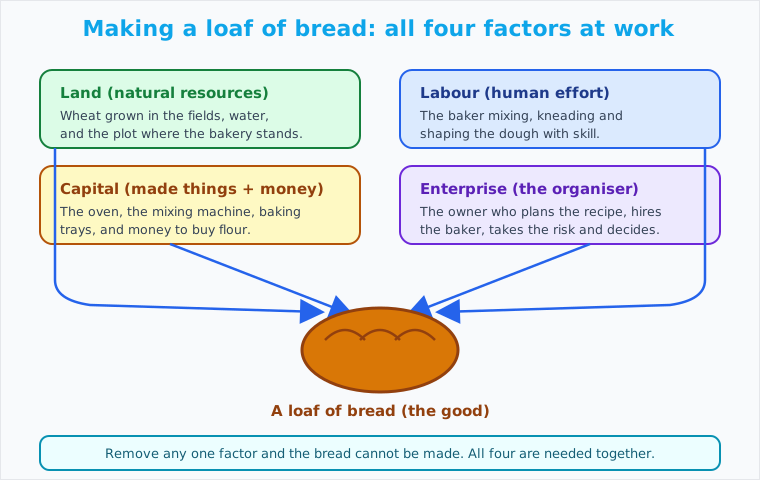
Look at Figure 7.3 carefully. Take away the land — no wheat, no bread. Take away the labour — no one to bake, no bread. Take away the capital — no oven, no bread. Take away the enterprise — no one to organise it, no bread. Each factor is essential.
But here is the clever part: the mix of factors is different for different products.
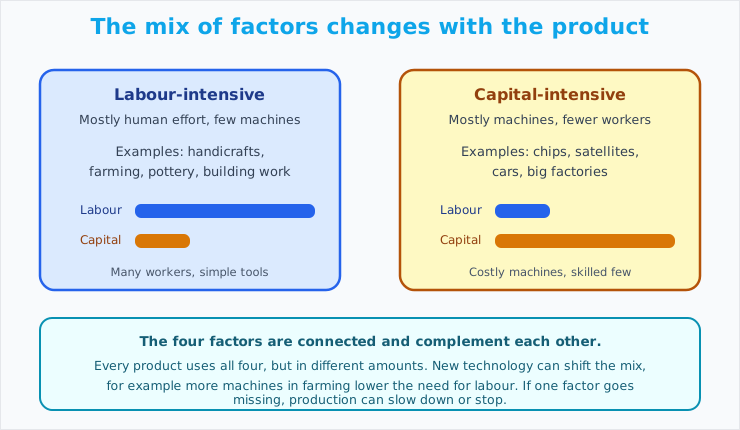
- Some products use mostly labour and only simple tools. We call these labour-intensive. Handicrafts, farming and pottery are good examples — they rely heavily on human hands.
- Some products use mostly capital — costly machines — and fewer workers. We call these capital-intensive. Making semiconductor chips, satellites and cars needs huge, expensive machines.
Figure 7.4 below compares these two kinds of production.
Two more important points about how factors connect:
- New technology can change the mix. For example, using more machines in farming lowers the need for labour. So technology can shift a product from being labour-intensive towards being capital-intensive.
- The factors are interconnected, and a missing factor can halt production. The inputs often come from many different places, joined by a supply chain — the network of people, resources and transport that brings the inputs together and gets the product to buyers. If one link breaks (as happened during the COVID-19 pandemic), production can slow down or stop completely.
Now let us put all four factors to work in a worked example you can follow step by step.
A tailor runs a small shop and stitches school uniforms. List the four factors of production in this shop, and name the reward each one earns.
- Start with land — the gifts of nature used. Here, the cloth comes from cotton, which grows on the land, and the shop stands on a plot of land. So land = the cotton (a natural resource) and the plot. Its reward is rent.
- Next, labour — the human effort. The tailor measuring, cutting and stitching the uniform is the labour. Its reward is wages (the tailor’s pay for the work).
- Now capital — the made things and money used to produce. The sewing machine, the scissors, the measuring tape, and the money to buy cloth are all capital. Its reward is interest (if the money was borrowed).
- Finally, enterprise — the organiser. The shop owner who decided to start the tailoring business, hired the tailor, bought the machine and takes the risk is the entrepreneur. Their reward is profit. So the four factors are: land (cotton and plot, earns rent), labour (the tailor, earns wages), capital (sewing machine and money, earns interest), and enterprise (the owner, earns profit). All four together produce the uniform.
Let us also see all four factors compared neatly in one table.
| Factor | What it is | Example | Reward |
|---|---|---|---|
| Land | Free gifts of nature used in production | Soil, water, forests, minerals | Rent |
| Labour | Human effort, both body and mind | A baker, farmer, teacher, doctor | Wages |
| Capital | Made things and money used to produce | Oven, machine, tools, savings | Interest |
| Enterprise | The organiser who gathers the rest and takes the risk | A bakery owner, a startup founder | Profit |
The same comparison is shown as a picture in Figure 7.5 below, which also points out one neat pattern.
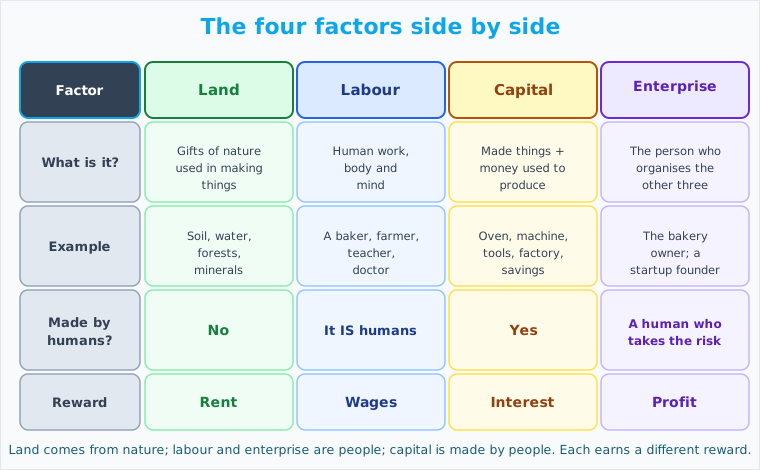
Notice the lovely pattern in Figure 7.5: land is the only factor that comes from nature, labour and enterprise are people, and capital is the thing made by people. That simple split helps you never mix them up.
Now check that you really understand the why behind two of these ideas.
Why is a sewing machine called 'capital' but the cotton used to make cloth called 'land'?
Because capital is made by humans, while land comes from nature. A sewing machine was built in a factory by people — so it is a human-made tool used to produce, which makes it capital. Cotton, however, grows in a field; it is a gift of nature, so economists group it under “land”. The test is simple: did nature give it (land) or did people make it (capital)?
Why does the entrepreneur earn 'profit' rather than a fixed payment like wages or rent?
Because the entrepreneur takes the biggest risk. Rent, wages and interest are fixed amounts that must be paid no matter what — the landlord, worker and lender get paid even if the business does badly. The entrepreneur is paid last, out of whatever money is left after all those costs. If the business does well, that leftover is profit; if it does badly, there may be a loss. So profit is the reward for taking the risk and organising everything.
Common Mistakes
Here are three slip-ups students often make about this topic. Read them once, and you will not be fooled.
In economics, 'land' only means the ground or a plot of soil.
In everyday language 'land' almost always means a piece of ground, so it feels natural to assume economics uses the word the same way.
In economics, 'land' means all the free gifts of nature used in production — not just soil, but also water, forests, minerals, oil, air and sunlight. The plot of ground is only one small part of what economists call land.
Capital just means money.
In daily life we often say 'I need some capital' when we mean we need cash, so it sounds like capital and money are the same thing.
Capital means both money AND the human-made things used to produce, like machines, tools, vehicles, shops and factories. Money is only one part of capital; the oven, the sewing machine and the factory building are capital too.
Labour and human capital are exactly the same thing.
Both words are about people working, so it is easy to treat them as one idea.
Labour is the basic human effort of working. Human capital is the quality of that effort — the knowledge, skills, training and experience a worker brings. A trained chef and an untrained helper both do labour, but the chef has far more human capital, so produces better work.
Quick Check
Try these quick questions. Each one checks one idea from the chapter.
Which factor of production means all the free gifts of nature used to produce things?
A baker uses an oven and a mixing machine to make bread. These tools are an example of which factor?
Match each factor to its reward. Which pairing is correct?
Why does the entrepreneur (enterprise) earn profit instead of a fixed payment?
Practice Problems
Try each one on your own first. Only then tap to see the full answer.
Easy
Name the four factors of production, and write one example of each.
The four factors of production are:
- Land — the gifts of nature. Example: soil, water, a forest, or minerals.
- Labour — human effort, body and mind. Example: a farmer, a baker, a teacher.
- Capital — made things and money used to produce. Example: a machine, a tool, a factory, or savings.
- Enterprise — the organiser who gathers the rest and takes the risk. Example: a shop owner or a startup founder.
Write the reward earned by each factor of production.
Each factor earns its own reward:
- Land earns rent — paid to use it.
- Labour earns wages — pay for the work done.
- Capital earns interest — the charge for using borrowed money.
- Enterprise earns profit — whatever is left after all the costs are paid.
Medium
Ravi wants to start a small business making clay pots. List the four factors of production he will need, with a clear example of each for his pottery business.
For Ravi’s pottery business, the four factors are:
- Land: the clay (a gift of nature) and the plot of ground where his workshop stands. Reward: rent.
- Labour: Ravi and any helpers shaping, drying and painting the pots — the human effort and skill. Reward: wages.
- Capital: the potter’s wheel, the kiln (oven for baking the pots), tools, and the money to buy clay and paint. Reward: interest.
- Enterprise: Ravi himself as the organiser — he had the idea, gathered the clay, tools and helpers, took the risk with his own money, and makes the decisions. Reward: profit.
If even one of these is missing, the pots cannot be made.
Explain the difference between 'labour' and 'human capital' using a kitchen as an example.
Labour is the basic human effort of working. Human capital is the quality of that effort — the special knowledge, skills, training and experience a worker brings.
In a kitchen:
- Both a trained chef and an untrained helper do labour — they both put in human effort.
- But the chef has much higher human capital. Years of training and practice gave the chef recipes, techniques and speed.
- So the chef produces better food, faster, even though both are “doing labour”.
This is why education, training, health and experience matter so much. They turn ordinary labour into skilled, valuable work by building human capital.
Challenge
A village handicraft workshop makes bamboo baskets mostly by hand. A modern factory makes mobile phones using huge automatic machines. Compare these two using the idea of labour-intensive and capital-intensive production. Then explain what might happen if new machines are introduced into the bamboo workshop.
Comparing the two:
- The bamboo workshop is labour-intensive. It relies mostly on human effort (labour) and only simple tools (a little capital). Many workers shape the baskets by hand. So the labour part of the mix is large and the capital part is small.
- The phone factory is capital-intensive. It relies mostly on costly, automatic machines (a lot of capital) and only a few skilled workers. So the capital part of the mix is large and the labour part is small.
Both businesses still use all four factors — land, labour, capital and enterprise — but in very different amounts.
If new machines are introduced into the bamboo workshop:
- The workshop would start using more capital (the machines) and less labour, because machines can do work that people used to do by hand.
- This could let the workshop produce baskets faster and in larger numbers, which may help it serve a bigger market.
- But it could also mean fewer workers are needed, so some people might lose their jobs.
This shows the key idea: new technology can shift the mix of factors — moving a business from labour-intensive towards capital-intensive. That can be good (more output) and challenging (fewer jobs) at the same time.
Summary
Here is everything you can now explain to a friend:
- Production means making goods or providing services. The inputs used to produce are called the factors of production.
- There are four factors of production: land, labour, capital and enterprise.
- Land is all the free gifts of nature used in production — soil, water, forests, minerals, oil, air. Its reward is rent.
- Labour is human effort, both body and mind. Its reward is wages. The quality of that effort — skills, knowledge, training and health — is called human capital.
- Capital is the human-made things and the money used to produce — machines, tools, factories and savings. Its reward is interest.
- Enterprise is the organiser (the entrepreneur) who gathers the other factors, takes the risk and makes the decisions. Its reward is profit.
- The four factors must combine to make any product — remove one and production stops.
- The mix of factors differs by product: labour-intensive goods (handicrafts, farming) use mostly labour; capital-intensive goods (chips, cars) use mostly machines. New technology can shift this mix.
- Producers also have responsibilities — to use natural resources carefully, treat workers fairly, and protect the environment for future generations.
What’s Next
Congratulations — you have reached the end of your Class 8 Social Science journey!
Look back at how far you have come. You explored the land and people of India, travelled through its history and culture, learned how our country is governed, and in these last chapters, you discovered how the economy around you actually works — how resources, money and human effort come together to produce everything we use.
That is the real power of Social Science. It helps you understand the world you live in — the places, the past, the rules and the economy — all at once. The factors of production you just learned are working all around you, every single day, in every shop, farm and factory you pass.
Want to revisit any chapter or pick a different subject? Head back to the Class 8 Social Science subject page to choose what to explore next. Well done, and keep that curiosity alive!
Frequently Asked Questions
What are the four factors of production in economics?
The four factors of production are land, labour, capital and enterprise. Land means natural resources like soil, water and minerals. Labour is the human effort, both body and mind. Capital is the made things and money used to produce, like tools and machines. Enterprise is the organiser who brings the other three together and takes the risk.
What reward does each factor of production earn?
Each factor earns its own reward. Land earns rent, which is paid to use it. Labour earns wages, which is pay for the work done. Capital earns interest, which is paid for using borrowed money. Enterprise earns profit, which is what is left after all the costs are paid.
What is the difference between labour and capital?
Labour is human effort, the work people do with their body and mind. Capital is the made things and money used in production, like ovens, machines, tools and savings. Labour is the people working; capital is the things and money they work with. Labour earns wages while capital earns interest.
What is human capital and how is it different from physical capital?
Human capital is the knowledge, skills and good health that make a worker more productive. Physical capital is the made objects used in production, like machines, tools and buildings. Human capital lives inside a person and grows with education, training and health, while physical capital is a thing you can touch.
Why are all four factors of production needed together?
Each factor on its own cannot make a product. Land gives raw materials but cannot shape them, labour needs tools and resources to work with, capital sits idle without people to use it, and enterprise has nothing to organise without the other three. Only when all four are combined does production actually happen.