Water Resources
Why This Matters
Three-fourths of the earth is covered in water. And water is a renewable resource. That means it keeps coming back. The sun heats the oceans and lifts the water up as vapour. Clouds carry it. Rain brings it back down to the land and the rivers. Then the whole cycle starts all over again.
So here is a puzzle. If there is so much water, and it keeps coming back, why do whole regions run dry? Why do experts warn that by 2025 nearly two billion people could be living in absolute water scarcity? (Water scarcity means there is not enough usable water for the people who need it.)
You have probably seen the pictures. Women in Rajasthan walking for miles with earthen pots (matkas) balanced on their heads. A boy in flooded Kolkata scooping drinking water out of the streets. An earthquake survivor carrying water through the snow. Here is the strange part. Scarcity is often not about how much rain falls. Cities that get plenty of water still run short. A river can be full and flooding in the monsoon, and yet the same land can be dry and cracked by April.
This chapter is about that puzzle. It is also about what India is doing to solve it. India builds giant dams. People fight over them. And quietly, many are going back to 2,000-year-old ways of catching the rain. Once you understand all this, you will look at the tap in your home differently. Water is not endless. How we manage it decides whether it lasts.
The Big Idea
Water is renewable because it keeps moving through the water cycle. But water scarcity is still real. It is caused less by low rainfall and more by four things: over-exploitation (using up water faster than nature refills it), excessive use, unequal access (some people get more than others), and pollution. To save and manage water, India built multi-purpose river projects. These are dams that do many jobs at once — they give water for farming, make electricity, supply water to homes, and control floods. But large dams also caused big problems. They forced people off their land, damaged nature, and led to protests. So many people went back to an older, gentler answer: rainwater harvesting — simply catching and storing rain. India uses both old and new ways to do this.
As you read, hold two ideas side by side. The first is bigness. A single dam can change four states at once. But it can also force thousands of people out of their homes at once. The second is smallness. A small tank under one family’s courtyard, or a bamboo pipe on a hillside, can quietly solve the same water problem — and cause none of that damage. In a way, this whole chapter is an argument between the big and the small.
Let’s Break It Down
How water becomes a renewable resource
Most of the water on earth is salty sea water, which we cannot drink. Freshwater is the small part we can actually use. Where does this freshwater come from? It comes from three places: precipitation (rain and snow), surface run-off (water flowing on the land, like rivers and streams), and groundwater (water stored under the ground).
All three of these are constantly refilled by one loop you have already met in science. Here is a quick reminder of how it works.
All of this is refilled again and again by the hydrological cycle, which is just the scientific name for the water cycle. Water keeps moving in a loop. It evaporates from oceans, forms clouds, falls as rain, flows on the land, and soaks into the ground. Then it evaporates again. Because this loop never stops, the water is replenished, which means it gets filled up again and again. That is exactly why we call water a renewable resource.
Water scarcity — and why it is not just about rainfall
It is easy to imagine scarcity as just a dry desert with no rain. But that is not the full story. How much water a place has does depend partly on rainfall, and rainfall changes from season to season and from year to year. However, in most cases scarcity is caused by something else: over-exploitation, excessive use, and unequal access among different groups of people.
But first, let us crack the puzzle from the start of the chapter — how can the same river be flooding in July and bone-dry in April? The answer is about timing. India gets most of its rain in just a few months, during the monsoon. Think of it like a year’s worth of pocket money being handed to you all at once in June. For those few weeks there is so much water that the rivers overflow and flood. But this is a problem, not a gift. The water comes far faster than the soil can drink it in or than we can store it. So most of it simply runs off the land and rushes away into the sea within days. Then, for the long dry months that follow, hardly a drop falls. The river bed cracks. The wells sink low. The land is thirsty for most of the year — even though the total rain for the year was plenty. Figure 3.1 below shows the same place in its two halves.

This is exactly why catching and storing the monsoon water matters so much — and it sets up everything that follows in this chapter. But uneven timing is only one part of the story. The bigger, everyday causes are things we do ourselves. Let us look at the main causes one by one.
- A large and growing population — More people means more water is needed. Not just for drinking, but also to grow more food for everyone.
- Irrigated agriculture, the biggest user of water — Irrigation means giving water to crops through canals, wells and pumps. To grow more food grains, farmers need more irrigation, especially in the dry season. To get this water, they pump it out of the ground using wells and tube-wells. They pump so much that the groundwater level falls — the water under the ground keeps getting lower. This is dangerous, because it leaves less water for the future and puts our food supply at risk.
- Industries and growing cities — Factories use huge amounts of water. They also need a lot of electricity, much of which comes from water (hydroelectric power). On top of that, crowded cities and housing colonies dig their own pumps to draw groundwater. All of this drains our limited water.
- Polluted (dirty) water — Sometimes there is enough water, but it is too dirty to use. It gets polluted by waste from homes and factories, and by chemicals, pesticides and fertilisers from farms. So a place can have plenty of water and still face scarcity, because none of it is safe to use.
Put these four causes side by side and you can see how they all push toward the same result. Figure 3.2 below shows them feeding into one shortage.

This is why a city can look water-rich on paper and yet still go thirsty. The government has started schemes to fix this. The Atal Bhujal Yojana (Atal Jal) works to manage groundwater better in water-short Gram Panchayats (village councils) across seven states. The Jal Jeevan Mission (JJM) has a clear goal: to bring safe piped drinking water — about 55 litres per person per day — to every rural household.
Before moving on to dams, test the key idea from this section — that scarcity is about usable water, not just rainfall.
Can a region with plenty of water still face water scarcity? Give the reason.
Yes. If the available water is polluted by waste from homes and factories, or by chemicals and pesticides, it becomes unfit to use. So the region faces scarcity even though it has water. Scarcity can also come from over-use and unequal access, not only from low rainfall.
Multi-purpose river projects: dams as “temples of modern India”
So how do we save and manage water? One very old answer is the dam. A dam is a wall built across a flowing river. It blocks, slows down, or guides the flow of water. Behind the wall, the stopped water collects and forms a large lake. This stored lake of water is called a reservoir. (Fun fact: people often use the word “dam” to mean the reservoir too, not just the wall.) Most dams also have a spillway, which is a path that lets extra water flow out safely so the dam does not overflow.
India has built dams across its rivers since ancient times. There was flood-water harvesting at Sringaverapura near Allahabad in the 1st century B.C. There were dams in the time of Chandragupta Maurya. Later came Bhopal Lake in the 11th century, and the Hauz Khas tank in Delhi, built by Allauddin Khilji.
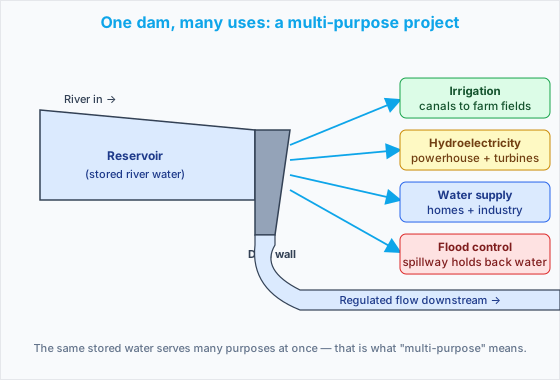
After India became independent, these dams became multi-purpose projects. “Multi-purpose” simply means “many uses.” Instead of storing water for farming alone, one dam now does several jobs at the same time: making electricity, supplying water to homes and factories, controlling floods, allowing boating and recreation, helping boats travel along the river (inland navigation), and breeding fish. Jawaharlal Nehru was so proud of these dams that he called them the “temples of modern India.” He felt they would link village farming with city industry and help the whole country grow.
So how does a single wall across a river manage to do so many jobs at once? Figure 3.3 below traces the stored water out to each of its uses.
One of those jobs sounds almost like magic: the dam makes electricity out of plain water. How? Let us trace it step by step, because it is simpler than it sounds. The key is that the reservoir holds the water up high, behind a tall wall. Anything held up high has stored-up energy, ready to be released when it falls — the same reason a stone dropped from a roof hits the ground hard. So a steep pipe called a penstock lets that high water fall down fast to the bottom of the dam. There, the rushing water hits the curved blades of a wheel called a turbine and shoves it round, just like wind pushing a pinwheel or water pushing an old water-wheel. The spinning turbine is joined to a generator sitting above it. A generator is a machine that turns spinning motion into electricity. So as long as the water keeps falling and the turbine keeps spinning, the generator keeps making electricity. Power lines then carry it off to homes and factories, and the water — having done its job — simply flows on downstream. Figure 3.4 below follows this chain from the high reservoir all the way to the wires.

Here are some famous examples to remember:
- Bhakra-Nangal project (on the Sutlej-Beas rivers) — its water is used for both hydel (water-made) power and irrigation.
- Hirakud project (on the Mahanadi river) — it joins together storing water and controlling floods.
- Sardar Sarovar Dam on the Narmada river in Gujarat — one of India’s biggest projects. It covers four states (Maharashtra, Madhya Pradesh, Gujarat, Rajasthan). It is meant to bring steady water to areas that face droughts and to desert regions.
Why large dams came under fire
In recent years, people have looked closely at large dams and started to oppose them. (“Oppose” means to be against something.) Their reasons are serious. Let us go through them.
- Harm to the river’s nature — When you dam a river, you change the way it naturally flows. The river carries fine soil called sediment. When the flow is blocked, this sediment cannot move freely. Instead, it settles and piles up at the bottom of the reservoir. This is called sedimentation. The river bed downstream becomes rockier, which is bad for the animals and plants that live in the water. The dam also breaks the river into pieces, so fish cannot swim along it to lay their eggs.
- Drowned land and rotting plants — A reservoir often forms over floodplains, which are flat lands beside a river. The rising water drowns the plants and soil there. These plants then rot underwater.
- People lose their homes and work — Building a dam forces large numbers of people off their land. Most of them are poor villagers and tribal communities. The most famous protest against this is the Narmada Bachao Andolan (“Save the Narmada Movement”). It opposes the large dams on the Narmada river. People protest because the dams drown their land and harm nature.
- Floods — the opposite of what dams promised — Dams are built to stop floods. But sometimes they have actually caused floods, because too much sediment piles up. And during very heavy rain, dams have mostly failed to hold the water back. These floods wash away soil. Also, the dam traps the fine soil (silt) that used to spread over the floodplains and make them fertile. Without this natural fertiliser, the land slowly gets poorer.
- Other problems — Big dams have set off earthquakes, caused water-borne diseases and pests, and created pollution. Because irrigation became easy, farmers began growing commercial crops that need a lot of water. This causes problems like salinisation, where too much salt builds up in the soil and harms it. Sharing the dam’s water also leads to fights between states. One example is the Krishna-Godavari dispute between Maharashtra, Karnataka and Andhra Pradesh over moving water at Koyna.
That is a lot of good and a lot of harm from the same dams. The table below lines the two sides up so you can weigh them at a glance.
| Benefits (arguments in favour) | Problems (arguments against) |
|---|---|
| Irrigation for dry-season and drought-prone areas | Large-scale displacement and loss of livelihood (e.g. Narmada Bachao Andolan) |
| Hydroelectricity for industry and homes | Disturbed river flow, excessive reservoir sedimentation, rockier beds |
| Water supply for domestic and industrial use | Submerges land and vegetation on floodplains, which decomposes |
| Flood control by regulating river flow | Has sometimes triggered floods; mostly failed in very heavy rain |
| Also aids recreation, navigation, fish breeding | Induced earthquakes, water-borne diseases, soil salinisation, inter-state disputes |
The most famous of these protests has a name worth fixing in your memory. Check that you can recall it and why people marched.
Name the movement associated with opposition to large dams on the Narmada, and one reason for the protest.
The Narmada Bachao Andolan. One reason for the protest is that the dams force large numbers of villagers and tribal people off their land when it gets drowned. Another reason is the damage to nature caused by the dams.
Rainwater harvesting: going back to catch the rain
Because large dams cause so many problems, and because more and more people are against them, many turned to a better choice: rainwater harvesting. This simply means catching rainwater and storing it for later use, instead of letting it run away. It works well for people, costs less, and is kinder to nature. In fact, ancient India was full of clever rainwater-harvesting methods. Each one was matched to the local soil and rainfall. Here are a few:
- Guls and kuls — These are channels (man-made water paths) in the Western Himalayas. They carry water from a stream down to the fields.
- Rooftop rainwater harvesting — This means catching the rain that falls on rooftops and storing it as drinking water. It was very common in Rajasthan.
- Inundation channels — These are found in the floodplains of Bengal. They guide flood water onto the fields to water the crops.
- Khadins (in Jaisalmer) and Johads (in other parts of Rajasthan) — Here, fields themselves are used to store rain. The water stands on the field and slowly soaks into the soil, keeping it moist in these dry regions.
See all these methods together below in Figure 3.5, each sitting with the region whose soil and rainfall it was built for.

Tankas of Rajasthan. Rajasthan is a very dry, semi-desert state. In towns like Bikaner, Phalodi and Barmer, almost every house used to have an underground tank called a tanka to store drinking water. The tank was built inside the house or in the courtyard. These tanks could be huge. One house in Phalodi had a tank that was 6.1 m deep, 4.27 m long and 2.44 m wide — about the size of a room.
So how did the tank fill up? A pipe connected the tanka to the sloping rooftop of the house. When it rained, the water ran down the roof, into the pipe, and down into the tank. But the first rain was not collected. Why? Because the first rain washed the dust and dirt off the roof and the pipes. Only the cleaner rain from later showers was stored. This stored rainwater was called palar pani, and people believed it was the purest natural water of all. It stayed clean and reliable right through the hot, dry summers, when every other water source had dried up. Some families even built cool underground rooms next to the tanka to escape the heat.
Sadly, fewer people use tankas now in western Rajasthan. This is because the Indira Gandhi Canal, which flows all year round, now brings plenty of water to the area. Still, some families keep their tankas — they simply do not like the taste of tap water.
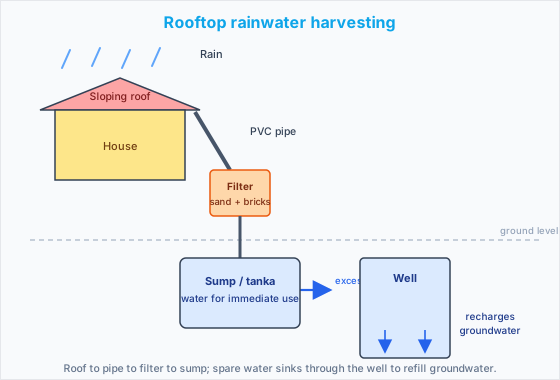
The same roof-to-tank idea is now built in a modern form, with a filter and a recharge well added. Figure 3.6 below shows the full path the rain takes.
Modern adaptations. Rooftop rainwater harvesting is now coming back across India, in both villages and cities. Here are some examples:
- Shillong, Meghalaya — Almost every house here collects rooftop rainwater. It meets about 15-25% of each home’s water needs. This is surprising, because nearby Cherrapunji and Mawsynram get the highest rainfall in the whole world — and yet Shillong still runs short of water.
- Gendathur, near Mysuru, Karnataka — This is a far-off village where about 200 houses set up rooftop systems. The village earned a rare title: “rich in rainwater.” The village gets about 1,000 mm of rain a year. With 80% of it collected, and the tank filled about 10 times, each house can collect roughly 50,000 litres of water a year.
- Tamil Nadu — This was the first state in India to make rooftop rainwater harvesting compulsory (a must) for every house. People who do not follow the rule can be punished by law.
How does a modern system work? The rain that falls on the roof is collected through a PVC pipe (a plastic pipe). The water is then filtered (cleaned) using sand and bricks. From there, an underground pipe carries it to a sump (an underground storage tank) for use right away. If there is extra water, it is sent down a well, where it soaks into the ground and refills the groundwater for later use.
Bamboo drip irrigation of Meghalaya. In Meghalaya, there is a clever 200-year-old system that uses bamboo pipes to carry water. Springs on the hilltops flow all year round. The water from these springs is guided downhill using gravity (the natural pull that makes things fall) through bamboo channels. Along the way, the channels split into smaller branches and run for hundreds of metres. About 18-20 litres of water enters the system at the top. By the end, it comes out as just 20-80 drops per minute, dropping right at the roots of each plant. It is a simple but brilliant way to water crops drop by drop.
That is a lot of methods spread across very different regions. The table below gathers them in one place — what each is called, where it is used, and what it does — so they are easy to revise.
| Method | Where | What it does |
|---|---|---|
| Guls / kuls | Western Himalayas | Diversion channels carrying stream water to fields |
| Khadins / Johads | Jaisalmer / Rajasthan | Fields store rain so water stands and moistens the soil |
| Tankas (rooftop harvesting) | Bikaner, Phalodi, Barmer (Rajasthan) | Underground tanks store rooftop rain as drinking water (palar pani) |
| Modern rooftop harvesting | Shillong, Gendathur, Tamil Nadu | Filtered roof water to a sump; excess recharges groundwater |
| Bamboo drip irrigation | Meghalaya | Bamboo pipes carry spring water by gravity, dripping at plant roots |
Common Mistakes
A few ideas in this chapter are easy to get backwards. Here are the four that trip students up most often.
Water scarcity simply means a region does not get enough rainfall.
When we think of scarcity, we picture a dry desert with women carrying pots over long distances. So 'no rain means scarcity' feels obviously true.
Rainfall does matter. But in most cases, scarcity is caused by over-use, excessive use, unequal access and pollution. A place can get heavy rain but still run short if it has a huge population, or if all its water is polluted.
Because water is renewable through the water cycle, it can never actually run out.
The water cycle really does keep refilling our water, so it feels safe to think the supply is endless.
Renewable does not mean endless in every place at every time. If we pump out groundwater faster than nature can refill it, the level keeps falling. And pollution makes the water we have unusable. So usable freshwater can definitely become scarce.
Multi-purpose river projects are all good — there is no real downside to building big dams.
One dam gives irrigation, electricity, water supply and flood control all at once. So it looks like pure progress, just like the 'temples of modern India'.
Big dams have heavy costs too. They force people off their land (which started movements like the Narmada Bachao Andolan), harm the river's nature, pile up sediment, drown land, add too much salt to the soil, set off earthquakes, and cause fights between states. Dams meant to stop floods have even caused them.
In rooftop rainwater harvesting, you should collect the very first rain because it is the cleanest.
The first rain feels the purest because it is the 'freshest' water, straight from the sky, before anything else.
The first rain is deliberately NOT collected. It is used to wash the dust off the roofs and pipes first. Only the cleaner rainwater from later showers is stored in the tanka.
Quick Check
Which of these is the MAIN cause of water scarcity in most cases?
Which statement is NOT an argument in favour of multi-purpose river projects?
In the tankas of Rajasthan, the first spell of rain is not collected because it:
Which state was the first in India to make rooftop rainwater harvesting compulsory for all houses?
Practice Problems
Easy
Explain how water becomes a renewable resource. (about 30 words)
Water is refilled again and again through the water cycle (hydrological cycle). It evaporates, forms clouds, falls as rain, and flows as surface run-off and groundwater. This non-stop loop keeps refilling freshwater, so water is renewable.
A region has high annual rainfall but its water is highly polluted. Is it suffering from water scarcity? Justify.
Yes, it is facing water scarcity. There is plenty of water, but it is of bad quality. It is polluted by waste from homes and factories, and by chemicals and pesticides. This makes it unsafe and unfit to use. Scarcity is about usable water, not just total water.
Medium
What is water scarcity and what are its main causes? (about 30 words)
Water scarcity is a shortage of usable water compared to how much people need. Its main causes are over-use and excessive use (mainly by farming and industry), a large and growing population, unequal access, falling groundwater, and pollution of the water we have.
Compare the advantages and disadvantages of multi-purpose river projects. (about 30 words)
Advantages: irrigation, hydroelectricity, water for homes and industry, flood control, recreation, boat travel and fish breeding.
Disadvantages: people lose their homes and work, the river’s nature is harmed, sediment piles up, land is drowned, soil gets too salty, earthquakes are set off, and states fight over water. Dams have sometimes even caused floods.
Challenge
Discuss how rainwater harvesting in the semi-arid regions of Rajasthan is carried out. (about 120 words)
Rajasthan is a very dry, semi-desert state. In towns like Bikaner, Phalodi and Barmer, almost every house used to have an underground tank (tanka) for storing drinking water. These tanks could be as big as a large room (one in Phalodi was 6.1 m deep, 4.27 m long and 2.44 m wide). They were built inside the main house or in the courtyard.
A pipe connected each tanka to the sloping rooftop of the house. When it rained, the water ran down the roof, into the pipe, and down into the underground tank. The first rain was not collected, because it washed the dust off the roofs and pipes. Only the cleaner rain from the later showers was stored. This water was called palar pani, and people believed it was the purest natural water. It stayed reliable through the dry summers, when every other source had dried up. Many families also built cool underground rooms next to the tanka.
Describe how modern adaptations of traditional rainwater harvesting methods are being carried out to conserve and store water. (about 120 words)
Old rooftop harvesting is now coming back in a modern form across India, in villages and cities. In a typical modern system, the rain on the roof is collected through a PVC (plastic) pipe, then cleaned using sand and bricks, and carried by an underground pipe to a sump (an underground tank) for use right away. Any extra water is sent down a well, where it soaks in and refills the groundwater for later.
Examples show how well it works. In Gendathur (near Mysuru, Karnataka), about 200 houses set up rooftop systems and the village became “rich in rainwater,” with each house collecting around 50,000 litres a year. In Shillong, Meghalaya, almost every house collects rooftop rain, meeting 15-25% of its needs — even though nearby Cherrapunji and Mawsynram get the world’s highest rainfall. Tamil Nadu has made rooftop rainwater harvesting a must for all houses by law, and punishes those who do not follow the rule.
Summary
- Water is renewable because the water cycle keeps refilling it (rain, surface run-off, groundwater). But scarcity is still real. It is caused mainly by over-use, excessive use, unequal access and pollution — not just by low rainfall.
- Causes of scarcity: a growing population, water-hungry irrigated farming, industries and growing cities (which pull down groundwater), and polluted water. So even a place with lots of water can be short of usable water.
- Multi-purpose river projects are dams that do many jobs at once — irrigation, hydroelectricity, water supply, flood control, boat travel, recreation and fish breeding. Nehru called them the “temples of modern India.” Examples: Bhakra-Nangal, Hirakud, and Sardar Sarovar (on the Narmada).
- Large dams also have heavy costs: people lose their homes and work (the Narmada Bachao Andolan), the river’s nature is harmed, sediment piles up, land is drowned, soil gets too salty, earthquakes are set off, and states fight over water. Dams have sometimes even caused floods instead of stopping them.
- Rainwater harvesting is the gentler choice — old methods like guls/kuls, khadins, johads and the tankas of Rajasthan (which store pure palar pani), modern revivals (Gendathur, Shillong, and Tamil Nadu’s compulsory rule), and Meghalaya’s bamboo drip irrigation.
What’s Next
You have just seen how India manages its water, which is what makes farming possible. Now we look at what that water is mostly used for: Agriculture (farming). The next chapter covers the crops India grows, the different types of farming, the crop seasons (rabi, kharif, zaid), and the problems Indian farmers face. In short, it turns the water of this chapter into the food on the country’s plate.
Frequently Asked Questions
Why does water scarcity happen even though water is a renewable resource?
Water is renewable because it keeps moving through the water cycle, but scarcity still happens because of four reasons: we overuse water faster than nature refills it, access is unequal (some people get much more than others), water is often polluted and becomes unusable, and many regions get very little rainfall. A city can have plenty of water and still run short if it wastes or pollutes it.
What is a multi-purpose river project and what are its benefits?
A multi-purpose river project is a large dam built across a river that does several jobs at once. It stores water for irrigation so farmers can grow crops even in dry months, generates hydroelectric power, supplies drinking water to cities, helps control floods, and sometimes also helps with navigation and tourism. Examples include Bhakra-Nangal and Sardar Sarovar.
Why did people oppose large dams like the Narmada Bachao Andolan?
Large dams force many families — often poor, tribal and farming communities — to leave their homes and villages that go underwater. They also damage local ecosystems and disrupt the natural flow of rivers. The Narmada Bachao Andolan was a movement that protested the Sardar Sarovar dam because it displaced hundreds of thousands of people without fair compensation or rehabilitation.
What is rainwater harvesting and why is it important?
Rainwater harvesting means collecting and storing rainwater before it runs away, so it can be used later for drinking, cooking or farming. It is important because it reduces dependence on rivers and groundwater, and it works even in dry regions. Traditional systems like tankas in Rajasthan and bamboo drip irrigation in Meghalaya show that communities have been doing this smartly for thousands of years.
What is integrated water resources management?
Integrated water resources management means planning and using water from all sources — rivers, groundwater, rainwater — together in a coordinated way, instead of treating each source separately. The goal is to meet everyone's water needs fairly while protecting the environment. It moves away from big, single-purpose dams and combines multiple small and large solutions.