Forest and Wildlife Resources
Why This Matters
We share this planet with millions of other living things. There are tiny ones like microbes and bacteria. There are lichens and huge banyan trees. There are elephants and blue whales. They are not just nice to look at. The plants, animals and tiny living things around us do a quiet, important job. They keep making the things we cannot live without. They help give us clean air to breathe. They help give us clean water to drink. They keep the soil healthy so our food can grow. We humans are just one small part of this big web of life. And we depend on it completely.
India is one of the richest countries in the world for this kind of variety. Just look around your own area. You will find plants and animals that grow nowhere else on Earth. These plants and animals are part of our daily life. But because they are always around us, we often take them for granted. And lately they are in serious trouble. Most of this trouble is caused by us, because we have not cared enough for the environment.
This chapter is about that web of life. We will see how rich it is. We will see what is going wrong with it. And we will see the real, practical ways India is trying to save its forests and wildlife. This includes the work of ordinary villagers. Many times, villagers protect a forest even better than any government office can.
The Big Idea
Biodiversity is the huge variety of all life on Earth. It includes wild species and the crops we grow. Every species looks different and does a different job. But they are all closely linked, and they depend on each other. Forests are the primary producers — they make the food that the whole system depends on. We can sort species by how much danger they are in. The order goes from normal, to vulnerable, to rare, to endangered, and finally to extinct. (Endemic species are a separate idea — they are found in just one place.) When forests and wildlife shrink, we lose the things that keep us alive. So India protects them in three ways. First, through law (the Wildlife Protection Act and Project Tiger). Second, by sorting and managing forests (reserved, protected and unclassed). And third — more and more — through local communities who guard their own forests.
Let’s Break It Down
Flora, fauna and biodiversity
Flora means all the plant life of an area. For example, the trees, grasses and flowers in a forest are its flora. Fauna means all the animal life of an area. For example, the tigers, deer, birds and insects in that forest are its fauna. Now put together the whole variety of living things — wild species, the crops we grow, and the way they all depend on each other. This whole variety is called biodiversity (which is short for “biological diversity”).
The main idea here is interdependence. This means living things depend on one another. No species can live all alone. Plants make their own food using sunlight, and then animals eat the plants. Animals spread seeds and put nutrients back into the soil. Tiny living things (microorganisms) break down dead plants and animals and recycle everything. Forests sit at the bottom of this chain. As primary producers (the first ones to make food), they feed everything else above them. This is why losing forests harms the whole chain.
Those words — food chain and primary producer — came up in Science last year. Here is a quick reminder before we go on.
But here is something that surprises many students. It is not only the bottom link that matters. Losing any one species can hurt many others. Why? Because real nature is not a single neat line. It is a web. Each species is joined to several others, like threads tied across each other. When you pull out one thread, the whole web wobbles.
Let us see this with the tiger. The tiger eats deer. The deer eats grass. Now imagine all the tigers vanish. With no tiger to hunt them, the deer keep breeding. Soon there are far too many deer. All those deer eat too much grass. The grass cannot grow back fast enough, so it gets stripped bare. Now the rabbits and insects that also needed that grass start to go hungry too. And the birds and snakes that fed on those rabbits and insects suffer in turn. So removing one animal at the top set off a chain reaction that hurt animals and plants all over the web. Figure 2.1 below shows the same web before and after the tiger is removed.

This is the real reason conservationists worry so much about each species. No species is just “one animal we can do without.” Each one is holding up several others.
The categories of existing species
People who work to protect nature (called conservationists) sort species by how much danger they are in. In other words, how close a species is to disappearing for good. This helps us see which species need help most urgently.
Picture these groups as a ladder, running from the safest species at one end to the lost ones at the other. Figure 2.2 below lays out the ladder.
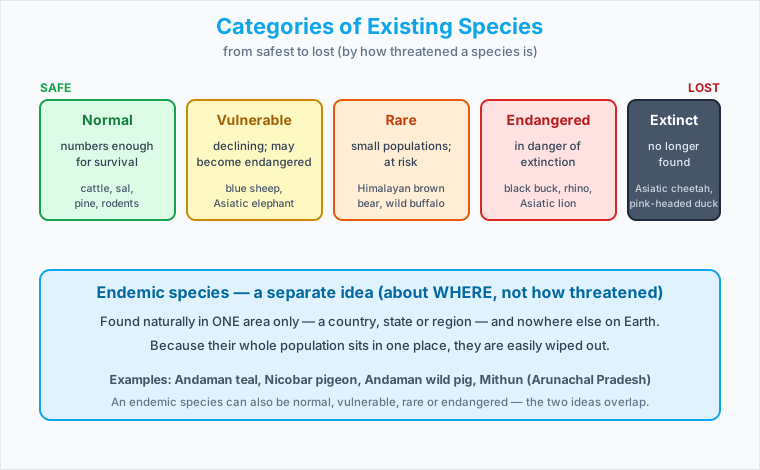
Here is each of these categories in plain words, with real Indian examples for each.
| Category | What it means | Examples |
|---|---|---|
| Normal species | There are enough of them to survive safely | cattle, sal, pine, rodents |
| Endangered species | In danger of dying out; will not survive if these threats go on | black buck, crocodile, Indian rhino, lion-tailed macaque, sangai (Manipur brow-antlered deer) |
| Vulnerable species | Their numbers are falling; may soon become endangered | blue sheep, Asiatic elephant, Gangetic dolphin |
| Rare species | Very few of them left; may become endangered or vulnerable if disturbed | Himalayan brown bear, wild Asiatic buffalo, desert fox, hornbill |
| Endemic species | Found naturally in ONE area only and nowhere else | Andaman teal, Nicobar pigeon, Andaman wild pig, mithun (Arunachal Pradesh) |
| Extinct species | Not found anywhere any more — in a region, a country, or the whole Earth | Asiatic cheetah, pink-headed duck |
The easy mistake here is to mix up endemic with the other words. The first five — normal, vulnerable, rare, endangered, extinct — are all about danger. They form a ladder, from safe to lost. But endemic is about place. An endemic species is one found only in one region and nowhere else. Here is the key point: a species can be endemic AND rare or endangered at the same time. The two ideas do not clash. They can both be true together.
Try placing one species on the ladder yourself.
The Asiatic cheetah is no longer found in India. Which category does it belong to?
Why forests and wildlife are being depleted
The variety of life in India is getting smaller. And almost all the causes come from humans. There are five main pressures, and Figure 2.3 below shows how they all press in on the same forests at once.

- Loss of habitat — A habitat is the natural home of a plant or animal. Forests are cut down to make space for farming, growing cities, roads, dams, mines and factories. When the home is gone, the animals are gone too.
- Over-use and hunting — Poaching means hunting animals illegally. People hunt animals for their skins, bones, horns and meat. They also buy and sell wild animals. This has pushed several species close to dying out.
- Forest fires and grazing — Forests catch fire again and again. Also, too many cattle graze (eat grass) in them. Both of these stop the forest from growing back.
- Pollution — Chemicals, plastics and factory waste poison our rivers and soil. This harms life in the water and on the land.
- Pressure of a growing population — When there are more people, they need more land, more firewood and more resources. All of this is taken from the forests.
Here is the pattern to remember. It is not one big cause acting alone. It is many human pressures acting together. Slowly, they squeeze forests and wildlife out of the space they need to live.
Conservation — and why we need it
Conservation means protecting our forests and wildlife and using them carefully, so they last into the future. Why should we bother?
Before the formal reasons, let us answer the deeper question: why does nature matter to a human at all? It is easy to think of a forest as just a nice green place far away. But a living, varied forest is quietly doing jobs that keep you alive — and it does them for free. You only notice them when they stop. Here is how that works, step by step.
- Clean air. Trees take in carbon dioxide (the gas we breathe out) and give out oxygen (the gas we breathe in). A forest is like a giant air cleaner running day and night, with no electricity bill.
- Clean water. When rain falls on a forest, the roots and soil soak it up and slowly let it out. The soil filters the dirt as the water passes through. This is what keeps springs and rivers flowing clean. Cut the forest, and the rain just runs off, carrying mud with it.
- Healthy soil for food. Fallen leaves rot and mix into the soil. Tiny soil creatures break them down and make the soil rich. The roots also hold the soil in place so it does not wash away. Rich, held-together soil is what your food grows in.
- Pollination. Bees, birds and insects move from flower to flower, carrying pollen. Without that, many fruits, vegetables and crops simply cannot form. No bees, no mangoes — it really is that direct.
- Medicines. A huge number of real medicines first came from forest plants. Every species we lose might have been a future cure we never got to find.
The big point is this. These are not luxuries. They are your air, water, food and health. And nature gives them only because it is varied and alive — many different species each doing their bit. That is why biodiversity is worth protecting. Figure 2.4 below puts these free services in one picture.

With that in mind, here are the formal reasons conservation matters:
- It protects ecological diversity (the variety in nature) and our life-support systems — that is, our water, air and soil.
- It protects the genetic diversity of plants and animals. (Genes are passed from parents to their young. Genetic diversity means a healthy range of these genes.) This is needed so that species can grow well and breed (have healthy young). For example, farming still depends on old, traditional types of crops. And fishing depends on keeping water life alive and varied.
In the 1960s and 1970s, conservationists asked for a national plan to protect wildlife. So the government passed the Indian Wildlife (Protection) Act, 1972. This Act also had rules to protect animal habitats. It made an all-India list of protected species. It banned the hunting of these species. It gave their habitats legal protection. And it put limits on the trade (buying and selling) of wildlife.
After this, the central and state governments set up national parks and wildlife sanctuaries (safe, protected areas for animals). The central government also started special projects for animals in very serious danger. These included the tiger, the one-horned rhinoceros, the Kashmir stag (hangul), three kinds of crocodile (fresh water crocodile, saltwater crocodile and the gharial), the Asiatic lion, and others. More recently, full or partial protection from hunting and trade was given to the Indian elephant, the black buck (chinkara), the great Indian bustard (godawan) and the snow leopard all across India.
One important change is this. At first, conservation was about saving a few big animals. But it has now widened to protect all of biodiversity. Under the Wildlife Act, in the years 1980 and 1986, several hundred butterflies, moths, beetles and one dragonfly were added to the protected list. In 1991, for the very first time, plants were added too. It started with six species.
Project Tiger
The tiger is one of the most important species in the animal web. If you protect the tiger, you also protect the whole forest where it lives. By 1973, the authorities saw a shocking thing. The tiger population had crashed to just 1,827. At the turn of the century (around the year 1900), there had been about 55,000 tigers. So the numbers had dropped a huge amount.
There were many reasons for this drop. There was poaching (illegal hunting) for trade. The tigers’ habitat was shrinking. They were also losing their prey (the animals they hunt for food). And the human population was growing. The trade in tiger skins, and the use of tiger bones in traditional medicines, was a big problem. This was especially true in many Asian countries. All of this had pushed tigers to the edge of dying out. India and Nepal together hold about two-thirds of all the tigers left in the world. So both countries became top targets for poachers.
So “Project Tiger” was launched in 1973. It is one of the best-known wildlife campaigns in the world. It was not seen only as a way to save one endangered species. It was also seen as a way to protect large, important natural areas as a whole. Some of India’s tiger reserves are listed below:
| Tiger reserve / park | State |
|---|---|
| Corbett National Park | Uttarakhand |
| Sunderbans National Park | West Bengal |
| Bandhavgarh National Park | Madhya Pradesh |
| Sariska Wildlife Sanctuary | Rajasthan |
| Manas Tiger Reserve | Assam |
| Periyar Tiger Reserve | Kerala |
Types of forests — by who manages them
Even when we want to protect forests, they are hard to manage and control. In India, most forests and wildlife are owned or looked after by the government. This is done mainly through the Forest Department. Forests are sorted into three groups, based on how they are managed. Figure 2.5 below shows how all forest land splits between these three.
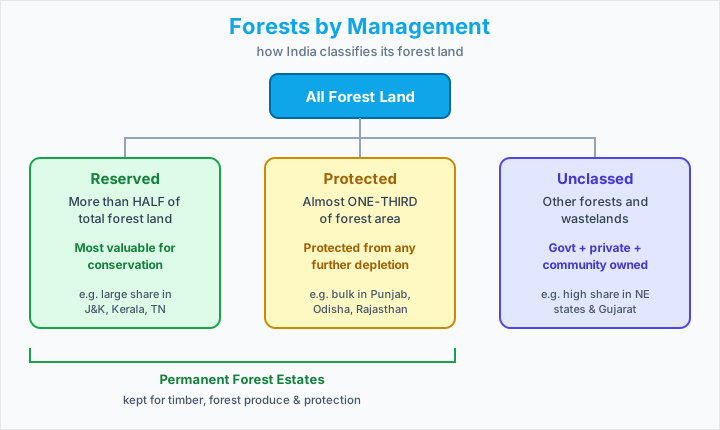
The table below lays out the three groups side by side — how big each one is, and who owns it.
| Type | Share / status | Who owns or manages it |
|---|---|---|
| Reserved forests | More than HALF of all forest land; the MOST valuable for protecting forests and wildlife | Government (Forest Department) |
| Protected forests | Almost ONE-THIRD of forest area; protected so they are not cut down any further | Government (Forest Department) |
| Unclassed forests | Other forests and waste lands | Both the government, and private people and communities |
So what do these names mean? A reserved forest is one the government keeps under its full control and protects strongly. A protected forest is one the government guards so it is not cut down any more. Together, reserved and protected forests are called permanent forest estates. (A “permanent forest estate” simply means forest land that is kept as forest for a long time.) These forests are kept mainly to produce timber (wood) and other forest goods, and to protect nature. Here are a few facts worth knowing:
- Madhya Pradesh has the most permanent forest land — about 75% of its total forest area.
- Jammu and Kashmir, Andhra Pradesh, Uttarakhand, Kerala, Tamil Nadu, West Bengal and Maharashtra have large amounts of reserved forests.
- Bihar, Haryana, Punjab, Himachal Pradesh, Odisha and Rajasthan have most of their forests as protected forests.
- All North-eastern states and parts of Gujarat have a very large share of unclassed forests. These are looked after by local communities.
Community and conservation
Protecting forests is not only the government’s job. Many traditional communities live in or near forests. In several places, the local people protect the forest themselves. Sometimes they work together with government officials. Sometimes they refuse the government’s help completely and do it on their own. They do this because they know their own future depends on the forest.
This is worth slowing down on, because it explains why protecting a forest and protecting the people who live in it cannot be separated. Think about how the two are tied together. The forest gives the community its daily living — firewood to cook with, fruit and honey and herbs to eat or sell, grass for the cattle, and clean water from the streams. Because the people depend on the forest, they have the strongest reason of all to guard it. So they stop outsiders from cutting it or mining it, and they replant trees. That keeps the forest healthy — which keeps giving them a living. Round and round it goes, each side keeping the other alive.
Now see what happens if you break this circle. If a company clears the forest, the community loses its food, fuel and water all at once. And the other way round: if the community is pushed off its land, there is no one left who cares enough to guard the forest day after day. That is why a government office far away often protects a forest worse than the villagers who live in it. Figure 2.6 below shows this circle.

That mutual link is the thread running through every example below.
- Sariska Tiger Reserve (Rajasthan) — Villagers fought against mining (digging out minerals). They used the Wildlife Protection Act as their reason.
- Alwar district (Rajasthan) — The people of five villages took 1,200 hectares of forest and named it the Bhairodev Dakav ‘Sonchuri’. They made their own rules that banned hunting. They guard the wildlife and keep outsiders away.
- The Chipko movement in the Himalayas stopped trees from being cut down in several areas. (Deforestation means cutting down forests.) It also proved something important. It showed that when a community plants trees of local (indigenous) species, it can work very well. (Afforestation means planting trees to grow a new forest.)
- Beej Bachao Andolan (in Tehri) and Navdanya — These are groups of farmers and ordinary citizens. They show that you can grow good, varied crops without man-made chemicals. And they show that this can earn money too.
Joint Forest Management (JFM)
The Joint Forest Management (JFM) programme is a good example of getting local communities to help fix damaged forests. (A degraded, or damaged, forest is one that has lost much of its trees and life.) JFM has been an official programme since 1988. That year, Odisha passed the first JFM rule. The idea is simple. Village groups are formed to protect forest land that is mostly damaged and is managed by the Forest Department. In return, the community members get some benefits. They get forest goods other than timber (like fruit, honey and herbs). And once the forest grows back well, they get a share of the timber (wood) that is cut.
Sacred groves
Worshipping nature is a very old tribal belief. The idea is that everything made by nature must be protected. Because of this belief, some patches of forest have been kept untouched in their original form. These are called sacred groves (“the forests of God and Goddesses”). A “grove” is a small group of trees. In these sacred groves, no one is allowed to touch or harm anything.
Some communities also treat certain trees as holy. The Mundas and Santhals of the Chota Nagpur region worship the mahua and kadamba trees. Tribal people of Odisha and Bihar worship the tamarind and mango trees at weddings. And many of us treat the peepal and banyan trees as sacred. People also treat springs, mountain peaks and animals as holy. For example, you will see groups of macaques and langurs (types of monkeys) being cared for near temples. And around the Bishnoi villages in Rajasthan, herds of blackbuck (chinkara), nilgai and peacocks live safely as part of the community.
The clear lesson is this. Local communities everywhere must be part of managing natural resources. And we should only allow development work that is good for people, kind to the environment, and able to earn money.
Common Mistakes
A few traps in this chapter catch students again and again — mostly because some words sound alike or some dates sit close together. Here are the four to watch for.
'Endemic' and 'endangered' mean the same thing.
Both words sound difficult, and both describe species we need to keep an eye on. So it is easy to think they mean the same thing.
They answer DIFFERENT questions. 'Endangered' is about DANGER — a species that may die out. 'Endemic' is about PLACE — a species found in only one area and nowhere else. An endemic species (like the Nicobar pigeon) may be perfectly safe. Or it may also be endangered. The two ideas can both be true together, but they do not mean the same thing.
Reserved forests are 'reserved' for the public, and protected forests are 'protected' from the public.
The normal meaning of these words pulls you this way. 'Reserved' sounds like 'booked for people', and 'protected' sounds like 'fenced off'.
Both are ways the GOVERNMENT MANAGES forests. Reserved forests are the most valuable for protecting nature, and make up more than half of forest land. Protected forests are kept safe so they are not cut down any more, and make up about a third. Neither one is about keeping land for the public to use. Together they are called the 'permanent forest estates'.
The Wildlife Protection Act was passed in 1973, the same year as Project Tiger.
Project Tiger (1973) is the most famous date in this chapter. So it is tempting to give the Act the same year too.
The Indian Wildlife (Protection) Act was passed in 1972. Project Tiger was launched the next year, in 1973. And plants were first added to the protected list even later, in 1991.
Conservation is only the government's job, done through laws and parks.
The chapter talks a lot about the Wildlife Act, Project Tiger and national parks. So it can feel like the whole story is about the government.
Communities are just as important. Villagers at Sariska used the law to stop mining. The people of Alwar made their own sanctuary. The Chipko movement and JFM show local people protecting and fixing forests. Very often, the best conservation comes from the local people, not from the top.
Quick Check
Which Act, passed in 1972, banned the hunting of listed species and gave legal protection to their habitats?
More than half of India's total forest land falls under which category?
A species found naturally in only one area and nowhere else on Earth is called:
Which of these conservation strategies does NOT directly involve community participation?
Practice Problems
Easy
What is biodiversity? Why is biodiversity important for human lives? (about 30 words)
Biodiversity is the huge variety of all living things — both wild species and the crops we grow. They all look and act differently, but they are linked together and depend on each other.
It is important because it keeps our life-support systems going (air, water, soil). It also keeps up the variety of genes needed for farming, fishing, and the survival of all species, including humans.
Match each forest type to its description: (a) Reserved forests (b) Protected forests (c) Unclassed forests.
- Reserved forests → Forests seen as the most valuable for protecting forests and wildlife (more than half of all forest land).
- Protected forests → Forest land that is kept safe so it is not cut down any more (almost one-third of forest area).
- Unclassed forests → Other forests and waste lands, owned by both the government and by private people and communities.
Medium
How have human activities affected the depletion of flora and fauna? Explain. (about 30 words)
Human activities harm plants and animals mainly through habitat loss (forests cut down for farming, cities, dams, mines and factories), poaching and too much hunting, forest fires and too much grazing, pollution, and the pressure of a growing population that needs more land and resources.
What was Project Tiger, why was it needed, and when was it launched?
Project Tiger was a big wildlife conservation campaign. It was launched in 1973 to save the tiger, a key species in the animal web.
It was needed because the tiger population had crashed to about 1,827. (Around the year 1900 there had been about 55,000 tigers.) The tigers were in trouble because of poaching for skins and bones, a shrinking habitat, the loss of prey, and a growing human population. India and Nepal hold about two-thirds of the world’s tigers, which made them targets for poachers.
The project did not only want to save one endangered species. It also wanted to protect large natural areas as a whole. The reserves include Corbett (Uttarakhand), Sunderbans (West Bengal), Bandhavgarh (Madhya Pradesh), Sariska (Rajasthan), Manas (Assam) and Periyar (Kerala).
Challenge
Describe how communities have conserved and protected forests and wildlife in India. (about 120 words)
All over India, local communities have protected forests and wildlife. Often they do it even better than official efforts.
In Sariska Tiger Reserve, Rajasthan, villagers fought against mining. They used the Wildlife Protection Act to do it. In Alwar district, the people of five villages took 1,200 hectares of forest and named it the Bhairodev Dakav ‘Sonchuri’. They made their own rules that ban hunting and keep out people who try to take over the land.
The Chipko movement in the Himalayas stopped trees from being cut down. It also proved that planting local (indigenous) species can succeed. Groups like the Beej Bachao Andolan and Navdanya support varied farming without chemicals.
Joint Forest Management (JFM) became official in 1988 in Odisha. It lets village groups protect damaged forests in return for forest goods. Finally, sacred groves and the worship of trees and animals (as around Bishnoi villages) protect biodiversity through belief and tradition.
Write a note on good practices towards conserving forest and wildlife. (about 120 words)
Good conservation in India mixes law, management and community action.
The Wildlife (Protection) Act, 1972 bans the hunting of listed species. It protects their habitats and puts limits on wildlife trade. National parks, wildlife sanctuaries, and species projects like Project Tiger (1973) protect animals in danger, such as the tiger, the one-horned rhino, the gharial and the Asiatic lion. At first, conservation was about a few large animals. But it has now widened to cover all of biodiversity. Insects were added (in 1980 and 1986), and even plants were added from 1991.
Forests are managed in three groups: reserved, protected and unclassed. Most importantly of all, communities must take part — through Joint Forest Management, sacred groves, and movements like Chipko. The rule to follow is this: only allow development that is good for people, kind to the environment, and able to earn money.
Summary
- We share the planet with millions of species. The whole variety of life — wild and grown, all depending on each other — is called biodiversity. Forests are the primary producers that the whole system depends on.
- Flora is plant life. Fauna is animal life. India is one of the world’s richest countries in biodiversity.
- Species are grouped by how much danger they are in: normal, vulnerable, rare, endangered, extinct. Endemic species (found in one area only) are a separate idea — about place, not danger.
- Plants and animals are being lost mainly because of human activities: habitat loss, poaching and over-use, fires and grazing, pollution, and population pressure.
- Conservation protects the variety in nature, the variety of genes, and our life-support systems. The Indian Wildlife (Protection) Act, 1972 banned hunting, protected habitats and put limits on trade. Plants were added to the protected list in 1991.
- Project Tiger (launched 1973) saved the tiger and large natural areas. Reserves include Corbett, Sunderbans, Bandhavgarh, Sariska, Manas and Periyar.
- Forests are managed as reserved (most valuable, over half), protected (about a third) and unclassed (government, private and community). Reserved + protected = permanent forest estates.
- Communities are central to conservation: Sariska, the Alwar ‘Sonchuri’, the Chipko movement, Joint Forest Management (1988, Odisha) and sacred groves.
What’s Next
You have seen how forests and wildlife are living resources. We must use them wisely and protect them. Next we look at a resource that is just as important and just as stressed — water. In Water Resources, you will learn something surprising. You will see why a country with heavy monsoon rains can still run short of water. You will learn how dams and rainwater harvesting work. And once again, you will see how communities play a key role in saving a shared resource.
Frequently Asked Questions
What is the difference between endangered, vulnerable, rare and extinct species?
Endangered species face a very high risk of extinction soon if threats continue, like the Bengal tiger. Vulnerable species face a high risk if threats do not reduce. Rare species have small populations and could become endangered. Extinct species no longer exist anywhere on Earth. Endemic species are a separate category — they are found only in one specific region and nowhere else.
What are reserved forests, protected forests and unclassed forests in India?
Reserved forests are the most protected — no one can cut trees or hunt there without government permission. Protected forests are guarded but local people may have some limited rights. Unclassed forests are owned by the government or communities and have fewer rules. More than half of India's forest area is reserved forest.
What is the Wildlife Protection Act and why was Project Tiger launched?
The Wildlife Protection Act of 1972 gave legal protection to wild animals and their habitats across India. Project Tiger was launched in 1973 because the tiger population had fallen dangerously low due to hunting and habitat loss. It set up protected tiger reserves and helped the population recover significantly.
What is the Chipko movement and why is it important for forest conservation?
The Chipko movement started in the 1970s in the hills of Uttarakhand, where villagers — especially women — hugged trees to stop them from being cut by contractors. It showed that local communities can protect forests more passionately than government agencies, and it inspired community-based conservation across India.
What are sacred groves and how do they help conserve biodiversity?
Sacred groves are patches of forest that local communities have protected for generations for religious reasons — cutting trees or harming animals there is considered a sin. They are found in many states like Rajasthan, Meghalaya and Maharashtra. Because no one disturbs them, these small patches become safe homes for many rare plants and animals.