Minerals and Energy Resources
Why This Matters
Look around the room you are sitting in. The steel in a cupboard. The aluminium in a window frame. The copper inside every wire. The cement in the walls. The glass in the windows. Every one of these things started as a mineral dug out of the earth’s crust. A tiny pin and a huge ship are both made from minerals. Cars, buses, trains and aeroplanes are built from minerals too. And they run on power that we also pull out of the earth. Even the food we eat carries minerals. They are only about 0.3 per cent of what we eat. But without them, our body cannot use the other 99.7 per cent.
So minerals are not some far-off topic that only matters in a geology lesson. They are the raw material of modern life. But there is a catch, and it runs through this whole chapter. Minerals took millions of years to form. They are spread unevenly across the country, which means some states have a lot and others have very little. And we are using them up much faster than nature can make new ones. The same problem is true for the energy we burn to run all those machines. So this chapter is really about one big question. Where do these resources come from, and how do we make them last?
The Big Idea
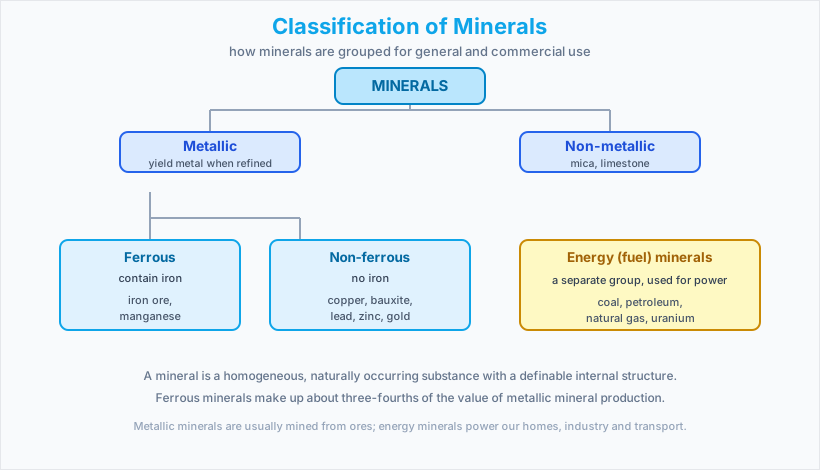
A mineral is a natural substance that is the same all the way through and has a fixed inner structure. A diamond is a mineral; so is salt. We usually dig minerals out of the earth as part of an ore — that means the mineral is mixed with other stuff, like rock and soil. Minerals are sorted into three groups: metallic (these have a metal in them — split into ferrous, meaning they contain iron, and non-ferrous, meaning they do not), non-metallic, and energy or fuel minerals (the ones we burn for power). Energy resources also come in two kinds. Conventional sources are the ones we have used for a long time — firewood, dung cake, coal, petroleum, natural gas and electricity. Non-conventional sources are newer and mostly renewable — solar, wind, tidal, geothermal, biogas and nuclear. Both minerals and fossil fuels are finite and non-renewable, which means they will run out one day. So the real lesson of this chapter is conservation: recycling, using substitutes, and switching to renewable sources.
Let’s Break It Down
What exactly is a mineral?
Geologists (scientists who study the earth) define a mineral as a “homogeneous, naturally occurring substance with a definable internal structure.” In plain words, a mineral is a natural substance that is the same all the way through and has a fixed inner pattern. Rocks are made up of minerals. Some rocks, like limestone, are just one mineral. But most rocks are a mixture of several minerals, in different amounts. Scientists have found more than 2000 minerals so far. But only a few of them are common in most rocks.
Why are minerals so different from one another — from the hardest one, diamond, to the softest one, talc? It is because the mineral that forms depends on the conditions around it, like heat and pressure. These conditions give each mineral its own colour, hardness, crystal shape, shine (called lustre) and weight (called density). Geologists use exactly these features to tell minerals apart and sort them into groups.
How minerals occur (mode of occurrence)
Minerals are usually found inside ores. An ore is a build-up of a mineral that is mixed with other elements, like rock and soil. For it to count as an ore, the mineral must be packed in tightly enough that digging it out is worth the money and effort. The kind of rock formation a mineral sits in decides how easy and how cheap it is to mine. There are five main ways, called modes, in which minerals occur. But since each one is tied to a type of rock, let us quickly remind ourselves what rocks are first.
| Mode | Where / how it forms | Examples |
|---|---|---|
| Veins and lodes | In the cracks and gaps of igneous and metamorphic rocks. Hot molten or gas-like minerals are pushed up into these gaps, then cool down and turn solid. Small ones are called veins; big ones are called lodes | tin, copper, zinc, lead |
| Beds and layers | In sedimentary rocks. The minerals settle and gather in flat, horizontal layers, packed down by heat and pressure. Some also form when water dries up in hot, dry areas | coal, some iron ore; gypsum, potash salt, sodium salt |
| Decomposition of surface rocks | Rocks at the surface slowly break down. The parts that dissolve in water are washed away. What is left behind is a weathered mass that holds the ore | bauxite |
| Placer deposits | In the sand of valley floors and at the foot of hills, carried there by rivers. Only minerals that water does NOT eat away are found here | gold, silver, tin, platinum |
| Ocean waters | Dissolved in sea water (mostly too spread out to be useful) and in lumps lying on the ocean bed called nodules | common salt, magnesium, bromine; manganese nodules |
It is easier to see all five modes if we put them into one picture of the earth. Figure 5.1 below is a single cross-section of the ground. Try to spot each of the five modes in it.

Now that we know how minerals occur, the next question is how we group them. Figure 5.2 below is a tree that shows the main families — metallic, non-metallic, and energy minerals. It is the map for the rest of this chapter, so keep coming back to it.
India is lucky to have a good amount and a wide variety of minerals. But they are not spread evenly. Some parts have plenty, and some have almost none. Here is the simple picture. The peninsular rocks (the old hard rocks in the southern part of India) hold most of the coal, the metallic minerals, the mica and many non-metallic minerals. The sedimentary rocks on the western and eastern edges of the peninsula, like in Gujarat and Assam, hold most of the petroleum. Rajasthan has many non-ferrous minerals. And the big flat plains of north India (made of soil carried by rivers) have almost no useful minerals.
Ferrous minerals: iron ore and manganese
Ferrous minerals are the ones that contain iron. (The word “ferrous” comes from a Latin word for iron.) They make up about three-fourths of the total value of all the metallic minerals India produces. That is a huge share. So they give a strong base to metallurgical industries (industries that make and shape metals). India has so much of these minerals that, after using what it needs, it still has enough left to sell to other countries.
Iron ore is the backbone of industrial growth, because steel is made from it and steel is used everywhere. The good news is that India has plenty of high-quality iron ore:
| Type | Iron content | Special quality |
|---|---|---|
| Magnetite | very high, up to 70% | the finest iron ore; it is strongly magnetic, which makes it very useful in the electrical industry |
| Haematite | lower, 50–60% | the most used in industry, because there is so much of it |
In 2018–19, almost all the iron ore in India (97%) came from just four states — Odisha, Chhattisgarh, Karnataka and Jharkhand. The iron ore is found mainly in four big areas called belts. (A belt just means a long stretch of land where a lot of that mineral is found.) The four major iron ore belts are:
| Belt | States | Key mines / facts |
|---|---|---|
| Odisha–Jharkhand belt | Odisha, Jharkhand | good-quality haematite at Badampahar (in Mayurbhanj and Kendujhar); also Gua and Noamundi in Singhbhum |
| Durg–Bastar–Chandrapur belt | Chhattisgarh, Maharashtra | very high-quality haematite in the Bailadila range (Bastar), which has 14 deposits; this ore is sold to Japan and South Korea through Vishakhapatnam port |
| Ballari–Chitradurga–Chikkamagaluru–Tumakuru belt | Karnataka | very large reserves; the Kudremukh mines (in the Western Ghats) sell 100% of their ore abroad; the ore is mixed with water into a slurry and sent through a pipeline to a port near Mangaluru |
| Maharashtra–Goa belt | Goa, Ratnagiri (Maharashtra) | the ore here is not top quality, but it is mined well and used fully; sold abroad through Marmagao port |
Manganese is mostly used to make steel and an alloy (a mixture of metals) called ferro-manganese. To make one tonne of steel, you need about 10 kg of manganese. It is also used in bleaching powder, insecticides and paints. The leading producers are Madhya Pradesh, Maharashtra and Odisha.
Non-ferrous minerals: copper and bauxite
Non-ferrous minerals are metallic minerals that do NOT have iron in them — for example copper, bauxite, lead, zinc and gold. India does not have very much of these, and it does not produce a lot of them either. Even so, they are very important for metallurgical, engineering and electrical industries.
- Copper — India has very little of it, so we have to buy a lot from other countries. Copper is malleable (it can be hammered into thin sheets without breaking), ductile (it can be pulled into thin wires), and a good conductor (electricity passes through it easily). That is why it is used in electrical cables, electronics and the chemical industry. The leading producers are the Balaghat mines (Madhya Pradesh), the Khetri mines (Rajasthan) and the Singhbhum district (Jharkhand).
- Bauxite — this is a clay-like ore. From it we first get alumina, and then from alumina we get the metal aluminium. Bauxite forms when rocks rich in aluminium silicate break down at the surface. Aluminium is special because it is as strong as iron but much lighter, it conducts electricity well, and it can be easily shaped. Bauxite is found in the Amarkantak plateau, the Maikal hills, and the Bilaspur–Katni plateau. Odisha was the biggest producer in 2018–19, mainly from the Panchpatmali deposits in Koraput district.
Non-metallic minerals: mica and limestone
- Mica is made of many thin plates or leaves stacked together. These split apart very easily into very thin sheets. In fact, a thousand thin sheets can be piled up to make a block only a few centimetres tall. Mica can be clear, black, green, red, yellow or brown. Its big strength is that electricity does not pass through it, even at very high voltage. (We say it has good di-electric strength and insulating properties, and there is very little power loss.) This makes mica very important for the electric and electronic industries. The leading area for mica is the Koderma–Gaya–Hazaribagh belt of Jharkhand, on the northern edge of the Chota Nagpur plateau. Other producers are around Ajmer (Rajasthan) and the Nellore belt (Andhra Pradesh).
- Limestone is found in rocks made of calcium carbonate (or calcium and magnesium carbonate). It occurs in sedimentary rocks of almost every age. It is the main raw material for the cement industry. It is also needed for smelting iron ore (melting the ore to take out the metal) in the blast furnace.
Before moving on to energy, here is a quick check to see if you can spot a mineral from its clues.
A mineral is mainly used in electric and electronic industries because it can be split into very thin sheets and resists high voltage. Which mineral is it, and which category does it belong to?
Hazards of mining and conservation of minerals
Mining harms both people and nature. Miners breathe in dust and harmful fumes all day. This makes them likely to get pulmonary diseases, which means lung diseases. The roofs of mines can fall in. Mines can flood with water. Coal mines can catch fire. These are dangers miners face every day. Mining also dirties water sources. When waste and slurry (the muddy leftover mix) are dumped, they spoil the land and pollute streams and rivers. So we need stronger safety rules and environment laws, so that mining does not turn into a “killer industry”.
Why should we conserve minerals? The deposits we can actually use are only a tiny part — about one per cent — of the earth’s crust. They took millions of years to form. Nature does make new ones, but so slowly that, next to how fast we use them, it is as good as zero. So minerals are finite and non-renewable — they will run out and cannot be replaced. And as we dig deeper to reach more ore, mining gets more expensive and the ore gets poorer. So conservation needs a planned, sustainable approach. This means building technology that can use low-grade ores (ores with less metal) cheaply, recycling metals, using scrap metal (old metal used again), and finding substitutes (other materials we can use in place of a mineral).
Energy resources: conventional vs non-conventional
We need energy for almost everything — cooking, light, heat, moving vehicles and running machines. This energy comes from fuel minerals (coal, petroleum, natural gas and uranium) and from electricity. Energy resources are sorted into two groups, shown in the tree in Figure 5.3 below:
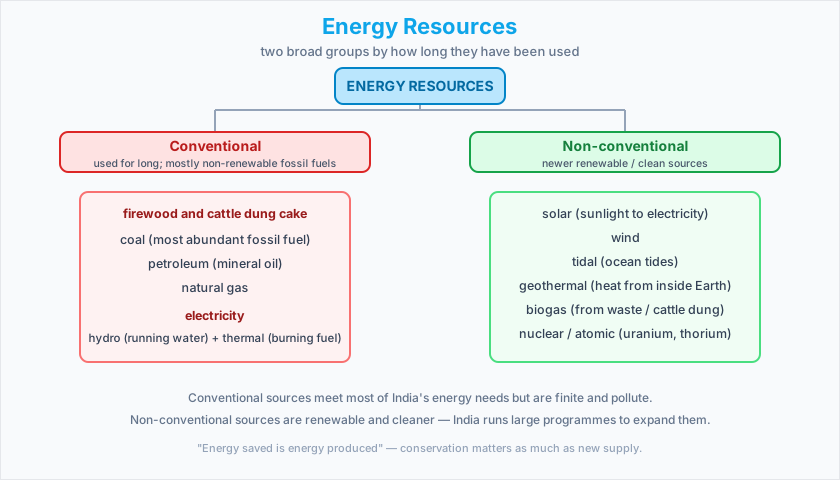
The table below lines the two groups up side by side, so you can see how they differ in renewability, pollution and how much of India’s energy they supply.
| Conventional | Non-conventional | |
|---|---|---|
| Sources | firewood, cattle dung cake, coal, petroleum, natural gas, electricity (hydro and thermal) | solar, wind, tidal, geothermal, biogas, nuclear/atomic |
| Renewable? | mostly fossil fuels that will run out one day (except hydro) | mostly renewable and clean — they do not run out |
| Pollution | burning fossil fuels causes serious harm to the environment | much cleaner |
| Status | supply most of India's energy today | growing fast; India runs some of the largest renewable-energy programmes in the world |
Conventional sources in detail:
Most of these sources are fossil fuels, so let us be sure of what that word actually means before we look at coal, oil and gas one by one.
But how does a green plant turn into a hard black rock you can burn? It helps to picture it as a slow, four-step story. Figure 5.4 below walks through coal forming over millions of years — and it makes the word “non-renewable” click. Notice the timescale: this is not days or years, it is ages.

Now you can see why fossil fuels run out. Nature is still making coal somewhere deep underground right now. But it works at the speed of geology — many millions of years for one seam. We burn through seams in a few decades. So next to how fast we use it, nature’s supply might as well be zero. This is the same lesson as minerals: finite and non-renewable. It is also the strongest reason to switch to sources that never run out, which we meet at the end of this chapter.
- Coal — this is the fossil fuel India has the most of. We use it to make electricity, to run industries, and at home. Coal forms from plant material that was pressed down for millions of years. The more it was pressed, the better the coal. So there are different forms, from weakest to strongest: peat (least carbon, lots of moisture, gives little heat) → lignite (a soft, low-quality brown coal with high moisture; found at Neyveli in Tamil Nadu and used to make electricity) → bituminous (buried deep, gives more heat; the most used coal for business; the best bituminous coal, called metallurgical coal, is used to smelt iron) → anthracite (the best and hardest coal). Indian coal comes from two time periods. Gondwana coal is over 200 million years old. This is metallurgical coal, found mainly in the Damodar valley (Jharia, Raniganj, Bokaro), and also in the Godavari, Mahanadi, Son and Wardha valleys. Tertiary coal is about 55 million years old, found in Meghalaya, Assam, Arunachal Pradesh and Nagaland. Coal is heavy to carry, and it loses weight as it burns down to ash. So it is not worth carrying it far. That is why heavy industries and thermal power stations are built on or near the coalfields.
- Petroleum (mineral oil) — this is the next big energy source after coal. It gives us fuel, lubricants (oils that keep machines running smoothly) and raw material for other products. So oil refineries act as a “nodal industry” — many other industries (synthetic cloth, fertiliser, chemicals) grow up around them. Petroleum is trapped inside folds in the rock called anticlines and in fault traps, in tertiary rocks. It sits inside rocks with tiny holes (porous limestone or sandstone) and is sealed in by solid rock layers above and below. Natural gas is lighter, so it floats above the oil. The main areas are Mumbai High, Gujarat (Ankleshwar) and Assam. Assam is India’s oldest oil-producing state — its fields are at Digboi, Naharkatiya and Moran-Hugrijan.
- Natural gas — this is found together with petroleum, and it comes out when crude oil rises to the surface. We use it to make power, for heating, as raw material for chemicals and fertilisers, and more and more as a vehicle fuel (CNG) and a cooking fuel piped to homes (PNG). The big reserves are at Mumbai High and other west-coast fields, the Cambay basin, and the Krishna–Godavari basin on the east coast. A company called GAIL built a 1700 km pipeline, the Hazira–Vijaipur–Jagdishpur (HVJ) pipeline, to carry this gas from the fields to the industries.
- Electricity — how much electricity each person uses is a sign of how developed a country is. We say it is an index of development. Electricity is made in two ways. Hydro electricity is made by fast-flowing water turning turbines (spinning wheels). Water keeps flowing, so this is a renewable source. Examples are Bhakra Nangal, the Damodar Valley Corporation and the Kopili Hydel Project. Thermal electricity is made by burning coal, petroleum or natural gas. These are fossil fuels, so this source is non-renewable. But once the electricity is made, it is exactly the same either way.
Non-conventional sources in detail:
- Nuclear / atomic — this energy comes from changing the structure of atoms. This releases a lot of heat, which is used to make power. It uses uranium and thorium. These are found in Jharkhand and the Aravalli ranges of Rajasthan. The Monazite sands of Kerala have a lot of thorium.
- Solar — India is a tropical country, which means it gets strong sunlight for most of the year. So it has huge potential here. Photovoltaic technology turns sunlight straight into electricity. Solar power is spreading in villages and far-off areas. This cuts down how much firewood and dung cake people have to burn. (How a panel turns light into electricity is shown just below.)
- Wind — India has great potential for wind power too. The biggest group of wind farms runs in Tamil Nadu, from Nagarcoil to Madurai. Nagarcoil and Jaisalmer are famous for wind energy. There are more wind farms in Andhra Pradesh, Karnataka, Gujarat, Kerala, Maharashtra and Lakshadweep. (How the wind is turned into electricity is shown just below.)
- Biogas — when shrubs, farm waste and animal or human waste are allowed to rot, they give off a gas. This biogas gives more heat than kerosene, dung cake or charcoal. The plants that use cattle dung are called ‘Gobar gas plants’. They give two benefits at once — energy and better manure for the fields.
- Tidal — dams with gates are built across narrow inlets of the sea. When the tide comes in (high tide), water is trapped behind the dam. When the tide goes out (low tide), the trapped water rushes back through a turbine and makes power. The best places for this are the Gulf of Khambhat and the Gulf of Kuchchh in Gujarat, and the Gangetic delta in the Sunderbans in West Bengal.
- Geothermal — this is heat that comes from deep inside the Earth. In some places the rock gets very hot close to the surface. There, the underground water turns into steam, and this steam drives turbines to make power. There are two test projects: one in the Parvati valley near Manikaran (Himachal Pradesh) and one in the Puga valley, Ladakh.
How solar and wind actually make electricity
The list above says solar “turns sunlight into electricity” and wind has “great potential”. But how does a flat panel on a roof, or a giant fan on a hill, give you electricity to charge your phone? These two are worth slowing down for, because they are the future. And the why is simpler than it sounds.
First, what is electricity, really? Think of it as tiny electric charges that move. When those charges flow along a wire, that flow is electricity — the same thing that lights your bulb. So to make electricity, you just need something that gets those tiny charges moving. Solar and wind do this in two different ways.
A solar panel is the surprising one. It has no spinning parts at all. It is built from many small solar cells. When sunlight falls on a cell, the light’s energy knocks the tiny charges loose and pushes them to move in one direction. A moving charge is electricity — so the panel makes electricity straight from light, with nothing turning. Figure 5.5 below shows the whole path from the sun to your home.

A wind turbine uses an idea you already know — a pinwheel. Blow on a paper pinwheel and it spins. The wind does the same to the turbine’s huge blades. The trick is what the spinning is connected to. Inside the box at the top of the tower sits a generator — a machine that makes electricity whenever it is spun. The blades spin the generator, and the generator turns that spinning into electricity. Figure 5.6 below traces this from the wind to the home. (Hydro electricity, which you met earlier, works the very same way — there, falling water spins the generator instead of wind.)

Notice the big difference from coal. Coal had to form for millions of years, and once burnt it is gone. But the sun rises again tomorrow, and the wind keeps blowing. They are never used up. That is exactly why they are called renewable, and why India is building so much solar and wind power for the future.
Conservation of energy resources
Every part of life needs energy — farming, industry, transport, business and our homes. And we are using more and more energy every year. Right now India is one of the countries that wastes the most energy (it is one of the least energy-efficient). So the way forward is a sustainable path. This means two things together: saving energy (energy conservation) and using more renewable sources. As ordinary people, we can help. We can use public transport instead of private vehicles. We can switch off lights we are not using. We can use power-saving devices. And we can choose non-conventional sources when we can. Remember, “energy saved is energy produced” — every unit you do not waste is a unit that did not need to be made.
Common Mistakes
Minerals are renewable — the earth will just make more, so we need not worry about running out.
The earth is so big, and we have always dug minerals out of it. So it feels like an endless supply that quietly fills back up on its own.
The deposits we can actually use are only about one per cent of the earth's crust, and they took millions of years to form. Nature does make more, but so slowly that, next to how fast we use them, it is basically zero. So minerals are finite and non-renewable. That is exactly why recycling and finding substitutes matter so much.
Ferrous and non-ferrous just mean 'metal' and 'non-metal'.
The two words sound like a metal-versus-non-metal split. And ferrous minerals really are metals, so it seems like the pattern carries on.
Both ferrous and non-ferrous minerals are METALLIC — they both have metal in them. The real difference is iron. Ferrous minerals CONTAIN iron (like iron ore and manganese). Non-ferrous minerals do NOT (like copper, bauxite, lead, zinc and gold). The truly non-metallic group is a separate thing — mica and limestone.
All non-conventional energy sources are renewable and clean.
Solar, wind, tidal and biogas really are renewable. So it is easy to think the whole group must be the same.
Most non-conventional sources are renewable, but nuclear (atomic) energy is not. It uses uranium and thorium, which are mineral fuels that will run out. It is put in the non-conventional group because it is a newer, alternative source — not because it is renewable.
Hydro and thermal electricity are two different kinds of electricity.
They are made in very different ways — one from falling water, one from burning fuel. So it feels like the end product must be different too.
Only the METHOD of making it is different. Hydro uses fast-flowing water (renewable). Thermal burns coal, oil or gas (non-renewable). But once it is made, the electricity is exactly the same.
Quick Check
Which mineral is formed by the decomposition of surface rocks, leaving a residual mass of weathered material?
Koderma in Jharkhand is the leading producer of which mineral?
Minerals deposited and accumulated in horizontal strata are found mainly in which rocks?
The Monazite sands of Kerala are an important source of which mineral?
Practice Problems
Easy
What is a mineral?
A mineral is a homogeneous, naturally occurring substance with a definable internal structure. In simple words, it is a natural substance that is the same all the way through and has a fixed inner pattern. Minerals come in many forms, from the hardest one (diamond) to the softest one (talc). And rocks are made up of one or more minerals.
Distinguish between ferrous and non-ferrous minerals (in about 30 words).
Ferrous minerals contain iron — for example iron ore and manganese. They form the base of metallurgical industries (industries that make and shape metals). Non-ferrous minerals do not contain iron — for example copper, bauxite, lead, zinc and gold. Both kinds are metallic.
Medium
How are minerals formed in igneous and metamorphic rocks?
In igneous and metamorphic rocks, minerals are found in the cracks and gaps of the rock. Minerals in liquid (molten) or gas form are pushed up through these gaps towards the earth’s surface. As they rise, they cool down and turn solid. The smaller ones are called veins and the bigger ones are called lodes. Important metallic minerals like tin, copper, zinc and lead are taken out this way.
Why do we need to conserve mineral resources? (about 30 words)
The mineral deposits we can actually use are only about one per cent of the earth’s crust. They took millions of years to form, and they are finite and non-renewable — they will run out and cannot be replaced. We are using them up far faster than nature can make more. So we must conserve them through planned use, recycling and substitutes.
Challenge
Describe the distribution of coal in India (about 120 words).
Coal is the fossil fuel India has the most of. It is found in rocks from two different time periods. The older one is Gondwana coal, which is over 200 million years old. This is metallurgical coal. It is found mainly in the Damodar valley of West Bengal and Jharkhand. The important coalfields there are Jharia, Raniganj and Bokaro. Gondwana coal is also found in the Godavari, Mahanadi, Son and Wardha valleys.
The younger one is tertiary coal, about 55 million years old. It is found in the north-eastern states of Meghalaya, Assam, Arunachal Pradesh and Nagaland.
Coal is a heavy material, and it loses weight when it is used, because it burns down to ash. So it is not worth carrying it far. That is why heavy industries and thermal power stations are built on or near the coalfields.
Why do you think solar energy has a bright future in India? (about 120 words)
India is a tropical country, so it gets plenty of sunlight for most of the year. This gives it huge potential for solar energy. Photovoltaic technology turns sunlight straight into electricity. Solar power is quickly becoming popular in villages and far-off areas, where the electricity grid is weak or missing.
Big solar power plants are being built across the country. These will cut down how much firewood and cattle-dung cake village homes have to burn. This brings two more benefits. First, it protects the environment — fewer trees are cut and less is burnt. Second, it gives farmers enough manure, because dung can now go back into the fields instead of being burnt as fuel.
Solar energy is renewable, clean and does not pollute. India also runs some of the world’s biggest renewable-energy programmes. So solar energy truly has a bright future.
Summary
You should now be able to explain:
- A mineral is a natural substance that is the same all the way through and has a fixed inner structure. We usually mine it from an ore (a mineral mixed with other elements, packed in tightly enough to be worth digging out).
- Minerals occur in five ways: veins and lodes (in igneous/metamorphic rock — tin, copper, zinc, lead), beds and layers (in sedimentary rock — coal, some iron ore), decomposition of surface rocks (bauxite), placer deposits in river sands (gold, silver, tin, platinum), and ocean waters (salt, magnesium, bromine, manganese nodules).
- Minerals are sorted into metallic (ferrous = with iron: iron ore, manganese; non-ferrous = without iron: copper, bauxite, lead, zinc, gold), non-metallic (mica, limestone) and energy/fuel minerals.
- Iron ore has two types: magnetite (up to 70% iron, strongly magnetic) and haematite (50–60% iron, the most used). The four belts are Odisha–Jharkhand, Durg–Bastar–Chandrapur, Ballari–Chitradurga–Chikkamagaluru–Tumakuru, and Maharashtra–Goa.
- Minerals are finite and non-renewable, so we save them by using low-grade ores, recycling, using scrap metal and finding substitutes.
- Energy resources are conventional (firewood, dung cake, coal, petroleum, natural gas, electricity from hydro and thermal) and non-conventional (solar, wind, tidal, geothermal, biogas, nuclear).
- Saving energy matters just as much as making new energy — “energy saved is energy produced.”
What’s Next
You have now seen where our raw materials and power come from. Next, in Manufacturing Industries, you will follow those minerals and that energy into the factory. You will see how iron ore plus coal becomes steel, how raw cotton becomes cloth, and why factories are built where they are. You will also see how manufacturing helps the economy grow, but at the same time pollutes the air, water and land we depend on.
Frequently Asked Questions
What is the difference between metallic and non-metallic minerals?
Metallic minerals contain a metal and can be melted to get that metal out — examples are iron ore, bauxite (for aluminium) and copper. They are further divided into ferrous (containing iron) and non-ferrous (no iron). Non-metallic minerals do not contain a metal and are used differently — examples are limestone, mica and salt.
What are the different ways or modes of occurrence of minerals?
Minerals are found in five main ways. In veins and lodes inside igneous and metamorphic rocks (like gold and copper). In beds or layers in sedimentary rocks (like coal and iron ore of the Gondwana type). As alluvial or placer deposits in river sands (like gold and tin). In ocean waters dissolved as salts. And as surface deposits like gypsum. The type of rock formation decides how easy it is to mine.
What is the difference between conventional and non-conventional energy resources?
Conventional energy sources are the ones we have used for a long time — firewood, coal, petroleum, natural gas and thermal electricity. They are mostly non-renewable and cause pollution. Non-conventional sources are newer and mostly renewable — solar, wind, tidal, geothermal and biogas. India is investing heavily in solar and wind energy because conventional fuels are running out and damaging the environment.
Why is conservation of minerals so important?
Minerals took millions of years to form inside the earth and cannot be replaced once used up. We are using them much faster than they are being created. If we waste them now, future generations will have none left. Conservation means using minerals efficiently, recycling scrap metal, finding substitutes, and using them only where truly needed — so supplies last as long as possible.
What are the major iron ore belts in India and why is iron ore so important?
Iron ore is the raw material for steel, which is used in everything from bridges and railways to machines and vehicles. India has four main iron ore belts: Odisha-Jharkhand (the largest, includes Singhbhum district), Durg-Bastar-Chandrapur, Bellary-Chitradurga-Chikmagalur-Tumkur in Karnataka, and the Maharashtra-Goa belt. High-grade hematite ore is found mainly in Odisha and Jharkhand.