Manufacturing Industries
Why This Matters
Walk into a Diwali market. It is full of things — shoes, clothes, utensils, sugar, tea, earthen diyas. Have you ever wondered how so many of each thing can exist?
Think about where they came from. The shoes and clothes were made by big machines in a factory. The steel ladle was made in a small workshop. The diya was shaped by one potter at home. These are three very different sizes of “making”. But they all do the same thing: they turn raw material into something more useful. That is what we call manufacturing.
This chapter is the story of how India makes things. We turn paper from wood, sugar from sugarcane, steel from iron ore, aluminium from bauxite, and cloth from yarn.
It also answers some interesting questions. Why is a steel plant built on a high, flat plateau, but a jute mill is built right next to a river? Why is one sugar mill run by a group of farmers, while a huge steel company is run by the government? And why do the same factories that help our country grow also dirty our air and rivers? We will answer all of these.
Why does this matter so much? Because the strength of a country’s economy depends a lot on how well it manufactures. A country that only sells raw materials (like just selling iron ore) stays poor. But a country that turns those raw materials into valuable finished goods (like cars and machines) becomes rich. India’s future wealth is being built, quite literally, inside its factories.
The Big Idea
Manufacturing means making goods in large quantities. We do this by processing raw materials and turning them into more valuable finished products. (For example, turning cheap iron ore into valuable steel.) Manufacturing is the backbone of economic development. It improves farming, gives people jobs other than farming, earns foreign money through exports, and helps poorer regions catch up. Where a factory is built is decided by a tug-of-war between many things: raw material, power, labour, market, transport, capital and water. Since there are thousands of industries, we sort them using five simple bases: what they are made from, what job they do, how much money is invested, who owns them, and how heavy their goods are.
That whole idea rests on two words we will use again and again — “raw material” and “finished product”. Let us make sure they are crystal clear before we go further.
Keep two ideas in your mind for this whole chapter.
First, farming and industry are friends, not rivals. They help each other. Agro-industries take crops from farmers to use as raw material. In return, they sell pumps, fertilisers and tools back to the farmers.
Second, every industry has a cost, and this chapter is honest about it: pollution. We have to balance growth with care for the environment. This balance is called sustainable development.
Let’s Break It Down
Why manufacturing is the backbone
To see where manufacturing fits, it helps to know that all work in an economy is split into three groups, called sectors. Here is a quick tour of them.
Manufacturing belongs to the secondary sector. The secondary sector is the part of the economy where workers take raw materials and turn them into finished goods. (These raw materials come from the primary sector, which is farming, mining and forestry.) Steel factories, car plants, textile mills and bakeries all belong to this secondary sector.
Why do we call manufacturing the backbone of a country’s development? There are a few clear reasons.
- It improves farming. It also means people do not have to depend only on farm income, because it gives them new jobs in factories and services.
- It helps end joblessness and poverty. This was the main reason behind India’s government-owned industries. These industries were also placed in tribal and backward areas on purpose, so that poorer regions could catch up with richer ones.
- Exporting (selling our goods to other countries) grows our trade. It also earns us foreign exchange (money from other countries), which we badly need.
- Countries that make many kinds of high-value finished goods become rich. So, India should grow its manufacturing as fast as it can, and make many different types of goods.
One last point. In today’s connected world, just making enough for ourselves is not enough. Our goods must be as good in quality as goods from other countries. Only then can we compete and sell them in the world market.
But why does making things make a country rich?
We keep saying a country that only sells raw material stays poor, while one that makes finished goods grows rich. That sounds like a slogan. Let us see why it is actually true, step by step. The secret has a name: adding value.
Think about cotton. Raw cotton picked from the field is worth very little — say ₹10. Now somebody spins it into yarn. That spinning is work, and it makes the cotton more useful, so the yarn is worth more — say ₹25. Then somebody weaves the yarn into cloth: more work, more use, more value — say ₹60. Finally a tailor cuts and stitches the cloth into a shirt — now it is worth ₹300.
At every step, a worker added some work, and the price went up. The extra money at each step is called the value added. (The prices here are made up, just to show the idea.) Here is the important part. If India sells only the raw cotton at ₹10, all the rich ₹290 of value-adding is done in another country, and that country keeps the money and the jobs. But if India does all the steps itself, India keeps the whole ₹290 — and employs the spinner, the weaver and the tailor along the way.
So manufacturing is simply the act of climbing this value ladder at home. That is the real reason it makes a country rich, and why India wants to make finished goods, not just sell raw materials.
Figure 6.1 below lays out the cotton value ladder so you can see the price climb at every step.

Here is a common myth worth testing before we move on — that farms and factories are fighting each other.
Agriculture and industry are rivals competing for the same workers. True or false?
False. They help each other. Agro-industries need farms for their raw materials. In return, they sell farmers many useful things: water pumps, fertilisers, pesticides, PVC pipes, machines and tools. This helps farmers grow more crops and work faster.
What decides where a factory is built
A factory is not built just anywhere. Its location (the place where it is built) is chosen carefully. The owners pick the spot where making goods will cost the least and earn the most profit. Many things pull on this decision at the same time. Here are the main ones.
- Raw material. Some materials are heavy and bulky. Some even lose weight or quality when moved far. These materials pull the factory close to where they are found. (A steel plant is built near coal and iron ore. A sugar mill is built near sugarcane, because cut cane loses its sugar the longer it waits or travels.)
- Power. This is the electricity needed to run the machines. (Aluminium-making needs a large, steady supply of electricity.)
- Labour. This means workers who are available and not too costly.
- Market. This means being close to the place where the goods will be sold.
- Transport. This means good road, rail, water and port links. These are needed to bring materials in and send goods out.
- Capital. This simply means money to invest in the factory.
- Water. This is needed for processing. (Jute mills need a lot of water.)
When many of these things are found in one place, factories gather there together. This is why the Chhotanagpur plateau has the most iron and steel plants in India. It has cheap iron ore, good-quality raw materials nearby, cheap labour, and a large market to sell to.
Picture all these pulls tugging on one factory at the same time. Figure 6.2 below lays out the seven of them so you can see how they compete.

Why do factories gather in the same place?
We just said factories gather together. But think about it — why would a new factory owner want to build next to other factories? Would it not be smarter to go somewhere empty and quiet? The answer is no, and the reason is simple: factories that sit together can share things, and sharing makes each one cheaper to run. This gathering-together has a name — agglomeration.
Imagine the first factory comes to a place. To run it, someone has to bring in a power line, set up a bank for loans, train a group of workers, and build a road or railway to carry goods. All of that is expensive. Now a second factory arrives. It does not have to build all that again. It just plugs into the same power line, borrows from the same bank, hires from the same pool of trained workers, and uses the same road. So the second factory starts up far more cheaply.
The more factories that join, the better it gets for everyone. Shops open up nearby to supply spare parts. Skilled workers move there knowing jobs are plenty. Banks, insurance offices and transport all grow to serve the crowd. Each new arrival makes the place even more useful for the next one. This is exactly why one spot — like the Chhotanagpur plateau for steel, or the Hugli river belt for jute — fills up with the same kind of industry instead of spreading out evenly.
Figure 6.3 below shows the costly things that a cluster of factories shares between them.

Now let us turn each of those pulls into a way of sorting industries.
Five ways to classify industries
There are thousands of industries. To make sense of them, we sort them into groups. Each time we sort, we pick one rule to sort by. This rule is called a basis. Here is the important part: the same industry can fall into different groups, depending on which basis we use. (For example, iron and steel is one industry, but it fits several groups at once, as you will see.)
Figure 6.4 below sorts industries on all five bases in one view — read it once to get the big picture, then we will unpack each row.
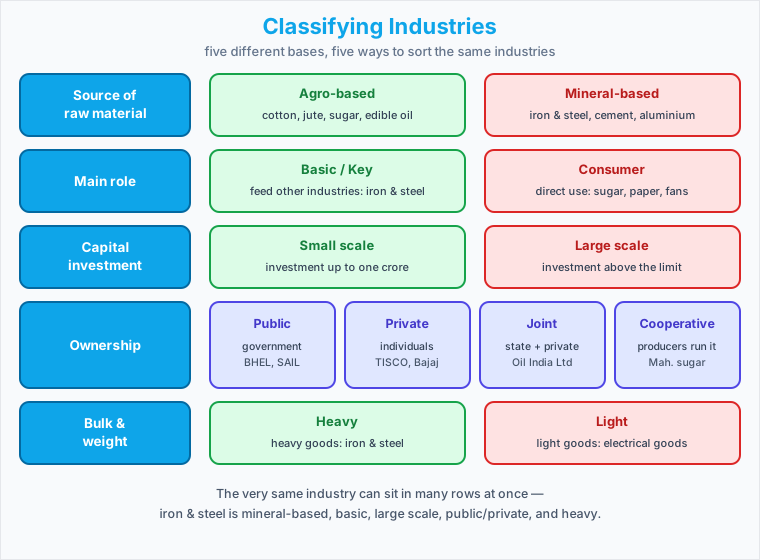
The table below spells out each basis with its categories and clear examples, so you can tell them apart in an exam.
| Basis | Categories | Examples |
|---|---|---|
| Source of raw material (what they are made from) | Agro-based / Mineral-based | Agro-based (made from farm products): cotton, jute, silk, woollen textile, rubber, sugar, tea, coffee, edible oil. Mineral-based (made from minerals and metals): iron & steel, cement, aluminium, machine tools, petrochemicals. |
| Main role (the job they do) | Basic (key) / Consumer | Basic: iron & steel, copper smelting, aluminium smelting. (These supply raw materials to other industries.) Consumer: sugar, toothpaste, paper, sewing machines, fans. (These make goods we use directly.) |
| Capital investment (money put in) | Small scale / Large scale | Small scale = money invested in assets is up to ₹1 crore (this limit has changed over time). If more than that, it is large scale. |
| Ownership (who owns it) | Public / Private / Joint / Cooperative | Public (owned by government): BHEL, SAIL. Private (owned by a person or company): TISCO, Bajaj Auto, Dabur. Joint (government and private together): Oil India Ltd. Cooperative (owned by the producers/workers): sugar in Maharashtra, coir in Kerala. |
| Bulk & weight (how heavy the goods are) | Heavy / Light | Heavy: iron & steel. Light: electrical goods. |
Here is a quick note on the cooperative sector. A cooperative is owned and run by the people who supply the raw materials, or the workers, or both together. They put their resources into one pool. Then they share the profit or loss between them, in fair amounts.
One label from that table is worth a second look — why iron and steel gets called a “basic” industry.
Iron and steel is a 'basic' industry. Why that name?
Because its product, steel, is used as a raw material to make other goods. Heavy, medium and light industries all need steel for their machines. So iron and steel is the base on which other industries stand. That is why we call it ‘basic’.
Agro-based industries: textiles & sugar
“Agro” means farming. So agro-based industries are industries that use farm products as their raw material. Examples are cotton, jute, silk, woollen textiles, sugar and edible oil.
The textile industry is very special in India’s economy. It adds a huge amount to three things: total factory output, jobs for people, and foreign money earned through exports. It is also the only industry in India that is self-reliant and complete from start to finish. This means it can do the whole journey within India by itself: it starts from the raw material and goes all the way up to the finished, high-value cloth.
Cotton textiles. Long ago in India, cotton cloth was made by hand. People spun thread by hand and wove it on handlooms. After the 18th century, power-looms (machines) arrived. During the colonial period (when the British ruled India), our old hand-based industry suffered badly. It could not compete with the cheaper, machine-made cloth coming from England.
- The first successful textile mill was set up in Mumbai in 1854.
- The two World Wars were fought in Europe, while India was still a British colony. These wars created a big demand for cloth in the U.K. This demand gave a boost to India’s cotton textile industry.
In the early days, the industry gathered in the cotton-growing belt of Maharashtra and Gujarat. Many things pulled it there: the raw cotton itself, a good market, transport and ports, plenty of workers, and a moist (damp) climate. This industry is closely tied to farming. It also gives work to a long chain of people: those who pick the cotton bolls, and those who do ginning, spinning, weaving, dyeing, designing, packaging, tailoring and sewing. On top of this, it helps other industries too, such as chemicals and dyes, packaging and engineering.
Today, the work is split. Spinning (making yarn) is centralised, meaning it happens mostly in a few states: Maharashtra, Gujarat and Tamil Nadu. But weaving (making cloth from yarn) is highly decentralised, meaning it is spread out across many places. This spreading-out is done on purpose, to keep alive traditional skills and designs like cotton, silk, zari and embroidery. India is among the best in the world at spinning. But our weaving is still weak and makes lower-quality cloth, because it cannot use much of the fine yarn we produce. Weaving is done in three ways: by handloom, by powerloom, and in mills. Hand-spun khadi also gives jobs to a large number of weavers working from their own homes.
Jute textiles. India is the largest producer of raw jute and jute goods in the world. It is the second-largest exporter of jute, after Bangladesh. Most jute mills are in West Bengal. They sit in a narrow belt along the banks of the Hugli river. The first jute mill was set up near Kolkata, at a place called Rishra, in 1855.
After Partition in 1947, the mills stayed in India. But three-fourths of the jute-growing area went to Bangladesh (which was then called East Pakistan). So why are the mills in the Hugli area? There are several reasons. The jute-growing areas are nearby. There is cheap water transport (along with railways and roads). There is plenty of water to process the raw jute. There is cheap labour from West Bengal and the nearby states of Bihar, Odisha and Uttar Pradesh. And Kolkata is a big city that offers banking, insurance and port facilities.
Sugar industry. India is the second-largest producer of sugar in the world. But it is first in the world for gur and khandsari (these are local, less-refined forms of sugar). The raw material is sugarcane. Sugarcane is bulky, and it loses its sucrose (sugar) when carried over long distances. So the mills must be built close to the cane fields. Mills are found in Uttar Pradesh, Bihar, Maharashtra, Karnataka, Tamil Nadu, Andhra Pradesh, Gujarat, Punjab, Haryana and Madhya Pradesh. In fact, 60% of the mills are in Uttar Pradesh and Bihar.
This industry is seasonal, which means it only works for part of the year (the cane-crushing season). This seasonal nature makes it a perfect fit for the cooperative sector, where the cane-growing farmers own the mill together. In recent years, the mills have been moving to the southern and western states, especially Maharashtra. Why? Three reasons. The cane there has more sucrose. The cooler climate gives a longer crushing season. And cooperatives work better in those states.
Mineral-based industries
Mineral-based industries are industries that use minerals and metals as their raw materials.
Iron and steel is the basic industry. We call it “basic” because every other industry, whether heavy, medium or light, depends on it to get machinery. Steel is needed for many things: engineering goods, construction, defence, medical equipment, telephone and scientific equipment, and countless everyday goods. In fact, how much steel a country makes and uses is treated as a measure of how developed that country is.
Iron and steel is a heavy industry. Both its raw materials and its finished goods are heavy and bulky. So moving them around costs a lot. To make steel, we need three materials in a fixed ratio: iron ore, coking coal and limestone, in the ratio of about 4 : 2 : 1. (This means roughly 4 parts ore, 2 parts coal and 1 part limestone.) We also add a little manganese to make the steel harder. The best place for a steel plant is where all these materials and good transport meet in one spot. This is exactly why the Chhotanagpur plateau has the most iron and steel plants in India.
Figure 6.5 below shows the whole journey at a glance — the three inputs going in, and steel coming out the other end.

Aluminium smelting is India’s second most important metal industry (after iron and steel). Aluminium has many useful qualities. It is light in weight, does not rust easily, carries heat well, can be bent and shaped, and becomes strong when mixed with other metals. We use it for aircraft, utensils and wires. More and more, it is being used in place of steel, copper, zinc and lead. Its raw material is bauxite, which is a very bulky, dark reddish rock. Aluminium plants are located in Odisha, West Bengal, Kerala, Uttar Pradesh, Chhattisgarh, Maharashtra and Tamil Nadu. Two things matter most when choosing where to build them: a steady supply of electricity, and a sure supply of raw material at the lowest cost.
Chemical industries. This industry is growing fast and making more and more kinds of products. It includes both large and small units. It has two sides: inorganic and organic.
- Inorganic chemicals include sulphuric acid (used in fertilisers, synthetic fibres, plastics, glues, paints and dyes), nitric acid, alkalies, soda ash (used in glass, soaps, detergents and paper) and caustic soda. These are made in many places all over the country.
- Organic chemicals include petrochemicals. These are used to make synthetic fibres, synthetic rubber, plastics, dyes, drugs and medicines. Their plants are built near oil refineries or petrochemical plants.
Here is an interesting point: the chemical industry is its own biggest customer. The basic chemicals it makes are turned into other chemicals, which are then used by industry, farming or ordinary people.
Fertiliser industry. This industry makes a few main types of fertiliser. These are nitrogenous fertilisers (mainly urea), phosphatic fertilisers, ammonium phosphate (DAP), and complex fertilisers that mix nitrogen (N), phosphate (P) and potash (K). One key fact: India has to import all of its potash from other countries, because it has no usable potash reserves of its own. The industry grew a lot after the Green Revolution (a period when India greatly increased its crop output). The states of Gujarat, Tamil Nadu, Uttar Pradesh, Punjab and Kerala make about half of all the fertiliser in the country.
Cement industry. Cement is needed for all kinds of building work, such as houses, factories, bridges, roads, airports and dams. It needs bulky, heavy raw materials like limestone, silica and gypsum. It also needs coal, electric power and rail transport. The first cement plant was set up in Chennai in 1904. The industry grew a lot after Independence. The plants in Gujarat are well placed to sell cement to the Gulf countries.
Automobile industry. This industry makes vehicles that carry goods and people quickly: trucks, buses, cars, motorcycles, scooters, three-wheelers and multi-utility vehicles. After liberalisation (when India opened up its economy and allowed more foreign companies in), new and modern models created more demand, and the industry grew well. It is located in and around Delhi, Gurugram, Mumbai, Pune, Chennai, Kolkata, Lucknow, Indore, Hyderabad, Jamshedpur and Bengaluru.
Information Technology and Electronics industry. This industry makes a wide range of products: transistor sets, televisions, telephones, mobile telecom equipment, telephone exchanges, radars, computers and other telecom equipment. Bengaluru has become the electronic capital of India. Other important centres are Mumbai, Delhi, Hyderabad, Pune, Chennai, Kolkata, Lucknow and Coimbatore. The biggest centres are Bengaluru, Noida, Mumbai, Chennai, Hyderabad and Pune. The greatest gift of this industry has been the jobs it creates. Growing both hardware and software is the key to its success.
Now let us put the location idea to work on two industries that both hug their raw material — but for surprisingly different reasons.
Both sugar mills and iron & steel plants are built close to their raw material. But the reason is a little different for each. Explain the reason for both.
- Look at the sugar mill first. Sugarcane is bulky. Worse, it loses its sucrose (sugar) the longer it waits and the farther it travels after cutting. So, to save the sugar, the mill must be near the fields.
- Now look at iron & steel. It uses iron ore, coking coal and limestone (in the ratio of about 4 : 2 : 1). All of these are heavy and bulky. So carrying them a long way is very costly. The finished steel is heavy too.
- So both build near their raw materials to save money. But the reasons differ. The sugar mill is racing to stop the sugar from being lost. The steel plant is trying to avoid the high cost of moving heavy materials. This is exactly why the Chhotanagpur plateau, which is rich in ore and coal, has most of India’s steel plants.
Industrial pollution and how it is controlled
Industries help India grow. But they also cause pollution. There are four types of industrial pollution. And thermal power plants (which burn fuel to make electricity) cause pollution too.
Figure 6.6 below links one factory to all four kinds of pollution and the main sources of each — a handy overview before the details.
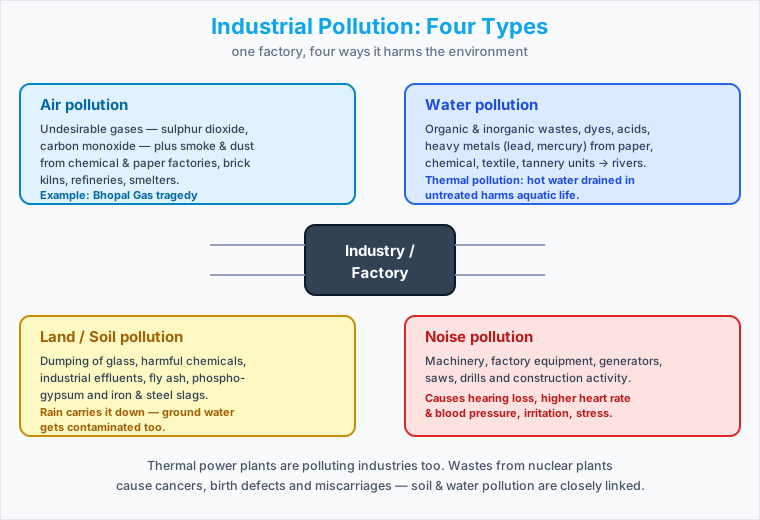
Let us take the four types one by one — what causes each and the damage it does — set side by side in the table.
| Type | Caused by | Main effects |
|---|---|---|
| Air | Too many harmful gases (like sulphur dioxide and carbon monoxide), plus smoke and dust from chemical & paper factories, brick kilns, refineries and smelters; also leaks of poisonous gas | Harms people's health, animals, plants, buildings and the air. Example: the Bhopal Gas tragedy. |
| Water | Waste and dirty water from factories — dyes, detergents, acids, salts, and heavy metals like lead & mercury — from paper, pulp, chemical, textile & dyeing, refineries, tanneries and electroplating units; also solid wastes like fly ash, phospho-gypsum and slags | Dirties rivers and other water bodies. Thermal pollution (when hot water is poured in before it cools down) harms water animals and plants. |
| Land / Soil | Dumping of glass, harmful chemicals, factory waste, packaging, salts and garbage; rain then carries these pollutants down into the ground | Makes the soil useless and dirties the ground water below. Nuclear waste can cause cancer, birth defects and miscarriages. |
| Noise | Factory and construction work, machines, factory equipment, generators, saws, and air-powered and electric drills | Causes irritation, anger and stress; can damage hearing; and raises heart rate and blood pressure. |
How do we control the damage? First, think about how serious water pollution is. Every one litre of waste water that a factory pours out can dirty eight litres of clean freshwater. Here is how we can fight back.
- Use less freshwater. Factories can reuse and recycle the same water through two or more stages. They can also collect rainwater to use.
- Treat hot water and waste water before letting it out. This treatment happens in three stages. (a) Primary is mechanical cleaning, like screening, grinding, and letting solids settle. (b) Secondary uses tiny living things (biological) to clean the water. (c) Tertiary uses biological, chemical and physical methods together, and recycles the water for use again.
- Make laws to stop too much ground water being pumped out, in places where the water reserves are in danger.
- Reduce air pollution. Fit chimneys with special filters called electrostatic precipitators, fabric filters, scrubbers and inertial separators. Also, burn oil or gas instead of coal, since this makes less smoke.
- Reduce noise. Fit generators with silencers. Redesign machines so they use less energy and make less noise. Use sound-absorbing material, earplugs and earphones.
The goal of sustainable development is to grow the economy and protect the environment at the same time. NTPC, a major power company, shows how this can be done. It has earned the ISO 14001 certificate for managing the environment well. It protects nature in several ways: it uses its equipment carefully, makes as little waste as possible, recycles its ash and ash-water, plants green belts and trees, and keeps an eye on the environment at all its power stations.
Common Mistakes
Four ideas trip up most students in this chapter. Read each one and check whether you were quietly believing it.
Manufacturing just means making any product, even a single piece by hand.
In daily talk, we call any kind of making 'manufacturing'. A potter who shapes one diya is surely making something. So it feels right to say 'making one item = manufacturing'.
The real meaning has two key parts: large amount and more value. Manufacturing means making goods in LARGE quantities, and turning raw materials into MORE VALUABLE finished products. The important ideas are bulk production and adding value — not just making one piece by hand.
A factory should always be built right next to its market, or wherever the land is cheap.
Being close to buyers sounds smart and saves trouble. And cheap land clearly saves money. So it feels like location is mostly about the market and the land price.
Location is a balance of many things: raw material, power, labour, market, transport, capital and water. Which one matters most depends on the industry. If the raw material is heavy or loses weight (like iron ore or sugarcane), the factory is pulled to the SOURCE of that material, not to the market.
India does not import any raw material for fertilisers, because it makes everything itself.
India is a big farming country with a large fertiliser industry. So it feels obvious that India would make all of its own materials.
India IMPORTS all of its potash (the 'K' in NPK) from other countries. This is because India has no usable potash reserves of its own. India does make its own nitrogenous and phosphatic fertilisers, but the potash must be brought in from outside.
Thermal pollution means the air getting hotter near a factory.
The word 'thermal' means heat. Factories do feel hot. So 'thermal pollution' sounds like hot air around the factory.
Thermal pollution is actually a WATER problem, not an air problem. It happens when hot water from factories and thermal plants is poured into rivers and ponds BEFORE it has cooled down. This harms the animals and plants living in the water. That is why it is listed under water pollution.
Quick Check
Which one of the following industries uses bauxite as a raw material?
Which industry manufactures telephones, computers and similar equipment?
Most jute mills in India are located along the banks of which river?
Why is the sugar industry well suited to the cooperative sector?
Practice Problems
Easy
What is manufacturing? (Answer in not more than 30 words.)
Manufacturing is the production of goods in large quantities by processing raw materials into more valuable finished products — for example, sugar from sugarcane, steel from iron ore, or aluminium from bauxite.
What are basic industries? Give an example.
Basic (or key) industries are industries whose products are used as raw materials to make other goods. Other heavy, medium and light industries all depend on them.
Example: the iron and steel industry. Its steel becomes the machines and material for almost every other industry.
Medium
Why is the cotton textile industry called self-reliant and complete in its value chain, and name three states where spinning is centralised.
The cotton textile industry is the only industry in India that is self-reliant and complete from start to finish. This means it can do the whole job within India by itself. It covers everything, from the raw material right up to the finished, high-value cloth. It also adds a lot to factory output, to jobs, and to the foreign money India earns.
Spinning is centralised in Maharashtra, Gujarat and Tamil Nadu. Weaving, on the other hand, is spread out across many places. This is done to keep alive the traditional skills and designs in cotton, silk, zari and embroidery.
Explain why the Chhotanagpur plateau has the maximum concentration of iron and steel industries.
The Chhotanagpur plateau has several advantages for this industry:
- Iron ore is cheap in this region.
- Good-quality raw materials (coking coal and limestone) are found close by. This matters a lot, because iron & steel is a heavy industry and these materials are bulky and costly to move.
- Labour is cheap.
- There is a large market nearby with room to grow.
Together, these things make it cheaper to produce steel here than anywhere else. So most steel plants gather on this plateau.
Challenge
How do industries pollute the environment? Discuss the four types. (Around 120 words.)
Industries cause four types of pollution: air, water, land and noise. Thermal power plants add to it too.
Air pollution comes from harmful gases like sulphur dioxide and carbon monoxide, and from smoke and dust from chemical and paper factories, brick kilns, refineries and smelters. Leaks of poisonous gas (such as the Bhopal Gas tragedy) are especially dangerous.
Water pollution is caused by waste, dyes, acids, salts, and heavy metals like lead and mercury. These are poured into rivers by paper, chemical, textile, tannery and electroplating units. Hot water (thermal pollution) also harms water life.
Land/soil pollution comes from dumping glass, chemicals, waste, fly ash and slags. These also dirty the ground water.
Noise pollution from machines, generators and drills causes hearing loss, high blood pressure and stress.
Discuss the steps to be taken to minimise environmental degradation by industry. (Around 120 words.)
Factories can cause less freshwater pollution by using less water. They can do this by reusing and recycling water through two or more stages, and by collecting rainwater. Hot water and waste water must be treated before being let out, in three stages: primary (mechanical cleaning — screening, grinding, letting solids settle), secondary (cleaning with tiny living things), and tertiary (biological, chemical and physical methods, with the water recycled). Laws should also stop factories from pumping out too much ground water.
For air, harmful dust and particles can be cut by fitting chimneys with electrostatic precipitators, fabric filters, scrubbers and inertial separators. Smoke can be cut by using oil or gas instead of coal. Noise can be lowered by fitting generators with silencers, redesigning machines, and using sound-absorbing material and earplugs.
In the end, sustainable development means growing the economy while also caring for the environment.
Summary
You should now be able to explain:
- Manufacturing means making goods in large quantities, by turning raw materials into more valuable finished products. It is the backbone of economic development — it improves farming, creates jobs, earns foreign money, and helps poorer regions catch up.
- A factory’s location is a balance of raw material, power, labour, market, transport, capital and water. Heavy raw materials, or ones that lose weight, pull the factory to their source.
- Industries are sorted on five bases: source of raw material (agro/mineral), main role (basic/consumer), capital (small/large scale), ownership (public/private/joint/cooperative), and bulk & weight (heavy/light).
- Agro-based: the textile industry (cotton — first mill Mumbai 1854, spinning in Maharashtra/Gujarat/Tamil Nadu; jute — mostly West Bengal along the Hugli, first mill Rishra 1855) and sugar (seasonal, suited to cooperatives, now shifting to Maharashtra for higher sucrose).
- Mineral-based: iron & steel (the basic industry, gathered on the Chhotanagpur plateau), aluminium smelting (made from bauxite, needs power), chemical, fertiliser (all potash is imported), cement (needs limestone, silica, gypsum), automobile, and IT & electronics (Bengaluru, the electronic capital).
- Industries cause four types of pollution — air, water, land and noise (plus thermal pollution of water). We control it by recycling and treating water, fitting filters on chimneys, silencing machines, and following sustainable development.
What’s Next
Factories make goods. But those goods are useless if they cannot move. Raw materials must reach the factory, and finished products must reach the market. So how does all of this travel? In the next chapter, Lifelines of National Economy, you will see how roads, railways, waterways, airways, pipelines and communication tie the whole country together. You will also learn why trade — the buying and selling of goods inside and outside our country — is the true lifeline. It is trade that carries everything this chapter produced to the people who need it.
Frequently Asked Questions
Why is manufacturing called the backbone of economic development?
Manufacturing turns cheap raw materials into more valuable finished goods, which earns much more money than just selling raw materials. It creates millions of jobs outside of farming, earns foreign exchange through exports, and helps develop poorer regions by setting up factories there. Countries that manufacture well grow faster and become wealthier than countries that only supply raw materials.
What factors decide where an industry or factory is located?
A factory is built where it can reduce costs and increase profit. The key factors are: closeness to raw materials (heavy materials like iron ore are expensive to transport), availability of power and water, a large pool of workers, good transport links to bring in supplies and send out goods, a nearby market to sell to, and available capital. The factory is located where the right combination of these is found.
What is the difference between agro-based and mineral-based industries?
Agro-based industries use farm produce as their raw material — examples are cotton textile mills, jute mills, sugar factories and vegetable oil plants. Mineral-based industries use minerals from the earth as raw material — examples are iron and steel plants, aluminium smelters, cement factories and fertiliser plants. The difference matters because agro-based industries tend to be near farming regions, while mineral-based ones are near mines.
Why is the iron and steel industry called a basic industry?
Iron and steel is called a basic or key industry because steel is used to make the machines, tools and infrastructure that every other industry needs. Without steel there would be no bridges, no railway lines, no machines in textile mills, no agricultural equipment. So iron and steel development is the foundation on which all other industries are built.
What are the four types of industrial pollution and how can they be controlled?
Industries cause four types of pollution: air pollution (smoke and fumes from factories), water pollution (chemical waste dumped into rivers), land pollution (solid waste and toxic chemicals in soil), and noise pollution (machines and equipment). They can be controlled by fitting scrubbers and filters on chimneys, treating waste water before releasing it, recycling solid waste, using sound-absorbing materials around noisy machines, and following strict environmental laws.