How do Organisms Reproduce?
Why This Matters
Here’s a puzzle. Nutrition, respiration, excretion — every life process so far keeps an individual alive. But reproduction doesn’t. A single organism can live a full life without ever reproducing. It even costs a lot of energy. So why does every living thing do it?
Because life isn’t about one individual — it’s about the species carrying on. And there’s a deeper twist: when organisms copy themselves, the copies are almost identical, but never perfectly. Those tiny differences — variations — are what let life survive when the world changes. A pond heats up, most bacteria die, but a few heat-tolerant variants live on. No variation, no survival.
So reproduction is really two stories at once: making copies (so a species continues) and making slightly different copies (so it can adapt). This chapter runs from a single splitting cell all the way to the human reproductive system — and shows why “sexual reproduction” exists at all: it’s nature’s machine for mixing variation.
The Big Idea
Reproduction copies the DNA blueprint so a species continues. Copying is never perfect — the small variations that result are what let species survive a changing world. Asexual reproduction (one parent) makes near-identical copies; sexual reproduction (two parents) mixes DNA to create much more variation.
At its heart, reproduction is DNA copying. DNA in the nucleus is the instruction manual for building proteins, and proteins build the body. Copy the DNA, build the cellular apparatus, split into two — that’s the basic event.
But no chemical copy is flawless, so each generation carries small changes. That’s not a bug — it’s the raw material of evolution (next chapter). Sexual reproduction takes this further by combining the variations of two individuals, generating brand-new combinations every time.
Hold that dual purpose — copy faithfully, yet vary — and every mode in this chapter makes sense.
Let’s Break It Down
Asexual reproduction: one parent
When new individuals come from a single parent, it’s asexual — fast, and the offspring are genetically (almost) identical. Different body designs use different methods:
| Method | What happens | Examples |
|---|---|---|
| Binary fission | Cell splits into two | Amoeba, Leishmania, bacteria |
| Multiple fission | Cell splits into many at once | Plasmodium (malaria parasite) |
| Budding | A small bud grows on the body, then detaches | Hydra, yeast |
| Fragmentation | Body breaks into pieces, each grows whole | Spirogyra |
| Regeneration | A cut-off piece regrows a whole body | Planaria, Hydra |
| Spore formation | Sporangia release thick-walled spores | Rhizopus (bread mould) |
| Vegetative propagation | New plant from root/stem/leaf | Potato, Bryophyllum, sugarcane, rose |
Two things to keep straight:
- Regeneration is NOT reproduction. Planaria can regrow from a cut piece, but it doesn’t normally rely on being cut up to reproduce. Regeneration is repair that can go all the way; budding is a true reproductive strategy.
- Vegetative propagation is useful in farming: plants grow faster than from seed, plants that have lost the ability to make seeds (banana, jasmine) can still be grown, and all offspring are genetically identical to the parent. (Tissue culture does this in the lab — growing many disease-free plants from a tiny bit of tissue.)
Why sexual reproduction exists
If asexual reproduction is so quick, why bother with two parents? Variation. DNA copying is too accurate to generate variation fast on its own. But each individual already carries a different set of accumulated, harmless variations. Combine the DNA of two individuals and you get a brand-new combination — far more variety, far faster.
This creates one problem: if each child simply added two parents’ DNA, the DNA would double every generation. The fix is meiosis — a special cell division that makes germ cells (gametes) with half the normal chromosomes. When a male gamete fuses with a female gamete, the full number is restored.
Gametes specialise: one is large and stores food (the female gamete), the other is small and motile (the male gamete).
Why does sexual reproduction produce more variation than asexual reproduction?
In asexual reproduction the offspring come from one parent, so they’re almost identical copies — variation only comes from rare DNA-copying errors. In sexual reproduction, DNA from two different individuals (each carrying its own set of accumulated variations) is combined, creating new combinations every time. So sexual reproduction mixes and multiplies variation much faster.
Sexual reproduction in flowering plants
The flower holds the reproductive parts:
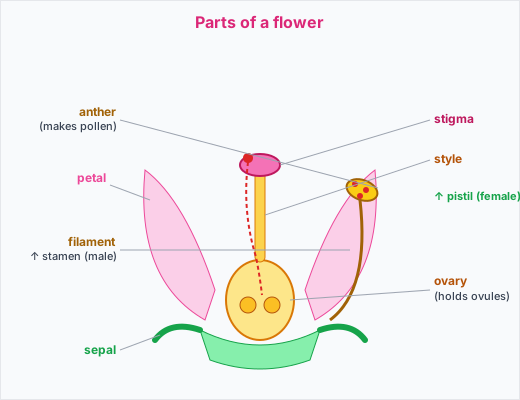
- Stamen (anther + filament) = male part; makes the yellow pollen grains.
- Pistil (stigma + style + ovary) = female part; the ovary holds ovules, each with an egg cell.
The steps:
- Pollination — pollen is carried from anther to stigma (by wind, water or animals). Self-pollination = same flower; cross-pollination = different flower.
- A pollen tube grows down the style to the ovule.
- Fertilisation — the male gamete fuses with the egg → zygote.
- The zygote → embryo; the ovule → seed (with a tough coat); the ovary → fruit. Under the right conditions the seed germinates into a new plant.
Pollination ≠ fertilisation. Pollination is just the transfer of pollen; fertilisation is the actual fusion of gametes that follows.
Asexual reproduction takes place through budding in:
Yeast reproduces by budding (and so does Hydra). Amoeba and Leishmania use binary fission; Plasmodium uses multiple fission.
Reproduction in human beings
Humans reproduce sexually. At puberty, reproductive tissues mature (this is why it happens after most body growth — the body finishes growing first). Signs include body hair, and — in girls — breast development and the start of menstruation; in boys — facial hair and a deeper voice.
Male reproductive system: testes make sperms (kept in the scrotum, outside the body, because sperm need a slightly lower temperature). Sperms travel through the vas deferens; the seminal vesicles and prostate gland add fluid that nourishes the sperm and helps them move. The urethra carries both sperm and urine (at different times). A sperm is mostly genetic material with a long tail.
Female reproductive system: ovaries make eggs (a girl is born with thousands of immature eggs; one matures roughly each month). The egg travels down the oviduct (fallopian tube) — where fertilisation happens — to the uterus, which opens via the cervix into the vagina.
If the egg is fertilised: the zygote divides into an embryo, implants in the uterus lining, and grows into a foetus. It gets food and oxygen from the mother’s blood through the placenta (a disc rich in villi and blood spaces — huge surface area for exchange) and passes its wastes back the same way. Development takes about nine months, ending in birth by muscular contractions of the uterus.
If the egg is NOT fertilised: the thickened, blood-rich uterus lining isn’t needed, so it breaks down and leaves through the vagina as blood and mucus — this is menstruation, occurring roughly monthly.
Where does fertilisation normally take place in a human female?
The egg is released by the ovary and travels into the oviduct (fallopian tube), where sperm meet it — so fertilisation happens in the oviduct. The fertilised egg then moves to the uterus to develop.
Reproductive health
Because the sexual act intimately connects two bodies, infections can be sexually transmitted — bacterial (gonorrhoea, syphilis) and viral (warts, HIV-AIDS). A condom helps prevent both these infections and pregnancy.
Contraception (avoiding pregnancy) works in a few ways:
- Barrier — condoms / coverings stop sperm reaching the egg.
- Hormonal — pills change hormone balance so no egg is released (can have side-effects).
- Devices — copper-T / loop placed in the uterus.
- Surgical — blocking the vas deferens (male) or fallopian tube (female).
The textbook also notes a social concern: sex-selective abortion of female foetuses has skewed the child sex ratio, even though prenatal sex determination is illegal. A healthy society needs a balanced sex ratio.
Common Mistakes
Regeneration is a form of reproduction — Planaria reproduces by being cut up.
A cut piece does grow into a whole organism, so it looks like reproduction.
Regeneration is the ability to REGROW from a piece, but organisms don't normally rely on being cut up to reproduce. It's repair taken to the extreme — NOT a normal reproductive method. Budding (Hydra) IS reproduction.
Pollination and fertilisation are the same thing.
Both happen in the flower, one after the other.
Pollination is the TRANSFER of pollen from anther to stigma. Fertilisation is the later FUSION of the male gamete with the egg in the ovule. Pollination comes first and makes fertilisation possible.
Offspring of asexual reproduction show lots of variation.
All reproduction is assumed to produce variety.
Asexual offspring are near-IDENTICAL to the single parent (only rare copying errors differ). It's SEXUAL reproduction — combining two parents' DNA — that generates lots of variation.
The testes are inside the abdomen like the ovaries.
It seems the body would protect them inside.
The testes sit OUTSIDE the body in the scrotum because sperm formation needs a temperature slightly LOWER than normal body temperature.
Quick Check
The anther of a flower contains:
The anther (top of the stamen, the male part) produces pollen grains. Ovules are inside the ovary (female part).
If a woman is using a copper-T, will it protect her from sexually transmitted diseases?
A copper-T sits in the uterus to prevent pregnancy. It does not stop the exchange of body fluids, so it gives no protection against STDs. Only a barrier like a condom helps prevent infection.
Practice Problems
These are written by Curriv and are completely free. Try before revealing.
Easy
How is binary fission different from multiple fission?
- In binary fission, a cell divides into two daughter cells (e.g. Amoeba).
- In multiple fission, a single cell divides into many daughter cells at once (e.g. Plasmodium, the malaria parasite).
Name the male and female reproductive parts of a flower.
- Male part: the stamen — made of the anther (produces pollen) and the filament.
- Female part: the pistil — made of the stigma, style and ovary (which contains the ovules with egg cells).
Medium
Why is variation beneficial to a species but not necessarily to the individual?
A variation might not help (or might even slightly harm) the individual that carries it. But for the species as a whole, having a range of variations means that if the environment changes suddenly (temperature, water, disease), at least some individuals may have the right features to survive and reproduce. So variation keeps the species going even though any single variation may not benefit its owner.
How does the embryo get nourishment inside the mother's body?
Through a special tissue called the placenta, a disc embedded in the uterus wall. It has villi on the embryo’s side and blood spaces on the mother’s side, giving a large surface area. Glucose and oxygen pass from the mother’s blood to the embryo, and the embryo’s waste passes back to the mother’s blood to be removed.
Challenge
What are the advantages of sexual reproduction over asexual reproduction?
- More variation: it combines DNA from two individuals, creating new genetic combinations every time — far more variety than asexual reproduction.
- Better survival of the species: that variation is the raw material for adapting to changing environments and for evolution.
(The trade-off is that it’s slower and needs two parents — but the long-term benefit of variation is worth it for the species.)
Why must germ cells (gametes) have only half the number of chromosomes, and how is this achieved?
If each gamete had the full number of chromosomes, then combining two gametes would double the chromosome number every generation, throwing off the DNA’s control of the cell.
To prevent this, gametes are made by a special cell division called meiosis, which gives each gamete half the chromosomes. When a male and female gamete fuse at fertilisation, the full number is restored in the zygote — and stays constant across generations.
Summary
- Reproduction isn’t needed to keep an individual alive, but it keeps the species going. Its basic event is DNA copying; imperfect copying creates variation, the raw material of evolution.
- Asexual reproduction (one parent, near-identical offspring): binary/multiple fission, budding (Hydra, yeast), fragmentation (Spirogyra), regeneration (Planaria — not true reproduction), spore formation (Rhizopus), vegetative propagation (potato, Bryophyllum) and tissue culture.
- Sexual reproduction (two parents) generates much more variation by combining DNA; meiosis halves chromosomes in gametes so the number stays constant.
- In flowers: pollination (anther → stigma) then a pollen tube → fertilisation (gamete + egg) → zygote → embryo → seed; ovary → fruit.
- In humans: testes make sperm (in the scrotum); ovaries make eggs. Fertilisation happens in the oviduct; the embryo grows in the uterus, nourished by the placenta, for ~9 months. If no fertilisation → the lining sheds as menstruation.
- Reproductive health: condoms prevent STDs and pregnancy; other contraceptives are hormonal pills, copper-T, and surgery. A balanced sex ratio matters; prenatal sex determination is illegal.
What’s Next
Reproduction passes a DNA blueprint — with small variations — from parents to offspring. But how exactly are traits inherited? Why do some features show up in grandchildren but skip the parents? In Chapter 8: Heredity, you’ll meet Mendel’s pea-plant experiments, dominant and recessive traits, how sex is determined — the rules behind why you resemble your family, and how variation gets passed on.