The Colonial Era in India
Why This Matters
Picture this. A small group of foreign traders sails to India just to buy and sell goods. Two hundred years later, that same group rules the whole country. How could that even happen?
This is the strange and important story of this chapter.
For nearly two centuries, India was ruled by Britain. Not by an Indian king. Not by the Mughals. By a country far away across the seas. And it did not begin with an invading army. It began with a trading company — people who came only to do business.
Why should you care about this today? Because the colonial era shaped the India you live in. Before it, India was one of the richest lands in the world. After it, India was one of the poorest. That huge fall did not just happen. It was made to happen.
When we understand how a trader became a ruler, and how India’s wealth was drained away, we understand why our freedom struggle mattered so much. We also understand why India had to rebuild itself almost from zero after Independence.
So this is not a dry list of dates. It is the story of how a great land was taken over — and how Indians fought back.
The Big Idea
India was once a wealthy, self-running land. For centuries it made about one-fourth of all the world’s wealth, alongside China. This very richness made India a tempting target. Several European powers — the Portuguese, Dutch, French and British — came for trade, then fought each other to control it. The British won. But here is the key idea: the British did not conquer India in one big war. The English East India Company crept in as a “trader”, used Indians’ own quarrels with a policy of “divide and rule”, won the battles of Plassey (1757) and Buxar (1764), and slowly turned itself into the ruler. Then it drained India’s wealth to Britain through heavy taxes and unfair trade. By Independence, India’s share of world wealth had crashed from about one-fourth to nearly 5 per cent. Colonialism made the colonisers rich and the colonised poor.
Let’s Break It Down
What is colonialism?
Let us start with the big word: colonialism.
Colonialism is when one country takes control of another land, settles in it, and forces its own systems — political, economic and cultural — onto the people there. In simple words: a stronger country grabs a weaker land, rules it, and runs it for its own benefit.
This is an old idea in history. But the “Age of Colonialism” usually means Europe’s big push from the 15th century onward. Over a few centuries, European powers — Spain, Portugal, Britain, France and the Netherlands — took over large parts of Africa, Asia, the Americas and Australia.
Why did they do it? There were a few reasons:
- Money and resources. New lands meant new natural resources, new markets to sell to, and new trade routes. And often, plain plunder (stolen wealth).
- Power and rivalry. European countries competed with each other. Taking land abroad made a country bigger and stronger than its rivals.
- Religion. Converting local people to Christianity was a strong motive for some.
- Knowledge. A smaller reason was the wish to explore unknown lands and study the world’s geography and nature.
The colonisers often claimed they had come on a “civilising mission” — to bring “progress” to people they wrongly called “savage” or “primitive”. But that was mostly an excuse. The real result for the colonised was loss of freedom, stolen resources, broken traditions, and great suffering.
Why India? A land of great wealth
To understand why everyone wanted India, you must understand how rich India was.
For over two thousand years, India traded with the Greeks and Romans. Indian goods — spices, fine cotton, ivory, gems, sandalwood, teakwood, and wootz steel — were wanted all over the world. Until the 16th century, India was a true economic powerhouse.
How rich exactly? One careful estimate (by the economist Angus Maddison) says India made at least one-fourth of the entire world’s wealth for a very long stretch. India and China were the two largest economies on Earth. European travellers who came here described India as “flourishing”.
Here is the sad twist. This very wealth is what attracted the colonisers. India was rich, so India became a target.
Before we go further, let us refresh one term that comes up a lot in this chapter.
The first Europeans: Portuguese, Dutch and French
The British were not the first Europeans here. Three others came before them. Knowing them helps us see how different the British approach was.
The Portuguese (commerce and cruelty). In May 1498, the explorer Vasco da Gama reached Kappad, near Kozhikode (Calicut) in Kerala. This opened the door to European colonisation in India. The Portuguese captured key ports, including Goa in 1510, which became their Indian capital. They forced all ships in the Arabian Sea to buy Portuguese permits (called cartaz); ships without one were seized. This let them control the spice trade for almost a century. They were also harsh on religion — they set up the cruel Goa Inquisition in 1560, which persecuted Hindus, Muslims, Jews and others.
The Dutch (commerce and competition). The Dutch arrived in the early 17th century. They cared mostly about trade, especially spices, and set up posts on both coasts. Their power did not last. They were badly beaten at the Battle of Colachel in 1741 by the forces of Travancore under King Marthanda Varma. This was a rare case of an Asian power defeating a European colonial force.
The French (big ambitions, small result). The French came later, setting up at Pondicherry in 1674. Their leader Dupleix was clever — he trained Indian soldiers in European methods, creating disciplined troops called sepoys, and he developed the trick of ruling through puppet Indian rulers. The British later copied both ideas. But the French lost the Carnatic Wars (1746–1763) against the British. Their colony shrank to just Pondicherry and a few small pockets.
So all four powers came for India’s wealth and fought each other for it. The British came out on top. Let us see how.
From a trader to a ruler
Now for the heart of the chapter. The British conquest of India is one of history’s strangest stories: a trading company became an empire.
The English East India Company started simply as a business. Queen Elizabeth I gave it a royal charter (an official permission document). But this charter had a hidden, dangerous power inside it — it allowed the Company to raise its own private army.
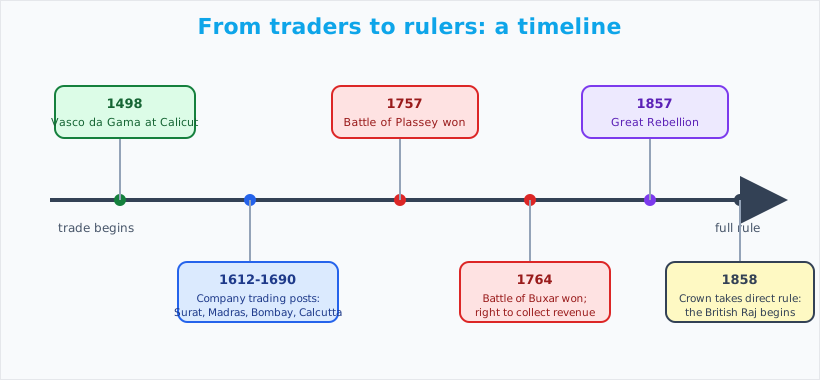
At first, the Company’s agents pretended to be just traders. In the 17th century, they quietly set up posts along India’s coast: Surat, Madras, Bombay and Calcutta. Local rulers did not mind. India had always welcomed foreign trade, so a few trading posts seemed harmless. Nobody guessed what was coming.
Figure 4.1 below lays out the whole journey on a timeline, from peaceful trade to total rule. Look at how the green “trade” start slowly turns into the red battles and finally full British rule.
Now let us walk through the exact steps of this takeover. The figure below breaks it into six stages. Follow the arrows downward — each step makes the next one possible.
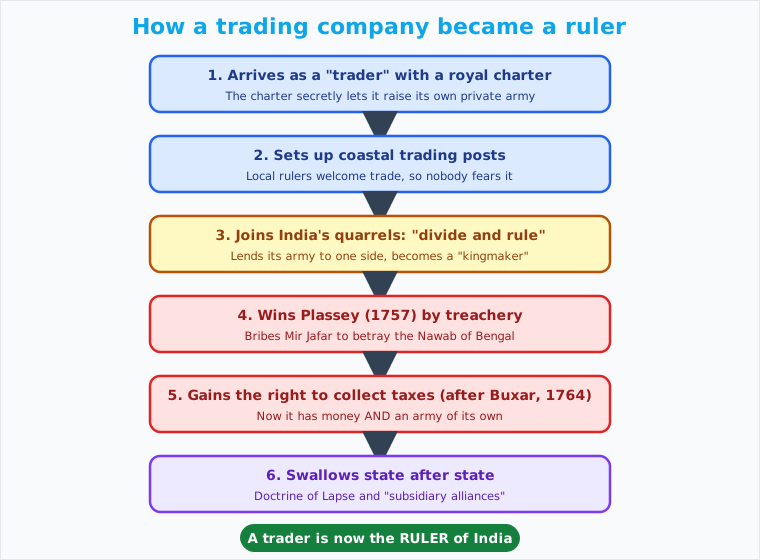
Each step in Figure 4.2 deserves a closer look, because the why behind each one is what makes this story click.
Divide and rule, and the Battle of Plassey
How did such a small Company control such a huge land? The answer is one phrase: “divide and rule”.
India in the 1700s was not one united kingdom. It had many rulers, often quarrelling with each other. The Company’s agents were clever. Instead of fighting everyone, they took sides in Indian quarrels. They would offer their army to one ruler against his rival. By doing this, they slipped into Indian politics not as foreign invaders, but as a useful “friend” — and then as a “kingmaker”.
They also looked for splits inside a kingdom: a jealous minister, an angry commander, a fight over who should be king. They would quietly side with the unhappy person and use him.
The Battle of Plassey (1757) shows this perfectly. It is the moment British power truly began — so let us slow down and see exactly how it was won.
The Company, led by Robert Clive, was in conflict with Siraj-ud-daulah, the Nawab (ruler) of Bengal. The Nawab had a big army. The British had a small one. In a fair fight, the British should have lost.
So they did not fight fair. Clive made a secret deal with Mir Jafar, the Nawab’s own military commander. The promise: betray your master, and we will make you the next Nawab. In the battle, Mir Jafar’s troops — most of the Nawab’s army — simply stood aside and did not fight. So the small British force won.
Figure 4.3 below shows this betrayal clearly. Notice how the deal with Mir Jafar, not the fighting, decided everything.
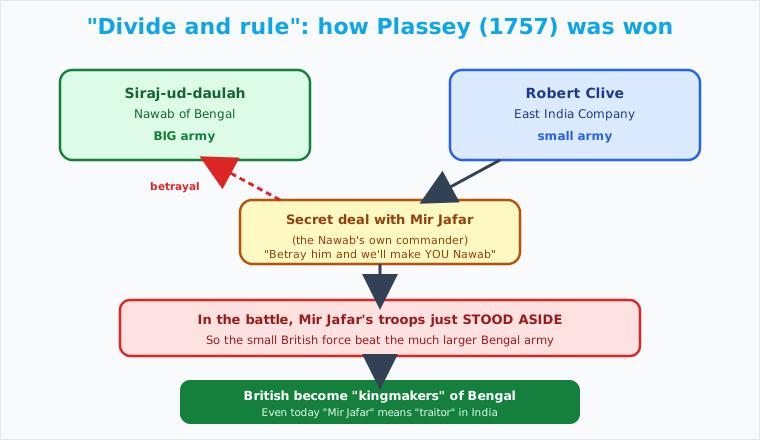
Why does this matter so much? Because it shows the British did not win by being braver or stronger. They won by turning Indians against each other. After Plassey, the Company became the real power behind the throne in Bengal. The word “Mir Jafar” became a synonym for “traitor” — and still is.
A few years later, the Battle of Buxar (1764) sealed it. After Buxar, the Company won the right to collect revenue (taxes) in Bengal, Bihar and Odisha — some of India’s richest regions. Now think about what that means. The Company now had both an army and a money supply. That deadly combination is what turned a trader into a ruler.
Swallowing the states: Doctrine of Lapse and subsidiary alliances
Once it had money and an army, the Company began swallowing Indian states one by one. It used two cunning tricks.
The Doctrine of Lapse. This rule said: if a ruler died without a natural male heir, his state would be taken over by the British. This was deeply unfair, because Indian tradition allowed a ruler to adopt a son as a legal heir. The British simply ignored this. Many states were grabbed this way, creating deep anger.
The subsidiary alliance. Here the British placed a “Resident” (a British officer) in an Indian ruler’s court, claiming to “protect” him. In return, the ruler had to pay for British troops himself and let the British handle all his foreign relations. It looked like the ruler was still in charge. But real power had quietly passed to the British — and the ruler was even paying for it! The ruler of Hyderabad was among the first to fall into this trap in 1798.
This let the British control huge territories cheaply. People called it “an empire on the cheap”. And once a state was in, getting out was almost impossible.
The subsidiary alliance let an Indian ruler keep his throne and crown. So why do we say the British really held the power?
Because under the alliance the ruler lost control over the two things that matter most: his army and his foreign affairs. He had to keep British troops (and pay for them himself), and he could only deal with other states through the British. So even though he still wore the crown and sat on the throne, he could not act on his own. He could not defend himself or make his own decisions. Real power — the power to use force and to decide policy — had passed to the British. The crown was just for show.
From paradise to hell: the famines
After Plassey, the Company began squeezing Bengal for money. Clive himself called Bengal “the paradise of the earth”. But the Company’s agents took as much revenue as they could while spending almost nothing on the people. The results were horrific.
In 1770–1772, after two years of poor harvests, the Company’s harsh tax demands caused a catastrophic famine in Bengal. Farmers were forced to pay high cash taxes no matter how bad the harvest was. About 10 million people died — nearly one-third of Bengal’s population. Shockingly, the Company even raised the land tax during the famine.
Why did so many die? This is the cruel “why” that the textbooks often state but do not explain. Let us be clear about it. A famine is not only about a lack of rain. People starved because:
- They were forced to pay heavy cash taxes even when their crops failed, so they had no money left for food.
- The British kept exporting grain to Britain even while Indians were dying. During one later famine, about a million tonnes of rice were shipped out each year.
- The British followed a “free market” rule and refused to control food prices. So food prices shot up and the poor could not afford to eat.
So the deaths were not just bad luck. They were the direct result of British policy. Such famines kept happening through British rule. During the Great Famine of 1876–1878, up to 8 million more Indians died, mostly in the Deccan. Across the whole colonial period, the total famine deaths are estimated at a staggering 50 to 100 million people — close to the number killed in World War II.
The drain of India’s wealth
The famines were one face of a bigger crime: the drain of wealth.
This is one of the most important ideas in this chapter. India’s riches were not just used in India — they were steadily carried away to Britain. Figure 4.4 below shows the three main “pipes” through which the wealth flowed out.
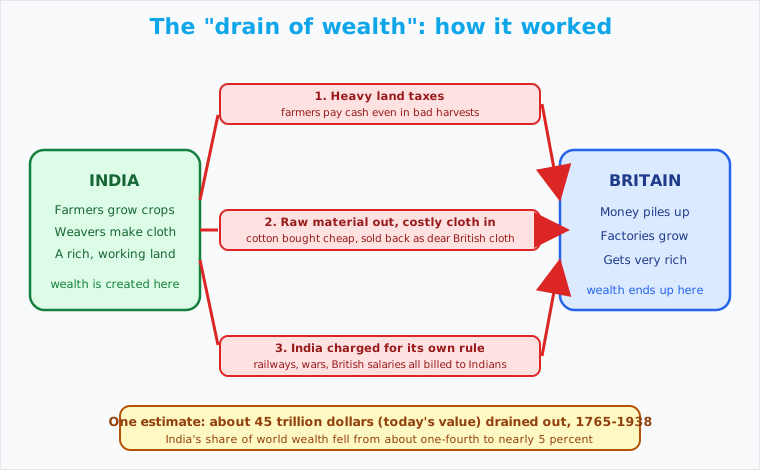
How big was this drain? Indian thinkers measured it carefully. Dadabhai Naoroji wrote a famous book in 1901, Poverty and Un-British Rule in India, gathering the figures from British reports. Romesh Chunder Dutt did the same in his Economic History of India. A more recent estimate (by Utsa Patnaik) for 1765 to 1938 comes to about 45 trillion US dollars in today’s money — roughly 13 times Britain’s entire GDP in 2023.
And notice the third pipe especially, because it is sneaky. The British built railways and the telegraph in India. These are often called “gifts”. But Indians paid for them with their own taxes — and they were built mainly to serve British trade and armies, not Indian needs. As the chapter’s summary puts it: Indians funded their own subjugation. They paid for the very system that ruled over them.
Many British and American writers admitted this drain. The historian Brooks Adams even argued that Britain’s Industrial Revolution was partly funded by “Bengal plunder” that began arriving in London after Plassey.
Changing landscapes: how colonial rule reshaped India
The British were sure that India should be remade in their own image. So they changed nearly every part of Indian life — usually for the worse. Let us look at the key changes.
The death of Indian industry. Before the 18th century, India was world-famous for manufacturing, especially textiles. Indian cotton cloth — from ultra-fine muslin to richly designed fabrics — was wanted everywhere. The British destroyed this. They put heavy taxes on Indian cloth entering Britain, while forcing India to accept British cloth with almost no tax. Britain also controlled the sea trade and exchange rates. So Indian weavers could not sell their cloth. Whole communities of skilled artisans were ruined and pushed back into farming. India’s share of world manufacturing collapsed.
The end of village self-rule. Before the British, India had strong local self-government. Village councils settled disputes and ran public works like irrigation and roads. An acting Governor-General, Charles Metcalfe, even praised these villages as “little republics” that survived while dynasties rose and fell. The British dismantled this system and replaced it with a centralised bureaucracy built mainly to collect taxes and keep order — not to help people.
Education for “brown Englishmen”. India once had many schools — pathshalas, madrasas, viharas and apprenticeships. British reports themselves counted lakhs of village schools. Then came Macaulay’s Minute on Indian Education in 1835. Macaulay (who admitted he knew no Sanskrit or Arabic) declared European knowledge far superior and wanted to create a class of Indians who were “Indian in blood and colour, but English in taste, in opinions, in morals, and in intellect”. His aim was to produce cheap Indian clerks to serve the British and to cut Indians off from their own culture. English became the language of prestige, splitting society between an English-educated elite and everyone else.
Now let us compare India before and after this rule, side by side. The figure below sums up the whole impact in one picture.
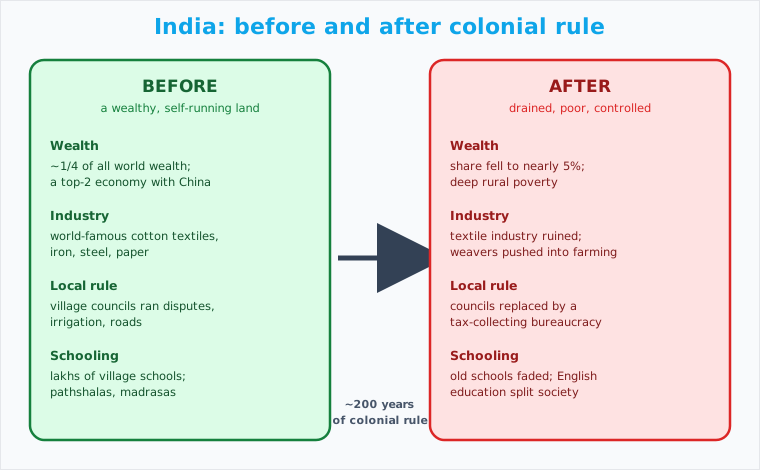
The lesson of Figure 4.5 is stark. In less than two centuries, one of the richest lands on Earth became one of the poorest.
Indians fight back: resistance and the Great Rebellion of 1857
The British called India “the jewel in the crown” and boasted that “the sun never sets on the British Empire”. But almost from the start, Indians resisted.
There were many uprisings:
- The Sannyasi-Fakir Rebellion in Bengal after the 1770 famine, when wandering ascetics attacked British treasuries.
- Tribal uprisings, like the Kol Uprising (1831–32) and the Santhal Rebellion (1855–56) led by the brothers Sidhu and Kanhu Murmu, who rose against landlords and moneylenders backed by the British.
- Peasant uprisings, like the Indigo Revolt (1859–62), when Bengal’s peasants refused to be forced into growing indigo for tiny pay.
All these built up to the biggest explosion: the Great Rebellion of 1857. The British called it the “Sepoy Mutiny”, but Indian historians reject that small name. Sepoys were the Indian soldiers in the Company’s army.
What sparked it? Most sepoys came from farming families already crushed by British taxes. In 1857, a rumour spread that new rifle cartridges were greased with cow and pig fat — deeply offensive to both Hindu and Muslim soldiers. At Barrackpore, the sepoy Mangal Pandey attacked British officers. At Meerut, sepoys killed their officers and marched to Delhi, where they declared the old, powerless Mughal emperor Bahadur Shah Zafar their leader. The revolt spread fast across north and central India, with fighting at Kanpur, Lucknow and Jhansi.
Two brave women stand out. Rani Lakshmibai of Jhansi fought to save her kingdom and died on the battlefield in 1858. Begum Hazrat Mahal of Awadh led the defence of Lucknow and warned Indians never to trust British promises.
The British crushed the rebellion with extreme brutality — burning villages, mass executions, and far more deaths than the rebels caused. Why did the rebellion fail? Mainly because the rebels had no single united leader and no common plan, despite their courage.
But 1857 was a turning point. It planted a powerful seed: the idea that foreign rule was simply unacceptable. That seed would grow, in the 20th century, into the full freedom struggle. Right after the rebellion, in 1858, the British Crown took over India directly from the Company. This began the period called the British Raj.
One last twist: culture flows the other way
The colonial era was, above all, a story of subjugation and exploitation. It was never a real “civilising mission” — India’s civilisation was far older than Europe’s.
But there was one unintended twist. The British were thorough record-keepers. They surveyed India’s geography, studied its monuments, and even began the discipline of archaeology, restoring some ruins. Sadly, they also stole thousands of statues, jewels and manuscripts for European museums — a huge loss India still seeks to recover.
And in a surprising reversal, British (and other European) scholars began translating India’s ancient Sanskrit texts, like the Bhagavad Gita, into European languages. These ideas deeply influenced European philosophers, writers and artists. So while political power flowed one way (Britain controlling India), cultural influence sometimes flowed the opposite way (India’s wisdom reaching the West).
Common Mistakes
Here are some slip-ups students make about this topic. Read them once, and you will not be fooled.
The British conquered India by invading it with a big army in one major war.
Most conquests in history happened through open invasion, so it feels natural to assume India was taken the same way.
The British takeover was slow and disguised as business. The East India Company came as a trader, used 'divide and rule' to join Indian quarrels, and won key moments like Plassey through betrayal and bribery, not a single grand invasion. It took about a century of scheming to turn from trader to ruler.
The famines under British rule were just natural disasters caused by a lack of rain.
The word 'famine' usually makes us think only of drought, so it is easy to blame the weather alone.
The weather was only the trigger. People died in huge numbers because the British forced farmers to pay heavy cash taxes even in bad years, kept exporting grain to Britain during the famine, and refused to control food prices. British policy turned a crop failure into mass death.
The railways were a generous gift the British gave to help the Indian people.
Railways are useful and modern, so it seems like a kind favour, and the British liked to present them that way.
Indians paid for the railways themselves through their own taxes. The railways were built mainly to carry raw materials to ports for export and to move British armies quickly, not to serve ordinary Indians. As the saying goes, Indians funded their own subjugation.
Quick Check
Try these quick questions. Each one checks one idea from the chapter.
What special power did the East India Company's royal charter secretly give it, which later helped it become a ruler?
How did the British actually win the Battle of Plassey in 1757?
Which of these was a real way the British drained wealth from India?
Why is the Great Rebellion of 1857 seen as a turning point, even though it failed?
Practice Problems
Try each one on your own first. Only then tap to see the full answer.
Easy
What is colonialism? Explain it in your own simple words.
Colonialism is when one country takes control of another land, settles in it, and forces its own systems — political, economic and cultural — onto the people who live there.
In simple words: a stronger country grabs a weaker land, rules over it, and runs it mainly for its own benefit. The colonised people usually lose their freedom, their wealth is taken, and their traditions are damaged. In this chapter, the main example is Britain colonising India for nearly two centuries.
Name the four European powers that came to India for trade, and say which one finally became the ruler.
The four European powers were:
- The Portuguese (arrived first, in 1498, with Vasco da Gama).
- The Dutch.
- The French.
- The British.
They all came for India’s great wealth and fought each other for control. The British (through the English East India Company) came out on top and became the rulers of India for nearly two hundred years.
Medium
Explain the policy of 'divide and rule'. Then show how the British used it to win the Battle of Plassey in 1757.
Divide and rule means turning people against each other so they cannot unite against you. India in the 1700s had many rulers who often quarrelled. Instead of fighting them all, the British took sides in these quarrels and used the splits — even splits inside a single kingdom — for their own gain.
At Plassey, this is exactly what they did:
- The Company under Robert Clive had a small army; Siraj-ud-daulah, the Nawab of Bengal, had a big one.
- A fair fight would have gone to the Nawab. So Clive made a secret deal with Mir Jafar, the Nawab’s own commander, promising to make him the next Nawab if he betrayed his master.
- In the battle, Mir Jafar’s troops (most of the Nawab’s army) stood aside and did not fight.
- So the small British force won.
This shows the British did not win by strength. They won by dividing the Nawab’s side and getting an Indian to betray another Indian.
The chapter says 'Indians funded their own subjugation.' What does this mean? Use the example of the railways.
“Indians funded their own subjugation” means that Indians themselves paid for the system that ruled and controlled them.
Take the railways:
- The British often called the railways a “gift” to India.
- But the railways were not paid for by Britain. They were paid for out of Indian tax money.
- And they were built mainly to serve British interests — moving raw materials to ports for export, distributing British goods across India, and moving British armies quickly to crush rebellions.
- So Indians paid, with their own money, for infrastructure that mostly helped the British rule them — instead of being built to serve Indian needs.
The same was true of the telegraph network, the army, and the salaries of British officials. In short, the cost of British rule was loaded onto the Indian people themselves.
Challenge
Before colonial rule, India made about one-fourth of the world's wealth. By Independence, its share had crashed to nearly 5 per cent. Explain at least three ways British colonial policy caused this huge fall.
Several British policies, working together, caused India’s wealth to collapse:
1. The drain of wealth. India’s riches were steadily carried off to Britain — through heavy land taxes, through buying Indian raw materials cheap and selling back costly British goods, and through charging Indians for railways, wars and British salaries. One estimate puts the total drained from 1765 to 1938 at about 45 trillion dollars in today’s value. That wealth could have stayed and grown in India, but instead it left.
2. The destruction of Indian industry. India was once world-famous for its textiles. Britain placed heavy taxes on Indian cloth entering Britain, while forcing India to accept British cloth with almost no tax, and controlled the sea trade and exchange rates. So Indian weavers could not sell their goods. Whole industries (textiles, iron, steel, paper) were ruined, and skilled artisans were pushed into poverty and farming.
3. The famines. Harsh cash taxes (demanded even when harvests failed), the export of grain during famines, and a refusal to control food prices turned crop failures into mass deaths. An estimated 50 to 100 million people died in famines across the colonial period. This destroyed lives, farms and the rural economy.
4. (Bonus) Funding their own rule. Indian taxes paid for the colonial army, railways and administration, so money that could have built India was spent ruling it instead.
Put together, the wealth was drained out, the industries were killed, the farmers were crushed, and the country was forced to pay for its own control. That is how one of the richest lands on Earth became one of the poorest in under two centuries.
Summary
Here is everything you can now explain to a friend:
- Colonialism is when one country takes control of another land, settles in it, and forces its own systems onto the people, mainly for its own benefit.
- India was once a wealthy, self-running land, making about one-fourth of all world wealth. This richness made it a target for European powers.
- The Portuguese, Dutch and French came before the British, but the British East India Company finally became the ruler.
- The Company came as a trader with a royal charter that secretly let it raise a private army. It set up coastal trading posts that local rulers welcomed.
- Using “divide and rule”, it joined Indian quarrels. It won the Battle of Plassey (1757) by bribing Mir Jafar to betray the Nawab, and after Buxar (1764) it gained the right to collect taxes.
- It then swallowed states using the Doctrine of Lapse and subsidiary alliances.
- The British drained India’s wealth through heavy taxes, unfair trade, and charging Indians for railways and wars — about 45 trillion dollars in today’s value. Indians funded their own subjugation.
- Harsh taxes and grain exports caused terrible famines that killed tens of millions of people.
- Colonial rule ruined India’s industries, ended village self-rule, and pushed English education to create clerks who served the British.
- Indians resisted through many uprisings, building up to the Great Rebellion of 1857. It failed, but it planted the idea that foreign rule was unacceptable. In 1858, the British Crown took direct control, starting the British Raj.
- By Independence, India’s share of world wealth had crashed from about one-fourth to nearly 5 per cent.
What’s Next
You have now seen how India lost its freedom and its wealth to colonial rule, and how the seed of resistance was planted. That seed grew into a long freedom struggle — and finally, into a free, democratic India where the people themselves choose their leaders.
In the next chapter, Chapter 5 — Universal Franchise and India’s Electoral System, we will see how free India gave every adult the right to vote, and how our elections work. After learning how rulers were once forced on India from outside, you will see how Indians today choose their own government. Get ready to understand the power that lies in a single vote!
Frequently Asked Questions
How did a trading company end up ruling all of India?
The English East India Company came as a trader, but its royal charter let it keep a private army. It set up coastal trading posts, then slipped into India's quarrels using 'divide and rule'. After winning Plassey in 1757 and Buxar in 1764, it gained the right to collect taxes. With money and an army of its own, it slowly took over state after state.
Why was the Battle of Plassey in 1757 so important?
Plassey was won mostly by treachery, not by fighting. Robert Clive bribed Mir Jafar, the Nawab of Bengal's own commander, to stand aside. So a small British force beat a much bigger army. After Plassey the Company became the 'kingmaker' of Bengal, which is why it marks the real start of British power in India.
What does the 'drain of wealth' from India mean?
It means India's riches were steadily taken to Britain. This happened through heavy land taxes, buying Indian raw materials cheap and selling back costly British goods, and charging Indians for railways, wars and British salaries. One estimate puts the total drained between 1765 and 1938 at about 45 trillion dollars in today's value.
Why did so many famines happen during British rule?
The Company and later the Crown demanded high cash taxes from farmers even when harvests failed. They kept exporting grain to Britain during famines and refused to control food prices. So when crops failed, millions had no food and no money. The 1770 Bengal famine alone killed about 10 million people.
How did colonial rule ruin India's textile industry?
Britain put heavy taxes on Indian cloth entering Britain, while forcing India to accept British cloth with almost no tax. Britain also controlled the sea trade and exchange rates. So Indian weavers could not sell their famous cotton textiles, lost their livelihoods, and were pushed back into farming on overtaxed land.