Reshaping India's Political Map
Why This Matters
Look at a map of India today. It is one country, with one border, ruled from one capital — Delhi.
But it was not always like this. Six hundred years ago, India was not one country. It was many kingdoms and empires, all at once. Some were rising. Some were falling. The map kept changing, almost like a moving picture.
Why should you care about all this old fighting? Here is why. The India you live in today was shaped by these very events. The cities, the forts, the languages, the festivals, even some of the food — many of them grew out of this exact period.
There is also a bigger lesson hiding here. Big empires look strong and forever. But they can grow weak and fall apart. And when one big power falls, new powers rise to take its place. This happened again and again in Indian history. Understanding why it happened is the real prize.
In this chapter, we will watch India’s political map being reshaped, step by step. We will see old empires fall and new powers rise. And every time, we will ask the most important question: not just what happened, but why it happened.
The Big Idea
For hundreds of years, one big power tried to rule north India from Delhi — first the Delhi Sultanate, then the Mughal Empire. But no single power ever held all of India for long. The empires grew weak — through endless wars, money troubles, and violent fights over the throne. And whenever the centre grew weak, regional powers rose up in every corner of the land: the Rajputs in the northwest, the Vijayanagara Empire in the south, the Ahoms in the northeast, the Sikhs in Punjab, and more. So the political map of India was always being reshaped — one empire splitting into many kingdoms, then a new empire rising, then splitting again. This is a story of both destruction and resilience: armies plundered and burned, but India always rebuilt, and its art, trade and culture kept flowing.
Let’s Break It Down
This chapter covers a long stretch of time, from the 13th century to about 1800. That is a lot. To keep it simple, let us first see the whole story on one timeline. Then we will zoom into each part.
Figure 2.1 below lays out the big moments in order, from the founding of the Delhi Sultanate to the rise of the Sikh Empire. Glance at it first. Do not worry about every name yet — we will meet them all.
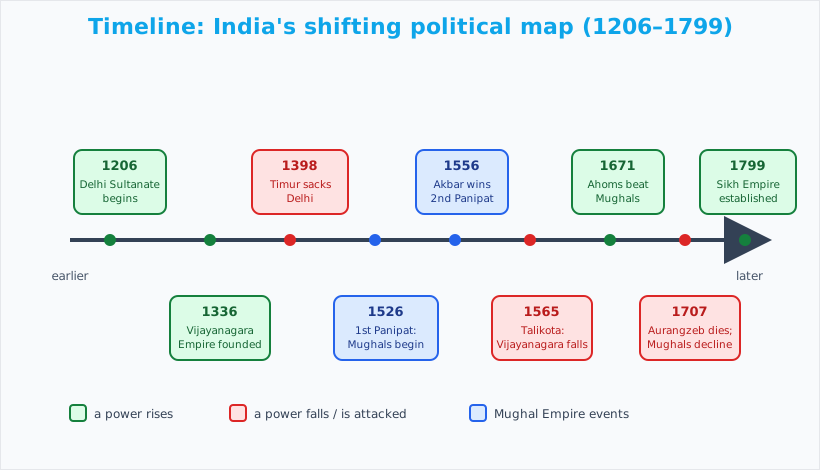
A wave of invasions, and the Delhi Sultanate
Our story begins in the early 11th century. A wave of invasions came from beyond the Hindu Kush mountains (in the northwest, near today’s Afghanistan). The invaders were mostly Central Asian — Turkic or Afghan. They came for India’s famous riches, for land, and often to spread their own religion by force.
India had seen wars before. But this wave was different. It was bigger, and it kept coming. These invasions reshaped India’s political map.
Out of this came the Delhi Sultanate. (A Sultanate is a land ruled by a Sultan — a title that some Muslim rulers used.) It was formed after the defeat of King Prithviraj Chauhan in 1192. Over the next 300 years, the Sultanate was ruled by five different Turkic-Afghan dynasties, one after another:
- the Mamluks (also called the Slave dynasty),
- the Khiljis (or Khaljis),
- the Tughlaqs,
- the Sayyids, and
- the Lodis (or Lodhis).
The Sultanate controlled parts of north India. But it was never calm. It was marked by political instability and a constant push to grab more land. This meant war after war. Armies raided villages and cities, plundered wealth, and destroyed many temples and seats of learning.
Here is a shocking fact that shows how unstable it was. Out of every three sultans, almost two seized power by killing or removing the sultan before them. So a sultan’s reign lasted, on average, hardly more than nine years. Think about that. The man at the very top was rarely safe.
Why does this matter for our “reshaping the map” story? Because a kingdom where the ruler keeps changing by violence cannot grow steady and strong for long. This weakness is a clue we will see again.
A few sultans did expand the Sultanate a lot. Ala-ud-din Khilji raided large parts of north and central India. His slave-general Malik Kafur pushed the Sultanate’s reach far into the south, plundering rich kingdoms along the way. Later, Muhammad bin Tughlaq expanded it even further. For a short while, most of the subcontinent came under one ruler — for the first time since the ancient Mauryan Empire.
But Muhammad bin Tughlaq’s big schemes often failed. Let us see why, because it teaches an important lesson about why power can slip away.
He moved his capital from Delhi all the way to Daulatabad (in the Deccan, far to the south). He thought a more central spot would help him control the empire. But the people were forced to march over 1,000 km. A few years later, when the plan failed, he moved the capital back to Delhi. Both moves caused huge loss of life. He also tried “token currency” — cheap copper coins declared to be worth as much as silver or gold. The idea was actually clever (most money today is “token” money). But at the time it caused confusion, people made fake coins, and the economy declined.
So even a powerful ruler could weaken his own kingdom through poorly-planned schemes. Power is not just about having a big army. It is about good decisions too.
Timur’s attack, and the shrinking Sultanate
At the end of the 14th century, a brutal conqueror named Timur invaded from Central Asia. He launched a devastating attack on Delhi, then a thriving city. He killed and enslaved huge numbers of people, took enormous plunder, and left the city in ruins. Then he withdrew, leaving chaos behind.
After this disaster, the Lodis emerged as the last dynasty of the Delhi Sultanate. But by now the Sultanate’s territory had shrunk a lot. Why? Because other Indian states and kingdoms were resisting it and pushing back. This is the key idea: even as Delhi tried to expand, other powers were rising against it. The map was already being reshaped.
Resistance: the powers that pushed back
Throughout its rule, the Delhi Sultanate faced strong resistance. Many kingdoms refused to be swallowed. Let us meet the most important ones, because these are the regional powers that reshaped the map.
- The Eastern Ganga kingdom in the east (in Kalinga — today’s Odisha and nearby). The Sultanate never managed to conquer it. One of its rulers, Narasimhadeva I (mid-13th century), even defeated the Sultanate’s governor of Bengal. To celebrate his victories, he built the famous Sun temple at Konark.
- The Hoysalas in the south (mostly today’s Karnataka). They fended off several Sultanate attacks and stayed the only independent kingdom in the south for a while. But, weakened by these attacks and internal conflict, the Hoysala kingdom declined and was absorbed into the rising Vijayanagara Empire.
- Independent regional Sultanates also broke away — the Bahmani Sultanate in the Deccan, and powerful Sultanates in Gujarat, Bengal and elsewhere. These were now rivals of Delhi, not parts of it.
- The Rajputs of Rajasthan. Parts of Rajasthan stayed beyond Delhi’s reach. In the 15th century, Rana Kumbha of the Mewar kingdom put up stiff resistance and built the mighty Kumbhalgarh Fort, famous for its 36-km-long wall.
Notice the pattern. The Delhi Sultanate was strong, but it was surrounded by powers that refused to bow. This is why it could never become a single, lasting empire over all of India.
The Vijayanagara Empire — a great power in the south
While Delhi grew unstable, a new and brilliant power rose in the south. In the 14th century, two brothers, Harihara and Bukka, had served as governors under Muhammad bin Tughlaq. They rejected Delhi’s authority and set up an independent kingdom. It grew into the great Vijayanagara Empire, with its capital at Hampi.
To its north, the Bahmani Sultanate was its big rival. The Bahmani Sultanate later broke into five independent states called the Deccan Sultanates — Bijapur, Golconda, Berar, Ahmednagar, and Bidar. Vijayanagara battled with these and with the Gajapati rulers of Odisha.
Vijayanagara reached its peak in the 16th century under its celebrated ruler, Krishnadevaraya. He was not just a great warrior. Under him the empire saw a cultural golden age. He supported poets and scholars in Sanskrit, Telugu and Kannada. He himself wrote an epic poem in Telugu. He gave grants to many temples, including Tirupati. Foreign travellers like the Portuguese Domingo Paes visited the capital and described it as one of the best-provided, most beautiful cities in the world — “as large as Rome”.
But its glory did not last. After Krishnadevaraya died in 1529, the Deccan Sultanates joined together as a coalition. In 1565, at the Battle of Talikota, they defeated the Vijayanagara forces. The great city of Hampi was sacked over several months — its houses, palaces and temples destroyed, much of its population killed. After this the empire broke into smaller regions ruled by Nayakas (former military governors), and it ended by the mid-17th century.
This is the “reshaping” at work again. A great empire rose, shone brightly, and then fell — and broke into smaller pieces.
The Mughals — a new empire from Delhi
Now we come to the most famous empire of this period: the Mughals.
While the Delhi Sultanate weakened, Babur — a Turkic-Mongol ruler and a descendant of Timur — turned his eyes to India. He had been thrown out of Samarkand (in today’s Uzbekistan). In 1526, at the First Battle of Panipat, Babur defeated Ibrahim Lodi, the last sultan of Delhi.
Why did Babur win? Because he used gunpowder, field cannons, and matchlock guns — weapons newly arrived in Indian warfare. His smaller army beat a larger one thanks to this new technology. This victory ended the Delhi Sultanate for good and founded the Mughal Empire.
After Babur died in 1530, his son Humayun struggled to hold the empire. An Afghan leader, Sher Shah Suri, even pushed him out and set up the Sur Empire for a while, bringing in many useful reforms. But Humayun later won back the lost ground. Then came the Second Battle of Panipat in 1556, where Babur’s grandson Akbar defeated the forces of Hemu (Hemchandra Vikramaditya) and reclaimed Delhi.
Akbar — and a new way to rule
Akbar became emperor at just 13 years old, after his father Humayun’s accidental death. He set out to bring the whole subcontinent under Mughal control. His reign was a mix of brutality and tolerance.
In his early years, Akbar was a ruthless conqueror. At the fort of Chittor (Chittorgarh, in Rajasthan), he besieged the Rajputs for over five months. When the fort finally fell, he ordered the massacre of about 30,000 civilians.
But as he grew older, Akbar changed his strategy in a smart way. Here is the key insight — and it is exactly the “why” that makes this chapter important. Akbar realised that ruling by force alone left enemies angry and ready to rebel. So he started using political strategies to make his empire stable:
- He made marriage alliances with princesses of neighbouring kingdoms.
- He welcomed Rajput and regional leaders into his court.
- He abolished the jizya (a tax on non-Muslims).
- He promoted sulh-i-kul — “peace with all”, or tolerance of all faiths.
- He appointed Hindu officials to high positions.
These bold reforms won him support, even from many Rajput rulers. His own words, recorded by his court historian Abul Fazl, show his change of heart: he said it was wrong to “force others” into his faith. His long reign lasted almost 50 years (1556 to 1605).
This contrast — force versus alliances — is so important that the worked example below pulls it apart for you.
Earlier Delhi rulers expanded mostly by military might, yet their power often stayed unstable. Akbar used force AND alliances, and his empire grew more stable. Explain step by step why Akbar's mixed approach worked better.
- Start with the problem of pure force. If you conquer a kingdom only by crushing it, the people you defeated stay angry. They want revenge. So they rebel at the first chance. The ruler must keep fighting the same enemies again and again. This is unstable.
- Now add Akbar’s tool: alliances. By marrying into neighbouring royal families and giving their leaders respected posts in his court, Akbar turned former enemies into partners. A partner who shares in the empire’s success does not want to rebel — he wants the empire to do well.
- Add the second tool: tolerance. By abolishing the jizya tax and promoting sulh-i-kul (peace with all), Akbar removed a major reason for people to resent his rule. People treated fairly are far less likely to revolt.
- Final answer: Akbar’s empire was more stable because alliances and tolerance turned possible rebels into supporters. Force can win a battle, but it makes lasting enemies. Alliances win loyalty, which holds an empire together over time. That is why a ruler who mixes both lasts longer than one who relies on force alone.
After Akbar — Jahangir, Shah Jahan, and the peak of art
Akbar’s son Jahangir loved art and architecture, like his father. His son Shah Jahan is best remembered as the builder of the Taj Mahal at Agra — still one of the world’s great architectural marvels. This period was the peak of a great flowering of Mughal art: Humayun’s tomb, the Red Forts in Delhi and Agra, miniature painting, calligraphy and classical music all flourished.
So the Mughal Empire was not only about war. It also gave India some of its most famous and beautiful buildings and art.
Aurangzeb — greatest size, but the seeds of decline
Now we reach a turning point. Aurangzeb.
When Shah Jahan fell ill in 1657, his sons fought a violent battle for the throne. Aurangzeb defeated and executed his elder brother Dara Shikoh, removed his other brothers, and imprisoned his own father Shah Jahan in the Agra Fort. He crowned himself emperor in 1658 and named himself Alamgir (“conqueror of the world”). He ruled for almost 49 years.
Under Aurangzeb, the Mughal Empire reached its greatest size ever. He conquered parts of the south. On a map, the empire looked bigger and stronger than ever before.
But here is the twist — and it is the central “why” of this chapter. That very expansion planted the seeds of decline. Let us see how.
Aurangzeb had to spend the last 25 years of his life fighting war after war in the Deccan. These endless wars needed huge armies. Huge armies cost enormous amounts of money. This drained the treasury and put great strain on the administration. So the empire was at its biggest and its most stretched at the same time.
Aurangzeb was also deeply religious in a strict way. Unlike Akbar, he banned things he saw as un-Islamic (like music and dance at court), reimposed the jizya tax on non-Muslims, and ordered the destruction of temples and other places of worship. This created resentment and rebellion in many parts of the empire.
Figure 2.2 below traces, step by step, why Mughal power declined. Follow the arrows from the root cause down to the result.
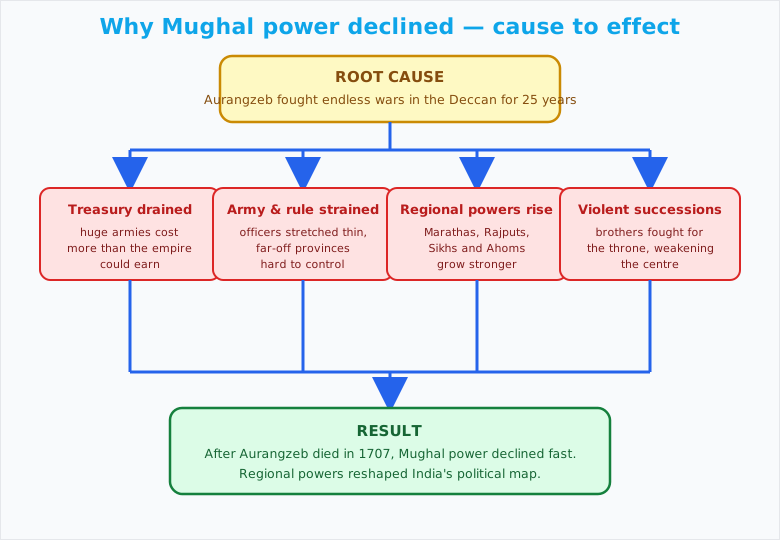
So Aurangzeb’s death in 1707 is one of the most important dates in this chapter. Up to him, Mughal emperors had reigned for an average of about 27 years — a sign of stability. After him, the empire weakened rapidly, and the regional powers we will meet next surged forward.
The regional powers that reshaped the map
As the Mughals weakened, powers rose in every corner of India. No single one took over all of India — instead, many strong kingdoms appeared at once. Figure 2.3 below sorts them out by region so you can see the whole picture at a glance. This is a chart, not a map — it shows who rose where.
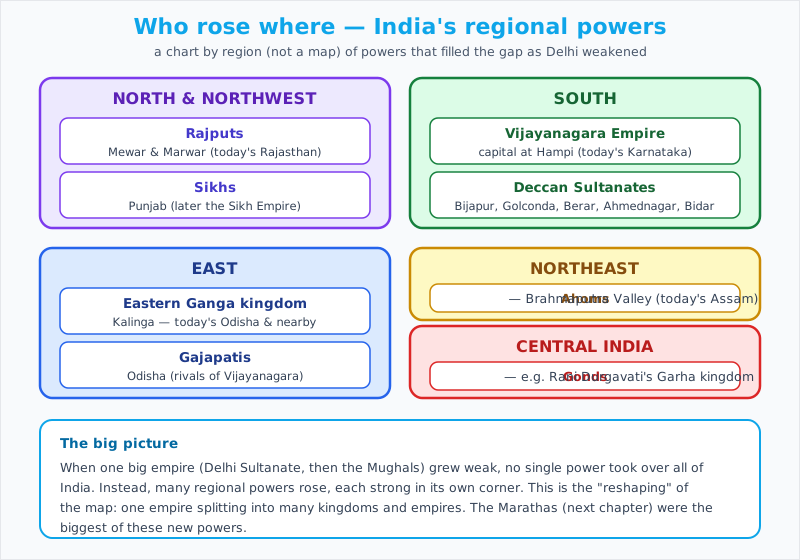
Let us meet the most important of these rising powers.
The Rajputs. The Rajputs of northwest India had a proud warrior tradition. After the Khiljis’ conquest, they rebuilt their kingdoms, especially in Mewar and Marwar. Rana Sanga united several Rajput clans early in the 16th century but was finally defeated by Babur at the Battle of Khanwa. The greatest hero of Rajput resistance was Maharana Pratap of Mewar. He refused to accept Mughal overlordship. At the Battle of Haldighati (1576), the Mughals had the upper hand, but Maharana Pratap escaped and fought for years using guerrilla warfare from the Aravalli hills. He was strongly helped by the Bhils, who joined as archers and shared their knowledge of the land. (Guerrilla warfare is a style of fighting where small groups who know the terrain use surprise attacks and ambushes to defeat bigger armies.)
The Ahoms. In the 13th century, the Ahom people migrated from present-day Myanmar to the Brahmaputra Valley (today’s Assam) and built a kingdom there. They stoutly resisted both the Sultanate and the Mughals. Their clever paik system asked every able-bodied man to serve the state through labour or military duty, in return for land — so the kingdom could raise a large force without keeping a permanent standing army. In the famous Battle of Saraighat (1671), fought on the Brahmaputra River near today’s Guwahati, the Ahom commander Lachit Borphukan and his 10,000 men defeated a Mughal force of 30,000. How? By using their deep knowledge of the rivers, hills and forests of Assam. The Ahoms kept their independence.
The Sikhs. In 15th-century Punjab, Guru Nanak spread a message of equality, compassion and the oneness of God. His followers became known as the Sikhs. Sikhism began as a purely spiritual movement. But later Sikh Gurus had to respond to persecution under some Mughal rulers. Emperor Jahangir had Guru Arjan tortured to death; in response, Guru Hargobind formed a Sikh army. In 1675, Aurangzeb had the ninth Guru, Guru Tegh Bahadur, publicly beheaded in Delhi after he refused to convert. In response, his son Guru Gobind Singh — the tenth and last Guru — founded the Khalsa, a martial brotherhood committed to justice and equality. Later, as the Mughals declined, several Sikh groups were united by Maharaja Ranjit Singh, who built a strong Sikh Empire across the northwest around 1800.
Other resistance. Many peasant and tribal communities also fought back — the Jats, and tribal groups like the Bhils, Gonds, Santhals and Kochs. Rani Durgavati, a brave queen of the Gond kingdom of Garha in central India, kept an army of 20,000 soldiers and 1,000 elephants and fought Akbar’s general to her last breath in 1564.
Before we compare the two big Delhi empires, here is a quick refresher on a word we keep using.
Comparing the Delhi Sultanate and the Mughals
We have now met both great Delhi-based powers. They had a lot in common, but also important differences. Figure 2.4 below lays them side by side, row by row, so you can compare them clearly.
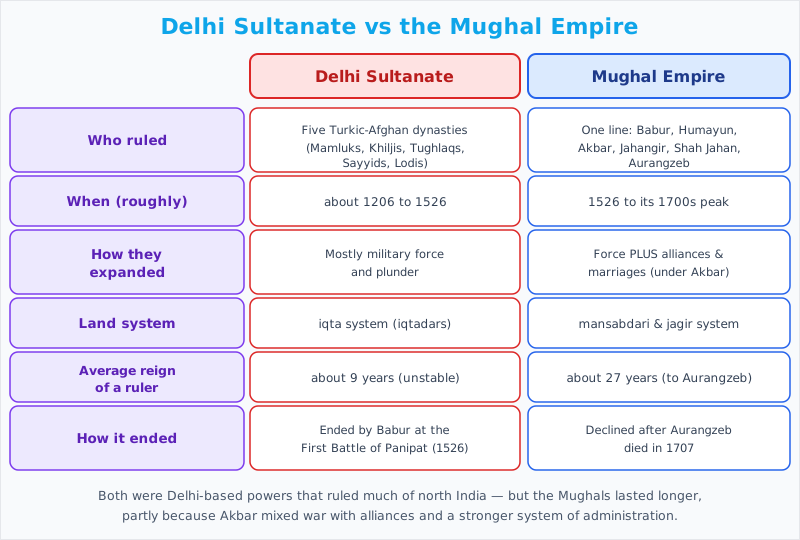
The two ran their lands through different systems. The Delhi Sultanate used the iqta system: it assigned territories to nobles (iqtadars) who collected taxes and, after expenses, sent the rest to the Sultan’s treasury — mainly to pay for the army. These posts were not hereditary. The Mughals, under Akbar, built a more organised system. Akbar split the empire into twelve provinces (subahs), each with ministers for finance, military, justice and so on. He created the mansabdari system, where officers (mansabdars) had a rank (mansab) and had to keep a set number of horses, elephants and troops ready for the state. They were paid by being given land (jagirs), so they were also called jagirdars. His finance minister, Todar Mal, brought in an efficient revenue system based on careful surveys of crops and land.
Here is a small comparison table you can use to revise the key administrative terms.
| Feature | Delhi Sultanate | Mughal Empire (Akbar) |
|---|---|---|
| Land/revenue system | Iqta system (nobles called iqtadars) | Mansabdari and jagir system (officers called mansabdars or jagirdars) |
| Were posts hereditary? | No, the iqta posts were not hereditary | Mansabs were ranks granted by the emperor, with land (jagirs) as pay |
| Provinces | Territories assigned to nobles | Twelve provinces (subahs), each with its own ministers |
| Revenue method | Heavy taxes, often harsh on peasants | Careful crop-and-land surveys under Todar Mal |
Let us pause and check that you have grasped the most important idea — why the map kept being reshaped.
Why did regional powers like the Rajputs, Sikhs and Ahoms grow stronger as the Mughal Empire weakened?
Because a strong central empire keeps regional powers in check — it has the armies and money to stop them growing too big. When the Mughal centre grew weak (drained by Aurangzeb’s endless wars, money troubles and rebellions), it could no longer hold these powers down. So they took their chance, grew stronger, and carved out their own kingdoms. This is exactly how one empire splitting apart “reshapes” the political map into many kingdoms.
Aurangzeb's empire was the largest the Mughals ever had. So why is his reign seen as the start of decline, not the height of strength?
Because the empire grew large only through 25 years of endless, costly wars in the Deccan. Those wars drained the treasury and stretched the army and administration to breaking point. A huge empire that is broke and exhausted is fragile, not strong. So the great size hid a deep weakness, and once Aurangzeb died in 1707, that weakness showed and the empire declined fast.
People’s lives — through all the chaos
With all this war, you might think India was just being destroyed. But that is only half the story. Through it all, India stayed one of the wealthiest regions in the world.
How? Because India’s economy did not depend only on rulers. It rested on strong, decentralised foundations: farming, busy artisan industries, temple-based economies, and wide trade networks. Older systems like shrenis (guilds), jatis (professional communities), and clever systems of credit kept working no matter who ruled.
Agriculture was the mainstay. Rulers took land revenue — usually about one-fifth of the produce, though some sultans raised it as high as one-half. Irrigation improved, so farmers grew many crops: rice, wheat, sugarcane, spices, and cash crops like cotton (which fed a huge textile industry), silk and indigo. India exported far more than it imported. Goods flowed out through ports like Surat, Calicut, Masulipatnam and Hooghly.
Traders even invented clever tools to work across war-torn borders. The hundi was a written note that let merchants transfer money without physically carrying coins — a kind of early banking. This made them safe from plunder. Trader communities like the Marwaris became experts at doing business under any ruler.
But life was not easy for everyone. By the late 1600s, there was economic stress. After taxes and payments, peasants were often left with very little. Many lost their land and became bonded labourers. The wealth was largely concentrated with rulers, courtiers and the merchant class. Frequent war also forced people to flee their homes.
And yet — and this is the heart of the chapter’s message — people of different faiths mostly lived peacefully side by side, depending on each other in daily life. Communities kept their traditions alive, often blending Indian and foreign elements to create new shared art, music and architecture. India faced great hardship in this period, but it survived through resilience — rebuilding, creating, and enduring.
Common Mistakes
Here are some slip-ups students make about this topic. Read them once, and you will not be fooled.
The Delhi Sultanate and the Mughal Empire were the same thing, just with different names.
Both ruled north India from Delhi and both were founded by Muslim rulers of Central Asian origin, so they blur together easily in memory.
They were two separate powers. The Delhi Sultanate (about 1206 to 1526) was ruled by five different Turkic-Afghan dynasties. The Mughal Empire was a single family line started by Babur in 1526, after Babur defeated the last sultan at Panipat. So the Mughals actually ended the Sultanate, then built a new empire of their own.
Aurangzeb's reign was the strongest point of the Mughal Empire because the empire was at its largest then.
On a map the empire looks biggest under Aurangzeb, and we naturally link 'biggest' with 'strongest'.
The huge size came from 25 years of costly Deccan wars that drained the treasury and exhausted the army and administration. The empire was stretched thin and full of rebellions. So Aurangzeb's reign actually planted the seeds of decline — the empire weakened rapidly after his death in 1707.
When the Mughal Empire weakened, one new big empire simply took over all of India.
We are used to thinking of history as one big power always replacing another, so it feels natural to expect a single successor.
No single power replaced the Mughals across India. Instead, many regional powers rose at once — the Rajputs, Sikhs, Ahoms, the Marathas and others — each strong in its own region. This splitting of one empire into many kingdoms is exactly what 'reshaping the political map' means.
Quick Check
Try these quick questions. Each one checks one idea from the chapter.
Who defeated the last sultan of Delhi and founded the Mughal Empire?
Why did Akbar use marriage alliances and tolerance instead of relying only on military force?
What was the main reason Mughal power declined after Aurangzeb?
How did the Ahoms manage to defeat a much larger Mughal army at the Battle of Saraighat in 1671?
Practice Problems
Try each one on your own first. Only then tap to see the full answer.
Easy
Name the five dynasties that ruled the Delhi Sultanate, in order.
The Delhi Sultanate was ruled by five Turkic-Afghan dynasties, one after another:
- The Mamluks (also called the Slave dynasty)
- The Khiljis (or Khaljis)
- The Tughlaqs
- The Sayyids
- The Lodis (or Lodhis)
The last dynasty, the Lodis, was ended by Babur at the First Battle of Panipat in 1526.
What was the Battle of Talikota (1565), and why was it important?
The Battle of Talikota in 1565 was a battle in which the Deccan Sultanates joined together as a coalition and defeated the Vijayanagara Empire.
It was important because, after this defeat, the great Vijayanagara capital (at Hampi) was sacked and destroyed over several months. The empire then broke into smaller regions ruled by Nayakas and came to an end by the mid-17th century. So Talikota marks the fall of one of south India’s greatest empires.
Medium
Explain in your own words why a sultan's average reign in the Delhi Sultanate was only about nine years. What does this tell us about the Sultanate?
A sultan’s average reign was only about nine years because successions were very violent. Almost two out of every three sultans seized the throne by killing or removing the sultan before them. So a sultan rarely stayed safe for long — someone was usually trying to take his place by force.
This tells us that the Delhi Sultanate was politically unstable. The man at the very top was never secure. A kingdom where the ruler keeps changing through violence finds it hard to grow steady and strong over a long time. This instability is one reason the Sultanate could never become a single lasting empire over all of India.
The Mughal Empire reached its greatest size under Aurangzeb, yet his reign is seen as the beginning of its decline. Explain this apparent contradiction.
This seems like a contradiction, but it makes sense once you look at how the empire grew so large.
Aurangzeb expanded the empire by spending the last 25 years of his life fighting war after war in the Deccan. To fight these wars, he had to keep huge armies. Huge armies cost enormous amounts of money. This drained the treasury and put great strain on the army and the administration.
So the empire was at its biggest and its most exhausted at the same time. A large empire that is broke and stretched thin is fragile, not strong. On top of this, Aurangzeb’s strict religious policies (like reimposing the jizya and destroying temples) caused many rebellions, and regional powers grew stronger.
So the great size hid a deep weakness. That is why, once Aurangzeb died in 1707, the weakened empire declined quickly. His reign was both the peak of size and the start of decline.
Challenge
This chapter is called 'Reshaping India's Political Map'. Using at least three examples from the chapter, explain what 'reshaping the map' means and why it kept happening.
“Reshaping the political map” means that the borders and powers ruling India kept changing over time. Old kingdoms fell and new ones rose, so a map of India would look very different from one century to the next. It happened again and again throughout this period.
Why did it keep happening? The main reason is that no single power could hold all of India for long. Whenever a central power grew weak, regional powers rose to fill the gap. Here are three examples:
-
The Delhi Sultanate shrank as regional powers resisted. Even at its height, the Sultanate could not conquer the Eastern Ganga kingdom in the east or fully control Rajasthan. As these and other powers pushed back, the Sultanate’s territory shrank — reshaping the map.
-
Vijayanagara rose, then fell. Vijayanagara rose in the south as Delhi weakened, became a great empire under Krishnadevaraya, then was destroyed after the Battle of Talikota in 1565 and broke into smaller Nayaka regions. One empire replaced another, then split apart.
-
The Mughals declined and regional powers surged. After Aurangzeb died in 1707, the exhausted Mughal Empire weakened. In its place, many regional powers rose at once — the Rajputs, the Sikhs (later the Sikh Empire), the Ahoms in Assam, and the Marathas. One big empire split into many kingdoms.
The pattern: a power rises, grows strong, then weakens (through endless wars, money troubles, or violent successions). As it weakens, other powers rise to take its place. This rise-and-fall cycle is exactly why India’s political map kept being reshaped throughout this period.
Summary
Here is everything you can now explain to a friend:
- For centuries, one big power tried to rule north India from Delhi — first the Delhi Sultanate (about 1206 to 1526), then the Mughal Empire (from 1526).
- The Delhi Sultanate was ruled by five Turkic-Afghan dynasties (Mamluks, Khiljis, Tughlaqs, Sayyids, Lodis). It was unstable — a sultan’s reign lasted only about nine years on average.
- Babur ended the Sultanate at the First Battle of Panipat (1526) using cannons, and founded the Mughal Empire.
- Akbar made the empire stable not just by force but by alliances, marriages and tolerance (abolishing the jizya, promoting sulh-i-kul). This is the key reason the Mughals lasted longer.
- Aurangzeb expanded the empire to its largest size, but his 25 years of costly Deccan wars drained the treasury and strained the empire — planting the seeds of decline. Mughal power fell fast after his death in 1707.
- No single power ruled all of India. Regional powers rose everywhere: the Rajputs (Maharana Pratap), the Vijayanagara Empire (Krishnadevaraya), the Ahoms (Lachit Borphukan at Saraighat), the Sikhs (later the Sikh Empire), and the Gonds (Rani Durgavati).
- The Sultanate ran its land through the iqta system; the Mughals used the mansabdari and jagir system, with provinces (subahs) and surveys by Todar Mal.
- Through all the war, India stayed one of the world’s wealthiest regions thanks to farming, crafts, trade and tools like the hundi. The story is one of both destruction and resilience.
What’s Next
You have seen how the Delhi Sultanate and the Mughal Empire rose and fell, and how regional powers reshaped India’s map. We mentioned one rising power again and again but kept saving it for later — the Marathas.
In the next chapter, Chapter 3 — The Rise of the Marathas, we will meet the power that did the most to break Mughal control and reshape India’s map. Get ready to discover how a determined people from the western Deccan rose to challenge the greatest empire of their time.
Frequently Asked Questions
Why did the Mughal Empire decline after Aurangzeb?
Aurangzeb spent his last 25 years fighting endless wars in the Deccan. These wars drained the treasury and strained the army and administration. At the same time, regional powers like the Marathas, Rajputs, Sikhs and Ahoms grew stronger. So after Aurangzeb died in 1707, the weakened empire could not hold together and Mughal power declined fast.
What is the difference between the Delhi Sultanate and the Mughal Empire?
The Delhi Sultanate (about 1206 to 1526) was ruled by five Turkic-Afghan dynasties and expanded mostly by military force. The Mughal Empire (from 1526) was ruled by one family line starting with Babur, and under Akbar it used both force and alliances like marriages. The Mughals also built a stronger system of administration, so their empire lasted longer.
Who ended the Delhi Sultanate?
Babur ended the Delhi Sultanate. In 1526, at the First Battle of Panipat, Babur defeated Ibrahim Lodi of the Lodi dynasty, the last dynasty of the Sultanate. Babur used cannons and matchlock guns, which were new to warfare in India. This victory ended the Sultanate and laid the foundation of the Mughal Empire.
How did the Ahoms defeat the Mughals at Saraighat?
In the Battle of Saraighat in 1671, fought on the Brahmaputra River near present-day Guwahati, the Ahom commander Lachit Borphukan and his 10,000 men defeated a much larger Mughal force of 30,000. The Ahoms used their deep knowledge of the rivers, hills and forests of Assam, along with surprise guerrilla tactics, to beat the bigger army.
Why did Akbar use alliances instead of only military force?
Akbar realised that conquering by force alone left enemies angry and ready to rebel. So he used marriage alliances with neighbouring kingdoms, welcomed Rajput and regional leaders into his court, abolished the jizya tax, and promoted sulh-i-kul or peace with all faiths. These strategies won support and made his large empire more stable than one held by force alone.